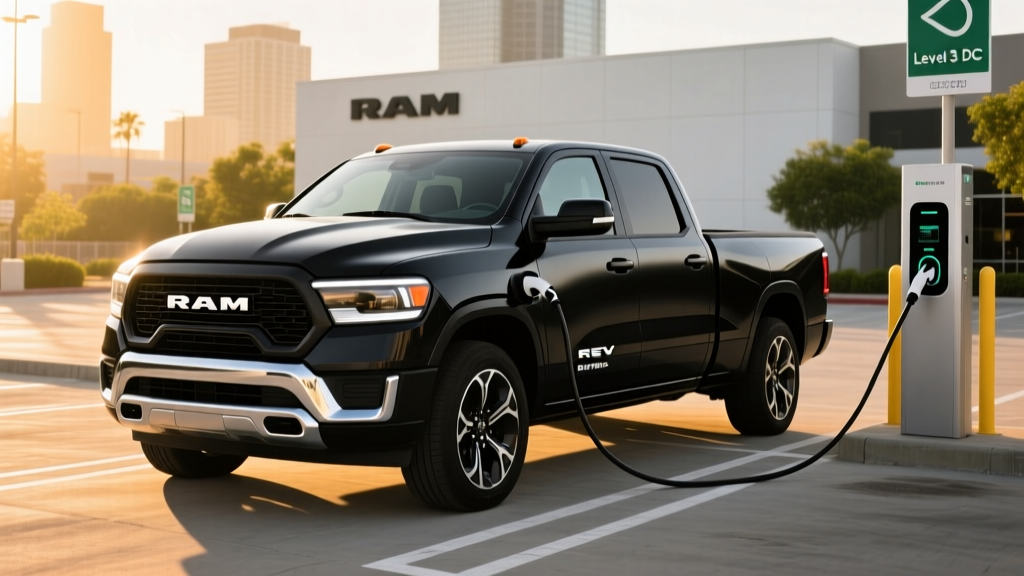
Quick Answer: Is the Ram REV 1500 Electric Truck Worth Buying in 2026?
The 2026 Ram REV 1500 is Ram's first battery-electric full-size pickup, offering an EPA-estimated 350 miles of range (with the available 180 kWh battery), 654 horsepower, and up to 14,000 lbs of towing capacity. Pricing starts at approximately $58,095 before incentives. It qualifies for partial or full federal tax credits depending on battery sourcing and buyer income. It's best suited for truck buyers with home Level 2 charging access who want near-silent daily driving, massive torque for towing, and lower per-mile energy costs — but buyers in extreme cold climates or those who regularly tow heavy loads over long distances should factor in real-world range loss of 25-40%.
Ram REV 1500 Specs at a Glance
| Specification | Standard Range (105 kWh) | Long Range (180 kWh) |
|---|---|---|
| EPA Range | ~230 miles | ~350 miles |
| Battery Chemistry | NMC (Nickel Manganese Cobalt) | NMC |
| Usable Battery Capacity | ~98 kWh | ~173 kWh |
| Horsepower | 654 hp | 654 hp |
| 0-60 mph | ~4.4 seconds | ~4.4 seconds |
| Peak DC Fast Charge Rate | ~180 kW | ~180 kW |
| 10-80% DC Fast Charge Time | ~25 minutes | ~45 minutes |
| Level 2 Charge Rate | 11.5 kW | 11.5 kW |
| Max Towing Capacity | 14,000 lbs | 14,000 lbs |
| Max Payload | ~1,800 lbs | ~1,800 lbs |
| Base MSRP (2026) | $58,095 | ~$73,095 |
| Battery/Powertrain Warranty | 8 years / 100,000 miles | 8 years / 100,000 miles |
Source: Ram Trucks Official. Specs are for the 2026 model year and may vary by trim and configuration. EPA range figures are estimates — real-world results depend on conditions.
Real-World Range vs. EPA Estimates: What to Actually Expect
EPA Sticker: 350 miles (Long Range / 180 kWh)
Real-World Highway (70-80 mph, moderate weather): ~275-300 miles
Real-World Highway + Towing (5,000-8,000 lb trailer): ~175-225 miles
Cold Weather (below 30°F, highway, no towing): ~230-260 miles
The 350-mile EPA figure is achievable in mixed city/suburban driving at moderate speeds and temperatures. Highway driving at 75+ mph increases aerodynamic drag substantially on a full-size truck, cutting range by 15-20%. Towing is the biggest range killer: pulling a loaded 7,000 lb enclosed trailer can reduce range by 40-50%, bringing the Long Range model down to roughly 175-200 miles before you need to stop.
Cold weather affects the NMC battery chemistry and cabin heating demands. In sustained sub-freezing temperatures, expect a 25-35% range reduction. The REV 1500 includes a heat pump for cabin climate, which mitigates some of this loss compared to resistive heating, but physics still wins in extreme cold. If your typical winter commute is under 150 miles round-trip, the Long Range pack handles it comfortably. If you regularly drive 250+ miles in single-digit temperatures, plan your charging stops carefully.
Charging the Ram REV: Home, Public, and What It Costs
Home Level 2 Charging
At 11.5 kW on a Level 2 home charger (240V, 48A circuit), the Long Range 180 kWh pack refills from 10% to 100% in approximately 15-16 hours. For most owners, an overnight session of 8-10 hours adds roughly 100-120 miles of range — more than enough for daily driving.
Home charging installation costs:
| Item | Estimated Cost Range |
|---|---|
| Level 2 EVSE (charger hardware, e.g., ChargePoint Home Flex, Wallbox Pulsar Plus) | $400 - $750 |
| Electrician labor (50A circuit, ~40 ft run from panel) | $800 - $2,000 |
| Electrical panel upgrade (if 200A panel is full or you have 100A service) | $1,500 - $3,500 |
| Permit and inspection | $100 - $300 |
| Total typical install | $1,300 - $6,550 |
Always get a quote from a licensed electrician. The final cost depends on your panel capacity, wire run distance, and local code requirements.
DC Fast Charging on the Road
| Charging Level | Power (kW) | Miles Added per Hour | Use Case |
|---|---|---|---|
| Level 1 (120V household outlet) | ~1.4 kW | ~3-5 mi/hr | Emergency top-up, overnight trickle |
| Level 2 (240V home/public) | 11.5 kW | ~28-35 mi/hr | Daily home charging, workplace |
| DC Fast Charge | Up to 180 kW peak | ~200-250 mi/hr (peak) | Road trips, highway travel |
The REV 1500's peak DC charge rate of ~180 kW means a 10-80% session on the Long Range pack takes roughly 45 minutes. That's competitive with other full-size electric trucks but slower than the fastest-charging crossovers. The charge curve tapers significantly above 80% — the last 20% can take nearly as long as the first 60%. For road trips, plan to charge from 10-80% and move on rather than waiting for a full fill.
Public DC fast charging costs vary widely. Electrify America, EVgo, and Tesla Superchargers (with NACS adapter or depending on Ram's connector choice for 2026) typically charge $0.30-$0.48 per kWh. A 10-80% charge on the Long Range pack (~120 kWh added) costs roughly $36-$58 at public rates.
Ram REV 1500 vs. Gas Ram 1500: Total Cost of Ownership
This is where the math gets interesting — and where the decision framework matters most. Let's compare a 2026 Ram REV 1500 Long Range against a comparably equipped 2026 Ram 1500 gas (5.7L HEMI V8, 4WD) over 5 years and 75,000 miles.
| Cost Factor (5 yr / 75k mi) | Ram REV 1500 (Electric) | Ram 1500 Gas (HEMI V8) |
|---|---|---|
| Base MSRP (approx.) | $73,095 | $52,000 |
| Federal Tax Credit (§30D) | Up to $7,500* | $0 |
| Effective Purchase Price | ~$65,595 | $52,000 |
| Fuel / Energy (75k miles) | $3,750 - $6,000** | $9,375 - $11,250*** |
| Maintenance (oil, filters, brakes, etc.) | $1,200 - $1,800 | $3,500 - $5,000 |
| Insurance (avg. annual) | $2,200/yr ($11,000 total) | $1,700/yr ($8,500 total) |
| 5-Year Estimated Total | ~$81,545 - $84,395 | ~$73,375 - $76,750 |
*§30D credit eligibility depends on MSRP cap (trucks: $80,000), buyer income limits ($150k single / $300k joint), and battery critical-mineral sourcing. Verify at IRS.gov.
**Based on $0.13-$0.16/kWh home charging and 2.2 kWh/mile.
***Based on $3.50-$4.20/gallon and 18-20 MPG combined (fueleconomy.gov).
The gas Ram 1500 still wins on upfront cost, but the REV closes the gap significantly over five years through lower energy and maintenance costs. The break-even point typically arrives around year 4-5 for buyers who charge primarily at home. If you rely exclusively on public DC fast charging (at $0.35-$0.48/kWh), the energy savings narrow considerably.
Federal Tax Credit & Incentive Reality Check
The Ram REV 1500, as a full-size truck with an MSRP under the $80,000 cap for trucks/vans, is potentially eligible for the full $7,500 §30D federal tax credit. However, eligibility is not automatic. Here's the checklist:
- MSRP Cap: Truck MSRP must not exceed $80,000 (REV base and mid-trims qualify; fully loaded top trims may exceed this)
- Buyer Income Limits: Modified AGI ≤ $150,000 (single) or ≤ $300,000 (married filing jointly)
- Battery Sourcing: Critical minerals and battery components must meet phased percentage thresholds from US or FTA-partner countries — Ram has not confirmed full compliance for all trims
- Point-of-Sale Transfer: As of 2024+, you can transfer the credit to the dealer at purchase, reducing your out-of-pocket cost immediately (instead of waiting for tax filing)
- Assembly: Final assembly must be in North America (REV is assembled in Michigan — qualifies)
Critical-mineral sourcing requirements tighten each year. Confirm the REV's current-year eligibility on fueleconomy.gov before purchasing. Consult a tax professional for your specific situation.
Common Misconceptions About Electric Trucks
| Myth | Fact |
|---|---|
| "Electric trucks can't tow anything useful." | The REV 1500 is rated for 14,000 lbs — comparable to many gas half-ton configurations. The limitation isn't capability; it's range while towing. |
| "The battery will need replacing in 5 years." | NMC batteries in modern thermal-managed packs like the REV's are warrantied for 8 years/100,000 miles at ≥70% capacity retention. Real-world data from similar platforms shows 10-15% degradation at 150,000 miles. |
| "Charging takes hours on road trips." | A 10-80% DC fast charge takes ~45 minutes on the Long Range pack. With route planning around chargers, a 500-mile trip adds roughly 1-1.5 hours total vs. a gas truck. |
| "Electric trucks are worse in cold weather." | Range drops 25-35% in extreme cold, but electric motors deliver full torque instantly (no warm-up), and regenerative braking performs well on icy roads. Preconditioning while plugged in mitigates range loss. |
| "Home charging requires a panel upgrade." | Most homes with 200A service can add a 50A EV circuit without a panel upgrade. Only older homes with 100A service or fully-loaded panels typically need one. |
Decision Framework: Should You Buy the Ram REV 1500?
Buy the Ram REV 1500 if:
- You have access to Level 2 home charging (garage or driveway with 240V circuit)
- Your daily driving is under 200 miles round-trip (covers 85%+ of US commutes)
- You want instant torque for towing and a near-silent daily driver
- You qualify for the §30D tax credit, bringing effective pricing close to a loaded gas Ram
- You value lower ongoing maintenance (no oil changes, fewer brake replacements with regen)
Stick with a gas or hybrid Ram 1500 if:
- You regularly tow heavy loads (8,000+ lbs) over distances exceeding 200 miles and don't want to plan charging stops
- You live in an apartment or lack reliable home/workplace charging access
- Your area has limited DC fast-charging infrastructure (check PlugShare or the EV network apps first)
- You need maximum payload (the REV's battery weight reduces payload vs. gas equivalents)
- You're in a region with extreme cold (sustained sub-10°F) and regularly drive 250+ miles in winter
Consider a PHEV truck (like the Ram 1500 Ramcharger, if available) if:
- You want electric daily driving (40-70 miles EV-only) but need unlimited range for frequent long hauls
- You're not ready to commit to full-electric but want reduced fuel consumption for commuting
What First-Time EV Truck Buyers Should Know
Transitioning from a gas truck to the Ram REV involves a few practical adjustments:
Route planning becomes a habit. For road trips over 250 miles, you'll use apps like A Better Routeplanner, PlugShare, or the built-in Ram navigation to identify DC fast chargers along your route. The REV's navigation system can precondition the battery for faster charging when a charger is set as your destination — this warms the NMC pack to optimal temperature and can shave 5-10 minutes off your charge stop.
Regenerative braking changes how you drive. The REV offers adjustable regen levels. At maximum, you can drive mostly with one pedal — lifting off the accelerator slows the truck significantly, recapturing energy back into the battery. This reduces brake wear dramatically and is especially useful in stop-and-go traffic or on downhill grades with a trailer.
Tire wear may be higher. The REV's 654 hp and instant torque, combined with the truck's heavy curb weight (likely 7,500+ lbs for the Long Range), accelerate tire wear. Budget for replacement tires every 25,000-35,000 miles, and look for EV-rated tires with higher load ratings and low rolling resistance.
Insurance premiums are typically higher. EV trucks carry higher repair costs (battery, aluminum body panels, sensor arrays). Expect insurance quotes 20-35% above a comparable gas Ram 1500. Shop quotes from multiple carriers — some insurers now offer EV-specific discounts.
Frequently Asked Questions
Does the Ram REV 1500 support bidirectional charging (V2L/V2H)?
Ram has indicated the REV platform will support vehicle-to-load (V2L) capability, allowing you to power tools, appliances, or a campsite from the truck's battery. Vehicle-to-home (V2H) integration, which could power your house during outages, requires additional hardware and utility compatibility — confirm availability for your specific trim and model year.
What connector does the Ram REV use — NACS or CCS?
Stellantis/Ram has committed to adopting the NACS (Tesla-style) connector for future EVs. For the 2026 REV 1500, check the specific model-year configuration — early production units may ship with CCS1, with a NACS adapter available, while later builds may feature native NACS. This affects which public chargers you can use without an adapter.
How does the Ram REV compare to the Ford F-150 Lightning and Chevy Silverado EV?
The F-150 Lightning (320-mile max range, ~$55,000 starting) is the established benchmark with widespread availability. The Silverado EV (up to 400+ miles on top trims, higher pricing) targets fleet and premium buyers. The REV 1500's 350-mile Long Range option and 14,000-lb towing capacity position it competitively between the two, though real-world availability and dealer inventory will influence your actual options in 2026.
Will the Ram REV qualify for the full $7,500 tax credit in 2026?
Potentially yes for trims under the $80,000 MSRP cap, provided you meet income limits and the battery sourcing requirements are satisfied. The critical-mineral sourcing thresholds increase annually, so a trim that qualified in 2025 may not in 2026. Always verify current eligibility on IRS.gov and fueleconomy.gov before finalizing your purchase.
What happens if the battery degrades significantly?
The REV's battery is warrantied for 8 years or 100,000 miles, covering defects and capacity loss below approximately 70% of original capacity. If the battery falls below this threshold within the warranty period, Stellantis is obligated to repair or replace it at no cost. Out-of-warranty replacement costs for a pack this size (180 kWh) could range from $15,000-$25,000+ based on current market pricing — though battery costs continue to decline, and full-pack replacements are rare in modern thermal-managed systems.