Quick Answer: Is the Ram ProMaster Electric Right for Your Fleet?
The 2026 Ram ProMaster Electric is a purpose-built commercial delivery van offering an EPA-estimated 162 miles of range from a 110 kWh battery pack, with DC fast charging up to 150 kW (10-80% in approximately 40 minutes). Starting at roughly $58,000 before incentives, it targets last-mile delivery fleets with predictable daily routes under 120 miles. Compared to the gas ProMaster, operators save an estimated $3,200-$4,800 annually on fuel and maintenance, with payback in 4-6 years depending on mileage and electricity rates. However, limited highway range, 40-minute fast-charge sessions, and depot charging requirements make it unsuitable for long-haul or rural routes.
Range & Efficiency: Real-World Expectations
The ProMaster Electric's 162-mile EPA range is competitive for the commercial van segment, matching the Ford E-Transit's 126-143 miles and exceeding the Mercedes-Benz eSprinter's 150-mile estimate. However, commercial operators should plan for real-world conditions that reduce this figure significantly.
EPA vs. Real-World Range
EPA Estimated: 162 miles (2.0 kWh/mi efficiency)
Real-World Expectations:
- Urban delivery (stop-start, regen-heavy): 140-155 miles
- Mixed highway/city: 120-135 miles
- Cold weather (below 32°F): 100-120 miles (30-40% loss without preconditioning)
- Full payload (2,000+ lbs cargo): Subtract 10-15% from above figures
Bottom line: Plan routes for 110-120 miles maximum to maintain a 20% buffer for traffic, detours, and climate control.
The van's efficiency of approximately 2.0 kWh per mile (equivalent to 1.7 MPGe) reflects its 5,800-pound curb weight and boxy aerodynamics. For context, a gas ProMaster 2500 averages 13-15 MPG combined, meaning the electric version delivers roughly 45-50 MPGe equivalent efficiency in energy cost terms, though the heavy battery limits range compared to the gas model's 300+ mile capability.
Charging Infrastructure: Depot vs. Public
The ProMaster Electric supports three charging levels, but commercial viability hinges almost entirely on depot-based Level 2 charging:
| Level | Power (kW) | Time (0-100%) | Miles Added/Hour | Use Case |
|---|---|---|---|---|
| Level 1 (120V) | 1.4 kW | 80+ hours | ~2 miles | Emergency/trickle only |
| Level 2 (240V, 48A) | 11.5 kW | ~10 hours | ~16 miles | Overnight depot charging |
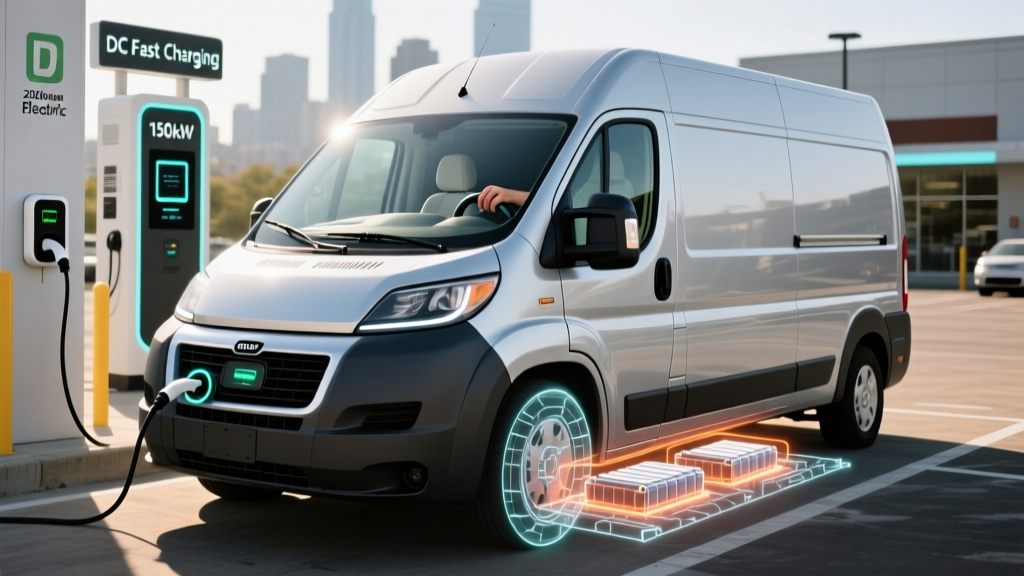
| DC Fast (150 kW peak) | 150 kW | ~1 hour (10-80%: 40 min) | ~120 miles (peak) | Mid-day top-up |
Critical charging curve reality: The 150 kW peak rate applies only between 10-40% state of charge. From 40-80%, charging slows to 80-100 kW, and above 80% it tapers to under 40 kW to protect battery longevity. This means a 10-80% session takes roughly 40 minutes, not the theoretical 25 minutes at sustained peak rate.
Depot charging installation costs: Installing a single 11.5 kW Level 2 charger (hardwired, 60A circuit) typically costs $2,500-$4,500 per unit, including electrician labor, conduit, and permits. Fleet operators installing 5-10 chargers should budget $25,000-$45,000 total, plus potential panel upgrades ($5,000-$15,000 if the building's electrical service needs expansion from 200A to 400A+).
The ProMaster Electric uses the CCS1 connector standard (not NACS/Tesla), ensuring compatibility with Electrify America, EVgo, and most public DC fast networks. However, public charging at $0.35-$0.50/kWh erodes cost savings compared to depot charging at $0.10-$0.15/kWh commercial rates.
Purchase Price & Tax Credit Eligibility
| Base MSRP (Cargo Van 2500) | $58,000 |
| Battery Capacity | 110 kWh (NMC chemistry) |
| EPA Range | 162 miles |
| Motor Output | 275 HP / 302 lb-ft torque |
| 0-60 mph | ~8.5 seconds |
| Payload Capacity | 2,100 lbs |
| Cargo Volume | 316 cu ft (high-roof) |
| DC Fast Charge | 150 kW peak (CCS1) |
| Warranty (Battery) | 8 years / 100,000 miles |
Federal tax credit (§30D): The ProMaster Electric may qualify for up to $7,500 in federal tax credits, but eligibility depends on battery component sourcing and critical mineral requirements that change annually. For 2026, commercial vehicles over 14,000 lbs GVWR (like the ProMaster 3500) fall under §45W commercial clean vehicle credit instead, with different rules. Consult a tax professional and verify current IRS guidance before purchase.
State incentives: California's HVIP program offers $20,000-$45,000 for commercial electric vans, and New York's NYTVIP provides up to $50,000. These stack with federal credits and dramatically improve payback timelines. Check your state's commercial EV incentive database.
Total Cost of Ownership: EV vs. Gas ProMaster
| Cost Category | ProMaster Electric | ProMaster Gas (2500) | Difference |
|---|---|---|---|
| Purchase Price (after credits) | $50,500 | $45,000 | +$5,500 |
| Fuel/Energy (5 years) | $7,500 | $22,500 | -$15,000 |
| Maintenance (5 years) | $2,000 | $6,500 | -$4,500 |
| Insurance (5 years) | $12,000 | $9,500 | +$2,500 |
| Total 5-Year Cost | $72,000 | $83,500 | -$11,500 |
Assumptions: Electricity at $0.12/kWh (depot), gas at $3.80/gallon, 14 MPG gas ProMaster. Insurance premiums for EVs run 15-25% higher due to repair costs and battery replacement risk.
The electric ProMaster breaks even around year 4-5 in most scenarios, then generates net savings of $2,000-$3,000 annually thereafter. High-mileage fleets (20,000+ miles/year) see faster payback, while low-mileage operators may never recover the upfront premium.
Real-World Ownership Considerations
Common Misconceptions
| Myth: "I can charge at public stations like a Tesla." | Fact: Commercial vans require depot charging for cost efficiency. Public DC fast charging at $0.40/kWh costs $44 for a full charge vs. $13 at depot rates, eliminating savings. |
| Myth: "The battery will need replacement in 5 years." | Fact: NMC batteries degrade 2-3% annually under normal use. The 8-year/100,000-mile warranty guarantees 70% capacity retention. Expect 130+ miles of range at year 8. |
| Myth: "Cold weather makes it unusable." | Fact: Range drops 30-40% in sub-freezing temps, but preconditioning while plugged in mitigates this. Northern fleets in Minneapolis and Boston operate EVs year-round with route planning adjustments. |
| Myth: "It can't handle full payload." | Fact: The 2,100-lb payload capacity matches gas ProMaster specs. However, full payload reduces range by 10-15%, so plan accordingly. |
First-Time EV Fleet Buyer Checklist
- Route analysis: Audit 3 months of GPS data. If 90% of daily routes fall under 120 miles, the ProMaster Electric works. If routes regularly exceed 150 miles, stick with gas or consider a hybrid approach (some EVs, some gas).
- Depot electrical capacity: Hire an electrician to assess your building's panel. Most commercial buildings need 400A+ service for 5+ chargers.
- Charging schedule: Vans must plug in nightly for 8-10 hours. If your operation runs 24/7 with hot-seating (multiple drivers per vehicle), EVs won't work without mid-day fast charging downtime.
- Driver training: Regenerative braking feels different. Budget 2-4 hours per driver for EV-specific training on one-pedal driving, preconditioning, and charge planning.
- Maintenance partner: Not all commercial shops service high-voltage systems. Verify Ram commercial service centers within 20 miles of your depot.
Decision Framework: Should You Buy?
Choose the Ram ProMaster Electric if:
- Your average daily route is under 120 miles with predictable stops
- You have depot access with electrical capacity for Level 2 charging
- Your operation is primarily daytime, allowing overnight charging
- You qualify for state commercial EV incentives (CA, NY, MA, CO)
- You plan to keep vehicles 5+ years to capture full TCO savings
- You operate in urban/suburban areas with low average speeds (regen-friendly)
Choose the Gas ProMaster (or wait) if:
- Daily routes regularly exceed 150 miles or include long highway segments
- You lack depot charging infrastructure or can't afford $30,000+ installation
- Your operation requires 24/7 vehicle availability with driver shift changes
- You operate primarily in extreme cold climates (northern MN, MT, AK) without garage parking
- You plan to sell vehicles within 3 years (won't recoup upfront premium)
- Your routes include rural areas with no DC fast charging backup
Frequently Asked Questions
What's the actual payload capacity with the heavy battery?
The ProMaster Electric maintains a 2,100-pound payload rating despite the 1,500-pound battery pack, thanks to a reinforced chassis and higher GVWR (9,350 lbs). This matches the gas ProMaster 2500's payload, so cargo capacity isn't compromised.
How long does the battery last before replacement?
Ram warranties the battery for 8 years/100,000 miles with a 70% capacity retention guarantee. Real-world data from similar commercial EVs (Ford E-Transit, Chevy Bolt EV fleet usage) shows 2-3% annual degradation, meaning you'll have roughly 85% capacity at year 5 and 75-80% at year 8. Full replacement costs $25,000-$35,000 if needed post-warranty, but most fleet vehicles are retired before this becomes necessary.
Can I tow with the ProMaster Electric?
No. The electric ProMaster has no official tow rating. If your operation requires trailer towing (even light 3,500-lb loads), the gas ProMaster is your only option.
What happens if I run out of charge on a route?
Ram's commercial roadside assistance includes flatbed towing to the nearest charger or depot. However, a single dead-battery incident costs 2-3 hours of downtime plus $300-$500 in towing fees. This is why route planning with a 20% buffer is critical—don't rely on roadside rescue as a backup plan.
Does the ProMaster Electric qualify for the $7,500 federal tax credit?
Eligibility depends on your business structure and the vehicle's GVWR. Vans under 14,000 lbs GVWR (ProMaster 2500) may qualify for the §30D credit, but battery sourcing requirements limit eligibility. Heavier ProMaster 3500 models fall under §45W commercial credits with different rules. Consult a tax professional and verify on IRS.gov before purchase. Point-of-sale transfers are available if eligible.
How does charging cost compare to gas?
At commercial depot rates ($0.12/kWh), a full 110 kWh charge costs $13.20 and delivers ~140 real-world miles. The gas ProMaster at 14 MPG needs 10 gallons ($38 at $3.80/gal) for the same distance. That's a 65% energy cost reduction per mile. However, public DC fast charging at $0.40/kWh costs $44 for a full charge—more than gas—so depot access is essential for savings.
Is the ProMaster Electric available now?
Yes, the 2026 ProMaster Electric is in production and available through Ram Commercial dealerships. However, allocation is limited and fleet orders may have 3-6 month lead times. Contact your local Ram Commercial dealer for current availability.
Sources: EPA Fuel Economy, Ram Commercial Specifications, IRS Clean Vehicle Credits