The Bottom Line on Ram EV Trucks
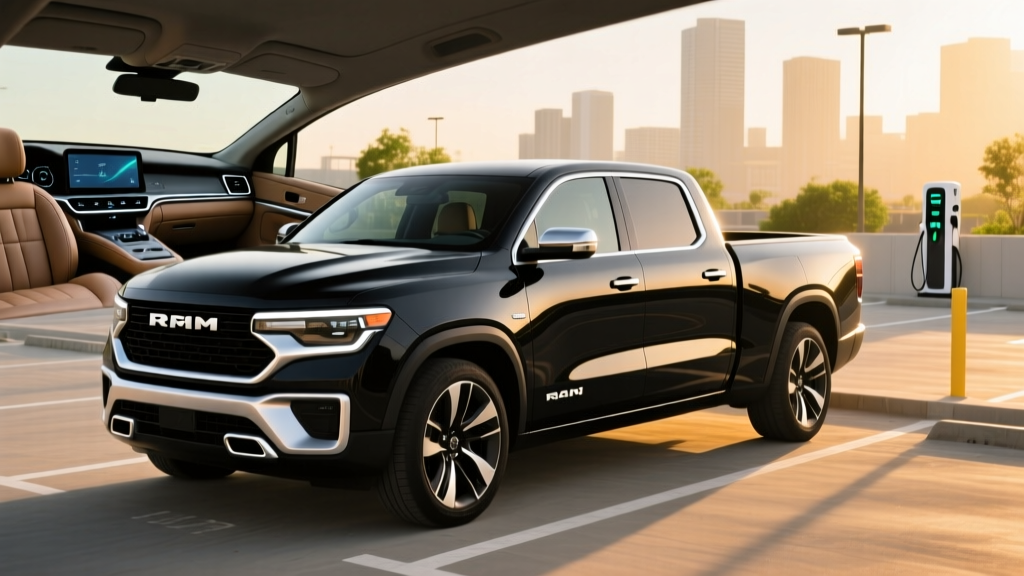
Ram's electric truck lineup centers on the Ram 1500 REV, a full-size battery-electric pickup with an EPA-estimated range of up to 350 miles (Standard Range) and an available 500-mile Range-Extended (REV) variant using a gasoline onboard generator. The 2026 Ram 1500 REV starts around $58,095 (before destination) for the Tradesman trim and climbs to roughly $85,000+ for the fully loaded Tungsten. It uses a 168 kWh usable battery (Standard Range) or 229 kWh (Extended Range), supports up to 350 kW DC fast charging on the STLA Frame architecture, and qualifies for a partial or full §30D federal tax credit depending on battery sourcing and buyer income. If you tow frequently over 200 miles or live where public DC charging is sparse, the REV's range-extended variant—or sticking with a gas Ram 1500—may serve you better than the pure BEV.
Ram 1500 REV: Specs, Trims, and What's Actually Available
Ram entered the electric truck race later than Ford (F-150 Lightning) and GM (Silverado EV), but the 1500 REV arrives with a larger standard battery and higher peak charging speeds. Built on Stellantis's STLA Frame platform, the REV is a body-on-frame truck designed from the ground up as an EV—not a conversion of the gas Ram.
| Spec | REV Standard Range | REV Extended Range | REV Range-Extended (EREV) |
|---|---|---|---|
| EPA Range (est.) | ~350 mi | ~500 mi | ~500 mi combined (EV + gas) |
| Battery (usable) | 168 kWh (NMC) | 229 kWh (NMC) | 92 kWh (NMC) + 3.6L V6 gen |
| Horsepower | 654 hp | 654 hp | 654 hp (EV) + generator |
| Torque | 620 lb-ft | 620 lb-ft | 620 lb-ft |
| 0-60 mph | ~4.4 sec | ~4.4 sec | ~4.4 sec |
| Max DC Fast Charge | 350 kW (peak) | 350 kW (peak) | 150 kW (peak) |
| 10-80% DC Charge | ~25 min | ~40 min | ~30 min (EV portion) |
| Level 2 (240V) Rate | 19.2 kW | 19.2 kW | 11.5 kW |
| Max Towing | ~11,000 lbs | ~10,500 lbs | ~11,000 lbs |
| Payload | ~1,800 lbs | ~1,600 lbs | ~1,800 lbs |
| Starting MSRP | ~$58,095 | ~$68,095 | ~$72,095 |
| Battery Warranty | 8 yr / 100,000 mi | 8 yr / 100,000 mi | 8 yr / 100,000 mi |
Source: Ram Trucks Official. Specs reflect announced 2026 model-year figures; final EPA certifications may vary by trim and wheel configuration.
Real-World Range Reality Check
The 350-mile EPA figure for the Standard Range REV is competitive, but real-world conditions change the math. Expect roughly 280-310 miles on the highway at 70-80 mph, and 230-270 miles in freezing temperatures (below 30°F) where NMC chemistry loses efficiency. Towing a 7,000-lb trailer can cut range by 40-50%, dropping effective range to 150-200 miles. The Extended Range (229 kWh) variant mitigates this significantly but adds substantial weight, reducing payload.
How the Ram 1500 REV Compares to Gas and Competing EV Trucks
Most Ram buyers cross-shop against the gas Ram 1500 and the Ford F-150 Lightning. Here's how the numbers stack up across the most common trims buyers actually purchase:
| Metric | Ram 1500 REV Std Range | Ford F-150 Lightning Ext Range | Gas Ram 1500 (5.7L HEMI V8) |
|---|---|---|---|
| EPA Range / Tank | ~350 mi | ~320 mi | ~490 mi (26 gal × 19 combined MPG) |
| HP / Torque | 654 / 620 | 580 / 775 | 395 / 410 |
| 0-60 mph | ~4.4 sec | ~3.8 sec | ~6.1 sec |
| Max Towing | 11,000 lbs | 10,000 lbs | 12,750 lbs |
| Base MSRP | ~$58,095 | ~$59,995 | ~$42,275 |
| Fuel/Energy Cost per Mile | ~$0.04-$0.07 (home) | ~$0.04-$0.07 (home) | ~$0.16-$0.20 |
| Fed. Tax Credit (§30D) | Up to $7,500* | Up to $7,500* | None |
* §30D credit eligibility depends on battery component and critical-mineral sourcing, buyer AGI limits, and MSRP caps. Verify current-year rules at IRS.gov before purchasing.
The gas Ram 1500 still wins on upfront cost and long-distance towing range. A gas Ram with a 26-gallon tank delivers roughly 490 miles between fill-ups and can tow over 12,000 lbs without range collapsing. But the REV's per-mile energy cost at home is roughly one-quarter the cost of gasoline, and its instant torque and lower maintenance burden (no oil changes, fewer brake replacements due to regen) shift the long-term economics.
Real Ownership Costs: 5-Year Breakdown
Sticker price is only part of the equation. Below is a realistic 5-year / 75,000-mile cost projection comparing a Ram 1500 REV Standard Range (Laramie trim, ~$68,000 MSRP) against a comparably equipped gas Ram 1500 Laramie HEMI (~$54,000 MSRP). Assumes 15,000 miles/year, 80% home Level 2 charging at $0.14/kWh, and 20% public DC at $0.40/kWh.
| Cost Category | Ram 1500 REV (BEV) | Gas Ram 1500 (HEMI) |
|---|---|---|
| Purchase Price (MSRP) | $68,000 | $54,000 |
| Federal Tax Credit (§30D est.) | -$3,750 to -$7,500 | $0 |
| Home Charger Install (Level 2) | $1,200-$2,500 | $0 |
| Fuel/Energy (5 yr / 75k mi) | $4,500-$6,000 | $12,000-$14,000 |
| Maintenance (5 yr) | $1,500-$2,000 | $3,500-$4,500 |
| Insurance (5 yr est.) | $11,000-$14,000 | $8,500-$11,000 |
| Estimated 5-Yr Depreciation | ~45-55% | ~40-50% |
| 5-Yr Total Cost (approx.) | $80,000-$92,000 | $78,000-$83,500 |
The EV saves substantially on fuel and maintenance—roughly $7,500-$10,000 over five years—but the higher purchase price, insurance premiums (EVs cost 15-25% more to insure on average), and steeper depreciation narrow the gap. The tax credit is the swing variable. If you qualify for the full $7,500 credit (and can apply it at point of sale), the REV's 5-year cost becomes competitive. If you don't qualify due to income caps or battery sourcing rules, the gas Ram wins on pure economics.
Charging the Ram 1500 REV: Home, Public, and What You Need
Charging a truck with a 168 kWh battery is a different proposition than charging a sedan. Here's the practical breakdown:
| Charging Level | Power (kW) | Miles Added per Hour | Full Charge Time (168 kWh) |
|---|---|---|---|
| Level 1 (120V / 12A) | ~1.4 kW | ~4-5 mi/hr | ~120+ hours |
| Level 2 (240V / 48A) | 11.5 kW | ~35-40 mi/hr | ~15-17 hours |
| Level 2 (240V / 80A) | 19.2 kW | ~58-65 mi/hr | ~9-10 hours |
| DC Fast (350 kW peak) | 350 kW | ~1,200+ mi/hr (peak) | 10-80% in ~25 min |
Home charging is essential for daily usability. Level 1 (standard wall outlet) adds only 4-5 miles per hour—completely impractical for a truck this size unless you drive under 40 miles daily. A Level 2 home charger at 48 amps (11.5 kW) will fully replenish the Standard Range battery overnight in about 15-17 hours. For faster home turnaround, a 80-amp hardwired Level 2 (19.2 kW) cuts that to roughly 9-10 hours but requires a 100-amp dedicated circuit and likely a panel upgrade (budget $1,500-$3,500 for older homes with 100-amp service).
On the road, the 350 kW peak DC rate is impressive, but remember that peak kW is not sustained kW. The charge curve tapers significantly above 80% State of Charge (SoC) to protect the NMC cells. Real-world 10-80% sessions average closer to 180-220 kW sustained, meaning a typical highway stop takes 25-30 minutes. Above 80%, charging slows dramatically—plan to charge to 80% and go, rather than waiting for a full top-up.
Federal Tax Credit: What Ram EV Truck Buyers Must Know
The §30D Clean Vehicle Credit can reduce your effective purchase price by up to $7,500, but eligibility is not automatic. Under current IRS rules, several conditions must be met:
- MSRP Cap: The truck must have an MSRP at or below $80,000 (pickup truck classification). Higher trims like the Tungsten may exceed this.
- Buyer Income Limits: Modified AGI must not exceed $150,000 (single), $225,000 (head of household), or $300,000 (joint).
- Battery Sourcing: $3,750 of the credit depends on critical minerals sourced from the U.S. or FTA partners; another $3,750 depends on battery components manufactured in North America. Sourcing requirements tighten annually.
- Point-of-Sale Transfer: You can transfer the credit to the dealer at purchase to reduce the sale price directly, rather than waiting to claim it on your tax return.
- Final Assembly: Vehicle must undergo final assembly in North America.
Always confirm current eligibility at IRS.gov and consult a tax professional. Battery sourcing rules change annually, and a truck that qualifies in January may have different eligibility by December.
Common Misconceptions About Ram EV Trucks
| Myth | Fact |
|---|---|
| "The REV can tow 11,000 lbs for 350 miles." | Max towing is 11,000 lbs, but towing cuts range by 40-50%. Expect 150-200 miles with a heavy trailer before needing a charge. |
| "I can charge at any public station." | The REV uses the NACS (Tesla-style) connector for 2026. CCS-only stations require an adapter. Always check connector type before a road trip. |
| "The battery will need replacing in 5 years." | NMC batteries are warrantied for 8 years/100,000 miles with a minimum 70% capacity retention. Real-world data shows most EV batteries retain 85-90% capacity at 100,000 miles with proper care. |
| "The EREV is just a hybrid." | The Range-Extended REV is a series EREV—the gas engine never drives the wheels. It only generates electricity to extend range. It drives as a pure EV with 100+ miles of electric-only range before the generator activates. |
| "I don't need home charging if there are stations nearby." | Public DC charging at $0.35-$0.50/kWh costs nearly as much as gasoline per mile. Without home charging at $0.10-$0.16/kWh, the REV's cost advantage over gas largely disappears. |
Decision Framework: Is a Ram EV Truck Right for You?
Choose the Ram 1500 REV (BEV) if:
- You have reliable home Level 2 charging (or can install it).
- Your daily driving is under 150 miles round-trip.
- You rarely tow over 5,000 lbs for distances exceeding 150 miles.
- You qualify for the §30D tax credit and value lower per-mile fuel costs.
- You live in a region with moderate winters (or can tolerate 20-30% cold-weather range loss).
Choose the Ram 1500 REV Range-Extended (EREV) if:
- You want EV daily driving (100+ electric-only miles) but need gas backup for long hauls.
- You tow frequently and can't rely on DC fast-charging infrastructure along your routes.
- You live in a rural area or charging desert where public chargers are sparse.
- You're not ready to fully commit to a BEV but want to reduce fuel consumption.
Stick with a Gas Ram 1500 if:
- You tow heavy (>8,000 lbs) over long distances regularly and can't plan around 25-minute charge stops.
- You lack home charging access and public DC infrastructure in your area is limited.
- Your budget caps below $50,000 and you can't absorb the EV premium even after tax credits.
- You operate in extreme cold (below 0°F) for extended periods where range loss is severe.
Frequently Asked Questions
What is the real-world range of the Ram 1500 REV?
The Standard Range REV carries an EPA estimate of ~350 miles. In mixed real-world driving at highway speeds (70-80 mph), expect 280-310 miles. In cold weather (below 30°F), plan for 230-270 miles. Towing a 7,000-lb trailer reduces range to approximately 150-200 miles. The Extended Range (229 kWh) variant pushes EPA estimates to ~500 miles, with real-world highway use closer to 380-420 miles.
How long does it take to charge the Ram 1500 REV at home?
On a 48-amp Level 2 charger (11.5 kW), the 168 kWh Standard Range battery charges from empty to full in roughly 15-17 hours. An 80-amp Level 2 (19.2 kW) cuts that to about 9-10 hours. Level 1 (120V) charging is impractical for daily use, adding only about 4-5 miles per hour.
Does the Ram 1500 REV qualify for the $7,500 federal tax credit?
It may qualify for up to $7,500 under §30D, but the amount depends on battery critical-mineral sourcing and component manufacturing requirements, which tighten each year. Buyer income limits ($300,000 joint / $150,000 single) and the $80,000 MSRP cap for trucks also apply. Always verify current-year eligibility on IRS.gov before purchase.
What connector does the Ram 1500 REV use?
For the 2026 model year, the Ram 1500 REV uses the NACS (North American Charging Standard) connector, granting native access to Tesla Supercharger stations. For CCS-only networks (some Electrify America and third-party stations), an adapter may be required.
Can the Ram 1500 REV power my home during an outage?
Ram has announced V2H (vehicle-to-home) capability for the REV platform, which would allow the large battery to serve as backup power during outages. However, this feature requires a compatible bidirectional charger and home electrical panel integration. Confirm availability and equipment requirements with your dealer, as V2H hardware may not be standard at launch.
How does insurance cost compare for the Ram EV vs. gas Ram?
EV insurance premiums typically run 15-25% higher than equivalent gas models due to higher repair costs, specialized parts, and battery replacement considerations. For a Ram 1500 REV, expect annual premiums in the $2,200-$2,800 range depending on your state, driving record, and coverage level, compared to roughly $1,700-$2,200 for the gas Ram 1500.