The Quick Answer: Ram 1500 REV Is Dead
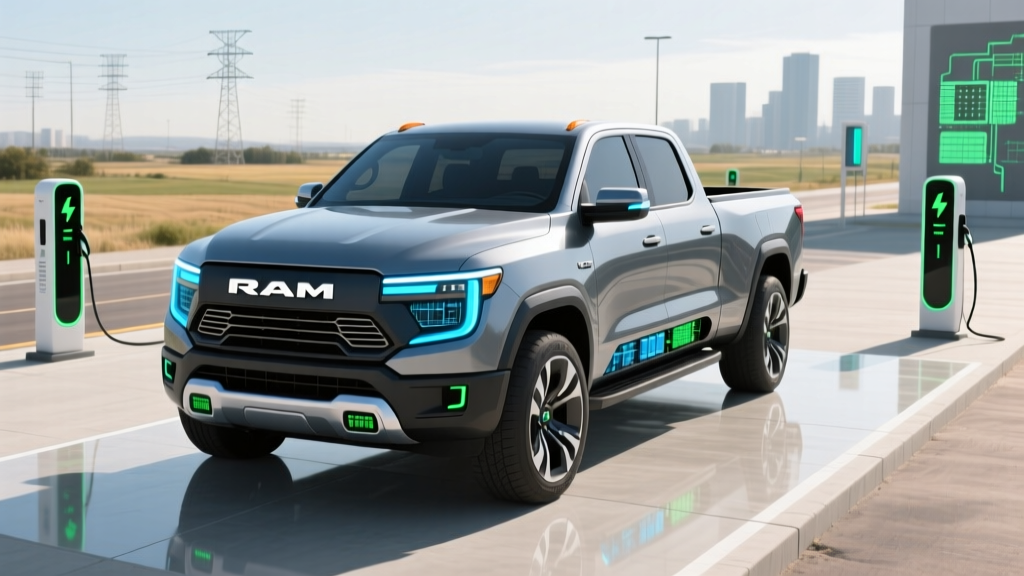
Stellantis officially canceled the Ram 1500 REV all-electric pickup in early 2025, pivoting instead to the Ram 1500 Ramcharger — an extended-range electric vehicle (EREV) with a gas-engine generator. If you were waiting for a fully electric Ram truck, it is not coming for the current generation. Your best alternatives for a battery-electric pickup in 2026 are the Ford F-150 Lightning (EPA range up to 320 miles, starting at $54,995), the Chevrolet Silverado EV (up to 492 miles EPA, from $57,900), the Rivian R1T (up to 420 miles, from $69,900), and the Tesla Cybertruck (up to 340 miles, from $79,990). The Ramcharger EREV offers ~145 miles of electric-only range before the onboard generator kicks in, starting around $60,000.
Why Ram Canceled the Electric 1500 REV
The Ram 1500 REV was originally announced in 2022 with ambitious specs: two battery options (a 168 kWh standard pack and a massive 229 kWh extended pack), up to 500 miles of EPA-estimated range, 800-volt architecture, and DC fast charging at up to 350 kW. It was supposed to hit dealerships by late 2024.
Several factors converged to kill the project:
- Chronic delays: The REV was pushed from late 2024 to mid-2025, then to late 2025, eroding buyer confidence and reservation-holder patience.
- Battery cost and weight: The 229 kWh pack would have added over 1,500 lbs to the vehicle, impacting payload, tire wear, and manufacturing cost. At projected pricing near $75,000–$90,000 for the extended-range trims, it struggled to compete with the F-150 Lightning's established market position.
- Softening EV demand in the truck segment: By 2025, EV adoption in full-size pickups was growing slower than in sedans and SUVs. Truck buyers — particularly fleet and commercial customers — cited range under load, towing range loss, and charging infrastructure gaps as dealbreakers.
- The EREV pivot: Stellantis leadership decided the Ramcharger's EREV architecture (a 92 kWh battery paired with a 3.6L V6 generator) better addressed range anxiety and towing needs while keeping costs lower than a 229 kWh pure battery pack.
The cancellation means Stellantis has no fully electric light-duty truck in its 2026 lineup, a notable gap as Ford, GM, Rivian, and Tesla all have production EV pickups on sale.
Ramcharger EREV vs. Pure Electric Trucks: The Numbers
With the REV gone, Ram is betting everything on the Ramcharger. Here is how it stacks up against the battery-electric competition:
| Spec | Ram 1500 Ramcharger (EREV) | Ford F-150 Lightning (Ext. Range) | Chevrolet Silverado EV 4WT | Rivian R1T (Max Pack) |
|---|---|---|---|---|
| Powertrain | Dual-motor EV + 3.6L V6 generator | Dual-motor BEV | Dual-motor BEV | Quad-motor BEV |
| Battery (usable) | 92 kWh (NMC) | 131 kWh (NMC) | 200+ kWh (NMC) | 149 kWh (NMC) |
| Electric-only range | ~145 mi (EPA est.) | 320 mi (EPA) | 492 mi (EPA est.) | 420 mi (EPA est.) |
| Total range (with generator/fuel) | ~690 mi combined | 320 mi (battery only) | 492 mi (battery only) | 420 mi (battery only) |
| Horsepower | 663 hp combined | 580 hp | 754 hp (max) | 1,025 hp |
| 0–60 mph | ~4.4 sec | ~3.8 sec | ~4.5 sec | ~3.0 sec |
| Max towing | 14,000 lbs | 10,000 lbs | 12,500 lbs | 11,000 lbs |
| Max DC fast charge | ~165 kW | 150 kW | 350 kW | 220 kW |
| 10–80% DC charge time | ~28 min | ~41 min | ~20 min | ~25 min |
| Starting MSRP (2026) | ~$60,000 | $54,995 | $57,900 | $69,900 |
| Federal §30D tax credit | $3,750 (partial — EREV rules) | $7,500 (if sourcing qualifies) | $7,500 (if sourcing qualifies) | $0 (MSRP cap / sourcing) |
Sources: fueleconomy.gov, IRS §30D guidance, manufacturer specifications. Tax credit eligibility depends on MSRP caps, buyer income limits, and battery-component/critical-mineral sourcing requirements. The Ramcharger, as an EREV, qualifies under different §30D rules than a pure BEV — consult a tax professional.
Real Costs: Electric Truck vs. Gas Truck Ownership
The sticker price is only the start. Here is a five-year cost-of-ownership comparison for a typical truck buyer driving 15,000 miles per year, assuming home Level 2 charging at $0.14/kWh national average and regular unleaded at $3.40/gallon:
| Cost Category (5 years / 75,000 mi) | F-150 Lightning (BEV) | Ramcharger (EREV) | Ford F-150 Gas (3.5L EcoBoost) |
|---|---|---|---|
| Purchase price (base MSRP) | $54,995 | $60,000 | $48,000 |
| Federal tax credit applied | −$7,500 | −$3,750 | $0 |
| Net purchase | $47,495 | $56,250 | $48,000 |
| Energy cost (fuel/electricity) | $3,150 (home charging) | $5,200 (mix of electric + gas) | $9,450 (gasoline) |
| Maintenance | $1,200 | $2,800 | $3,500 |
| Insurance (avg.) | $9,500 | $8,800 | $7,500 |
| Estimated depreciation | $18,000 | $20,000 | $16,000 |
| 5-Year Total Cost | $79,345 | $93,050 | $84,450 |
Key takeaways from this comparison:
- The F-150 Lightning wins on total cost when you can charge at home and qualify for the full tax credit. Energy savings alone offset the higher insurance premiums EVs typically carry.
- The Ramcharger's EREV design means you will buy gasoline for longer trips, eating into the efficiency advantage. Drivers who mostly stay under 145 miles daily and charge at home will see lower costs than shown; those who tow or drive long distances regularly will burn more gas.
- The gas F-150 has the lowest upfront cost and cheapest insurance, but fuel and maintenance expenses compound significantly over five years.
- Insurance for EVs runs 15–25% higher than equivalent gas trucks, driven by higher repair costs for battery packs and aluminum body panels. Get quotes before committing.
Real-World Ownership: What First-Time EV Truck Buyers Must Know
If you are coming from a gas truck, the ownership experience shifts in ways that specs alone do not capture. Here are the practical realities:
Home Charging Is Non-Negotiable for Cost Savings
Every cost advantage in the table above assumes regular home Level 2 charging. A 240V Level 2 home charger (typically 11.5 kW / 48A) adds roughly 30–40 miles of range per hour of charging, easily replenishing a full day's driving overnight. Installation costs range from $800 to $2,500 depending on your electrical panel capacity — if you need a 200A panel upgrade, add $1,500–$3,000. Relying solely on public DC fast charging at $0.35–$0.50/kWh nearly doubles your energy cost and erases the fuel savings advantage.
Towing Slashes Range — Dramatically
Every electric and EREV truck loses 40–55% of its range when towing at or near max capacity at highway speeds. The F-150 Lightning's 320-mile EPA range drops to roughly 140–170 miles when towing 8,000+ lbs on the highway. The Ramcharger's advantage here is the gas generator — you can refuel in 5 minutes at any station, avoiding 30-minute DC fast-charge stops every 150 miles. If you tow frequently over long distances, the EREV or a diesel remains more practical than a pure BEV in 2026.
Cold Weather Hits Hard
At 20°F, expect 25–35% range reduction in a BEV truck due to battery chemistry limitations and cabin/climate energy draw. The F-150 Lightning's 320-mile range drops to approximately 210–240 miles in sustained cold. The Ramcharger's gas generator mitigates this — it can run to provide heat and extend range without draining the battery as severely, making it more winter-capable for northern-climate buyers.
The §30D Tax Credit Is Not Guaranteed
As of 2026, the federal clean vehicle credit under IRS §30D has strict requirements:
- MSRP caps: Vans, SUVs, and pickups must have an MSRP at or below $80,000.
- Buyer income limits: Modified AGI cannot exceed $150,000 (single), $225,000 (head of household), or $300,000 (joint).
- Battery sourcing: Increasing percentages of critical minerals and battery components must be sourced from the U.S. or FTA partners. Vehicles with battery components from "foreign entities of concern" (primarily China) are disqualified.
- Point-of-sale transfer: You can transfer the credit to the dealer at purchase to reduce the sale price, rather than waiting for a tax refund.
The F-150 Lightning and Silverado EV may qualify for the full $7,500 depending on battery sourcing for the specific model year and build. The Ramcharger, as an EREV, faces different sourcing thresholds. Always verify eligibility on the IRS Clean Vehicle Credit portal before purchasing.
EV Truck Myths vs. Facts
| Myth | Fact |
|---|---|
| "Electric trucks can't tow anything useful." | The F-150 Lightning tows up to 10,000 lbs; the Silverado EV up to 12,500 lbs. The limitation is not capability — it is range reduction under load. |
| "The battery will need replacing in 5 years." | All major EV truck batteries carry 8-year/100,000-mile warranties (10 years for some). Real-world degradation data shows most packs retain 85–90% capacity after 150,000 miles. Replacement, if needed, costs $12,000–$22,000 but is rarely required within the warranty period. |
| "You'll be stranded with no charging stations." | The U.S. has over 70,000 public Level 2 ports and 45,000+ DC fast-charging ports as of 2026 (AFDC). However, rural corridors and towing routes remain underserved — plan accordingly. |
| "EREVs like the Ramcharger are just complicated gas cars." | An EREV drives as a pure EV for its battery range (145 mi in the Ramcharger's case). The gas engine never drives the wheels — it only generates electricity. This is fundamentally different from a conventional hybrid where the engine directly powers the drivetrain. |
| "Electric trucks cost more to own, period." | When you qualify for the tax credit and charge at home, BEV trucks like the F-150 Lightning can undercut comparable gas trucks on 5-year total cost by $5,000–$10,000, primarily from fuel and maintenance savings. |
Decision Framework: Which Electric Truck Should You Buy?
If-Then Buyer Guide
- If you tow frequently over 200+ miles: Choose the Ramcharger EREV or stick with a diesel. Pure BEVs lose too much range under tow load, and DC fast-charging infrastructure for trailers is still limited in 2026.
- If you want the lowest total cost and charge at home: The Ford F-150 Lightning with the extended-range battery is the value leader — especially after the $7,500 federal credit (verify sourcing eligibility for your model year).
- If maximum range is your top priority: The Chevrolet Silverado EV with the max battery targets 492 miles EPA. This is the range king, though it carries a higher MSRP and is a newer platform with less long-term reliability data.
- If you want performance and off-road capability: The Rivian R1T quad-motor offers 1,025 hp, a dedicated off-road mode, and a gear tunnel. It starts at $69,900 and does not qualify for the federal credit due to MSRP and sourcing rules.
- If you live in a cold northern climate and don't have a garage: The Ramcharger EREV or a gas/diesel truck is more practical. Cold weather severely impacts BEV range, and outdoor Level 2 charging in sub-zero temps is slow without battery preconditioning.
- If you cannot install a home charger: Seriously reconsider a pure BEV truck. Public DC fast charging at $0.40/kWh costs more per mile than gasoline in many states. An EREV like the Ramcharger, which you can refuel at any gas station, is more viable without home charging.
- If you were specifically waiting for the Ram 1500 REV: It is not coming. Your closest Ram-brand option is the Ramcharger. If a pure BEV is a must, cross-shop the F-150 Lightning and Silverado EV immediately — both are in production and on dealer lots now.
What About Used Electric Trucks?
The used EV truck market in 2026 offers genuine value. A 2023–2024 F-150 Lightning Lariat with 25,000–40,000 miles can be found in the $38,000–$48,000 range. The federal used clean vehicle credit (§25E) provides up to $4,000 (30% of sale price, capped) on qualifying used EVs priced at or below $25,000 — though most used Lightning and Rivian listings exceed that cap. Battery health reports (State of Health / SoH) are increasingly available through dealer diagnostics and third-party services. Request the SoH percentage before purchasing; anything above 90% is strong for a truck with under 50,000 miles.
Frequently Asked Questions
Will Ram ever build a fully electric truck?
Stellantis has not announced a successor to the canceled 1500 REV. The company's current strategy focuses on the Ramcharger EREV and the STLA Frame platform, which supports both BEV and EREV architectures. A future all-electric Ram is possible on the next-generation platform (expected late this decade), but nothing is confirmed for production.
Is the Ramcharger considered an EV for tax credit purposes?
Yes, but with different rules. Under §30D, EREVs (which the IRS classifies as plug-in hybrid electric vehicles) must meet battery-component and critical-mineral sourcing requirements and have a battery capacity of at least 7 kWh. The maximum credit may differ from the $7,500 available to qualifying pure BEVs. Check the IRS portal for the specific credit amount for the model year you are purchasing.
Can I charge an electric truck on a standard 120V outlet?
Technically yes — Level 1 charging on a 120V/15A outlet delivers roughly 1.4 kW, adding about 3–5 miles of range per hour to a large truck battery. Fully charging a 131 kWh F-150 Lightning from empty would take over 90 hours on Level 1. It is useful for emergency trickle charging but not practical as a daily strategy.
How much does it cost to install a Level 2 home charger for a truck?
Expect $800–$2,500 for a standard installation (48A hardwired charger, 60A circuit) if your panel has capacity. If you need a 200A service upgrade, total cost can reach $3,500–$5,500. The charger unit itself costs $400–$700 for a quality unit (ChargePoint Home Flex, Emporia V2, or Wallbox Pulsar Plus). Trucks with larger batteries benefit from 48A or even 80A chargers to reduce overnight charge times.
Are electric trucks good for fleet and commercial use?
For depot-based fleets with predictable routes under 200 miles, BEV trucks like the F-150 Lightning and Silverado EV work well and offer significant fuel savings. For long-haul or variable-route fleets, the charging infrastructure gap and 30+ minute DC fast-charge stops remain operational friction. EREVs like the Ramcharger bridge this gap — electric for short urban routes, gas-generator backup for longer hauls.
What is the real-world highway range of electric trucks?
Expect 15–20% less than the EPA sticker at sustained 70–75 mph highway speeds. The F-150 Lightning Extended Range (EPA 320 mi) delivers roughly 255–275 miles real-world highway. The Silverado EV 4WT (EPA ~492 mi) should yield 390–420 miles. Cold weather and headwinds reduce this further.