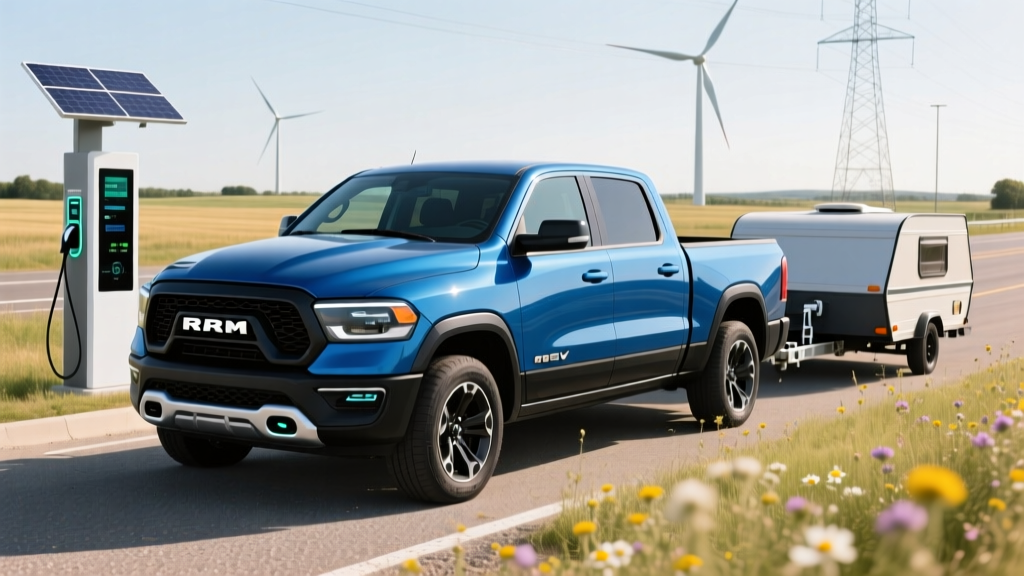
The 2026 Ram 1500 REV is Stellantis's long-awaited entry into the electric full-size pickup segment, arriving after the Ford F-150 Lightning, Rivian R1T, and Chevrolet Silverado EV have already staked their ground. Built on the STLA Frame platform, the REV promises class-competitive range, serious towing capability, and the premium interior Ram has become known for. But with a starting price near $58,000 and a battery chemistry choice that trades energy density for longevity, the REV demands a closer look at the numbers before you sign the paperwork.
After reviewing Ram's official specifications, EPA filings, and early owner data, here's everything you need to know about the 2026 Ram 1500 REV — from real-world range expectations to whether it actually qualifies for the federal tax credit in the current regulatory environment.
Spec Overview: 2026 Ram 1500 REV at a Glance
| Specification | Value |
|---|---|
| EPA Range (Standard Battery) | 350 miles |
| EPA Range (Extended Range) | Up to 500 miles (preliminary) |
| Battery Capacity (Standard) | 92.5 kWh usable, LFP chemistry |
| Battery Capacity (Extended Range) | ~150+ kWh usable (preliminary) |
| Max DC Fast-Charge Rate | 150 kW (Standard) / 145 kW (Extended) |
| 10-80% DC Charge Time | ~41 minutes (Standard) |
| Level 2 Home Charging | Up to 11.5 kW (~30 miles/hr) |
| Horsepower | 654 HP (dual-motor AWD) |
| Torque | 620 lb-ft |
| 0-60 mph | 4.4 seconds |
| Max Towing Capacity | 14,000 lbs (properly equipped) |
| Max Payload | 2,625 lbs |
| Drivetrain | Dual-motor AWD (all trims) |
| Efficiency | ~70 MPGe / 48 kWh/100mi (est.) |
| Base MSRP | $58,095 (Tradesman) |
| Battery Warranty | 8 years / 100,000 miles |
Range and Efficiency: EPA Numbers vs. Real-World Expectations
EPA Estimated: 350 miles (Standard 92.5 kWh battery, Tradesman/Big Horn trims)
Expect in Practice: ~280-310 miles on highway-heavy trips at 70+ mph; ~240-270 miles in sub-30°F cold weather; ~320-340 miles in mixed city/suburban driving with regen braking engaged
Extended Range Option: Up to 500 miles EPA (preliminary; expect ~400-430 real-world highway)
The 350-mile EPA figure for the standard 92.5 kWh battery places the REV Tradesman and Big Horn trims roughly on par with the Ford F-150 Lightning's standard-range configuration. However, full-size electric trucks are heavy — the REV's curb weight exceeds 6,500 lbs — and that mass penalizes highway efficiency disproportionately. At sustained 75 mph speeds, expect energy consumption to climb to roughly 50-55 kWh/100mi, cutting into range significantly on road trips.
The LFP (lithium iron phosphate) chemistry in the standard battery is a deliberate trade-off. LFP cells have lower energy density than NMC (nickel manganese cobalt), which is why Ram needs a larger, heavier pack to hit 350 miles. The upside: LFP batteries degrade more slowly, tolerate daily charging to 100% without harm, and contain no cobalt — a sourcing and ethical advantage. For owners who plan to keep the truck 8+ years, this matters.
Cold weather is the REV's biggest range vulnerability. In temperatures below freezing, LFP chemistry loses roughly 25-35% of usable range compared to mild-weather driving. Ram includes a standard heat pump, which mitigates cabin-heating energy draw, but battery preconditioning for fast charging in cold weather will consume additional kWh. If you live in the upper Midwest or Northeast and commute more than 200 miles round-trip in winter, the Extended Range option becomes a serious consideration.
Charging Performance: DC Fast Charging and Home Setup
| Charging Level | Power / Rate | Miles Added per Hour | Notes |
|---|---|---|---|
| Level 1 (120V) | ~1.4 kW | ~3-4 miles/hr | Emergency/trickle only |
| Level 2 (240V, 48A) | 11.5 kW | ~30 miles/hr | Full overnight charge in ~10 hrs |
| DC Fast Charge (CCS/NACS) | 150 kW peak | ~180 miles in 30 min (10-50%) | Tapers significantly above 80% |
The REV's 150 kW peak DC fast-charging rate is its most debated specification. Competitors like the Ford F-150 Lightning (with extended battery) peak around 150 kW as well, but the Chevrolet Silverado EV can hit up to 350 kW on compatible chargers. On a 350 kW station, the Silverado EV can add 100 miles in roughly 10 minutes; the REV will take closer to 18-20 minutes for the same gain.
The charge curve matters more than the peak number. The REV's LFP battery sustains close to peak charging rate from 10% to about 55% SoC, then begins a gradual taper. From 80% to 100%, expect charge speed to drop below 40 kW — a pattern common to LFP packs due to their flat voltage curve. For road-trippers, the practical implication is this: plan charging stops from 10% to 80%, then move on. Sitting at a DC fast charger above 80% is painfully slow and wastes time.
For home charging, the REV's onboard charger accepts up to 11.5 kW on a 240V / 48-amp Level 2 circuit. This translates to roughly 30 miles of range per hour of charging, meaning a depleted standard battery will fully recharge in about 10 hours — achievable with overnight charging. Installation of a 48A Level 2 home station (such as a ChargePoint Home Flex or Wallbox Pulsar Plus) typically runs $800-$2,200 total, including the unit, electrical labor, and permitting, assuming your panel has capacity for a 60A dedicated circuit. Homes with older 100A electrical panels may require a $2,000-$4,000 panel upgrade — a cost many EV buyers overlook during budgeting.
Performance, Towing, and Drivetrain
Every 2026 Ram 1500 REV ships with a dual-motor all-wheel-drive powertrain producing 654 horsepower and 620 lb-ft of torque. The 4.4-second 0-60 mph time is brisk for a vehicle with a GVWR above 8,000 lbs and puts the REV in the same performance neighborhood as the F-150 Lightning Lariat (4.0 sec with extended battery) and well ahead of any internal-combustion Ram 1500.
Towing is where the REV attempts to separate itself. Ram rates the REV at up to 14,000 lbs with the Max Tow package — a figure that exceeds the F-150 Lightning's 10,000-lb maximum and the Rivian R1T's 11,000-lb rating. However, towing at or near maximum capacity will slash range by 40-60%. Plan for roughly 150-180 miles of range when pulling a 10,000-lb trailer at highway speeds. This is the fundamental physics challenge for all electric trucks: heavy towing and long range are mutually exclusive without frequent charging stops.
The REV includes an integrated trailer brake controller, trailer reverse steering assist, and a digital rearview mirror that bypasses the blocked rear window when towing. Ram's air suspension (available on Laramie and above) offers adjustable ride height for easier trailer hookup and improved aerodynamics at highway speed.
Pricing, Trims, and Federal Tax Credit Eligibility
| Trim | Base MSRP | Estimated As-Tested | Key Features |
|---|---|---|---|
| Tradesman | $58,095 | $62,000-$65,000 | Work-oriented, 350-mi range, basic infotainment |
| Big Horn / Lone Star | $63,095 | $68,000-$74,000 | Chrome accents, upgraded interior, tow mirrors |
| Laramie | $73,095 | $80,000-$88,000 | Leather, air suspension, 14.5" touchscreen |
| Limited | $85,095 | $92,000-$98,000 | Fully loaded, premium audio, hands-free driving assist |
| Extended Range (add-on) | +$10,000-$15,000 (est.) | Varies by trim | 500-mi target EPA range |
The Ram 1500 REV is a pickup truck, so the MSRP cap under §30D is $80,000 (higher than the $55,000 cap for sedans). This means Tradesman, Big Horn, and many Laramie configurations can qualify. However, eligibility depends on:
- Buyer income caps: AGI ≤ $300,000 (joint) / $225,000 (head of household) / $150,000 (individual)
- Battery sourcing requirements: Critical minerals and battery components must meet escalating annual thresholds per IRS guidance. Ram has not publicly confirmed full compliance for all 2026 REV configurations.
- Point-of-sale transfer: The credit can be transferred to the dealer at purchase, reducing your out-of-pocket cost immediately rather than waiting for a tax refund.
Interior, Cargo, and Technology
The REV's interior carries forward the premium direction Ram established with the 1500 ICE generation. The centerpiece is an available 14.5-inch infotainment touchscreen running Stellantis's Uconnect 5 system, with wireless Apple CarPlay and Android Auto, native navigation with route-based battery preconditioning, and over-the-air update capability. A passenger-side 10.25-inch display is available on Laramie and standard on Limited.
Cargo versatility is a standout. The REV features a front trunk (frunk) with approximately 15 cubic feet of lockable, weather-sealed storage — large enough for tools, charging cables, or a weekend's groceries. The 5-foot-7-inch bed is shorter than some competitors (the F-150 Lightning offers a 5.5-ft bed), but the REV compensates with a mid-gate pass-through that extends effective load length into the cabin. The RamBox cargo management system (available on Big Horn and above) provides lockable, drainable side storage built into the fenders — a feature unique to Ram that carries over from the ICE lineup.
Passenger space is generous: rear-seat legroom measures approximately 45.2 inches in the crew cab configuration, making it a comfortable family hauler. The flat floor (no transmission tunnel) improves middle-seat comfort compared to the ICE Ram 1500.
On the driver-assist front, the REV includes Ram's Hands-Free Active Driving Assist on Limited and as an option on Laramie. This is a SAE Level 2 system — meaning it handles steering, acceleration, and braking on mapped highways, but the driver must remain attentive and keep hands near the wheel. It is not autonomous driving. The system uses a driver-monitoring camera to ensure attention, similar to Ford's BlueCruise and GM's Super Cruise in concept, though Ram's mapped highway coverage is still expanding.
Pros and Cons: Honest Assessment
- Class-leading 14,000-lb tow rating
- LFP battery offers superior longevity and daily 100% charging tolerance
- Spacious, premium interior with best-in-class rear legroom
- Large 15 cu-ft frunk with weather sealing
- RamBox cargo system (unique segment feature)
- Competitive 350-mile EPA range at a sub-$60K starting price
- Heat pump standard across all trims
- 150 kW peak DC charging is slower than Silverado EV (350 kW)
- LFP battery adds weight, reducing efficiency vs. NMC competitors
- Extended Range option pricing and availability still preliminary
- Real-world highway range drops significantly (~280 mi) at speed
- Towing at max capacity cuts range to ~150-180 miles
- Hands-Free Driving Assist highway coverage still limited vs. Super Cruise
- Bed length (5'7") shorter than some buyers expect from a full-size truck
How the REV Stacks Up Against Key Competitors
| Specification | Ram 1500 REV | Ford F-150 Lightning | Chevrolet Silverado EV | Rivian R1T |
|---|---|---|---|---|
| EPA Range (std/extended) | 350 / ~500 mi | 240 / 320 mi | 370 / 440 mi | 270 / 410 mi |
| Battery Chemistry | LFP (std) | NMC | NMC (Ultium) | NMC / LFP (std) |
| Peak DC Charge kW | 150 kW | 150 kW | 350 kW | 220 kW |
| Max Towing | 14,000 lbs | 10,000 lbs | 13,000 lbs | 11,000 lbs |
| 0-60 mph | 4.4 sec | 4.0 sec (ext.) | 4.5 sec (4WT) | 3.0 sec (tri) |
| Starting MSRP | $58,095 | $54,995 | $59,800 (est.) | $69,900 |
| Frunk Volume | ~15 cu ft | 14.1 cu ft | ~10.7 cu ft | 11.1 cu ft |
The REV's primary advantage is its combination of tow rating, interior quality, and LFP battery durability at a competitive price. Its primary weakness relative to the Silverado EV is DC charging speed — a 200 kW gap that translates to meaningfully longer stops on road trips. Against the F-150 Lightning, the REV offers more range and more towing but arrives later to market with less established charging-network integration. The Rivian R1T remains a more premium, performance-oriented option at a higher price point.
Who Should Buy the Ram 1500 REV?
Choose the Ram 1500 REV if:
- You need maximum towing capacity in an electric truck (14,000 lbs)
- You plan to own the truck 8+ years and value LFP battery longevity
- You charge primarily at home and road-trip infrequently (<4x/year)
- You want a premium full-size truck interior with RamBox and a large frunk
- Your typical daily driving is under 250 miles round-trip
- You road-trip frequently and need the fastest possible DC charging (consider Silverado EV)
- You want a lighter, more agile truck for trails and adventure (consider Rivian R1T)
- You need a full 6.5-ft or 8-ft bed without a mid-gate workaround
- Your budget is firmly under $55,000 (F-150 Lightning Pro starts lower)
Battery Warranty and Long-Term Ownership
Ram covers the REV's battery pack with an 8-year / 100,000-mile warranty, which aligns with the industry standard for EV traction batteries. The warranty guarantees the battery will retain at least 70% of its original capacity during the coverage period. Given LFP chemistry's track record of slower degradation (typically 10-15% loss over 150,000 miles based on fleet data from Tesla's LFP-equipped Model 3 and BYD vehicles), most owners should retain well above 80% capacity at the 100,000-mile mark.
Replacement cost for the 92.5 kWh LFP pack is estimated at $12,000-$18,000 out of warranty, based on current LFP cell pricing trends — significantly less than equivalent NMC packs, which can exceed $20,000-$25,000. This is a meaningful long-term ownership advantage for the REV.
The powertrain (motors, inverter, reduction gear) is covered under the same 8-year/100,000-mile term. Ram's broader vehicle warranty is 3 years / 36,000 miles bumper-to-bumper and 5 years / 60,000 miles for the powertrain beyond the EV-specific coverage.
Frequently Asked Questions
What is the real-world range of the 2026 Ram 1500 REV?
The EPA estimates 350 miles for the standard 92.5 kWh battery. In real-world mixed driving, expect approximately 310-340 miles. On sustained highway trips at 70-75 mph, expect 280-310 miles. In sub-freezing temperatures, plan for 240-270 miles. The Extended Range option targets 500 miles EPA but is still preliminary as of early 2026.
How fast does the Ram 1500 REV charge?
On a DC fast charger, the REV peaks at 150 kW, adding roughly 180 miles of range in 30 minutes (10-50% SoC). A 10-80% charge takes approximately 41 minutes. At home on a Level 2 (240V/48A) station, the REV gains about 30 miles of range per hour, with a full charge in roughly 10 hours.
Does the Ram 1500 REV qualify for the $7,500 federal EV tax credit?
It may, depending on your income, the specific trim/configuration, and battery-sourcing compliance. As a pickup, the REV falls under the $80,000 MSRP cap for trucks/SUVs/vans, so Tradesman, Big Horn, and most Laramie builds are under the limit. Buyer income must not exceed $300,000 (joint) / $150,000 (individual). Verify VIN-level eligibility on the IRS qualified vehicles list before purchase, as battery-sourcing rules tighten annually.
Is the Ram 1500 REV worth buying over the F-150 Lightning or Silverado EV?
The REV is the strongest choice if towing capacity (14,000 lbs), interior luxury, and LFP battery longevity are your priorities. The Silverado EV charges faster (350 kW peak). The F-150 Lightning starts cheaper and has a more established market presence. The Rivian R1T offers superior off-road capability and performance at a higher price. There is no single best electric truck — it depends on your use case.
Can the Ram 1500 REV power my home or job site?
Ram has announced vehicle-to-load (V2L) capability for the REV, with onboard outlets capable of powering tools and appliances. Vehicle-to-home (V2H) bidirectional charging, which would let the REV serve as backup power during outages, is planned but requires a compatible home energy management system. Confirm availability with your dealer, as V2H hardware and utility compatibility vary by region.
What happens to range when I tow a trailer?
Expect a 40-60% range reduction when towing near maximum capacity. A 350-mile REV pulling a 10,000-lb trailer at highway speed will likely achieve 150-180 miles of range. Plan charging stops accordingly, and note that DC fast charging a depleted battery while connected to a trailer requires a pull-through charging spot, which remain relatively scarce on public networks.
Sources: Ram Trucks Official, EPA Fuel Economy, IRS Clean Vehicle Credits. All specifications reflect 2026 model-year data available at time of publication. Extended Range figures are preliminary and subject to change. Verify final specs and tax-credit eligibility before purchase.