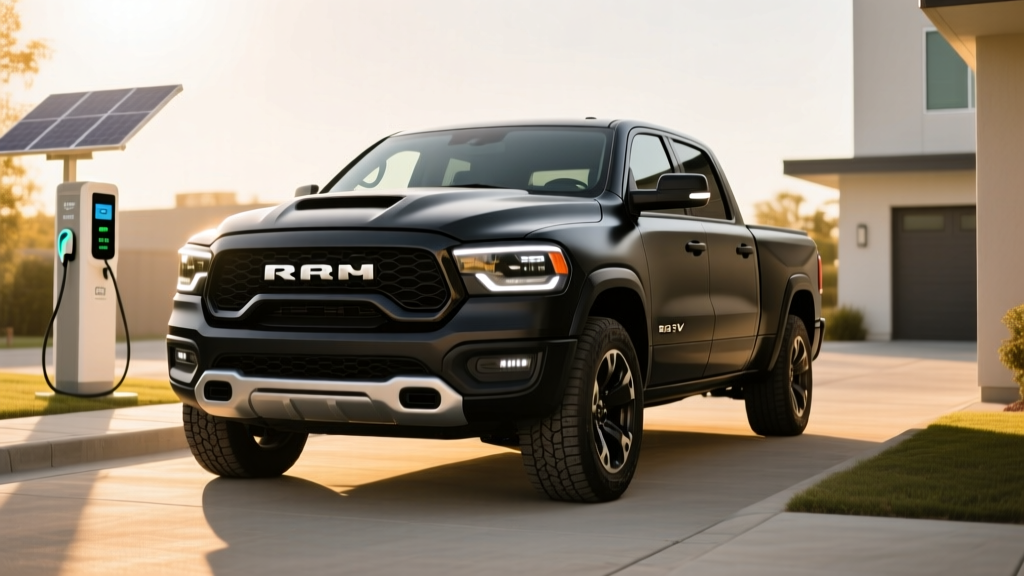
Quick Answer: The 2026 Ram 1500 REV is a battery-electric full-size pickup with a 229 kWh battery pack (the largest in any production EV), targeting an EPA-estimated 510 miles of range on the top-tier trim, or 350 miles on the standard 168 kWh pack. Peak DC fast charging reaches 350 kW, adding up to 110 miles in roughly 10 minutes. Starting MSRP lands around $58,095, though federal §30D tax credit eligibility depends on battery sourcing, buyer income, and MSRP caps that shift yearly. For truck buyers who tow occasionally, commute daily, and have Level 2 home charging, the REV can cut fuel costs by roughly 50–65% versus the gas Ram 1500 — but cold-weather range loss and limited public charging infrastructure for trucks remain real constraints.
2026 Ram 1500 REV: The Electric Truck Landscape
The Ram 1500 REV enters a competitive electric truck segment that includes the Ford F-150 Lightning, Rivian R1T, Chevrolet Silverado EV, and the Tesla Cybertruck. Ram's entry is notable for offering the largest battery pack ever put in a production vehicle — a 229 kWh lithium-ion NMC (nickel manganese cobalt) pack that prioritizes maximum range over weight savings.
For 2026, Ram offers the REV across multiple trims: Tradesman (fleet-oriented), Big Horn/Lone Star, Laramie, Limited, and the off-road-focused REV R. Each trim can be configured with either the standard 168 kWh battery or the extended 229 kWh pack, though availability varies by trim level and production timing.
The key decision for buyers is whether the REV's massive battery and range claims justify its weight, pricing, and the current state of truck-compatible DC fast charging infrastructure. Let's break down the numbers.
Range, Battery, and Real-World Expectations
Ram's headline claim is 510 miles of EPA-estimated range on the 229 kWh pack. That would make the REV the longest-range electric vehicle on sale in the U.S. However, real-world range requires honest context.
| Specification | Standard Pack (168 kWh) | Extended Pack (229 kWh) |
|---|---|---|
| Battery Chemistry | NMC (Nickel Manganese Cobalt) | NMC (Nickel Manganese Cobalt) |
| Usable Capacity | ~160 kWh | ~220 kWh |
| EPA Est. Range | 350 miles | 510 miles |
| Real-World Highway (~70 mph) | ~270–290 miles | ~380–420 miles |
| Cold Weather (20°F, highway) | ~210–235 miles | ~300–340 miles |
| Towing (5,000 lb trailer, hwy) | ~150–180 miles | ~220–260 miles |
| 0–60 mph | ~4.4 seconds | ~4.4 seconds |
| Horsepower | 654 hp (dual motor AWD) | 654 hp (dual motor AWD) |
| Torque | 620 lb-ft | 620 lb-ft |
| Max Towing Capacity | 11,000 lbs | 11,000 lbs |
| Max Payload | ~1,800 lbs | ~1,600 lbs |
Real-World Range Reality: The 510-mile EPA figure assumes mixed driving at moderate temperatures. On sustained highway trips at 70+ mph, expect roughly 380–420 miles from the extended pack. In sub-freezing conditions, range drops 20–30% due to battery heating demands and increased aerodynamic drag on a large truck body. When towing — the use case many truck buyers care about most — range roughly halves. Plan charging stops accordingly for any trailered haul over 150 miles one-way.
Ram equips the REV with a heat pump for cabin and battery thermal management, which helps mitigate cold-weather losses compared to resistive heating systems. The truck also supports battery preconditioning — when you navigate to a DC fast charger, the battery warms itself to optimal temperature, enabling faster charge rates upon arrival.
Charging Speed and Infrastructure
The Ram 1500 REV supports peak DC fast charging at 350 kW via its 800-volt architecture. On a compatible charger, Ram claims 10–80% in approximately 23 minutes for the standard pack and roughly 30 minutes for the extended pack. However, the charge curve matters far more than peak rate.
| Charging Level | Power (kW) | Connector | Miles of Range Added | Typical Use Case |
|---|---|---|---|---|
| Level 1 (120V household) | ~1.4 kW | NACS (standard) | ~3–4 miles/hour | Emergency / trickle |
| Level 2 (240V home) | 11.5 kW (onboard max) | NACS (standard) | ~28–32 miles/hour | Daily home charging |
| DC Fast Charge (peak) | Up to 350 kW | NACS (standard) | ~110 miles in 10 min (peak) | Road trips |
| DC Fast (sustained 10–80%) | ~200–250 kW avg | NACS (standard) | Full 10–80% in 23–30 min | Road trips |
At Level 2, fully recharging the 229 kWh extended pack from empty takes roughly 19–20 hours on an 11.5 kW home charger. In practice, most owners charge from 20–80% overnight, which takes about 11–12 hours — feasible with a standard overnight schedule. Home charging is practically mandatory for daily usability; relying exclusively on public DC fast charging is expensive, time-consuming, and hard on long-term battery health.
Ram has adopted the NACS (North American Charging Standard) connector, meaning the REV has native access to Tesla Superchargers (with V3 and V4 stalls) as well as the growing NACS-equipped networks from Electrify America, EVgo, and others. This is a significant infrastructure advantage over CCS1-only vehicles, though truck-accessible charging stalls (with pull-through lanes or extra-wide spaces) remain limited at many stations.
EV vs Gas Ram 1500: Cost Comparison
The most common question from truck buyers: does going electric actually save money? The answer depends heavily on your driving patterns, electricity rates, and how long you keep the vehicle.
| Cost Factor | 2026 Ram 1500 REV (Extended) | 2026 Ram 1500 Gas (5.7L HEMI V8, 4WD) |
|---|---|---|
| Base MSRP | ~$68,095 (Laramie) | ~$52,095 (Laramie) |
| Fed. Tax Credit (§30D) | Up to $7,500 (eligibility varies) | $0 |
| Effective Starting Price | ~$60,595–$68,095 | $52,095 |
| Fuel/Energy Cost per Mile | $0.04–$0.06 (home charging) | $0.17–$0.21 (gas at $3.50–$4.00/gal) |
| Annual Fuel (15,000 mi) | $600–$900 | $2,550–$3,150 |
| Annual Maintenance | ~$200–$350 | ~$600–$900 |
| Insurance (annual avg) | ~$2,400–$3,200 | ~$1,800–$2,400 |
| 5-Year Fuel/Energy Total | $3,000–$4,500 | $12,750–$15,750 |
| 5-Year Maintenance Total | $1,000–$1,750 | $3,000–$4,500 |
Over five years and 75,000 miles, the REV can save roughly $10,000–$14,000 in fuel and maintenance compared to the gas Ram 1500. However, the higher purchase price (even after tax credits) and elevated insurance premiums partially offset those savings. The break-even point typically arrives around year 3–5, depending on local electricity rates and annual mileage. Drivers who cover 20,000+ miles per year or who live in states with low electricity rates (under $0.12/kWh) will see faster payback.
According to fueleconomy.gov, electric vehicles convert over 77% of electrical energy to wheels, compared to 12–30% for gasoline vehicles — a fundamental efficiency advantage that drives the per-mile cost gap.
Tax Credits, Incentives, and Purchase Considerations
The federal §30D Clean Vehicle Credit can reduce the REV's effective cost by up to $7,500, but eligibility is not automatic. Current IRS rules impose several requirements:
- Buyer Income Caps: Modified AGI must not exceed $150,000 (single), $225,000 (head of household), or $300,000 (joint filing).
- MSRP Cap: The vehicle's base MSRP plus commonly included options must not exceed $80,000 for trucks and vans.
- Battery Sourcing: A percentage of critical minerals and battery components must be sourced from the U.S. or free-trade-agreement countries. These thresholds tighten annually.
- Point-of-Sale Transfer: Eligible buyers can transfer the credit to the dealer at purchase, reducing the sale price directly rather than waiting for a tax refund.
- Assembly: Final assembly must occur in North America (the REV is built in Warren, Michigan).
Consult the IRS Clean Vehicle Credit page for current-year sourcing thresholds and eligible vehicle lists, as these change frequently. A tax professional can confirm your individual eligibility.
Many states offer additional incentives — California's CVRP, Colorado's innovative vehicle tax credit, and various utility rebates for home charger installation can stack with the federal credit. Check your state energy office and local utility for specifics.
Common Misconceptions About the Ram 1500 REV
| Myth | Fact |
|---|---|
| "510 miles means I'll never need to charge on road trips." | 510 miles is the EPA mixed-driving estimate. Highway-only driving at 75 mph yields roughly 380–420 miles. Add cold weather or a trailer, and range drops further. Plan stops on trips over 300 miles. |
| "The REV can't tow as much as a gas Ram." | The REV is rated for 11,000 lbs of towing — competitive with many gas Ram 1500 configurations. However, towing cuts range roughly in half, making gas or the Ram 1500 Ramcharger (EREV) more practical for frequent long-distance towing. |
| "Electric trucks are cheaper to own from day one." | Upfront cost is higher. Savings accrue over years through lower fuel and maintenance. Break-even typically takes 3–5 years depending on mileage and local energy costs. |
| "I can charge at any public station." | The REV uses NACS, which opens Tesla Supercharger access. However, many public chargers lack pull-through lanes for trucks with trailers, and some urban stations have tight spaces. Truck-friendly DC fast charging is still expanding. |
| "The battery will need expensive replacement." | Ram warranties the battery for 8 years/100,000 miles (whichever comes first) against degradation below 70% capacity. Modern NMC packs are engineered for 150,000–200,000+ miles with gradual, manageable degradation. Full replacements are rare and typically covered under warranty in the early years. |
| "Home charging requires a full panel upgrade." | Many homes with 200-amp electrical panels can support a 48-amp (11.5 kW) Level 2 charger without an upgrade. Homes with older 100-amp panels may need a $1,500–$3,000 panel upgrade. A licensed electrician should evaluate your specific setup. |
Ownership Practicalities: What First-Time EV Truck Buyers Need to Know
Home Charging Is Essential. The 229 kWh battery is simply too large to rely on public charging alone for daily use. Budget $500–$1,200 for a quality Level 2 home charger (such as the ChargePoint Home Flex or Emporia Level 2) plus $800–$2,500 for professional installation by a licensed electrician. If your panel needs upgrading, add $1,500–$3,000. Total home charging setup: $1,300–$6,700 depending on your home's electrical infrastructure.
Tire Costs Are Higher. The REV's weight (estimated 8,500+ lbs for the extended pack) accelerates tire wear. Budget $1,200–$2,000 for a set of replacement tires, and expect 25,000–35,000 miles of life versus 40,000–60,000 on a lighter vehicle.
Insurance Premiums Run 25–40% Higher. EV trucks carry higher insurance costs due to repair complexity, battery replacement risk, and higher purchase prices. Shop quotes before buying — premiums vary significantly by insurer and region.
Off-Road and Work Site Use. The REV's instant torque and AWD system make it capable off-road, and the frunk (front trunk) adds sealed, lockable storage. However, ground clearance and approach/departure angles are competitive but not class-leading. Serious off-roaders should compare with the Rivian R1T or wait for the REV R trim details.
Depreciation Uncertainty. Electric truck depreciation curves are still being established. Early data on the F-150 Lightning shows steeper depreciation than gas equivalents, partly due to rapid EV tech advancement and price cuts from competitors. Factor this into total cost of ownership if you plan to sell or trade within 3–4 years.
Decision Framework: Is the Ram 1500 REV Right for You?
Choose the Ram 1500 REV if:
- You have reliable Level 2 home charging access (garage or driveway with 240V)
- Your daily commute is under 150 miles round-trip
- You want to eliminate fuel costs for daily driving and light towing
- You value instant torque, quiet operation, and frunk storage
- You drive 12,000–20,000+ miles per year (higher mileage = faster payback)
Consider the gas Ram 1500 or Ramcharger (EREV) instead if:
- You frequently tow heavy loads over 200+ miles one-way
- You live in an apartment or lack home charging access
- You regularly drive in extreme cold (below 0°F) with long highway stretches between chargers
- You plan to keep the truck only 2–3 years (depreciation risk)
- Your budget is under $55,000 and you cannot wait for tax credit point-of-sale transfer
2026 Ram 1500 REV Pricing by Trim
| Trim | Standard Pack (350 mi) | Extended Pack (510 mi) | Drivetrain |
|---|---|---|---|
| Tradesman | ~$58,095 | ~$66,095 | AWD (dual motor) |
| Big Horn / Lone Star | ~$62,095 | ~$70,095 | AWD (dual motor) |
| Laramie | ~$68,095 | ~$76,095 | AWD (dual motor) |
| Limited | N/A | ~$85,095 | AWD (dual motor) |
All trims include dual-motor all-wheel drive, air suspension, the 14.5-inch infotainment touchscreen, and Level 2 driver assistance (hands-on-wheel required — this is not autonomous driving). The Limited trim with the extended pack pushes close to the $80,000 MSRP cap for §30D tax credit eligibility on trucks — buyers should verify the exact as-equipped MSRP with their dealer.
According to NHTSA, check crash-test ratings before purchase as they become available for the 2026 model year. The IIHS also conducts independent safety testing that may inform your trim and option decisions.
Frequently Asked Questions
Does the Ram 1500 REV qualify for the $7,500 federal tax credit?
It may, depending on the current year's battery sourcing requirements, your income level, and the as-equipped MSRP staying under the $80,000 truck cap. The REV is assembled in Warren, Michigan, satisfying the North American assembly requirement. Check the IRS eligible vehicle list and consult a tax professional for your specific situation.
How long does it take to charge the Ram 1500 REV at home?
On an 11.5 kW Level 2 home charger, a full charge of the 229 kWh extended pack takes roughly 19–20 hours from empty. In typical use (charging from 20% to 80%), expect about 11–12 hours — easily achievable overnight. The standard 168 kWh pack charges in roughly 14 hours from empty, or 8–9 hours for a 20–80% session.
Can I tow a boat or camper with the Ram 1500 REV?
Yes — the REV is rated for up to 11,000 lbs of towing capacity. However, towing significantly reduces range. A 5,000 lb trailer at highway speeds will cut range roughly in half, meaning the 510-mile pack delivers approximately 220–260 real-world miles while towing. For frequent long-distance towing, the Ramcharger EREV variant (which adds a gasoline range-extender generator) may be more practical.
What's the difference between the Ram 1500 REV and the Ramcharger?
The REV is a pure battery-electric vehicle (BEV). The Ramcharger is an extended-range electric vehicle (EREV) — it has a smaller battery plus an onboard gasoline engine that acts solely as a generator to extend range. The Ramcharger sacrifices some EV-only range for the ability to refuel at any gas station, making it better suited for buyers who tow long distances or lack reliable charging access.
Will the REV's battery need replacement, and what does it cost?
Ram covers the battery with an 8-year/100,000-mile warranty against capacity loss below 70%. Modern NMC battery packs are engineered to last 150,000–200,000+ miles with gradual degradation (typically 1–2% per year). If out-of-warranty replacement is ever needed, industry estimates for packs of this size range from $15,000–$25,000, though prices are expected to decline as battery technology advances.
Is the Ram 1500 REV self-driving?
No. The REV comes equipped with Level 2 driver-assistance features (adaptive cruise control, lane centering, hands-free driving assist on compatible highways). Under SAE automation standards, Level 2 requires the driver to remain attentive and keep hands on or near the wheel at all times. This is not autonomous driving.