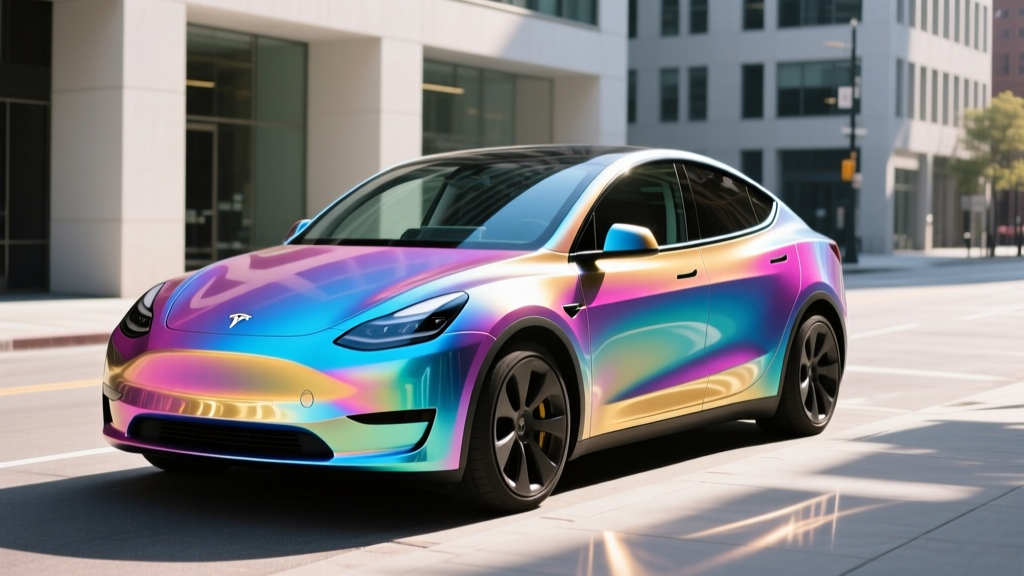
If you've scrolled through EV enthusiast forums or TikTok in the past year, you've probably seen a "rainbow Tesla" — a Model Y or Model 3 wrapped in a color-shifting, iridescent vinyl that cycles through hues depending on the light and viewing angle. The trend has exploded, with shops reporting month-long waitlists for chameleon and chroma-flair wraps on Tesla's best-selling crossover. But beneath the prismatic surface, the 2026 Tesla Model Y remains one of the most spec-dense, efficient, and widely adopted electric SUVs on the market.
This review covers the 2026 Tesla Model Y in full technical detail — range, charging, battery chemistry, pricing, tax-credit eligibility, and real-world ownership — while also addressing the rainbow wrap trend: what it costs, how it affects resale, and whether it voids any warranty protections. Whether you're here for the specs or the aesthetic, you'll leave with exact numbers.
2026 Tesla Model Y: Core Specifications at a Glance
| Spec | Long Range AWD | Performance |
|---|---|---|
| EPA Range | 320 miles | 295 miles |
| Battery (usable) | ~75 kWh (NMC) | ~75 kWh (NMC) |
| Drivetrain | Dual-Motor AWD | Dual-Motor AWD |
| Horsepower | 384 hp | 456 hp |
| 0–60 mph | 4.8 sec | 3.5 sec |
| Peak DC Fast Charge | 250 kW | 250 kW |
| 10–80% DC Time | ~27 min | ~27 min |
| Level 2 Rate | 11.5 kW (~44 mi/hr) | 11.5 kW (~44 mi/hr) |
| MPGe (combined) | 117 MPGe | 111 MPGe |
| Efficiency | 28 kWh/100 mi | 30 kWh/100 mi |
| Cargo (rear seats up) | 30.2 cu ft | 30.2 cu ft |
| Cargo (seats folded) | 72.1 cu ft | 72.1 cu ft |
| Base MSRP | $44,990 | $51,490 |
Sources: EPA fueleconomy.gov, Tesla.com order configurator (2026 model year).
Real-World Range: What the EPA Sticker Doesn't Tell You
EPA Estimate: 320 miles (Long Range AWD)
Real-World Expectation: ~265–285 miles at sustained 75 mph highway speeds in moderate temperatures; ~230–255 miles in sub-30°F winter conditions with cabin heat.
The 2026 Model Y Long Range carries roughly 75 kWh of usable capacity in its nickel-manganese-cobalt (NMC) lithium-ion pack. NMC chemistry offers higher energy density than lithium iron phosphate (LFP), which translates to more range in a lighter package — but it also means Tesla recommends daily charging to 80% for longevity, reserving 100% for road trips.
In mixed suburban-and-highway driving at 65–70 mph with climate control in the 68–72°F range, most owners report achieving 290–310 miles on a full charge — close to the EPA sticker. But sustained Interstate speeds above 75 mph, headwinds, roof cargo boxes, and cold weather all compress range meaningfully. If your commute includes mountain passes or you live in a northern climate, plan for 240–260 miles of usable range in winter and size your charging stops accordingly.
Charging Speed: DC Fast, Level 2, and the Charge-Curve Reality
| Charging Level | Power / Rate | Miles Added per Hour | Notes |
|---|---|---|---|
| Level 1 (120V outlet) | ~1.4 kW | ~5 mi/hr | Emergency/trickle only |
| Level 2 (240V home) | 11.5 kW | ~44 mi/hr | Full charge in ~7 hr |
| DC Fast (Supercharger V3) | Peak 250 kW | ~162 mi in 15 min | 10–80% in ~27 min |
| DC Fast (Supercharger V4) | Peak 250 kW (capped) | Similar | Model Y architecture limits to ~250 kW |
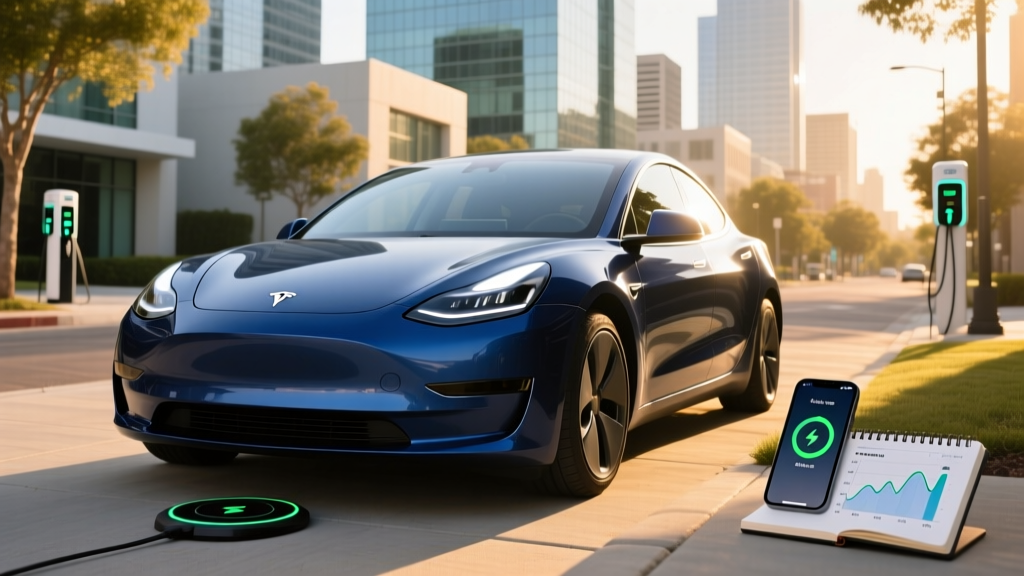
The Model Y uses the NACS (North American Charging Standard) connector natively — the same plug used across the Tesla Supercharger network, which now exceeds 6,500 stations in North America. The 2026 Model Y's battery management system peaks at approximately 250 kW when arriving at a V3 Supercharger with a preconditioned, low state-of-charge (ideally below 15%).
Charge-curve caveat: That 250 kW peak is not sustained. The curve tapers progressively — dropping to roughly 150 kW by 50% SoC and below 70 kW past 80%. This is why Tesla and every other manufacturer quote 10–80% times rather than 0–100%. Charging from 80% to 100% on DC fast charging can take nearly as long as the 10–80% portion. For daily driving, charge at home on Level 2 and reserve DC fast charging for road trips.
For home charging, a 48-amp Level 2 wall connector on a 60-amp circuit delivers the full 11.5 kW, adding roughly 44 miles of range per hour — enough to fully replenish the battery overnight. A licensed electrician will typically quote $800–$2,000 for installation depending on panel proximity and local permit costs. If your home has a 100-amp electrical panel, a panel upgrade to 200 amps may add $1,500–$3,000 to the project.
Performance, Efficiency, and Daily Livability
The Long Range AWD's dual-motor setup produces 384 horsepower with a 4.8-second 0–60 time — quick enough to merge onto any freeway with authority, and the instant torque delivery makes it feel faster than the number suggests. The Performance trim bumps output to 456 hp and drops the sprint to 3.5 seconds, though you sacrifice 25 miles of EPA range for that privilege.
At 117 MPGe combined (Long Range), the Model Y remains one of the most efficient electric SUVs in its class. That translates to roughly 28 kWh consumed per 100 miles driven. At the U.S. average residential electricity rate of ~$0.17/kWh, that's approximately $4.76 per 100 miles of driving — compared to roughly $12–$14 per 100 miles in a 25-MPG gasoline crossover at $3.30/gallon.
Interior space is a Model Y strength. With 30.2 cubic feet behind the second row and 72.1 cubic feet with the 60/40 split seats folded, it swallows luggage for a family of four on a week-long trip. Rear legroom measures 38.7 inches, adequate for adults on longer drives. The front trunk (frunk) adds an additional 4.1 cubic feet of secure storage — useful for charging cables, groceries, or a carry-on bag.
Pricing, Trim Levels, and Federal Tax Credit Eligibility
| Trim | Base MSRP | Est. Federal Credit (§30D) | Effective Price |
|---|---|---|---|
| Long Range AWD | $44,990 | Up to $7,500* | ~$37,490* |
| Performance | $51,490 | Up to $7,500* | ~$43,990* |
*Federal tax credit eligibility under IRS §30D depends on multiple requirements that change periodically. Verify current status before purchase.
IRS §30D Requirements (verify at irs.gov):
- MSRP Cap: SUVs/vans/pickups must have an MSRP at or below $80,000. Both Model Y trims qualify.
- Buyer Income Cap: Modified AGI must not exceed $150,000 (single), $225,000 (head of household), or $300,000 (joint filers).
- Battery Sourcing: Critical minerals and battery components must meet phased-in domestic/free-trade sourcing percentages — Tesla has largely restructured its supply chain, but confirm the specific VIN's eligibility at the point of sale.
- Point-of-Sale Transfer: As of 2024, buyers can transfer the credit to the dealer at purchase, reducing the out-of-pocket price immediately rather than waiting to claim it on a tax return.
- Final Assembly: Vehicle must undergo final assembly in North America. The Model Y is assembled at the Fremont, CA and Austin, TX Gigafactories — both qualify.
Options can push the as-tested price higher. A $2,000 Full Self-Driving (Supervised) subscription or transfer, premium interior colors ($1,000–$2,000), and 20-inch wheels ($2,000) can add $5,000+ to a Long Range build. A fully loaded Long Range AWD can approach $52,000 before incentives.
The Rainbow Wrap: Cost, Quality, and Warranty Implications
Now to the keyword that brought many of you here: the rainbow Tesla. Color-shift vinyl wraps — marketed under names like "Chameleon," "ChromaFlair," "Prismatic," or "Iridescent" — use multi-layer optical films that refract light differently depending on the angle. On a Model Y, a full-body wrap typically costs $3,500 to $6,500 depending on film brand (3M, Avery Dennison, KPMF, or Stek), shop reputation, and the complexity of the color-shift pattern.
What to know before wrapping your Tesla:
- Paint protection: A high-quality wrap actually protects the factory paint underneath from UV damage, rock chips, and minor scratches. When removed professionally (typically after 5–7 years), the original paint is often in better condition than an unwrapped car.
- Warranty: A vinyl wrap does not void Tesla's vehicle or battery warranty. However, if wrap installation involves removing trim, door handles, or sensors and something breaks, that damage would not be covered. Choose a shop experienced with Tesla's flush door handles and camera/sensor placements.
- Sensor and camera clearance: The Model Y's Autopilot cameras (front bumper, fenders, B-pillars, rear) and ultrasonic-free Tesla Vision system rely on unobstructed lenses. Ensure the wrap shop cuts precise openings around every camera — even a slight film overlap can cause ghosting or calibration errors.
- Resale impact: A tasteful, well-executed wrap in a popular color-shift pattern can be a neutral or slight positive at resale (buyer can remove it to reveal pristine paint). A loud or poorly installed wrap may deter some buyers. A PPF (paint protection film) with a subtle color-shift tint is a popular middle ground, running $5,000–$8,000 for full coverage.
Driver Assistance: Autopilot and FSD (Supervised)
SAE Automation Level: Level 2
Tesla Autopilot and Full Self-Driving (Supervised) are driver-assistance systems, not autonomous driving. The driver must remain fully attentive, keep hands on the wheel (or demonstrate engagement via the cabin camera), and be prepared to take over at any moment. No Tesla vehicle currently sold is capable of unsupervised self-driving.
The 2026 Model Y ships with Basic Autopilot (traffic-aware cruise control and autosteer on marked roads) at no extra cost. FSD (Supervised), available as a $8,000 one-time purchase or $99/month subscription, adds automatic lane changes, Navigate on Autopilot (highway on/off-ramp guidance), traffic-light and stop-sign recognition, and enhanced city-street driving. Tesla's vision-only "Tesla Vision" approach relies on eight external cameras and neural-network processing — no radar or ultrasonic sensors in current-production units.
Real-world FSD performance has improved substantially with the v12 and v13 neural-net stacks, handling most suburban and highway scenarios smoothly. However, it still struggles in construction zones, unmapped detours, heavy rain/snow, and complex unprotected left turns. Treat it as a fatigue-reduction tool, not a chauffeur.
Warranty, Ownership Costs, and Competitor Comparison
Tesla covers the 2026 Model Y with:
- Basic Vehicle Warranty: 4 years / 50,000 miles
- Battery & Drive Unit Warranty: 8 years / 120,000 miles (Long Range & Performance), with a guaranteed minimum 70% capacity retention over the warranty period
The 8-year/120,000-mile battery warranty is competitive within the segment, matching or exceeding Hyundai/Kia's 10-year/100,000-mile coverage in time but trailing in mileage. NMC battery degradation in Tesla packs has historically been modest — most Model Y owners report 5–8% capacity loss over the first 50,000 miles, with the curve flattening significantly afterward. Full battery replacement outside of warranty currently runs $12,000–$16,000 at Tesla Service Centers, though third-party options are emerging at lower cost.
Pros
- Class-leading Supercharger network access (6,500+ stations)
- Strong efficiency (117 MPGe combined)
- Spacious cargo area (72.1 cu ft max) with usable frunk
- Over-the-air updates continuously add features
- NACS connector — the emerging North American standard
- Wrap-friendly flat body panels for rainbow/custom finishes
Cons
- Ride quality firm on 20-inch wheels; road noise noticeable
- Minimalist interior lacks physical buttons (HVAC via screen)
- No Apple CarPlay or Android Auto — Tesla OS only
- FSD (Supervised) still requires full driver attention
- Insurance premiums often 20–35% higher than comparable gas SUVs
- Service center wait times can stretch to weeks in some metro areas
Key competitors to cross-shop: The Hyundai Ioniq 5 (310-mi range, 800V architecture for 10–80% in 18 min, starts ~$43,000), Ford Mustang Mach-E (320-mi Extended Range, more traditional interior), and Kia EV6 (310-mi range, sportier handling). All three offer 800V-class DC fast charging that outpaces the Model Y's 250 kW peak — but none match Tesla's Supercharger network reliability and coverage.
Frequently Asked Questions
What is the real-world range of the 2026 Tesla Model Y?
The EPA rates the Long Range AWD at 320 miles. Expect 265–285 miles at sustained highway speeds in moderate weather, and 230–255 miles in freezing temperatures with cabin heating. City driving with regenerative braking can match or slightly exceed the EPA number.
How fast does the Model Y charge at home and on the road?
On a 48-amp Level 2 home charger, the Model Y adds ~44 miles of range per hour (11.5 kW), achieving a full charge in roughly 7 hours. On a Tesla V3 Supercharger, it peaks at 250 kW and charges from 10–80% in approximately 27 minutes, though the rate tapers significantly above 80%.
Does the 2026 Model Y qualify for the $7,500 federal EV tax credit?
It can, but eligibility depends on your income (AGI caps of $150K/$225K/$300K), the vehicle's MSRP (under $80K — both trims qualify), and battery-sourcing compliance under IRS §30D rules. The credit can be transferred at the point of sale to reduce your purchase price immediately. Always verify your specific VIN's eligibility with the dealer and consult a tax professional.
How much does a rainbow wrap cost on a Tesla Model Y?
A full-body color-shift/chameleon vinyl wrap typically runs $3,500–$6,500 depending on film brand and shop quality. Paint protection film (PPF) with a subtle color-shift tint costs more ($5,000–$8,000) but offers superior impact protection. Neither voids the Tesla warranty if installed properly.
Is the Model Y worth buying over the Ioniq 5 or Mach-E?
Choose the Model Y if Supercharger network access, cargo volume, and OTA updates are priorities. Choose the Ioniq 5 or EV6 if faster DC charging (800V architecture) and a more conventional interior matter more. Choose the Mach-E if you prefer a traditional dealer experience and Ford's BlueCruise hands-free highway driving. All four are strong — your charging access and interface preference should decide.
What is the battery warranty and expected lifespan?
Tesla warrants the Model Y Long Range and Performance battery for 8 years or 120,000 miles, guaranteeing at least 70% capacity retention. Real-world data from high-mileage owners suggests NMC packs in Teslas typically retain 85–90% capacity at 100,000 miles with proper charging habits (daily limit of 80%, avoid prolonged 100% storage).