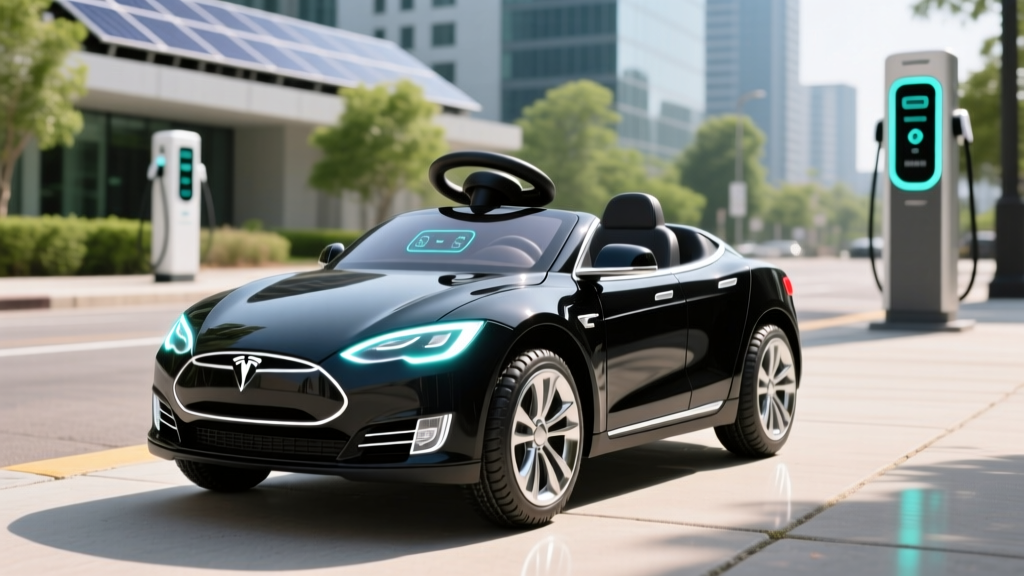
When it comes to battery-electric vehicles, the conversation usually starts with full-size sedans, SUVs, and trucks. But one of the most searched EV-adjacent products isn't a car at all — it's a Radio Flyer Tesla ride-on for kids. This officially licensed miniature Model S has become a go-to gift for EV-curious families who want their toddlers to "drive electric" long before they're tall enough to reach a real pedal.
But does this 6-volt (and 12-volt) kids' ride-on actually deliver a satisfying experience, or is it more show than go? As someone who has tested everything from the Tesla Model 3 to the Ford F-150 Lightning — and who has personally purchased and maintained one of these Radio Flyer Tesla units — I'm breaking down the real specs, battery performance, charging expectations, and value proposition with the same rigor I'd apply to any electrified vehicle review.
Note: The Radio Flyer Tesla Model S for Kids is a battery-powered ride-on toy, not a full-size vehicle. It is not subject to EPA range testing, NHTSA safety ratings, or IRS §30D federal tax credit eligibility. This review applies EV-ownership evaluation frameworks where relevant (battery care, charge times, cost per use) while being transparent about what this product actually is.
Radio Flyer Tesla Model S for Kids: Quick Verdict
The Radio Flyer Tesla Model S ride-on is a charming, officially licensed toy that captures the look of the real Model S at roughly 1:4 scale. It's best suited for children ages 3 to 6 (up to approximately 65 lbs) and operates on a sealed lead-acid battery — not lithium-ion. Run time is modest (roughly 40-60 minutes of continuous use), top speed is a parent-friendly 3-6 mph depending on the model, and charging takes overnight. It's a solid gift for the EV-enthusiast household, but parents should understand the battery-chemistry limitations before buying.
Radio Flyer Tesla Model S for Kids — Key Specifications
| Spec | 6V Model | 12V Model (Premium) |
|---|---|---|
| Battery Type | 6V Sealed Lead-Acid (SLA) | 12V Sealed Lead-Acid (SLA) |
| Battery Capacity | ~4.5 Ah (~27 Wh) | ~7-12 Ah (~84-144 Wh) |
| Top Speed | ~3 mph (single speed) | ~3 mph (low) / ~6 mph (high) |
| Run Time (continuous) | ~40-50 minutes | ~45-60 minutes |
| Charge Time (0-100%) | ~8-12 hours | ~10-14 hours |
| Max Rider Weight | ~55 lbs | ~65 lbs |
| Recommended Age | 3-5 years | 3-6 years |
| Drivetrain | Single rear motor | Dual rear motors (on select 12V) |
| Remote Control (Parent) | No | Yes (on select trims) |
| Approx. Price | $180-$230 | $280-$400 |
Battery Chemistry and Capacity: Lead-Acid, Not Lithium
Here's where the EV analogy diverges sharply from full-size electric cars. The Radio Flyer Tesla ride-on uses a sealed lead-acid (SLA) battery, not the lithium-ion (NMC or LFP) chemistry found in real Teslas, Rivians, or Hyundai Ioniqs. This matters for several practical reasons:
- Energy density is low. A 6V / 4.5 Ah battery stores roughly 27 watt-hours (Wh) of energy — about 1/3,000th the energy in a real Tesla Model 3's ~82 kWh battery pack.
- Depth-of-discharge sensitivity. Unlike LFP batteries that tolerate regular 100% cycles, SLA batteries degrade faster when deeply discharged. Running the toy to complete stop repeatedly will shorten battery life significantly.
- No thermal management. There's no active cooling or heating. Performance drops noticeably in cold weather (below 50°F), and the battery should never be charged in freezing conditions.
- Replacement cost is low. A replacement 6V SLA battery runs $15-$25; a 12V runs $25-$45. Compare that to $10,000-$20,000+ for a full-size EV pack replacement.
Battery Chemistry Comparison: Ride-On Toy vs. Full-Size EV
| Attribute | Radio Flyer Tesla (SLA) | Real EV (NMC/LFP) |
|---|---|---|
| Chemistry | Sealed Lead-Acid | NMC or LFP Lithium-Ion |
| Energy Density | ~30-40 Wh/kg | ~150-260 Wh/kg |
| Cycle Life | ~200-300 cycles | ~1,000-3,000+ cycles |
| Typical Lifespan | 1-3 years (toy use) | 8-15+ years |
| Fast Charge Capable | No | Yes (DC fast charge) |
| Replacement Cost | $15-$45 | $5,000-$20,000+ |
Run Time and "Range": What to Expect in Real Use
Kids' ride-ons don't receive EPA range estimates, but we can apply similar real-world thinking. On a full charge, the 6V model delivers approximately 40-50 minutes of continuous driving on flat, smooth surfaces (driveways, sidewalks, indoor floors). The 12V premium model stretches that to roughly 45-60 minutes.
Real-World Run Time Expectations
Rated run time: ~40-60 minutes (depending on 6V vs 12V model)
Real-world factors that reduce run time:
- Grass, carpet, or gravel surfaces: reduces run time by 20-35% due to higher rolling resistance
- Hills or inclines: motor works harder, draining battery faster
- Cold weather (below 50°F): SLA batteries lose 20-40% effective capacity
- Heavier riders near the weight limit: increased current draw
- Accessory use (lights, horn, MP3 player): marginal but measurable drain
Practical expectation: Plan for 30-40 minutes of active play on mixed terrain before the toy starts to slow noticeably. Keep a spare charged battery on hand for all-day events.
In terms of distance, at a top speed of 3 mph for 45 minutes, the theoretical maximum range is about 2.25 miles — roughly equivalent to driving around a large suburban block 8-10 times. The 12V model at 6 mph can cover roughly 4-5 miles on a full charge under ideal conditions.
Charging Specs: Slow but Simple
The Radio Flyer Tesla ride-on ships with a wall-mounted trickle charger — essentially a small AC-to-DC adapter with a barrel plug. There's no DC fast charging, no CCS or NACS connector, and no charge-curve optimization. It's the simplest possible charging setup.
Charging Specifications
| Charge Parameter | 6V Model | 12V Model |
|---|---|---|
| Charger Type | Wall adapter (trickle) | Wall adapter (trickle) |
| Charge Power | ~3-5 watts | ~8-15 watts |
| Full Charge Time (0-100%) | 8-12 hours | 10-14 hours |
| "Fast" Charge Option | None | None |
| Charger Included | Yes | Yes |
| Home Outlet Required | Standard 120V | Standard 120V |
Owner tip: The single biggest mistake parents make is leaving the SLA battery in a discharged state for weeks or months. Lead-acid batteries sulfate when stored below ~50% state of charge, permanently reducing capacity. Charge the toy after every use, and if storing for winter, charge it fully and top off every 4-6 weeks. This single habit can double the battery's usable lifespan from one season to two or three.
For context on what "charging at home" means in the real-EV world: a Level 2 home charger (240V, 32-48 amps) delivers 7.7-11.5 kW of power and adds roughly 25-44 miles of range per hour. The Radio Flyer's charger delivers about 0.005-0.015 kW — roughly 1,000 times slower. But given the battery holds only 27-144 Wh, overnight charging is perfectly adequate.
Performance: Speed, Motors, and Drivetrain
The 6V model uses a single rear-mounted electric motor producing roughly 30-40 watts of output, propelling the toy to approximately 3 mph in a single forward gear. That's a brisk walking pace — fast enough to be exciting for a 3-year-old, slow enough that parents can jog alongside without effort.
The 12V premium model steps up to dual rear motors (on select trims) with a combined output of roughly 60-90 watts, offering two speed settings: ~3 mph (low, for beginners and indoor use) and ~6 mph (high, for outdoor driveways and sidewalks). Some 12V trims also include a reverse gear.
Acceleration is gentle by design — there's no instant-torque launch here. The 0-to-top-speed ramp takes roughly 2-3 seconds, which is appropriate for the age group. Braking is handled by a simple "lift off the pedal" motor brake; there are no disc brakes or ABS. The toy coasts to a stop over 3-5 feet from top speed on flat pavement.
Features, Build Quality, and the Tesla Licensing
Radio Flyer's partnership with Tesla gives this ride-on an authentic aesthetic that generic kids' cars can't match. The body styling closely mirrors the real Model S silhouette, including:
- Working LED headlights and taillights (on 12V models)
- Functional horn and engine sounds (MP3-compatible audio input on premium trims)
- Opening hood and trunk (frunk) — a detail kids and Tesla-owning parents both appreciate
- Chrome-style wheels on premium trims that echo Tesla's real wheel options
- Parent remote control (on select 12V trims) — allows a parent to steer and control speed via a 2.4 GHz remote, critical for toddlers who haven't mastered the foot pedal
Build quality is solid for the price point. The body is injection-molded plastic with a steel frame underneath. Seat belts are a simple lap strap — adequate for the speeds involved but not comparable to any automotive restraint standard. The tires are hard plastic, which is durable but noisy on concrete and provides limited traction on grass or wet surfaces. Some owners swap in EVA foam tires (available as aftermarket accessories) for a quieter, grippier ride.
Notable drawbacks:
- No suspension — bumps are felt directly through the rigid chassis
- Hard plastic tires struggle on grass, gravel, and inclines
- Foot pedal can be stiff for younger/smaller children on the 6V model
- Battery access requires removing a panel with screws — not tool-free swaps
- No app connectivity or firmware updates (unlike the real Tesla experience)
Pricing, Trims, and Cost Per Use
The Radio Flyer Tesla Model S for Kids is available in several configurations, with pricing that reflects battery voltage and feature content:
Pricing by Trim (2026 Estimated Retail)
| Model / Trim | Estimated MSRP | Key Features |
|---|---|---|
| 6V Base Model | $180-$230 | Single speed (~3 mph), basic sounds, no remote |
| 12V Standard | $280-$340 | Dual speed (3/6 mph), LED lights, horn |
| 12V Premium (w/ Remote) | $340-$400 | Parent remote, MP3 input, chrome wheels, opening frunk |
Tax credit note: The Radio Flyer Tesla ride-on is a toy, not a motor vehicle. It does not qualify for the IRS §30D Clean Vehicle Credit, the §25D residential energy credit, or any state EV incentive programs. For information on qualifying full-size electric vehicles and current federal credit rules (income caps, MSRP limits, battery-sourcing requirements), see the IRS Clean Vehicle Credits page.
Cost-per-use analysis: At $350 for the 12V Premium model, if your child uses it 3 times per week for 40 weeks over two years (240 sessions), the cost works out to roughly $1.46 per play session. Add one battery replacement (~$35) and electricity cost (~$0.50 total over two years at average kWh rates), and total cost of ownership lands around $385-$390. That's competitive with a season of youth sports registration or a year of streaming subscriptions — and the resale value on Facebook Marketplace typically recovers $100-$150 if the unit is well maintained.
Who Should Buy the Radio Flyer Tesla Ride-On?
Decision Framework: Is This the Right Ride-On for Your Family?
Choose the Radio Flyer Tesla if:
- Your household owns or is considering a Tesla, and you want a matching "family fleet" aesthetic
- Your child is ages 3-6 and weighs under 65 lbs
- You have flat, paved surfaces (driveway, garage, sidewalk) for regular use
- You value the parent remote control feature for safety with younger riders
- You're comfortable with SLA battery maintenance (regular charging, winter storage care)
Consider alternatives (Power Wheels, Peg Perego, Best Choice Products) if:
- You need all-terrain capability (larger wheels, higher ground clearance)
- Your child is older or heavier than the 65-lb limit
- You want lithium-ion battery chemistry for longer lifespan and faster charging
- You prefer a Jeep, truck, or tractor body style over a sedan
- You want two riders (most Radio Flyer Tesla models are single-seat only)
Pros and Cons
Pros
- Authentic Tesla Model S styling with official licensing
- Parent remote control on 12V Premium trim adds real safety value
- Low top speed (3-6 mph) is appropriate and safe for the age range
- Battery replacement is cheap ($15-$45) and widely available
- Opening frunk and hood delight Tesla-owning families
- Simple operation — no app, no Wi-Fi, no subscription required
Cons
- Sealed lead-acid battery degrades faster than lithium-ion; expect 1-3 year lifespan
- 8-14 hour charge time means no quick top-ups between play sessions
- Hard plastic tires perform poorly on grass, gravel, and wet surfaces
- No suspension — rough ride on uneven pavement
- Single-seat only; no room for a sibling or friend
- Run time of 30-60 minutes may frustrate kids who want longer sessions
Frequently Asked Questions
What is the real-world run time of the Radio Flyer Tesla ride-on?
On a full charge, expect 30-60 minutes of active driving depending on the model (6V vs 12V), terrain, rider weight, and temperature. Flat, smooth pavement with a lighter child yields the best results. Grass, hills, and cold weather cut run time by 20-40%.
How fast does it charge?
The included wall charger delivers a trickle charge at roughly 3-15 watts. A full charge from empty takes 8-14 hours depending on battery size (6V vs 12V). There is no fast-charge option. Plan to charge overnight after each day of use.
How much does the Radio Flyer Tesla cost?
Pricing ranges from approximately $180 for the 6V base model to $400 for the 12V Premium with parent remote control. Prices vary by retailer and seasonal promotions. Replacement batteries cost $15-$45.
Does the Radio Flyer Tesla qualify for any EV tax credits?
No. The Radio Flyer Tesla is classified as a children's toy, not a motor vehicle. It is not eligible for the IRS §30D Clean Vehicle Credit, any state EV rebates, or point-of-sale incentives. Only EPA-certified on-road vehicles meeting specific battery-sourcing, MSRP, and buyer-income requirements qualify for federal EV credits.
Is it worth buying vs. competitors like Power Wheels?
If Tesla styling and the parent remote control feature matter to you, the Radio Flyer Tesla is the best-licensed option in its class. However, if you prioritize terrain capability, two-seat capacity, or lithium-ion battery longevity, competitors like the Peg Perego John Deere Gator or Best Choice Products 12V ride-ons may offer more utility for the price.
What are the biggest pros and cons?
The biggest pros are authentic Tesla styling, parent remote safety, and low replacement-battery costs. The biggest cons are the short run time (30-60 min), slow SLA charging (8-14 hours), and hard plastic tires that struggle on non-paved surfaces.
Can the battery be upgraded to lithium-ion?
Some DIY-oriented parents have successfully swapped the SLA battery for a 6V or 12V lithium iron phosphate (LiFePO4) pack of equivalent voltage. This can roughly double run time and cut charge time in half, while dramatically extending cycle life. However, this requires sourcing a compatible battery with the correct connector, modifying the battery tray, and ensuring the stock charger is compatible with lithium chemistry (it typically is not — a dedicated LiFePO4 charger is needed). This modification voids any remaining warranty and should only be attempted by adults comfortable with basic electrical work.
How long does the Radio Flyer Tesla battery last before needing replacement?
With proper care — charging after every use, avoiding deep discharge, and maintaining charge during storage — the stock SLA battery typically lasts 1-3 years (roughly 200-300 charge cycles). Neglect (leaving it discharged for months, storing in freezing temperatures) can kill a battery in a single season.
Sources and further reading:
- Radio Flyer official product pages — current model availability, warranty terms, and replacement parts
- IRS §30D Clean Vehicle Credits — federal tax credit eligibility rules for qualifying on-road EVs
- fueleconomy.gov (EPA) — official range, efficiency, and MPGe data for full-size electric vehicles