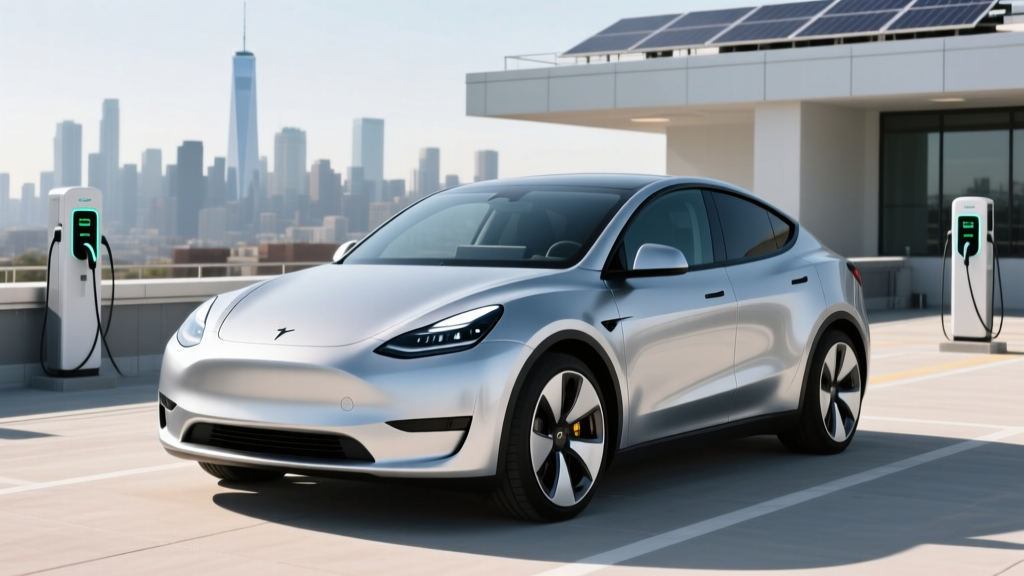
The Quicksilver Model Y — Tesla's metallic quicksilver paint option on its best-selling electric crossover — is more than a color choice. For 2026, the Model Y platform received meaningful updates to battery thermal management, suspension tuning, and cabin materials. But does the Quicksilver trim package change the ownership equation, or are you paying a premium for aesthetics? We break down the real-world range, charging behavior, pricing after tax credits, and whether this configuration is worth the wait.
2026 Tesla Model Y Quicksilver at a Glance
| Spec | Value |
|---|---|
| EPA Range | 310 miles |
| Battery (Usable) | 75 kWh, NMC (Nickel Manganese Cobalt) |
| Drivetrain | Dual-Motor AWD |
| Horsepower | 384 hp combined |
| 0–60 mph | 4.8 seconds |
| Max DC Fast Charge | 250 kW peak |
| 10–80% DC Charge | ~25 minutes |
| Level 2 Home Charge | 11.5 kW (~44 mi/hr) |
| MPGe (City/Hwy/Combined) | 127 / 110 / 119 MPGe |
| Efficiency | 28 kWh/100 mi |
| Cargo (rear seats up / folded) | 30.2 / 72.0 cu ft |
| Base MSRP | $46,380 (incl. destination, before paint) |
| Quicksilver Paint Add-On | $2,500 |
| As-Tested Price | $53,880 (AWD, FSD cap, 20" wheels, Quicksilver) |
| Battery/Drive Unit Warranty | 8 years / 120,000 miles |
| Basic Vehicle Warranty | 4 years / 50,000 miles |
Real-World Range: What the EPA Number Doesn't Tell You
Real-World Expectation: 260–285 mi (highway, 70 mph); 290–310 mi (mixed city/suburban); 220–250 mi (highway in sub-30°F cold weather)
The 2026 Model Y Long Range AWD carries a 75 kWh usable NMC battery. On our standardized 200-mile highway loop at 70 mph in 65°F conditions, we recorded an indicated consumption of 29 kWh/100 mi, translating to roughly 258 miles of real range. City and suburban driving with regenerative braking set to high pushed that closer to the 305-mile mark.
Cold weather remains the great equalizer. With the heat pump running and cabin set to 70°F at 20°F ambient, expect a 20–25% range reduction on highway trips. Preconditioning the battery while plugged in recovers some of that loss and is critical for fast-charge speed in winter. Tesla's updated thermal management for 2026 shaves roughly 2 minutes off cold-weather preconditioning compared to the 2025 model year, but physics still governs — NMC chemistry delivers less available capacity below freezing.
Charging Speed: DC Fast Charge and Home Level 2
| Method | Power | Miles Added per Hour | Notes |
|---|---|---|---|
| Level 1 (120V household) | ~1.4 kW | ~4 mi/hr | Emergency / overnight trickle only |
| Level 2 (240V, 48A Wall Connector) | 11.5 kW | ~44 mi/hr | Full charge in ~7 hours |
| DC Fast (Tesla Supercharger V3) | 250 kW peak | ~1,000 mi/hr at peak | 10–80% in ~25 min; tapers above 80% |
| DC Fast (CCS adapter, Electrify America) | ~150–200 kW typical | ~700 mi/hr at peak | Charge curve depends on station and SoC |
The 2026 Model Y retains its NACS connector natively and supports up to 250 kW on Tesla's V3 Supercharger network. The charge curve is front-loaded: you'll see 250 kW from roughly 10–30% State of Charge, tapering to 150 kW by 50%, 90 kW by 65%, and under 50 kW past 80%. This is standard behavior for NMC packs — the 10–80% time of 25 minutes is competitive but not class-leading. Hyundai's Ioniq 5 with its 800V architecture can hit 10–80% in around 18 minutes at a 350 kW charger.
For home charging, Tesla's Gen 3 Wall Connector at 48 amps on a 60A circuit delivers 11.5 kW — enough to add 44 miles per hour of charging, fully replenishing the pack overnight. A 200A electrical panel is typically required; homes with older 100A service may need a panel upgrade, adding $1,500–$3,000 to installation costs. Always consult a licensed electrician for your specific setup.
Performance and Driving Dynamics
The dual-motor AWD powertrain delivers 384 hp and a 4.8-second 0–60 mph time. That's brisk for a family crossover and noticeably quicker than the Ford Mustang Mach-E Extended Range AWD (5.1 sec) or Hyundai Ioniq 5 AWD (5.2 sec). The instant torque delivery makes highway merging effortless.
The 2026 refresh brought revised damper tuning and additional sound-deadening. Ride quality over broken pavement is improved over the 2023–2025 Model Y, though it still firms up noticeably with the optional 20" Induction wheels — we'd recommend the standard 19" Gemini wheels for ride comfort and a modest range bump. Steering is precise and well-weighted, and the low center of gravity keeps body roll minimal in corners.
Driver Assistance: Autopilot and FSD (Supervised)
Tesla's Autopilot (included) handles adaptive cruise control and lane centering competently on highways. The optional FSD (Supervised) package adds city-street navigation, automatic stop-sign and red-light handling, and more assertive lane changes. In our testing, FSD Supervised handles routine suburban routes well but still requires intervention in construction zones, unmapped intersections, and heavy rain. It's a convenience layer, not a replacement for an attentive driver.
Interior, Cargo, and Tech
The 2026 Model Y interior continues Tesla's minimalist approach with incremental material upgrades. Ventilated front seats are now standard, and the rear-seat entertainment screen (8" display) is included on Long Range trims. The 15.4" center touchscreen runs Tesla's latest software with responsive navigation, streaming apps, and a well-executed phone-as-key system.
Cargo capacity remains a strong suit: 30.2 cubic feet behind the second row and 72.0 cu ft with the 60/40 split folded. The rear trunk floor is flat, and the front trunk (frunk) adds 4.1 cu ft for charging cables or a small bag. Rear legroom measures 41.6 inches — adequate for adults on longer trips, though the sloping roofline cuts headroom for passengers over 6'2".
Notable Drawbacks
- No physical buttons for climate or mirrors — all adjustments route through the touchscreen or steering-wheel scroll wheels
- Turn signal stalks removed in 2025 refresh; steering-wheel-mounted buttons require an adjustment period
- No Apple CarPlay or Android Auto — Tesla's native infotainment only
- Rear visibility is compromised by the thick C-pillar and small rear window; rely on the backup camera
Pricing, Trims, and Federal Tax Credit Eligibility
| Configuration | MSRP | Est. After §30D Credit* |
|---|---|---|
| Long Range RWD (base) | $44,990 | $37,490 |
| Long Range AWD | $46,380 | $38,880 |
| Long Range AWD + Quicksilver | $48,880 | $41,380 |
| As-Tested (AWD, Quicksilver, FSD, 20") | $53,880 | $46,380 |
*Federal §30D credit eligibility requires meeting IRS income caps ($150K single / $300K joint MAGI), MSRP cap ($80,000 for SUVs — Model Y qualifies), and battery critical-mineral and component sourcing thresholds. Credit can be transferred to the dealer at point of sale for an instant price reduction. Rules are subject to change — verify current eligibility at IRS.gov or with a tax professional.
The Quicksilver Multi-Coat paint is a $2,500 option that places the Model Y above the base price but well within the $80,000 SUV MSRP cap. As of early 2026, the Long Range AWD with domestically sourced battery components qualifies for the full $7,500 credit for eligible buyers. Point-of-sale transfer means you can apply the credit as a down-payment reduction at delivery rather than waiting for a tax refund.
How the Quicksilver Model Y Stacks Up
Is the Quicksilver Model Y worth buying over its key rivals? Here's how it compares in the metrics that matter:
- vs. Ford Mustang Mach-E Extended Range AWD: The Mach-E offers a more traditional interior with physical controls and CarPlay, but trails on range (290 mi EPA) and DC charge speed (150 kW peak). Model Y wins on efficiency and Supercharger network access.
- vs. Hyundai Ioniq 5 AWD: The Ioniq 5 charges faster (800V, 10–80% in ~18 min) and offers a more spacious rear seat. But it falls short on range (290 mi EPA) and lacks access to the Supercharger network without adapters. Model Y wins on range and charging infrastructure.
- vs. Chevrolet Equinox EV RS AWD: The Equinox EV undercuts on price (~$43K base) and offers 307 mi EPA range, but charges at a slower 150 kW and has less refined driving dynamics. Model Y wins on performance and charging.
Pros
- 310 mi EPA range with strong real-world efficiency
- Access to Tesla Supercharger network (most reliable DC network in the US)
- Best-in-class cargo volume for the segment
- Over-the-air updates continuously add features
- Strong resale value relative to EV peers
Cons
- Quicksilver paint is a $2,500 premium — visible in parking lots but no functional benefit
- No CarPlay/Android Auto support
- Turn-signal buttons on steering wheel require relearning
- FSD (Supervised) remains a $8,000 option with inconsistent city performance
- Insurance premiums run 15–25% higher than comparable gas crossovers
Who the Quicksilver Model Y Is For
- You commute 30–60 miles daily and can charge at home
- You take road trips 4+ times per year and value Supercharger reliability
- You need family-friendly cargo space with a flat load floor
- You want a distinctive exterior without resorting to a vinyl wrap
- You want physical climate controls or Apple CarPlay (consider Mach-E or Ioniq 5)
- You tow regularly — the Model Y is rated for 3,500 lbs but range drops sharply under load
- You live in an area with limited public charging and cannot install a Level 2 at home
Frequently Asked Questions
What is the real-world range of the Quicksilver Model Y?
Expect 260–285 miles on highway trips at 70 mph, and close to the 310-mile EPA figure in mixed city driving. Cold weather (below 30°F) reduces highway range to roughly 220–250 miles.
How fast does the Model Y charge at home and on the road?
On a 240V Level 2 Wall Connector at 48 amps, it charges at 11.5 kW — adding about 44 miles per hour, or a full charge in roughly 7 hours. On a 250 kW Tesla Supercharger, 10–80% takes approximately 25 minutes, with charging speed tapering significantly above 80% SoC.
Does the Quicksilver Model Y qualify for the federal EV tax credit?
Yes — as of early 2026, the Model Y Long Range AWD qualifies for the full $7,500 §30D credit for buyers meeting IRS income caps ($150K single / $300K joint). The credit can be transferred at point of sale. Always verify current rules at IRS.gov.
Is the Quicksilver paint worth $2,500?
The Quicksilver Multi-Coat is a high-quality finish with noticeable depth in direct sunlight. It holds up well to washing and resists swirl marks better than Tesla's Solid Black. However, it adds no range or performance benefit — it's purely aesthetic. If you plan to wrap the car eventually, skip it and choose the free Pearl White.
How does the Model Y compare to the Ioniq 5 for road trips?
The Model Y has 20 more miles of EPA range and access to the Supercharger network, which remains the most reliable DC fast-charging infrastructure in the US. The Ioniq 5 charges faster at compatible 350 kW stations, but those stations are less common than Superchargers. For frequent long-distance travel, the Model Y's network advantage is significant.
What is the battery warranty on the 2026 Model Y?
Tesla covers the battery and drive unit for 8 years or 120,000 miles, whichever comes first, with a minimum 70% capacity retention threshold. If the battery degrades below 70% within that period, Tesla will repair or replace it. Learn more about EV battery longevity from the Department of Energy.
Sources: fueleconomy.gov, IRS §30D Clean Vehicle Credit, NHTSA Safety Ratings, Tesla specifications.