Why Puerto Rico and Tesla Are a Surprisingly Good Match
At first glance, Puerto Rico might not seem like ideal EV territory. The island's electrical grid — operated by LUMA Energy since 2021 — has faced well-documented reliability challenges, including frequent outages and voltage fluctuations. Yet Tesla ownership on the island has grown steadily, driven by a combination of high gasoline prices (often exceeding $4.50/gallon), zero tailpipe emissions in dense urban areas like San Juan, and the practical advantage of "fueling" at home with solar panels in a region that averages over 2,600 hours of sunshine annually.
This guide breaks down what it actually means to own a Tesla in Puerto Rico in 2026: which models make sense, real-world range expectations in tropical heat, charging infrastructure realities, and whether the federal §30D tax credit applies to island residents. We focus on the two most relevant models — the 2026 Tesla Model 3 (Highland refresh) and the 2026 Tesla Model Y (Juniper update) — because they represent the volume sellers and the most practical choices for island driving.
2026 Tesla Model 3: The Island Commuter
The refreshed Model 3 (internally called "Highland") continues into the 2026 model year with minor software and efficiency tweaks. It remains Tesla's most affordable vehicle and, for many Puerto Rico buyers, the logical entry point.
| Spec | RWD (Base) | Long Range AWD | Performance |
|---|---|---|---|
| EPA Range | 272 mi | 341 mi | 315 mi |
| Battery (usable) | ~57.5 kWh (LFP) | ~75 kWh (NMC) | ~75 kWh (NMC) |
| Peak DC Fast Charge | 170 kW | 250 kW | 250 kW |
| 10–80% DC Time | ~25 min | ~22 min | ~22 min |
| Level 2 Home Charge | 11.5 kW (~44 mi/hr) | 11.5 kW (~44 mi/hr) | 11.5 kW (~44 mi/hr) |
| 0–60 mph | 5.8 sec | 4.2 sec | 2.9 sec |
| Horsepower | 271 hp | 346 hp | 510 hp |
| Drivetrain | RWD | Dual-Motor AWD | Dual-Motor AWD |
| MPGe (combined) | 132 MPGe | 131 MPGe | 121 MPGe |
| Efficiency | 25 kWh/100mi | 26 kWh/100mi | 28 kWh/100mi |
| Cargo (trunk + frunk) | 23 cu ft | 23 cu ft | 23 cu ft |
| Base MSRP | $38,990 | $47,740 | $54,990 |
Sources: EPA fueleconomy.gov, Tesla Model 3 specs
The EPA's 272-mile (RWD) and 341-mile (Long Range) estimates assume mixed driving at moderate temperatures. In Puerto Rico's tropical climate — ambient temps regularly above 85°F with heavy A/C use — expect a 5–10% range reduction versus EPA. Highway driving at 65+ mph on PR-52 or PR-22 will further reduce range by roughly 10–15% compared to city speeds. A Long Range AWD Model 3 driven primarily on highways in summer heat will realistically deliver ~275–295 miles before needing a charge. The good news: unlike cold-weather states where range can drop 30%+, Puerto Rico's heat is far less punishing on lithium-ion batteries, and Tesla's thermal management system handles tropical conditions well.
2026 Tesla Model Y: The Practical Family Hauler
The Model Y received its "Juniper" refresh for 2025, and the 2026 model year carries forward with the updated interior, improved suspension tuning, and slightly enhanced efficiency. For Puerto Rico families needing more cargo space and the option of a third row (5+2 seating on select trims), this is the default Tesla choice.
| Spec | RWD (Base) | Long Range AWD | Performance |
|---|---|---|---|
| EPA Range | 259 mi | 320 mi | 285 mi |
| Battery (usable) | ~57.5 kWh (LFP) | ~75 kWh (NMC) | ~75 kWh (NMC) |
| Peak DC Fast Charge | 170 kW | 250 kW | 250 kW |
| 10–80% DC Time | ~25 min | ~22 min | ~22 min |
| Level 2 Home Charge | 11.5 kW (~37 mi/hr) | 11.5 kW (~37 mi/hr) | 11.5 kW (~37 mi/hr) |
| 0–60 mph | 6.6 sec | 4.8 sec | 3.5 sec |
| Horsepower | 295 hp | 384 hp | 510 hp |
| Drivetrain | RWD | Dual-Motor AWD | Dual-Motor AWD |
| MPGe (combined) | 123 MPGe | 122 MPGe | 111 MPGe |
| Efficiency | 27 kWh/100mi | 28 kWh/100mi | 30 kWh/100mi |
| Cargo (behind 2nd row) | 30 cu ft | 30 cu ft | 30 cu ft |
| Cargo (max, folded) | 72 cu ft | 72 cu ft | 72 cu ft |
| Base MSRP | $44,990 | $49,990 | $53,990 |
Sources: EPA fueleconomy.gov, Tesla Model Y specs
The Model Y's taller profile and greater weight mean slightly higher consumption than the Model 3. In Puerto Rico's heat with A/C running, expect the Long Range AWD to deliver approximately ~260–285 miles real-world on mixed driving, and closer to ~240 miles on sustained highway runs. The RWD base model (LFP battery) realistically provides ~215–235 miles in tropical conditions. For most San Juan metro commutes and even longer runs to Ponce or Mayagüez (roughly 70–90 miles one way), any Model Y trim covers a round trip comfortably — but you'll want to charge at home overnight rather than relying on public infrastructure.
Charging in Puerto Rico: Infrastructure Reality Check
This is where the "Puerto Rico and Tesla" conversation gets complicated. The island's public DC fast-charging network remains limited compared to the mainland U.S.
| Level | Power | Miles Added per Hour | Typical Use Case |
|---|---|---|---|
| Level 1 (120V) | ~1.4 kW | ~3–5 mi/hr | Emergency/trickle; not practical for daily use |
| Level 2 (240V, home) | 7.7–11.5 kW | ~30–44 mi/hr | Primary daily charging; full overnight refill |
| DC Fast Charge | 150–250 kW | ~150–350 mi in 20 min | Road trips; limited availability in PR |
Tesla Superchargers in Puerto Rico
As of early 2026, Tesla operates a small but growing Supercharger network on the island, with stations in the San Juan metro area, near Ponce, and at select locations along major corridors. However, the total number of stalls remains well under 50 island-wide. This is functional for a Tesla owner who charges primarily at home but requires planning for longer trips or for those without reliable home charging.
Home Charging: The Puerto Rico Advantage (and Challenge)
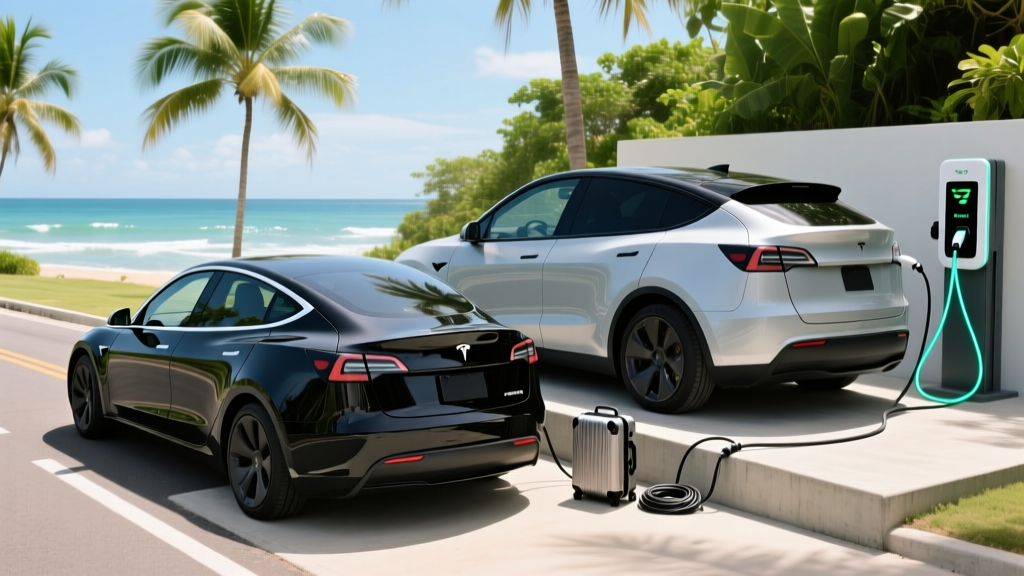
Most Puerto Rico Tesla owners charge at home using a Level 2 wall connector. Here's where the island's solar potential becomes a major asset: pairing a Tesla with rooftop solar and a Powerwall (Tesla's 13.5 kWh home battery) can effectively eliminate both range anxiety and grid-outage vulnerability. A typical 5–8 kW solar array in Puerto Rico generates enough daily energy to fully recharge a Model 3 RWD battery.
The challenge: LUMA grid instability means voltage fluctuations can occasionally interrupt charging sessions or, in worst cases, stress onboard chargers. Tesla's Wall Connector handles minor fluctuations well, but a whole-home surge protector (recommended for any PR homeowner) is essential. Installation of a 240V/48A circuit for an 11.5 kW Wall Connector typically costs $800–$2,000 from a licensed electrician, though older homes may need a panel upgrade adding $1,500–$3,000.
LFP vs NMC: Which Battery Chemistry for the Tropics?
| Factor | LFP (Base RWD Models) | NMC (Long Range / Performance) |
|---|---|---|
| Energy Density | Lower (heavier pack for same kWh) | Higher (more range in lighter package) |
| Cycle Life | 3,000+ cycles (superior longevity) | 1,500–2,000 cycles |
| Heat Tolerance | Excellent — ideal for PR climate | Good; managed by thermal system |
| Charging to 100% | Tesla recommends regular 100% charges | Best kept at 80% daily; 100% for trips only |
| Cost | Lower (reflected in RWD pricing) | Higher |
| Cold Performance | Weaker (irrelevant in PR) | Better (also irrelevant in PR) |
Bottom line for Puerto Rico: The LFP battery in the base RWD trims is arguably the better long-term choice for tropical ownership. LFP chemistry degrades more slowly in sustained heat, tolerates daily 100% charging without accelerated wear, and offers a longer overall cycle life. The trade-off is less range — but on an island roughly 110 miles long, even 215 real-world miles covers most needs.
Pricing, Tax Credits, and Total Cost of Ownership
| Model | Base MSRP | §30D Credit Eligible? | Effective Price (if eligible) |
|---|---|---|---|
| Model 3 RWD | $38,990 | Up to $7,500* | ~$31,490 |
| Model 3 Long Range AWD | $47,740 | Up to $7,500* | ~$40,240 |
| Model Y RWD | $44,990 | Up to $7,500* | ~$37,490 |
| Model Y Long Range AWD | $49,990 | Up to $7,500* | ~$42,490 |
*Eligibility for the full $7,500 federal tax credit under IRS §30D depends on multiple factors that change frequently:
- Buyer income cap: Modified AGI ≤ $150,000 (single) / ≤ $300,000 (joint)
- MSRP cap: ≤ $55,000 for sedans (Model 3) / ≤ $80,000 for SUVs/trucks (Model Y)
- Battery sourcing: Critical minerals and battery components must meet escalating domestic-content thresholds; Tesla's Fremont/Austin-built vehicles have generally qualified, but specific trim eligibility can shift as supply chains change
- Point-of-sale transfer: As of 2024+, you can transfer the credit to the dealer at purchase for an immediate price reduction rather than waiting for tax filing
- Verification: Always confirm eligibility at fueleconomy.gov and with a tax professional before purchasing
Cost to "Fuel" in Puerto Rico
At LUMA's residential rate of approximately $0.28–$0.32/kWh (among the highest in the U.S.), charging a Model 3 Long Range (75 kWh) from 10–80% costs roughly $15–$17 on grid power. With rooftop solar, that cost drops to near zero after the solar system payback period. Compare this to fueling a comparable gas sedan at $4.50/gallon and 28 MPG: a 340-mile fill-up costs about $55. Even at LUMA's high rates, Tesla owners save significantly per mile driven.
Warranty, Service, and Island-Specific Considerations
Tesla's warranty coverage applies uniformly in Puerto Rico:
- Basic Vehicle: 4 years / 50,000 miles
- Battery & Drive Unit: 8 years / 100,000 miles (RWD) or 8 years / 120,000 miles (Long Range/Performance), with a guaranteed minimum 70% capacity retention
- LFP-specific note: LFP batteries historically show slower degradation, often retaining 90%+ capacity after 100,000 miles based on fleet data
Service Access in Puerto Rico
Tesla operates a Service Center in the San Juan area (Bayamón), and mobile Ranger service covers much of the metro region. However, owners in more remote parts of the island (Aguadilla, Mayagüez, Fajardo) should factor in potentially longer wait times for service appointments or the need to drive to the metro area for anything beyond software-related fixes. Tesla's over-the-air update capability handles many issues remotely, which is a genuine advantage on an island where specialized EV service options are limited.
Hurricane Preparedness
A Tesla with a charged battery and a Powerwall provides meaningful resilience during hurricane season. The vehicle's battery can power essential home loads through a Powerwall setup, and Tesla's Sentry Mode and climate control can operate for days without grid power. This is a uniquely practical EV advantage in a region prone to extended outages.
Autopilot, FSD, and Puerto Rico Roads
Tesla's Autopilot and Full Self-Driving (Supervised) are Level 2 driver-assistance systems, not self-driving. The driver must remain fully engaged, hands on or near the wheel, and eyes on the road at all times. Only Waymo and similar driverless services operate at Level 4. (SAE J3016 reference)
On Puerto Rico's highways (PR-52, PR-22, PR-10), Tesla's basic Autopilot — adaptive cruise control and lane-keeping — works reasonably well on well-marked sections. However, FSD (Supervised) performance is less reliable on the island: lane markings on many secondary roads are faded or absent, construction zones are frequent, and some rural roads lack the clear infrastructure that FSD's vision system relies on. Puerto Rico is also not a priority market for Tesla's geofenced FSD mapping efforts. Expect to drive manually on most non-highway roads.
- Navigate unpaved or poorly marked rural roads reliably
- Handle sudden tropical downpours with reduced visibility safely (reduce speed, disengage if needed)
- Replace an attentive driver — NHTSA requires full driver engagement at Level 2
- Recognize all Puerto Rico-specific road signage or construction patterns
Pros and Cons: Tesla Ownership in Puerto Rico
- Excellent solar-pairing potential — 2,600+ annual sun hours make home charging nearly free
- LFP battery chemistry ideally suited to tropical heat with minimal degradation
- Significant fuel savings versus $4.50+/gallon gasoline
- Over-the-air updates reduce need for in-person service visits
- Hurricane resilience when paired with Powerwall
- No local emissions in congested San Juan metro
- Federal §30D tax credit applies to Puerto Rico residents (U.S. territory)
- Tesla Supercharger network, while small, is growing on the island
- Public DC fast-charging infrastructure remains limited outside San Juan metro
- LUMA grid instability requires surge protection and may interrupt charging
- Only one Tesla Service Center on the island (Bayamón/San Juan area)
- High residential electricity rates ($0.28–$0.32/kWh) if charging without solar
- FSD (Supervised) unreliable on many Puerto Rico roads due to poor lane markings
- No third-party DC fast-charging alternatives with NACS compatibility yet (adapters emerging)
- Shipping/delivery logistics can add time and cost versus mainland purchases
- Insurance premiums can be higher in PR for Teslas (parts availability, repair complexity)
Who Should Buy a Tesla in Puerto Rico?
- Home solar owner or planner: The economics become outstanding when you charge from your own panels
- Metro commuter: San Juan/Bayamón/Carolina daily drives of 20–60 miles are ideal EV territory
- Tech-forward buyer: OTA updates, app control, and the Tesla ecosystem add real value when service access is limited
- Hurricane-prep conscious: A charged EV + Powerwall = meaningful backup power
- Family needing 5-seat crossover: Model Y Long Range offers 320 EPA miles and 72 cu ft cargo
- You live in a remote area far from the San Juan service center with no home charging option
- You frequently drive long distances (>200 miles) in areas without Supercharger access
- You need a third-party charging network (Electrify America, EVgo have minimal PR presence)
- Budget is extremely tight and you cannot install a 240V home charger
Frequently Asked Questions
Does the federal EV tax credit apply in Puerto Rico?
Yes. Puerto Rico is a U.S. territory, and residents who file U.S. federal income taxes are eligible for the §30D New Clean Vehicle Credit, subject to the same income caps, MSRP limits, and battery-sourcing requirements as mainland buyers. However, because Puerto Rico has its own tax system and many residents do not owe U.S. federal income tax, the credit's practical value depends on your individual tax situation. Consult a tax professional familiar with both §30D and Puerto Rico's tax code. The point-of-sale transfer option (available since 2024) can simplify this by applying the credit as an immediate purchase-price reduction.
What is the real-world range of a Tesla in Puerto Rico's heat?
Expect 5–10% below EPA estimates due to sustained A/C use and highway speeds. A Model 3 Long Range (341 EPA) delivers roughly 275–295 real-world miles; a Model Y Long Range (320 EPA) delivers roughly 260–285 miles. Heat is less punishing than cold weather — you won't see the 30%+ losses that northern-state owners experience in winter.
How fast does a Tesla charge at home in Puerto Rico?
With a Tesla Wall Connector on a 240V/48A circuit, you'll charge at up to 11.5 kW, adding approximately 37–44 miles of range per hour depending on the model. A full overnight charge (8 hours) adds 250+ miles — more than enough for any single-day drive on the island. Without a Wall Connector, a standard 120V outlet adds only 3–5 miles per hour, which is impractical as a primary charging method.
Are there enough Superchargers in Puerto Rico for road trips?
For most island driving, home charging is sufficient — Puerto Rico is roughly 110 miles end to end. For the occasional longer day (e.g., San Juan to Rincón and back, ~240 miles round trip), a Model 3 or Model Y Long Range can handle it on a single charge with careful driving. The Supercharger network in PR is growing but remains sparse compared to the mainland. Plan ahead using the Tesla app's trip planner.
Is a Tesla worth buying versus a hybrid in Puerto Rico?
If you have home solar and can install a Level 2 charger, a Tesla's per-mile cost is dramatically lower than any hybrid. If you lack home charging access or live in an area with frequent multi-day outages without battery backup, a Toyota RAV4 Hybrid or similar HEV may be more practical — it requires no charging infrastructure and still delivers 40+ MPG. The break-even point versus a hybrid typically comes within 3–5 years for solar-equipped Tesla owners driving 12,000+ miles annually.
What happens to a Tesla during a Puerto Rico power outage?
The vehicle itself retains its charge regardless of grid status. If you have a Tesla Powerwall, you can continue charging your Tesla from stored solar energy during outages. Without a Powerwall, you're limited to whatever charge the vehicle had when the grid went down — making it critical to maintain a charging buffer during hurricane season (June–November). Tesla's Sentry Mode and cabin climate can operate for extended periods off the vehicle's battery alone.