Quick Verdict: Is the Cybertruck Worth Its Price?
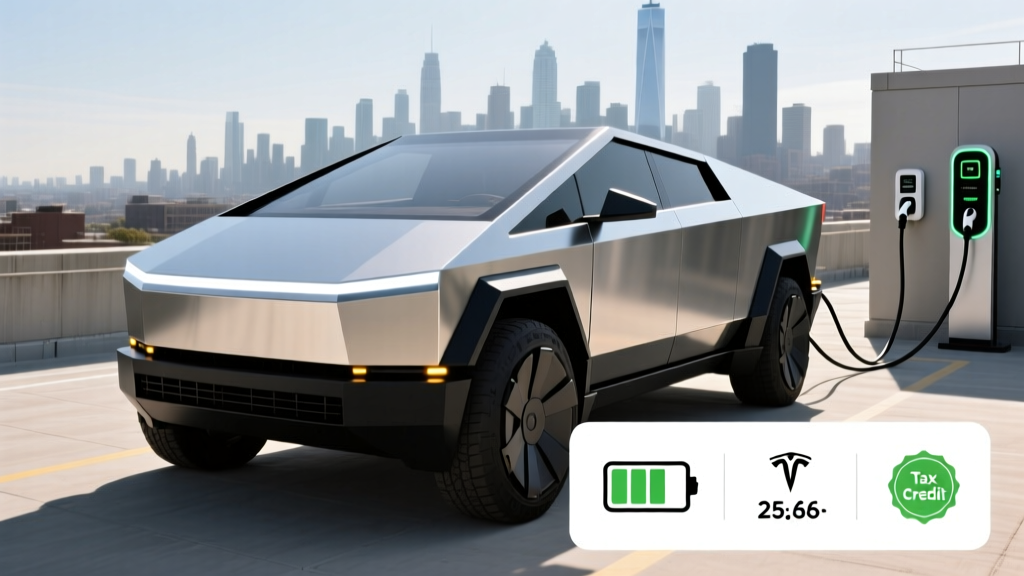
The Tesla Cybertruck remains one of the most polarizing — and searched — electric vehicles on the market. If you've been hunting for the precio de la Cybertruck, the short answer is that pricing spans from roughly $60,990 for the base Dual Motor AWD to $99,990 for the tri-motor Cyberbeast, before destination and options. But the sticker is only part of the ownership equation. Charging speed, real-world range versus the EPA label, and whether you actually qualify for the IRS §30D federal tax credit all reshape the effective cost.
This review dissects the 2026 Cybertruck lineup with the exact numbers buyers need: EPA range and its real-world delta, battery chemistry, DC fast-charge curves, and the tax-credit math that determines what you actually pay.
Cybertruck Pricing by Trim (2026 MSRP)
Tesla adjusts pricing more often than legacy automakers, so treat these figures as the current published MSRP before destination, paint, or FSD (Supervised) add-ons. The table below reflects the three production trims available to US buyers.
| Trim | Drivetrain | Base MSRP | Est. After §30D Credit* |
|---|---|---|---|
| Dual Motor AWD | Dual-motor AWD | $60,990 | ~$53,490 |
| AWD (Long Range) | Dual-motor AWD | $79,990 | ~$72,490 |
| Cyberbeast | Tri-motor AWD | $99,990 | $99,990 (over MSRP cap) |
*The $7,500 §30D credit is not automatic. It requires buyer AGI under IRS thresholds ($150k single / $300k joint), battery critical-mineral and component sourcing compliance, and — crucially for trucks — an MSRP at or below the $80,000 truck/van cap per IRS rules. The Cyberbeast exceeds that cap and is ineligible.
Range, Battery, and Real-World Efficiency
Tesla equips the Cybertruck with a structural battery pack using a mix of high-nickel NMC-type chemistry in the tri-motor and an LFP-leaning pack in certain Dual Motor configurations (chemistry can shift by production batch; verify on your VIN). Usable capacity sits in the ~123 kWh range across the lineup, which is enormous by passenger-EV standards and reflects the truck's mass and aero penalty.
EPA: 318–340 miles depending on trim and wheel config.
Real-world highway (70–75 mph): expect ~250–280 miles.
Cold weather (below freezing, HVAC on): ~210–240 miles.
The Cybertruck's angular stainless-steel body has a higher drag coefficient than a rounded crossover, and highway efficiency suffers accordingly. City regen-heavy driving gets closer to the sticker.
Efficiency lands around 67–70 MPGe combined, or roughly 48–52 kWh per 100 miles per fueleconomy.gov. That's thirstier than a Model Y or IONIQ 5, but typical for a 6,600+ lb electric truck.
Charging Speed: DC Fast, Level 2, and the Curve
The Cybertruck runs on an 800-volt-class architecture and uses the NACS connector natively — no adapter needed at Tesla Superchargers. Here's what the numbers actually look like once you account for the charge curve taper above 80% SoC.
| Level | Power / Rate | Practical Result |
|---|---|---|
| DC Fast Charge (peak) | ~250 kW at V3 Supercharger; higher on V4 stalls | 10–80% in ~25–30 min (preconditioned) |
| DC sustained (avg 10–80%) | ~170–190 kW average | Curve tapers hard past 80% SoC |
| Level 2 (home Wall Connector) | 11.5 kW / 48A | ~30–34 miles of range per hour |
| Level 1 (120V outlet) | ~1.4 kW | ~3–4 miles per hour — emergency only |
Preconditioning the battery via navigation routing to a Supercharger is non-negotiable for hitting peak kW. Skip it and you'll see 80–100 kW on a cold pack, doubling your stop. For home charging, a 60A NACS Wall Connector on a dedicated 240V/60A circuit is the practical baseline; budget $800–$1,800 for equipment plus electrician labor depending on panel proximity.
Performance and Drivetrain Numbers
| Trim | 0–60 mph | Horsepower | Drivetrain | Towing (max) |
|---|---|---|---|---|
| Dual Motor AWD | ~4.1 sec | ~600 hp | Dual-motor AWD | 11,000 lb |
| AWD (Long Range) | ~3.9 sec | ~600 hp | Dual-motor AWD | 11,000 lb |
| Cyberbeast | ~2.6 sec | ~845 hp | Tri-motor AWD | 11,000 lb |
Even the base Dual Motor outruns most sport sedans, and the Cyberbeast's 2.6-second 0–60 time puts it in hypercar territory — in a 6,600-pound stainless-steel truck. Torque vectoring on the tri-motor setup and rear-wheel steering sharpen what should feel like an unwieldy vehicle. Towing at 11,000 lb is class-competitive, but expect range to drop 40–55% when pulling a heavy trailer at highway speed.
Cargo, Interior, and Daily Usability
The 6-foot bed with a powered tonneau cover and integrated ramp is the centerpiece, but interior volume matters too. Front legroom is generous at ~41 inches; rear legroom sits around ~38 inches — adequate for adults on shorter trips, tight for tall passengers on long hauls. Behind the rear seats, the bed offers roughly 67 cu ft of lockable volume (with the tonneau closed), and the front trunk (frunk) adds useful enclosed storage for charging cables and gear.
The minimalist cabin centers on an 18.5-inch touchscreen that handles nearly every vehicle function — including glovebox release and mirror adjustments (there are no physical side mirrors on some configurations, replaced by cameras). That's a pro for tech-forward buyers and a con for anyone who prefers tactile controls. Rear passengers get their own 9.4-inch touchscreen, a rarity in trucks.
Tax Credit Eligibility and True Cost of Ownership
The §30D Clean Vehicle Credit can knock up to $7,500 off the purchase, but only the Dual Motor AWD trim reliably falls under the $80,000 truck MSRP cap. The Cyberbeast is categorically ineligible based on price alone. Even on eligible trims, you must clear these hurdles:
- Buyer AGI cap: $150,000 single / $225,000 HOH / $300,000 joint
- Battery sourcing: critical-mineral and component thresholds that tighten yearly per IRS §30D guidance
- MSRP cap: $80,000 for trucks, vans, SUVs
- Point-of-sale transfer: eligible buyers can apply the credit at purchase rather than waiting for tax filing
Insurance is the other hidden cost. Cybertruck premiums run 20–40% higher than a comparable F-150 Lightning in most states, driven by stainless-steel panel repair complexity and high parts costs. Budget $2,400–$3,800 annually depending on your ZIP and driving record.
Pros, Cons, and Who the Cybertruck Suits
- Tri-motor Cyberbeast performance is unmatched in trucks
- NACS native — full Supercharger network access
- Stainless exoskeleton resists dents and paint chips
- 11,000-lb towing + lockable 6-ft bed
- 800V-class charging architecture
- Highway range falls well short of EPA sticker
- Cyberbeast price exceeds §30D MSRP cap
- Camera-only mirrors and screen-heavy cabin aren't for everyone
- Insurance premiums significantly above truck average
- Build-quality variability on early production units
Best for: Tech-forward buyers who want a daily-driver truck with sports-car acceleration, Supercharger access for road trips, and a lockable bed for gear. Also suits fleet and commercial users who can absorb the higher insurance via productivity gains.
Look elsewhere if: You need maximum real-world highway range (Rivian R1T or F-150 Lightning Extended Range may serve better), want traditional mirrors and buttons, or require a sub-$70k price after credits with full tax-credit eligibility.
Warranty and Long-Term Ownership
Tesla covers the Cybertruck with a 4-year/50,000-mile basic warranty and an 8-year/120,000-mile battery and drive unit warranty, with a minimum 70% capacity retention threshold over that period. The structural pack's integration into the frame means out-of-warranty battery replacement would be a five-figure event — likely $18,000–$28,000 based on current pack pricing — so staying within the warranty window matters for long-horizon owners.
FAQ
What is the real-world range of the Cybertruck?
EPA labels read 318–340 miles, but steady 70–75 mph highway driving nets ~250–280 miles, and freezing temperatures drop that to ~210–240 miles. Plan road-trip charging stops around 220 miles of usable range for safety margin.
How fast does the Cybertruck charge at home and on the road?
On a preconditioned V3 Supercharger, 10–80% takes roughly 25–30 minutes with a ~250 kW peak. At home on an 11.5 kW Level 2 Wall Connector, expect ~30–34 miles of range added per hour, or a full overnight refill from 20% SoC.
Does the Cybertruck qualify for the $7,500 federal tax credit?
Only the Dual Motor AWD trim (under the $80,000 truck MSRP cap) is potentially eligible, and only if your AGI is under IRS limits and the specific vehicle's battery meets current critical-mineral and component sourcing rules. The Cyberbeast does not qualify. Always verify on the official IRS §30D page and with your tax professional before committing.
Is the Cybertruck worth buying versus the F-150 Lightning or Rivian R1T?
If Supercharger access, tri-motor performance, and the stainless-steel aesthetic are priorities, yes. If maximum real-world highway range, conventional controls, and broader tax-credit eligibility matter more, the Lightning or R1T are strong alternatives — and often cheaper to insure.
What's the biggest ownership surprise?
Insurance cost and tire wear. The Cybertruck's mass and torque chew through tires faster than a typical truck, and stainless-steel body repairs push premiums up. Factor both into your 5-year cost model before signing.