Quick Verdict: The Power Wheels Cybertruck Is a Toy, Not an EV — But Here's What Buyers Need to Know
Let's clear the air immediately: the Power Wheels Cybertruck is a battery-powered ride-on toy manufactured by Fisher-Price (a Mattel brand), designed for toddlers ages 18–36 months. It is not an electric vehicle in the automotive sense, and it does not qualify for any federal EV tax credits, EPA efficiency ratings, or highway registration. If you landed here researching the full-size Tesla Cybertruck, you'll want our Tesla Cybertruck review instead.
That said, the Power Wheels Cybertruck is one of the most searched ride-on toys online, and parents shopping for it deserve the same spec-driven, honest analysis we apply to full-size EVs. Below, we break down its battery chemistry, runtime, charge times, weight limits, and how it stacks up against competing kids' ride-ons — using the same precision we'd apply to a 100 kWh battery pack.
| Attribute | Specification |
|---|---|
| Battery | 6V sealed lead-acid (SLA), ~4.0 Ah |
| Top Speed | 2.5 mph (single speed, forward only) |
| Runtime | ~40–60 minutes (varies by terrain/rider weight) |
| Charge Time | 8–12 hours (wall-outlet charger included) |
| Max Rider Weight | 40 lbs |
| Age Range | 18–36 months |
| Drivetrain | Single rear motor, push-button go |
| MSRP (as of 2026) | $80–$100 |
| Warranty | 6 months (vehicle); 6 months (battery) |
| Federal EV Tax Credit | Not eligible (not a motor vehicle) |
Battery & Runtime: What 6V Lead-Acid Actually Gets You
The Power Wheels Cybertruck runs on a 6-volt sealed lead-acid (SLA) battery rated at approximately 4.0 amp-hours (Ah), yielding roughly 24 watt-hours (Wh) of total energy. To put that in automotive perspective, a Tesla Model 3 Standard Range carries about 60 kWh — roughly 2,500 times more energy. This is appropriate context: we're talking about a toy designed to putt around a driveway at walking speed.
The manufacturer advertises approximately 40–60 minutes of continuous use. In practice, expect:
- Flat, smooth surfaces (driveway, garage floor): 50–60 minutes with a lighter rider (~25 lbs)
- Grass or carpet: 30–40 minutes — higher rolling resistance drains the battery faster
- Cold weather (below 50°F): Lead-acid batteries lose 20–30% capacity in cold temperatures; expect shorter runs
- Heavier rider (35–40 lbs): Closer to 35–45 minutes on hard surfaces
Unlike lithium-ion EV batteries, SLA batteries do not have sophisticated battery management systems (BMS) or thermal preconditioning. They perform best at room temperature and degrade faster if routinely deep-discharged or stored uncharged.
One practical note: replacement 6V SLA batteries are widely available for $15–$25 and are user-swappable with basic connectors. Fisher-Price recommends charging the battery for a full 18 hours before first use and after each subsequent use to maximize lifespan.
Charging Speed: Slow by Design
The included wall-plug charger delivers approximately 6V at a very low amperage — roughly 0.5A, meaning a charge rate of about 3 watts. A full charge from depleted takes 8–12 hours, which effectively means overnight charging after each play session.
| Model | Battery Voltage | Charge Time (full) | Charger Included |
|---|---|---|---|
| Power Wheels Cybertruck | 6V SLA | 8–12 hours | Yes (wall plug) |
| Power Wheels Jeep Wrangler | 12V SLA | 14–18 hours | Yes |
| Best Choice Products 12V Ride-On | 12V SLA | 8–12 hours | Yes |
| Kiddieland Tesla Model S (kids) | 12V SLA | 10–12 hours | Yes |
There is no fast-charging option, no DC fast-charge equivalent, and no Level 2 upgrade path. The charger is essentially a trickle charger designed for safety and simplicity — appropriate for a toddler toy. Parents should plan on charging after every use rather than expecting multi-day runtime.
Performance: 2.5 MPH and That's the Point
The Power Wheels Cybertruck features a single electric motor driving the rear wheels through a simple gear reduction. Top speed is 2.5 mph — roughly a brisk walking pace. There is no reverse gear, no variable speed control, and no suspension beyond rigid plastic axles.
Acceleration is gentle by design. There's no meaningful 0–60 mph metric here (it would take approximately 24 seconds at constant acceleration, but the vehicle tops out long before that). The push-button throttle on the steering wheel provides simple go/stop operation that's intuitive for toddlers.
Braking is automatic: releasing the button engages a motor-brake that stops the vehicle within a few feet on flat ground. On inclines, the vehicle will roll backward since there is no parking brake or hill-hold feature — an important safety consideration for driveways with any grade.
Design, Build Quality & the Cybertruck Connection
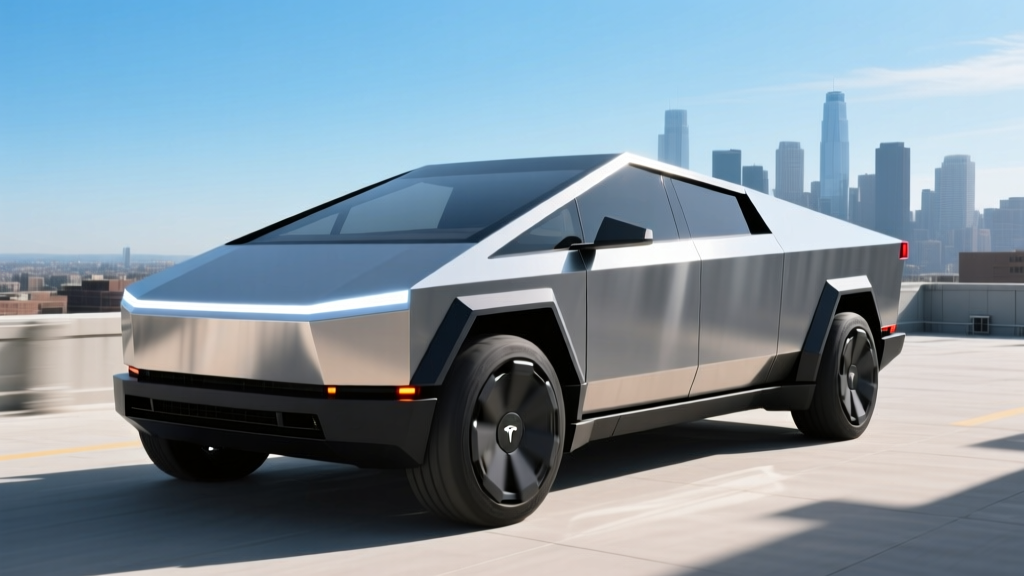
Fisher-Price licensed the Tesla Cybertruck aesthetic for this toy, and the angular, stainless-steel-look plastic body is a recognizable miniature of the full-size truck. The toy features:
- Angular body panels in a silver/gray finish mimicking the Cybertruck's exoskeleton design
- LED-style headlight stickers (non-functional on most versions)
- Single seat with a low seatback, suitable for one child up to 40 lbs
- Hard plastic wheels with minimal tread — best on smooth surfaces
- Approximate dimensions: 24" L × 16" W × 16" H; weight ~12 lbs
Build quality is consistent with Fisher-Price's Power Wheels line: durable enough for supervised outdoor use but not waterproof. The toy should not be used in rain, puddles, or on wet grass. Storage in a garage or covered area is recommended.
The Cybertruck design is largely cosmetic — there are no functional truck features like a bed, tow hitch, or frunk. This is a styling exercise aimed at parents who find the design amusing and kids who enjoy the ride-on experience.
Pricing & Where to Buy
The Power Wheels Cybertruck typically retails for $80–$100 depending on the retailer and any active promotions. It is available through major retailers including Amazon, Walmart, Target, and directly from Fisher-Price's website.
| Model | MSRP | Battery | Top Speed | Age Range |
|---|---|---|---|---|
| Power Wheels Cybertruck | $80–$100 | 6V SLA | 2.5 mph | 18–36 months |
| Power Wheels Disney Frozen Jeep | $250–$300 | 12V SLA | 2.5 / 5 mph | 3–7 years |
| Best Choice Products Lamborghini | $200–$250 | 12V SLA | 3.7 mph | 3–6 years |
| Rollplay BMW M4 (kids) | $150–$180 | 6V SLA | 2.5 mph | 18–36 months |
Federal EV tax credit: The Power Wheels Cybertruck does not qualify for the IRS §30D Clean Vehicle Credit. The credit applies only to new plug-in electric vehicles with at least four wheels, a gross vehicle weight rating under 14,000 lbs, and that are manufactured by a qualified manufacturer for use on public roads. A toddler ride-on toy meets none of these criteria. No state EV incentives apply either.
Pros, Cons & Who It's For
- Recognizable Cybertruck design — fun for EV-enthusiast parents
- Simple, single-button operation appropriate for toddlers
- Lightweight (~12 lbs) — easy to carry and store
- Replacement batteries are cheap ($15–$25) and easy to swap
- Under $100 — low financial commitment for a toy
- Fisher-Price brand support and parts availability
- 6V battery limits runtime to ~40–60 minutes max
- 8–12 hour charge time means one play session per day
- Forward only — no reverse gear
- Hard plastic wheels struggle on grass, gravel, and carpet
- 40-lb weight limit means most kids outgrow it by age 3
- No parent remote control or speed limiter
- Not suitable for any incline (no hill-hold or parking brake)
Who this suits: Parents of toddlers (18–36 months) who want an affordable, simple ride-on toy with a fun design for supervised driveway or indoor play. It's a first ride-on experience, not a long-term investment.
Who should look elsewhere: Families with children over 3 years old or over 35 lbs (they need a 12V ride-on with higher weight limits and dual-speed options). Also not ideal for homes with grassy yards or uneven terrain where the hard plastic wheels and low-torque motor will struggle.
Frequently Asked Questions
What is the real-world runtime of the Power Wheels Cybertruck?
Expect 40–60 minutes on smooth, flat surfaces with a lighter rider. On grass or carpet, runtime drops to 30–40 minutes. Cold weather (below 50°F) further reduces lead-acid battery performance by 20–30%.
How fast does the Power Wheels Cybertruck charge?
A full charge takes 8–12 hours using the included wall-outlet trickle charger. There is no fast-charge option. Fisher-Price recommends an 18-hour initial charge before first use.
Does the Power Wheels Cybertruck qualify for any EV tax credits?
No. The IRS §30D Clean Vehicle Credit applies only to road-legal plug-in electric vehicles with four wheels, meeting MSRP caps (under $80,000 for trucks/vans/SUVs, $55,000 for sedans), buyer income limits, and battery-sourcing requirements. A toddler toy does not qualify.
Is the Power Wheels Cybertruck worth buying vs. competitors?
At $80–$100, it's one of the most affordable ride-on toys with a recognizable design. If your toddler is under 3 and you want a simple first ride-on, it's a reasonable buy. For older kids or grassy yards, a 12V ride-on ($200–$300) with larger wheels and dual-speed options offers significantly more capability and longevity.
What are the biggest pros and cons?
Pros: affordable, recognizable design, simple operation, cheap replacement batteries. Cons: short runtime, slow overnight-only charging, forward-only, poor traction on grass, low weight limit means short usable lifespan.
Can I upgrade the battery to 12V for more power?
Fisher-Price does not support or recommend battery upgrades. While some hobbyists modify Power Wheels vehicles with 12V batteries and aftermarket wiring harnesses, this voids the warranty, can overheat the stock motor, and creates a safety risk for a toddler vehicle. We do not recommend modifications.
Where can I buy replacement parts?
Replacement 6V batteries, chargers, and some body parts are available through Fisher-Price's customer service, authorized repair centers, and third-party retailers on Amazon. Battery replacements are the most common need and cost $15–$25.