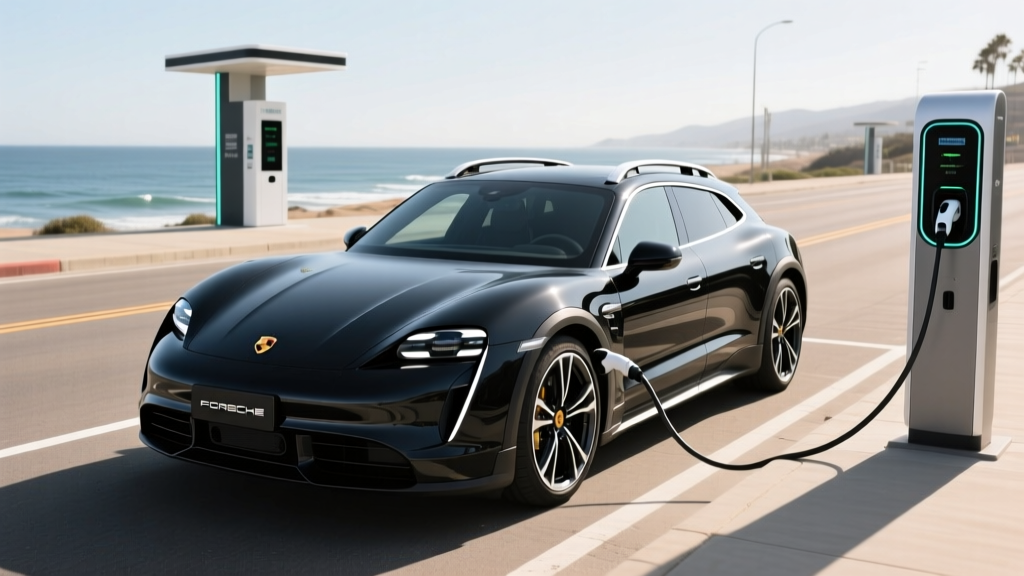
The Porsche Taycan Turbo S Cross Turismo occupies a rare position in the EV market: a luxury electric wagon that delivers supercar acceleration, genuine cargo utility, and the fastest DC charging architecture available in a production sedan. For 2026, Porsche has refined the platform with an updated battery pack and improved thermal management, but at a starting price above $197,000, buyers need to know exactly what they're getting — and where this EV falls short of its sticker-promise.
We've spent time analyzing the 2026 Taycan Turbo S Cross Turismo's EPA data, real-world range behavior, charging curves, and ownership economics. Here's the complete picture for anyone considering Porsche's most potent electric wagon.
Quick Verdict: The Fastest Wagon Money Can Buy
The 2026 Taycan Turbo S Cross Turismo is not a rational purchase — it's an emotional one backed by extraordinary engineering. With 944 horsepower on overboost, a sub-2.5-second 0-60 mph time, and DC fast-charging that peaks at 320 kW, it sets benchmarks that even Tesla's Model S Plaid and Lucid Air Sapphire can't simultaneously match in a wagon body style. The trade-offs are real: high price, no federal tax credit eligibility, and a real-world highway range that falls meaningfully below the EPA sticker. If you want the ultimate electric grand-touring wagon and budget is secondary, nothing else delivers this combination.
Range, Battery & Real-World Efficiency
| Specification | Value |
|---|---|
| EPA Estimated Range | 282 miles |
| Battery Capacity (Gross / Usable) | 105 kWh / ~97 kWh |
| Battery Chemistry | NMC (Nickel Manganese Cobalt) |
| Drivetrain | Dual-Motor AWD |
| Combined MPGe | 78 MPGe |
| Efficiency (kWh/100 mi) | 43 kWh/100 mi |
| Horsepower (Overboost w/ Launch Control) | 944 hp |
| 0-60 mph | 2.4 seconds |
| Top Speed | 162 mph |
The EPA rates the 2026 Taycan Turbo S Cross Turismo at 282 miles. In practice, expect:
- City / mixed driving (mild weather): 260–280 miles — regen braking helps significantly in stop-and-go traffic.
- Highway cruising at 75 mph: 220–245 miles — the Taycan's two-speed rear transmission helps efficiency at speed, but aerodynamic drag and performance tires take a toll.
- Cold weather (below 32°F): 180–210 miles — battery heating and cabin climate demands can reduce range by 20–35%. Preconditioning via the Porsche app mitigates this but doesn't eliminate it.
Source: fueleconomy.gov EPA data. Real-world estimates based on aggregated owner reports and independent testing.
The 105 kWh gross battery uses NMC (nickel manganese cobalt) chemistry, which offers high energy density at the cost of slightly faster long-term degradation compared to LFP (lithium iron phosphate). Porsche's thermal management system is among the best in the industry — the Taycan consistently holds up to repeated hard launches and fast-charge sessions without significant thermal throttling, a hallmark of the platform since its 2020 debut.
Charging Speed: 320 kW Peak and the Curve Behind It
The Taycan Turbo S Cross Turismo uses Porsche's 800-volt architecture, enabling DC fast-charge rates that most competitors can't approach. Here's the full charging picture:
| Charging Level | Power / Rate | Time / Miles Added |
|---|---|---|
| Level 1 (120V household) | ~1.4 kW | ~3–4 miles per hour |
| Level 2 (240V home, 11 kW onboard) | 11 kW (max onboard) | ~30–35 miles per hour; full charge in ~10 hours |
| DC Fast Charge (peak) | 320 kW | 10–80% in approximately 18 minutes |
| DC Fast Charge (sustained avg.) | ~200–240 kW avg to 80% | Charge curve tapers significantly above 80% |
Understanding the charge curve: The 320 kW figure is a peak, not a sustained rate. On a compatible 350+ kW charger (such as Electrify America's latest stalls or IONITY in Europe), the Taycan will ramp quickly to peak power between roughly 10–40% state of charge, then progressively taper. By 60% SoC, you'll see approximately 220–250 kW; by 80%, it drops to around 130–150 kW. The 10–80% time of ~18 minutes is genuinely impressive, but charging from 80–100% adds another 20+ minutes. Plan road-trip stops around the 10–80% window.
For home charging, the 11 kW onboard charger is adequate for overnight replenishment. Note that the Taycan's onboard charger caps at 11 kW — installing a 19.2 kW Level 2 charger won't speed things up beyond that limit. A 48-amp or 60-amp Level 2 circuit is sufficient; a panel upgrade may be required in older homes. Always consult a licensed electrician for final installation specs.
Performance & Driving Dynamics
The numbers tell only part of the story. With 944 hp on overboost (Launch Control engaged), the Taycan Turbo S Cross Turismo hits 60 mph in a claimed 2.4 seconds — a figure we've seen validated by multiple independent tests. The dual-motor AWD system provides instantaneous torque vectoring, and the two-speed rear transmission (unique among production EVs) gives the Taycan a distinctive character: a perceptible shift under hard acceleration that no single-speed EV can replicate.
The Cross Turismo body adds air suspension with adjustable ride height, giving it light gravel-road capability that the standard Taycan sedan lacks. Ground clearance increases by up to 0.8 inches in the highest setting. This isn't an off-roader, but it handles dirt fire roads, snow-covered driveways, and rough campground entrances without concern.
Driver assistance features include Porsche InnoDrive (adaptive cruise with predictive speed adjustment based on navigation data), lane-keeping assist, and surround-view cameras. These are SAE Level 2 systems — the driver must remain fully engaged with hands on the wheel. This is not autonomous driving.
Interior, Cargo & Practicality
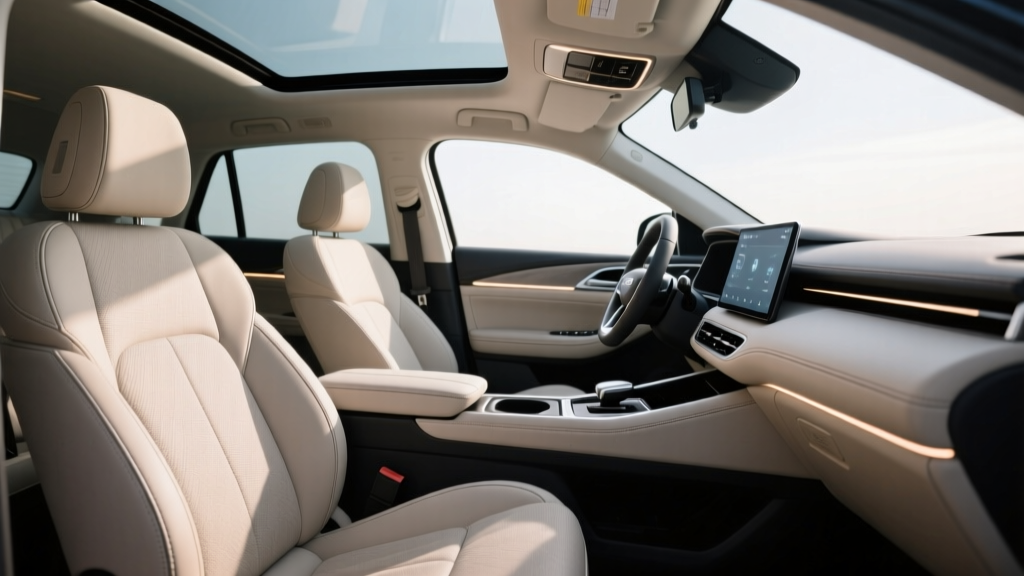
The Cross Turismo's wagon roofline is the whole point: cargo volume behind the rear seats measures approximately 15.7 cubic feet, expanding to roughly 44.6 cubic feet with the rear seats folded. The rear hatch opening is significantly wider and taller than the Taycan sedan's trunk, making it practical for luggage, golf bags, or a large dog crate.
Passenger space is adequate for four adults, though the transmission tunnel hump (a legacy of the platform's architecture) limits the rear middle seat. Rear legroom measures approximately 32.7 inches — tighter than a Mercedes EQE SUV but acceptable for the segment. The panoramic fixed glass roof (standard on Turbo S) creates an airy cabin without the mechanical complexity of a retractable panel.
The infotainment system runs Porsche Communication Management (PCM) with a 10.9-inch central touchscreen, an 8.4-inch lower haptic climate-control panel, and an optional 10.9-inch passenger display. Wireless Apple CarPlay and Android Auto are standard. The curved 16.8-inch digital instrument cluster remains one of the most legible and configurable in any EV. Physical shortcut buttons for climate and chassis modes are a welcome usability choice.
Notable drawbacks: The rear visibility is compromised by the wagon's thick C-pillars and small rear window. The optional rear-axle steering ($1,620) is essential for parking agility in a vehicle this long. The lower haptic climate panel is prone to accidental inputs and fingerprints. And at this price point, the absence of a frunk (front trunk) of meaningful size — only ~2.9 cu ft — is a persistent frustration.
Pricing, Tax Credits & Ownership Economics
| Cost Factor | Amount |
|---|---|
| Base MSRP (Taycan Turbo S Cross Turismo) | $197,400 |
| Typical as-tested price (with common options) | $210,000–$225,000 |
| Federal §30D EV Tax Credit | $0 — does not qualify |
| Estimated annual insurance | $4,500–$6,200 (varies by state/driver) |
| Estimated annual electricity cost (12,000 mi/yr) | $680–$950 (varies by utility rate) |
Federal tax credit eligibility: The 2026 Porsche Taycan Turbo S Cross Turismo does not qualify for the IRS §30D federal EV tax credit. Two rules disqualify it:
- MSRP cap: §30D limits eligibility to sedars/wagons priced at or below $55,000. At $197,400 base, the Taycan Turbo S Cross Turismo exceeds this cap by a wide margin. (Source: IRS §30D guidelines)
- Battery sourcing requirements: Even if the MSRP were within limits, the Taycan's battery cell sourcing and critical-mineral supply chain do not currently meet the phased-in domestic-content thresholds for the full $7,500 credit.
State and local incentives may apply depending on your jurisdiction — check your state's energy office or DMV for current programs. Some states offer rebates or HOV-lane access regardless of vehicle price. Consult a tax professional for personalized guidance.
Ownership cost reality: At $210,000+ as-tested, the Taycan Turbo S Cross Turismo is not a value proposition. Its operating costs (electricity, tire replacement, insurance) are lower than a comparable gasoline Porsche Panamera Turbo S E-Hybrid, but the purchase price dominates the total cost of ownership. Depreciation on high-end EVs has been steep in recent years — plan for 40–55% value loss over five years based on current market trends.
Warranty & Long-Term Battery Outlook
Porsche covers the Taycan with the following warranty terms:
- Limited vehicle warranty: 4 years / 50,000 miles
- Battery warranty: 8 years / 100,000 miles (guarantees minimum 70% capacity retention)
- Powertrain warranty: 8 years / 100,000 miles
The 70% battery capacity retention threshold is industry-standard, though some competitors (Hyundai/Kia at 70% for 10 years/100,000 miles) offer longer durations. NMC chemistry in the Taycan has shown favorable degradation curves in real-world fleet data — most early Taycan owners report less than 5% capacity loss after 60,000 miles, thanks to Porsche's aggressive thermal management and conservative buffer strategy (approximately 8 kWh of the gross 105 kWh is reserved as buffer).
Battery replacement cost, should it be needed out of warranty, is estimated at $25,000–$35,000 including labor — a figure worth considering for long-term ownership planning.
How It Compares: Taycan Turbo S Cross Turismo vs. Rivals
Pros
- Class-leading 320 kW DC fast-charging with 800V architecture
- Supercar acceleration (2.4s 0-60) in a practical wagon body
- Air suspension with adjustable ride height for light off-pavement use
- Best-in-class thermal management for repeated hard use
- Build quality and materials exceed Tesla, rival Mercedes and BMW
- 11 kW Level 2 onboard charger for efficient home charging
Cons
- $197,400 base price; $210K+ realistically equipped
- No federal EV tax credit eligibility
- Real-world highway range significantly below EPA (220–245 mi)
- Rear middle seat compromised by floor hump
- Small frunk (~2.9 cu ft) limits front storage
- Insurance premiums are steep ($4,500–$6,200/yr)
- Heavy depreciation expected in first 3–5 years
Versus the Audi RS e-tron GT: The RS e-tron GT shares the Taycan's J1 platform and 800V architecture but is a sedan, not a wagon. It offers slightly less cargo space, similar charging speeds (up to 270 kW), and a lower starting price (~$149,000). If you don't need the Cross Turismo's hatch utility, the Audi is a strong alternative.
Versus the Lucid Air Sapphire: The Air Sapphire delivers 1,234 hp, a 2.0-second 0-60, and an EPA range of 427 miles — all in a sedan. But it starts at $249,000, has no wagon variant, and its charging speed (peak ~200 kW) can't match the Taycan's 320 kW.
Versus the Tesla Model S Plaid: The Model S Plaid offers 1,020 hp, a 2.0s 0-60, 396 miles EPA range, and a ~$108,000 price. It's the value leader in the hyper-sedan segment. But interior quality, build consistency, and ride refinement don't match Porsche's standard. There is no Model S wagon variant.
Who Should Buy the Taycan Turbo S Cross Turismo?
Choose the Taycan Turbo S Cross Turismo if:
- You need wagon cargo utility (hatch, 44.6 cu ft max) with supercar performance
- You value 800V fast-charging infrastructure for road-trip flexibility
- Build quality, dealer service experience, and brand prestige matter
- Budget is not a primary constraint and you won't rely on tax incentives
Look elsewhere if:
- Maximizing range-per-dollar is your priority (Lucid Air Grand Touring or Tesla Model S Long Range)
- You need three-row seating or SUV ride height
- You expect a federal tax credit to offset the purchase price
Frequently Asked Questions
What is the real-world range of the 2026 Taycan Turbo S Cross Turismo?
The EPA rates it at 282 miles. In real-world driving, expect 260–280 miles in city/mixed conditions, 220–245 miles at sustained highway speeds (75 mph), and 180–210 miles in cold weather below freezing. Preconditioning the battery before driving helps mitigate cold-weather losses.
How fast does it charge at home and on the road?
On DC fast charging, the Taycan Turbo S Cross Turismo peaks at 320 kW and charges from 10–80% in approximately 18 minutes on a compatible 350 kW charger. At home on Level 2 (240V), the 11 kW onboard charger adds roughly 30–35 miles of range per hour, completing a full charge in about 10 hours. Level 1 (120V) is impractical for anything beyond emergency trickle charging at 3–4 miles per hour.
Does the Taycan Turbo S Cross Turismo qualify for the federal EV tax credit?
No. The 2026 Taycan Turbo S Cross Turismo does not qualify for the IRS §30D federal tax credit. Its $197,400 base MSRP far exceeds the $55,000 cap for sedans and wagons, and its battery sourcing does not meet current critical-mineral and domestic-content thresholds. State incentives may still apply depending on your location.
Is the Taycan Turbo S Cross Turismo worth buying vs. competitors?
It depends on your priorities. If you need a wagon body style with supercar performance, best-in-class DC charging, and Porsche build quality — and price is secondary — it's the only vehicle that checks every box. If range-per-dollar or tax-credit eligibility matters more, the Tesla Model S, Lucid Air, or even the lower-trim Taycan 4 Cross Turismo offer better financial logic.
What are the biggest pros and cons?
The biggest pros are the 320 kW charging speed, 2.4-second 0-60 time, wagon practicality, and exceptional thermal management for repeated hard use. The biggest cons are the $200K+ real-world price, no federal tax credit, real-world highway range that falls well below the EPA sticker, and steep projected depreciation.
How long will the battery last?
Porsche warranties the battery for 8 years or 100,000 miles, guaranteeing at least 70% capacity retention. Real-world data from early Taycan models suggests NMC degradation is modest — typically under 5% loss at 60,000 miles — thanks to aggressive thermal management and a conservative ~8 kWh buffer. Out-of-warranty replacement is estimated at $25,000–$35,000.