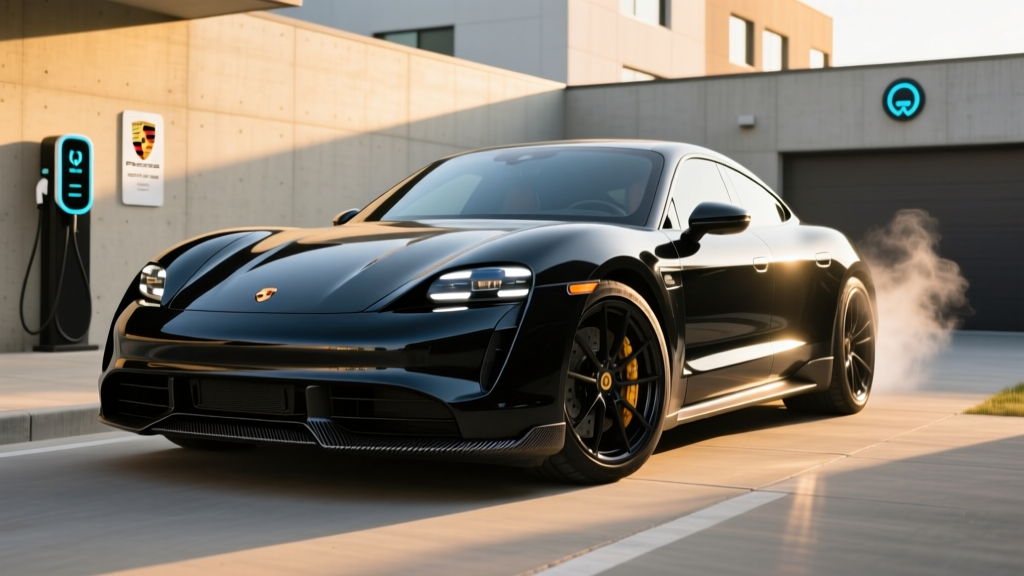
Quick Verdict: The Taycan Turbo S Is a Physics-Defying EV Sedan
The 2026 Porsche Taycan Turbo S remains the benchmark for electric performance sedans that prioritize driving dynamics over maximum range. With a manufacturer-claimed 0-60 mph time of 2.2 seconds and a peak DC fast-charging rate of 320 kW, it delivers supercar acceleration wrapped in a daily-drivable four-door body. But at a starting MSRP above $190,000, buyers need to know exactly what they're getting — and where the compromises live.
This review breaks down the Taycan Turbo S with the exact numbers that matter: real-world range versus the EPA sticker, sustained versus peak charging speeds, and whether any portion of the federal EV tax credit applies. If you're cross-shopping against the Tesla Model S Plaid, Lucid Air Sapphire, or BMW i7 M70, the data below will make the decision clearer.
| Spec | Value |
|---|---|
| EPA Estimated Range | 282 miles (Performance Battery Plus) |
| Battery Capacity (Usable) | 97.0 kWh (NMC chemistry) |
| Drivetrain | Dual-motor AWD with rear 2-speed transmission |
| Peak Horsepower (Launch Control) | 939 hp (700 kW) |
| 0-60 mph | 2.2 seconds (manufacturer, with Launch Control) |
| Top Speed | 162 mph |
| Max DC Fast Charge Rate | 320 kW (peak) |
| 10-80% DC Fast Charge Time | ~18 minutes (optimal conditions) |
| Level 2 Home Charge Rate | 19.2 kW (11.5 hours, 0-100%) |
| MPGe (Combined) | 78 MPGe |
| Efficiency | 43 kWh/100 mi |
| Cargo Volume (Trunk + Frunk) | 14.3 cu ft total |
| Base MSRP | $197,400 |
| Battery Warranty | 8 years / 100,000 miles |
Taycan Turbo S 0-60 and Performance: What the Numbers Mean in the Real World
The headline figure — Taycan Turbo S 0-60 in 2.2 seconds — is Porsche's official claim using Launch Control with the Performance Battery Plus pack. Independent testing by outlets like Car and Driver and Motor Trend has consistently verified this number, with some runs dipping to 2.1 seconds on prepped surfaces. That puts it in the same tier as the Tesla Model S Plaid (2.1 sec claimed) and the Lucid Air Sapphire (1.89 sec claimed), though the Lucid's number requires a specific rollout subtraction methodology.
What separates the Taycan Turbo S from its rivals is repeatability. Thanks to its 800-volt architecture, rear-axle two-speed gearbox, and sophisticated thermal management, the Taycan can deliver near-identical launch times back-to-back without power derating. In real-world use, this means you can hit a drag strip or merge onto a freeway at full thrust multiple times before the battery thermal system intervenes. The Tesla Model S Plaid, while marginally quicker on paper, has shown heat-related power tapering during repeated hard launches.
The dual-motor AWD system produces up to 939 hp (700 kW) in overboost mode with Launch Control engaged. In normal driving without launch prep, expect roughly 680 hp — still ferocious, but a reminder that peak output requires specific conditions. The rear two-speed transmission is unique in the EV world: first gear provides explosive off-the-line acceleration, while second gear optimizes highway efficiency and top-speed runs.
Real-World Range vs. EPA: What to Actually Expect
EPA Range: 282 miles (with Performance Battery Plus, 19" wheels)
Real-World Expectations:
- City / moderate driving (65°F): 265-285 miles — regenerative braking recovers significant energy in stop-and-go traffic
- Highway (70-80 mph, 65°F): 230-255 miles — the Taycan's aerodynamic efficiency and 2-speed rear axle help, but 939-hp sedans are inherently thirsty at speed
- Cold weather (30°F, highway): 195-220 miles — expect 20-30% range loss due to battery heating demands and reduced regen efficiency
- Cold weather + highway + aggressive driving: 170-195 miles — worst-case scenario
The Taycan Turbo S uses an NMC (nickel manganese cobalt) lithium-ion battery with 97.0 kWh of usable capacity (105 kWh gross). Porsche quotes a WLTP range as high as 391 miles for European-spec models, but the US EPA cycle is more stringent, yielding the 282-mile figure for the most efficient wheel configuration.
According to fueleconomy.gov, the Taycan Turbo S achieves 78 MPGe combined, which translates to 43 kWh per 100 miles. That's notably less efficient than a Tesla Model S (roughly 30 kWh/100mi) but typical for a heavy, high-performance AWD sedan. The efficiency penalty comes from the wider tires, more aggressive powertrain calibration, and additional mass of the Turbo S hardware.
One owner-relevant insight: the Taycan's thermal preconditioning system is among the best in the industry. When you set a navigation destination to a DC fast charger, the car actively warms or cools the battery to optimal charging temperature, which makes a tangible difference in charge speed upon arrival — especially in cold weather.
Charging Speed: 320 kW Peak, but the Curve Tells the Full Story
| Charge Level | Max Power | Connector | Speed (Approx.) | Time |
|---|---|---|---|---|
| Level 1 (120V) | 1.4 kW | J1772 / NACS adapter | ~4 mi/hr | ~70 hrs (0-100%) |
| Level 2 (240V, 80A) | 19.2 kW | NACS (native, 2025+) | ~56 mi/hr | ~5.5 hrs (0-100%) |
| Level 2 (240V, 48A) | 11.5 kW | NACS | ~33 mi/hr | ~9 hrs (0-100%) |
| DC Fast Charge | 320 kW (peak) | NACS / CCS1 (adapter) | ~200 mi in 18 min | 10-80% in ~18 min |
The Taycan Turbo S's 800-volt architecture enables a peak DC fast-charging rate of 320 kW, among the highest of any production EV. At a capable 350 kW charger (such as Electrify America or Tesla Supercharger V4 stalls with NACS access), the Taycan can add approximately 200 miles of range in 18 minutes under optimal conditions.
However, the charging curve matters more than the peak number. The Taycan sustains above 250 kW from roughly 10% to 40% State of Charge (SoC), then gradually tapers. From 40-60% SoC, expect roughly 200-220 kW; from 60-80%, approximately 150-170 kW. Above 80% SoC, charging slows dramatically to protect battery longevity — as it does in all lithium-ion EVs. The 10-80% time of ~18 minutes is impressive, but plan for 25-30 minutes if you need to charge from 10% to 90%.
For the 2025-2026 model years, Porsche transitioned the Taycan to the NACS (North American Charging Standard) connector natively, granting direct access to Tesla's Supercharger network. CCS1 chargers remain accessible via adapter. This is a significant practical improvement over earlier Taycan model years that relied solely on CCS1.
Home charging on a 240V/80A Level 2 circuit (requiring a 100A breaker) delivers up to 19.2 kW — enough to fully replenish the battery overnight in roughly 5.5 hours. Most home installations use a 48A circuit (60A breaker) yielding 11.5 kW and a 9-hour full charge, which is adequate for daily use. Expect home installation costs of $800-$2,500 for the charger and electrical work, depending on panel capacity and conduit runs — consult a licensed electrician for your specific setup.
Pricing, Trims, and Federal Tax Credit Eligibility
| Item | Amount |
|---|---|
| Base MSRP (Turbo S Sedan) | $197,400 |
| Typical As-Tested Price (with options) | $210,000 - $225,000 |
| Destination Charge | $1,650 |
| Federal Tax Credit (§30D) | $0 — exceeds MSRP cap |
| Estimated Out-the-Door (before state incentives) | $200,000+ |
The 2026 Taycan Turbo S starts at $197,400 for the sedan body style. The Turbo S Cross Turismo (wagon variant) starts slightly higher. Popular options — Porsche Electric Sport Sound, rear-axle steering, Sport Chrono package upgrades, premium leather interiors, and 21" wheels — can push the as-tested price to $210,000-$225,000.
Federal tax credit status: The Taycan Turbo S does not qualify for the §30D new clean vehicle credit. Per IRS guidelines, the credit has an MSRP cap of $55,000 for sedans. At nearly $200,000, the Taycan Turbo S exceeds this cap by a factor of nearly four. No amount of income qualification or battery sourcing compliance changes this — the MSRP cap is an absolute disqualifier.
Some buyers inquire about the used EV credit (§25E, up to $4,000). This credit applies to vehicles with an MSRP originally under $25,000 (used sale price) and has its own income caps. A used Taycan Turbo S will not meet the $25,000 sale-price threshold for many years, making this credit effectively unavailable as well. State-level incentives vary by jurisdiction — check your local DMV or energy office for applicable rebates.
Interior, Cargo, and Daily Livability
The Taycan Turbo S interior reflects Porsche's current design language: a curved 16.8" digital instrument cluster, a 10.9" central infotainment touchscreen, and an optional 10.9" front passenger display. The center console uses haptic-touch controls rather than physical buttons, which looks sleek but draws mixed reviews for ease of use while driving. Apple CarPlay is wireless; Android Auto is wired on most trims.
Practical dimensions:
- Front trunk (frunk): 2.9 cu ft — enough for a charging cable bag and small items
- Rear trunk: 11.4 cu ft — shallow and wide, adequate for two carry-on bags
- Total cargo: 14.3 cu ft — significantly less than a Tesla Model S (28 cu ft behind rear seats)
- Rear legroom: 32.7 inches — tight for adults on longer trips; the battery pack's "foot garage" cutouts help but don't fully solve the packaging challenge
- Front headroom: Adequate for most adults, though the sloping roofline limits rear headroom for passengers over 6'0"
The Taycan Turbo S is a four-seat sedan (no middle rear belt), which limits family utility compared to five-seat competitors. The Cross Turismo wagon variant adds roughly 5 cu ft of cargo space and slightly more rear headroom, making it the more practical choice for buyers who need versatility.
Driver Assistance, Tech, and Notable Drawbacks
SAE Automation Level: Level 2 (partial driving automation)
The Taycan's Porsche InnoDrive with Active Lane Keeping is a Level 2 driver-assist system. The driver must remain fully engaged, hands on or near the wheel, at all times. This is not autonomous driving.
Porsche InnoDrive combines adaptive cruise control, lane centering, and predictive speed adjustment based on navigation data and road-sign recognition. On highways, it performs competently — maintaining smooth following distances and gentle steering corrections. However, it lags behind Tesla's Autopilot, GM's Super Cruise, and Ford's BlueCruise in terms of hands-free capability and lane-change automation. Porsche's system requires regular steering-wheel contact and does not support automated lane changes.
Standout tech features:
- 800V architecture enabling 320 kW charging
- Rear-axle steering (optional) for tighter low-speed turning and high-speed stability
- Porsche Active Ride suspension (optional) with predictive road-surface adaptation
- Two-speed rear transmission for both explosive launches and efficient cruising
- Over-the-air (OTA) software updates for powertrain and infotainment
Notable drawbacks:
- Infotainment haptic controls are finicky compared to physical buttons or Tesla's touchscreen-first approach
- Rear seat space is tight for a car in this price range
- Cargo volume trails competitors significantly
- No hands-free driving mode — Porsche is conservative on ADAS automation
- High tire wear — the Turbo S's weight and torque chew through performance tires in 15,000-20,000 miles
- Regenerative braking feel is less aggressive than Tesla or Hyundai/Kia EVs; one-pedal driving is not fully supported (the car creeps at low speed rather than coming to a complete stop via regen alone)
Taycan Turbo S vs. Key Competitors: Which Should You Buy?
| Spec | Porsche Taycan Turbo S | Tesla Model S Plaid | Lucid Air Sapphire | BMW i7 M70 |
|---|---|---|---|---|
| 0-60 mph | 2.2 sec | 2.1 sec (claimed) | 1.89 sec (claimed) | 3.5 sec |
| EPA Range | 282 mi | 359 mi | 427 mi | 295 mi |
| Peak DC Charge | 320 kW | 250 kW | 300+ kW | 195 kW |
| Base MSRP | $197,400 | $89,990 | $249,000 | $169,700 |
| Cargo Volume | 14.3 cu ft | 28 cu ft | 32 cu ft | 19 cu ft |
| Build Quality | Exceptional | Improved, inconsistent | Excellent | Excellent |
| Federal Tax Credit | $0 | $0 (exceeds MSRP cap) | $0 (exceeds MSRP cap) | $0 (exceeds MSRP cap) |
The Taycan Turbo S wins on build quality, driving dynamics, and charging speed. The Model S Plaid wins on range, cargo space, and value. The Lucid Air Sapphire wins on straight-line acceleration and range but costs $50,000 more. The BMW i7 M70 is the luxury cruiser of the group — slower but more spacious and comfortable.
Choose the Taycan Turbo S if: You prioritize driving feel, build quality, and repeatable performance over range and practicality. You want the fastest-charging EV sedan available and value Porsche's dealership and service network.
Choose the Model S Plaid if: You want 90% of the performance at half the price, need more cargo space, and regularly drive routes where the 359-mile EPA range matters.
Choose the Lucid Air Sapphire if: Budget is not a constraint and you want the fastest production sedan ever built with class-leading range.
Choose the BMW i7 M70 if: You want a luxury-first EV with strong performance and a more comfortable, spacious rear seat for chauffeured use.
Warranty, Ownership Costs, and Long-Term Outlook
Porsche covers the Taycan Turbo S with:
- Basic vehicle warranty: 4 years / 50,000 miles
- Battery warranty: 8 years / 100,000 miles (minimum 70% capacity retention guaranteed)
- Roadside assistance: 4 years / 50,000 miles
The 8-year/100,000-mile battery warranty with a 70% retention threshold is industry-standard and matches most competitors. Porsche's NMC battery chemistry has shown strong longevity data from earlier Taycan model years (2020-2024), with most owners reporting less than 5% degradation in the first 40,000 miles based on community data from forums like TaycanForum.
Ownership costs to budget for:
- Insurance: Expect $4,000-$7,000/year depending on location, age, and driving record. High-performance EVs carry premium insurance rates.
- Tires: Michelin Pilot Sport EV or Pirelli P Zero Elect — approximately $1,800-$2,400 per set, lasting 15,000-20,000 miles under normal use.
- Home electricity (charging): At the US average of $0.16/kWh, fully charging the 97 kWh battery costs roughly $15.50 — or about $0.055/mile. Compare to premium gasoline at ~$0.18/mile in a comparable gas sports sedan.
- Maintenance: Minimal — no oil changes, no transmission fluid (the 2-speed rear unit is sealed). Brake pad life is extended by regenerative braking. Budget $500-$800/year for cabin air filters, wiper fluid, and inspections.
Pros, Cons, and Who the Taycan Turbo S Is For
Pros
- 2.2-second 0-60 mph — repeatable, not just a one-time stunt
- 320 kW peak DC charging — fastest in the luxury EV sedan segment
- Exceptional build quality and materials
- 800V architecture with NACS connector for Supercharger access
- Two-speed rear axle delivers both launch fury and highway composure
- Porsche Active Ride suspension (optional) is genuinely impressive
- Strong resale value relative to other luxury EVs
Cons
- 282-mile EPA range trails Tesla and Lucid significantly
- 14.3 cu ft cargo — cramped for the price
- Rear seat is tight; only seats four
- Infotainment haptic controls frustrate some drivers
- ADAS is competent but behind competitors in hands-free features
- No federal tax credit eligibility
- Tire replacement costs are high and frequent
Who the Taycan Turbo S suits best: Driving enthusiasts who want a daily-drivable electric supercar-sedan and prioritize handling, build quality, and charging speed over maximum range or back-seat space. It's ideal for owners who have reliable home charging, take road trips of 200-400 miles (where the 18-minute fast-charge stop is manageable), and value the Porsche brand experience. It is not the right choice for large families, high-mileage commuters who lack fast-charging access, or buyers seeking maximum value per dollar.
Frequently Asked Questions
What is the real-world range of the Taycan Turbo S?
The EPA rates it at 282 miles with the Performance Battery Plus and 19" wheels. In real-world highway driving at 70-80 mph in moderate temperatures, expect 230-255 miles. In cold weather (below 35°F), highway range drops to approximately 195-220 miles. City driving with regenerative braking can approach or match the EPA figure.
How fast does the Taycan Turbo S charge at home and on the road?
On a 320 kW-capable DC fast charger, it charges from 10-80% in approximately 18 minutes, adding roughly 200 miles of range. At home on a 240V/80A Level 2 charger, it adds about 56 miles per hour of charging. On a standard 48A Level 2 circuit, expect about 33 miles per hour. Level 1 (120V) trickle charging adds roughly 4 miles per hour — only practical for emergencies or very low daily mileage.
Does the Taycan Turbo S qualify for the federal EV tax credit?
No. The IRS §30D new clean vehicle credit has an MSRP cap of $55,000 for sedans. The Taycan Turbo S starts at $197,400, far exceeding this limit. There is no pathway to the $7,500 credit regardless of income, battery sourcing, or point-of-sale transfer. The used EV credit (§25E) also does not apply due to the $25,000 used-sale-price cap. Consult a tax professional for any state-level incentives.
Is the Taycan Turbo S worth it vs. the Tesla Model S Plaid?
It depends on your priorities. The Model S Plaid is marginally quicker (2.1 sec 0-60), has 77 more miles of EPA range, offers nearly double the cargo space, and costs roughly $107,000 less. The Taycan Turbo S counters with superior build quality, faster DC charging (320 kW vs 250 kW), a more engaging driving experience, Porsche's service network, and a repeatable launch system that doesn't overheat. If budget is a primary concern, the Plaid is the rational choice. If driving feel, build, and charging speed matter more, the Taycan justifies its premium.
What battery chemistry does the Taycan Turbo S use?
The Taycan Turbo S uses NMC (nickel manganese cobalt) lithium-ion cells. NMC offers higher energy density than LFP (lithium iron phosphate), which is necessary to package 97 kWh of usable capacity in a performance sedan. The trade-off is that NMC cells are more sensitive to sustained high SoC storage — Porsche recommends daily charging to 80% and only charging to 100% before long trips. The battery management system includes a buffer to protect against degradation.
How does the Taycan Turbo S handle cold weather?
The Taycan's thermal management system is among the best in the EV industry. It includes active battery heating and cooling, a heat pump for cabin heating (standard), and navigation-based preconditioning that warms the battery en route to a DC fast charger. Range loss in cold weather (30°F) is typically 20-30% on the highway. Charging speed is well-preserved when preconditioning is active, though cold-soaked batteries (car parked outside overnight in freezing temps without preconditioning) will see significantly slower initial charge rates.
What is the Taycan Turbo S towing capacity?
The Taycan Turbo S is not rated for towing. Porsche does not provide a tow rating for the Taycan sedan. If you need an electric vehicle with towing capability, consider the Porsche Cayenne EV (upcoming), Rivian R1S, Tesla Model X, or BMW iX.
Sources: fueleconomy.gov (EPA range and efficiency data), IRS §30D new clean vehicle credit guidelines, Porsche USA official specifications. Tax credit rules are subject to change — verify current eligibility with a tax professional before purchasing.