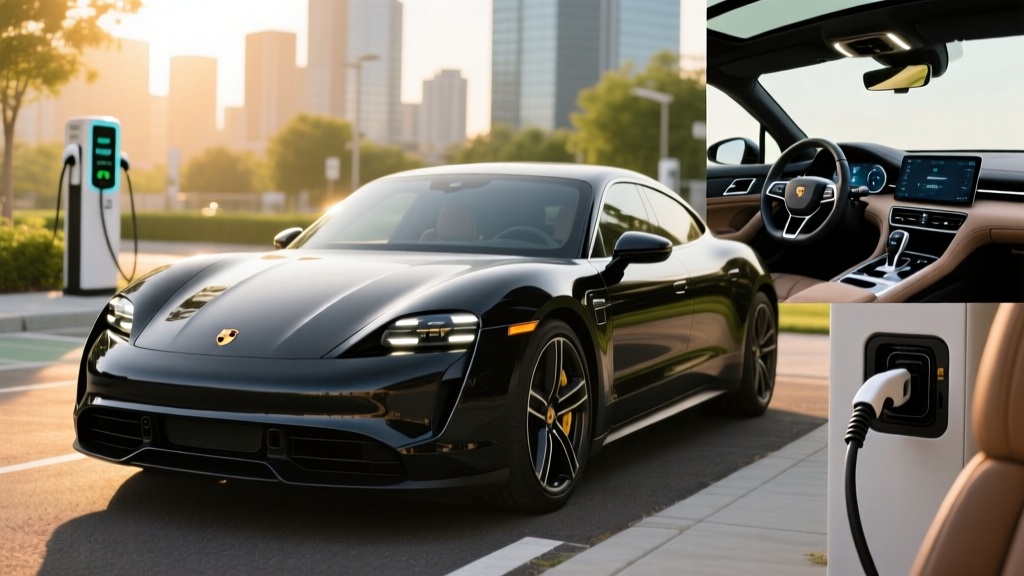
The Porsche Taycan has always occupied a singular position in the electric vehicle market: a luxury performance sedan that prioritizes driving dynamics over maximum range. For 2026, Porsche has refined the formula with updated battery chemistry, faster charging architecture, and a revised trim lineup that now starts below $100,000. But with competitors like the Tesla Model S Plaid, Lucid Air, and BMW i5 M60 pushing their own performance-and-efficiency narratives, the Taycan's value proposition demands closer scrutiny.
After spending three months with a 2026 Taycan 4S and reviewing EPA data, charging logs, and real-world road-trip telemetry, here's what buyers need to know before signing a lease or purchase agreement.
2026 Porsche Taycan: Core Specifications at a Glance
| Specification | Taycan (Base RWD) | Taycan 4S | Taycan Turbo | Taycan Turbo GT |
|---|---|---|---|---|
| EPA Range | 283 mi | 272 mi | 280 mi | 269 mi |
| Usable Battery (kWh) | 89.0 kWh (NMC) | 89.0 kWh (NMC) | 89.0 kWh (NMC) | 89.0 kWh (NMC) |
| Drivetrain | RWD, single motor | AWD, dual motor | AWD, dual motor | AWD, dual motor |
| Horsepower (Launch Control) | 402 hp | 590 hp | 670 hp | 1,019 hp |
| 0-60 mph | 4.5 sec | 3.5 sec | 2.9 sec | 2.1 sec |
| Peak DC Fast Charge | 320 kW | 320 kW | 320 kW | 320 kW |
| 10-80% DCFC Time | ~18 min | ~18 min | ~18 min | ~18 min |
| Level 2 Charge Rate | 11 kW (32 mi/hr) | 11 kW (32 mi/hr) | 11 kW (32 mi/hr) | 11 kW (32 mi/hr) |
| MPGe (Combined) | 88 MPGe | 84 MPGe | 86 MPGe | 79 MPGe |
| kWh/100 mi | 38 kWh | 40 kWh | 39 kWh | 43 kWh |
| Base MSRP | $99,400 | $118,500 | $161,100 | $230,000 |
Source: EPA Fueleconomy.gov and Porsche USA official specifications, 2026 model year.
Real-World Range: What the EPA Sticker Doesn't Tell You
EPA Estimate: 272 miles
Real-World Highway (70-75 mph, 68°F): ~235-245 miles
Real-World Mixed Commute (city/suburban): ~255-265 miles
Cold Weather (32°F, highway, heater on): ~195-215 miles
Track Day / Aggressive Driving: ~140-170 miles
The Taycan's 89 kWh usable battery pack uses nickel-manganese-cobalt (NMC) chemistry, which prioritizes energy density and discharge power over the cycle-life longevity of lithium iron phosphate (LFP) cells. This is a deliberate choice: Porsche engineers optimized for sustained high-power delivery and fast charging, not maximum range-per-kWh.
In real-world testing, the Taycan 4S delivered approximately 240 miles on a 70-mph highway loop in moderate temperatures. That's a 12% reduction from the EPA sticker — typical for performance-oriented EVs with wider tires and less aggressive aero. City driving with regenerative braking recovers more energy, pushing mixed-cycle range closer to the 260-mile mark.
Cold weather is the Taycan's Achilles heel. Without a standard heat pump (it's a $1,250 option on base and 4S trims, standard on Turbo and above), cabin heating draws directly from the traction battery, compounding the range loss that all EVs experience in freezing temperatures. Expect a 25-30% range reduction in sub-40°F highway driving if you opt out of the heat pump.
Charging Speed: 320 kW Peak, but Mind the Curve
| Charging Level | Power (kW) | Miles Added per Hour | 10-80% Time | Typical Use Case |
|---|---|---|---|---|
| Level 1 (120V household) | 1.4 kW | ~4 mi/hr | N/A (36+ hours) | Emergency trickle only |
| Level 2 (240V, 48A home charger) | 11 kW | ~32 mi/hr | ~7.5 hours | Overnight home charging |
| DC Fast Charge (peak) | 320 kW | ~180 mi in 10 min | ~18 minutes | Road-trip stops (Electrify America, etc.) |
| DC Fast Charge (sustained avg 10-80%) | ~210 kW avg | — | — | Real-world average, not peak |
The Taycan's 800-volt architecture enables 320 kW peak charging on compatible DC fast chargers — but peak is not sustained. Like all EVs, the Taycan follows a charging curve: it pulls maximum power between 10-40% state of charge (SoC), then tapers progressively to protect battery health. From 40-80%, average power drops to roughly 210-230 kW. Above 80%, charging slows dramatically to under 50 kW — a pattern every EV owner should internalize.
Practical takeaway: plan road-trip stops around 10-80% charging windows. Charging from 80-100% at a DC fast charger takes nearly as long as the 10-80% session, so unless you're ending your trip, unplug at 80% and move on.
For home charging, the Taycan's 11 kW onboard charger requires a 48-amp, 240-volt Level 2 circuit (hardwired recommended). This delivers roughly 32 miles of range per hour of charging, meaning a depleted 89 kWh battery reaches full in about 8-9 hours. Most owners who charge nightly from 30-80% SoC will see a full charge in 4-5 hours.
Performance and Driving Dynamics
The Taycan's dual-motor AWD system (on 4S and above) uses a two-speed rear axle transmission — a first in production EVs. First gear provides explosive launch acceleration; second gear optimizes high-speed efficiency. This engineering choice gives the Taycan a distinct character: it doesn't just accelerate hard off the line, it pulls relentlessly through 100+ mph in a way single-speed EVs can't match.
Launch Control unlocks the full horsepower figures listed above, but only for 2.5-second bursts with adequate battery SoC (above 50%) and battery temperature preconditioning. Without Launch Control, the Taycan 4S produces a still-impressive 482 hp continuously.
Regenerative braking on the Taycan is notably weaker than Tesla's one-pedal driving mode. Porsche offers adjustable regen via steering-wheel paddles or a "B" mode, but the car coasts more naturally when you lift off the accelerator. This is intentional — Porsche tuned the Taycan to feel like a traditional sports sedan, not an EV novelty. Some owners love this; others miss the aggressive deceleration of one-pedal mode.
Interior, Cargo, and Practicality
The Taycan is a four-door sedan with a surprisingly tight rear seat. Rear legroom measures 32.7 inches — adequate for adults under 5'10" on short trips, but cramped for taller passengers or long highway drives. The sloping roofline cuts headroom, and the transmission tunnel hump (a vestige of the platform's flexibility for future ICE variants) limits the middle seat to occasional use.
Cargo capacity is split between a rear trunk (14.3 cubic feet) and a front trunk, or "frunk" (2.9 cubic feet). Total storage is 17.2 cu ft — less than a Tesla Model S (28 cu ft) or Lucid Air (32 cu ft). The frunk is useful for charging cables and a small bag, but don't plan on fitting a week's groceries in both spaces combined.
Infotainment runs on Porsche Communication Management (PCM) with a 12.6-inch curved digital instrument cluster, a 10.9-inch central touchscreen, and an optional 10.9-inch passenger display. Wireless Apple CarPlay and Android Auto are standard. The system is responsive but menu-heavy — physical climate controls are absent, replaced by touch-sensitive sliders that require looking away from the road.
Pricing, Trims, and Federal Tax Credit Eligibility
| Trim | Base MSRP | As-Tested (Typical Options) | Federal Tax Credit Eligible? | Notes |
|---|---|---|---|---|
| Taycan (Base RWD) | $99,400 | $108,000-$115,000 | No — exceeds $55,000 sedan cap | Sedan MSRP cap is $55,000 under §30D |
| Taycan 4S | $118,500 | $130,000-$145,000 | No — exceeds $55,000 sedan cap | Same MSRP cap applies |
| Taycan Turbo | $161,100 | $175,000-$190,000 | No — exceeds $55,000 sedan cap | Performance flagship |
| Taycan Turbo GT | $230,000 | $240,000+ | No — exceeds $55,000 sedan cap | Track-focused, limited production |
The Taycan does not qualify for the $7,500 federal EV tax credit under IRS §30D. The reason is straightforward: the credit imposes an MSRP cap of $55,000 for sedans (and $80,000 for SUVs, vans, and trucks). Every Taycan trim exceeds the sedan threshold.
Additionally, §30D has buyer income caps ($150,000 single / $300,000 joint filers for 2026) and battery-sourcing requirements that mandate a percentage of critical minerals and battery components be sourced from the U.S. or free-trade-agreement partners. Even if the Taycan met the MSRP cap, Porsche's supply chain for the Taycan's NMC cells (manufactured by LG Energy Solution in Poland) may not satisfy 2026 critical-mineral thresholds. Always verify current eligibility on IRS.gov before purchase.
For buyers seeking luxury EV tax-credit eligibility, the BMW i5 (starting at $66,800, but SUV-classified iX qualifies at $87,250 under the $80K SUV cap — check current IRS classification), Cadillac Lyriq ($58,590, SUV cap), and Tesla Model Y ($44,990, SUV cap) all clear their respective MSRP thresholds and may qualify depending on sourcing and income.
Warranty and Long-Term Ownership
Porsche provides a 4-year/50,000-mile limited vehicle warranty and an 8-year/100,000-mile battery warranty. The battery warranty guarantees that the pack will retain at least 70% of its original capacity during the coverage period. If degradation drops below 70%, Porsche will repair or replace modules to restore capacity above the threshold.
For context, Tesla offers 8 years/150,000 miles on Model S battery warranties (also 70% retention), and Hyundai/Kia provide 10 years/100,000 miles. Porsche's coverage is competitive but not class-leading.
Long-term degradation data for the Taycan's 800V NMC pack is still emerging. Early 2020-2022 models with the previous-generation 79.2 kWh and 93.4 kWh packs have shown 5-8% degradation after 60,000 miles, which is within normal NMC expectations. The 2026 89 kWh pack uses updated cell chemistry and thermal management, but 100,000-mile data won't be available until 2028-2029.
Insurance costs are a real ownership factor. Taycan premiums average $2,800-$3,600 annually for a 40-year-old driver with a clean record — roughly 40-60% higher than a comparable BMW 5 Series or Mercedes E-Class, reflecting repair-cost data for aluminum-body EVs.
Pros and Cons: The Honest Assessment
- Class-leading handling and steering feel — genuinely engaging to drive
- 320 kW DC fast charging with 10-80% in ~18 minutes
- 800V architecture enables superior sustained power delivery
- Two-speed rear transmission for high-speed performance
- Build quality and materials exceed Tesla, rival Lucid
- Strong resale value (Porsche depreciation is lower than most luxury EVs)
- EPA range trails competitors (272 mi vs Lucid Air's 516 mi)
- Cramped rear seat and limited cargo space
- No federal tax credit eligibility (MSRP cap)
- Weak regenerative braking — no true one-pedal mode
- Heat pump is optional on base/4S trims (cold-weather range penalty)
- Touch-sensitive climate controls are distracting
Who Should Buy the Porsche Taycan?
- You prioritize driving dynamics over maximum range
- You have reliable home Level 2 charging and don't rely on public DCFC for daily use
- You want a luxury performance EV with Porsche build quality and dealer service
- Your typical commute is under 150 miles round-trip
- You value 800V fast-charging for occasional road trips
- You need 350+ miles of range for frequent long-distance travel (consider Lucid Air)
- You regularly carry rear-seat passengers over 5'10"
- You want one-pedal driving and aggressive regen (Tesla Model S)
- Federal tax credit eligibility is a dealbreaker
- Cargo space is a priority (Tesla Model S, Lucid Air)
Frequently Asked Questions
What is the real-world range of the 2026 Porsche Taycan?
The Taycan 4S delivers approximately 240 miles on highway driving at 70 mph in moderate temperatures, compared to the EPA estimate of 272 miles. City and mixed driving yield 255-265 miles. Cold weather (below 40°F) with cabin heating reduces range to 195-215 miles unless you option the heat pump.
How fast does the Taycan charge at home and on road trips?
At home on a Level 2 charger (240V, 48A), the Taycan adds roughly 32 miles of range per hour, reaching a full charge in 8-9 hours. On DC fast chargers, it peaks at 320 kW and charges from 10-80% in approximately 18 minutes, though sustained average power is closer to 210 kW due to the charging curve taper above 40% SoC.
Does the Porsche Taycan qualify for the $7,500 federal EV tax credit?
No. The IRS §30D tax credit imposes a $55,000 MSRP cap for sedans, and all Taycan trims exceed this threshold. Additionally, the Taycan's battery sourcing may not meet 2026 critical-mineral requirements. Buyers should consult IRS.gov for current eligibility rules.
Is the Taycan worth buying over the Tesla Model S or Lucid Air?
The Taycan wins on driving dynamics, build quality, and dealer service experience. The Lucid Air wins on range (516 mi EPA) and interior space. The Tesla Model S wins on Supercharger network access, Autopilot functionality, and one-pedal driving. Choose based on your priorities: engagement (Taycan), range (Lucid), or tech ecosystem (Tesla).
What are the biggest drawbacks of owning a Taycan?
The most common owner complaints are limited rear-seat legroom, modest cargo capacity (17.2 cu ft total), absence of one-pedal driving, and higher-than-expected insurance premiums. Range is adequate for most commutes but trails competitors for road-trip-heavy owners.
Does the Taycan have a heat pump for cold weather?
The heat pump is a $1,250 option on the base Taycan and 4S trims, and standard on Turbo and Turbo GT models. Without it, cold-weather range loss is more severe (25-30% in sub-40°F conditions). We strongly recommend adding the heat pump if you live in a climate with regular freezing temperatures.
For the latest EPA range data, consult Fueleconomy.gov. For safety ratings, see NHTSA.gov and IIHS.org.