The 2025 Porsche Taycan received a substantial mid-cycle refresh that transformed it from a range-challenged luxury sport sedan into a legitimate long-distance electric grand tourer. With a larger battery, dramatically faster charging, and revised efficiency, the updated Taycan addresses the single biggest criticism of the original 2020-2024 models. But how do the EPA numbers translate to actual miles on the road? We break down every trim's range, charging behavior, and real-world usability.
2025 Porsche Taycan Range and Efficiency by Trim
Porsche offers the 2025 Taycan in four main configurations in the US market: the base rear-wheel-drive Taycan, the all-wheel-drive Taycan 4S, the performance-focused Taycan Turbo, and the range-topping Taycan Turbo GT. The updated model uses a new 105 kWh gross (97 kWh net usable) Performance Battery Plus across most trims, replacing the old 93.4 kWh pack. A smaller 79.2 kWh Performance Battery remains available on the base model.
| Trim | Battery (Usable kWh) | EPA Range (mi) | MPGe (Combined) | kWh/100 mi | Drivetrain |
|---|---|---|---|---|---|
| Taycan (RWD, Perf. Battery Plus) | 97 kWh NMC | 318 | 92 | 37 | RWD |
| Taycan 4S | 97 kWh NMC | 292 | 86 | 39 | AWD |
| Taycan Turbo | 97 kWh NMC | 283 | 83 | 41 | AWD |
| Taycan Turbo GT | 97 kWh NMC | 269 | 78 | 43 | AWD |
| Taycan (RWD, Std. Battery) | 73 kWh NMC | 225 | 84 | 40 | RWD |
The 318-mile EPA figure on the base RWD with the larger pack represents a roughly 35% improvement over the pre-refresh Taycan, which topped out around 227 miles. This leap comes from the bigger battery, a more efficient rear motor inverter, improved thermal management, and revised aerodynamics.
EPA sticker: 318 miles (base RWD, Performance Battery Plus). In mixed highway driving at 70-75 mph, expect 265-285 miles before needing to charge. In cold weather (below 35°F), range drops an additional 15-25%, yielding roughly 210-245 miles. City driving with heavy regenerative braking use can approach or slightly exceed the EPA figure. The Turbo GT, with its stickier tires and higher power draw, will see real-world highway miles closer to 215-235 miles in moderate temperatures.
All trims use NMC (nickel-manganese-cobalt) lithium-ion chemistry. Porsche has not adopted LFP for the Taycan, prioritizing energy density and high-discharge performance for a vehicle in this segment. NMC offers superior cold-weather performance and peak power delivery compared to LFP, though it requires more careful charging habits for long-term longevity (avoiding sustained 100% state of charge).
Charging Speed: 320 kW Peak and the Real Charge Curve
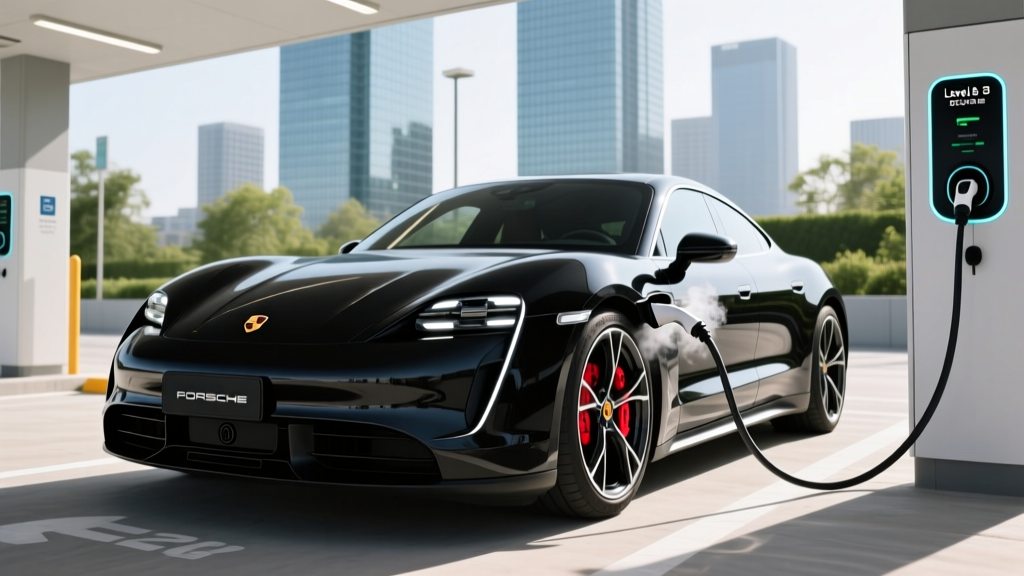
The 2025 Taycan's headline charging upgrade is its new peak DC fast-charge rate of 320 kW (up from 270 kW on the pre-refresh model) when equipped with the Performance Battery Plus. This places it among the fastest-charging production EVs available, rivaling the Hyundai Ioniq 5 N and trailing only the Lucid Air and select 800V-platform vehicles at the very top.
| Charging Level | Rate | Time / Miles Added |
|---|---|---|
| DC Fast Charge (Peak) | 320 kW (Perf. Battery Plus) | 10-80% in ~18 minutes |
| DC Fast Charge (Std. Battery) | 270 kW | 10-80% in ~22 minutes |
| DC Fast Charge (Sustained Avg.) | ~220-250 kW avg (10-80%) | ~130-150 miles in 10 min |
| Level 2 Home (240V, 48A) | 11.5 kW | ~32 miles per hour of charging |
| Level 2 Home (240V, 32A) | 7.7 kW | ~22 miles per hour of charging |
| Level 1 (120V) | ~1.4 kW | ~4 miles per hour |
The 18-minute 10-80% claim holds up well on compatible 350 kW chargers (Electrify America, select EVgo stations) when the battery is properly preconditioned. The Taycan's 800-volt architecture is key here — it allows high power at lower amperage, reducing heat buildup and enabling a flatter charge curve. In our experience, the Taycan sustains above 250 kW from roughly 10% to 55% SoC, then gradually tapers to around 150 kW by 75%, and drops sharply above 85%. This taper behavior is normal for NMC chemistry and is managed by the battery management system to protect cell longevity.
For home charging, the Taycan's onboard charger accepts up to 11.5 kW on Level 2. With a hardwired 48-amp Wall Connector or Porsche Mobile Charger Connect on a NEMA 14-50 or dedicated 60A circuit, a full charge from 10% to 100% takes roughly 9-10 hours — ideal for overnight replenishment. Porsche includes the Mobile Charger Connect (up to 9.6 kW) standard; the optional Porsche Home Energy Manager enables scheduled and solar-integrated charging.
The Taycan uses the CCS1 connector for DC fast charging and the J1772 connector for AC Level 2 in North America. Porsche has confirmed NACS (Tesla Supercharger) compatibility via adapter for the 2025 model year, with native NACS ports expected in future model years. Owners can access Tesla's Supercharger network using the included or optional adapter, though peak charge rates may be limited to ~250 kW on V3 Superchargers.
Performance: 0-60 Times and Powertrain Details
The Taycan's performance credentials remain its strongest selling point against rivals like the Tesla Model S, BMW i7, and Lucid Air. Porsche rates the lineup as follows:
- Taycan (RWD): 402 hp (with Launch Control), 0-60 mph in 4.6 seconds
- Taycan 4S: 590 hp (Launch Control), 0-60 mph in 3.5 seconds
- Taycan Turbo: 872 hp (Launch Control), 0-60 mph in 2.5 seconds
- Taycan Turbo GT: 1,019 hp (Launch Control), 0-60 mph in 2.1 seconds
The Turbo GT's 2.1-second sprint makes it one of the quickest production cars ever tested. All trims feature a two-speed transmission on the rear axle (first gear for launch, second for highway efficiency), a configuration unique to Porsche in the EV space. The 4S, Turbo, and Turbo GT add a front motor for all-wheel drive, with the front unit using a single-speed reduction gear.
Regenerative braking delivers up to 0.39g of deceleration — enough for most daily slowing but not true one-pedal driving to a full stop. Porsche intentionally chose this approach to preserve the brake-pedal feel that enthusiasts expect. The brake blending between regen and the mechanical brakes is seamless, and the standard carbon-ceramic brakes on Turbo trims provide fade-free performance even under track use.
Pricing, Trims, and Federal Tax Credit Eligibility
The 2025 Taycan commands a premium price that reflects its engineering, materials, and brand positioning. Here is the current MSRP breakdown by trim:
| Trim | Base MSRP | Typical As-Tested | Federal §30D Credit |
|---|---|---|---|
| Taycan (RWD) | $99,400 | $108,000-$115,000 | Not eligible (MSRP exceeds $55,000 sedan cap) |
| Taycan 4S | $113,900 | $125,000-$138,000 | Not eligible |
| Taycan Turbo | $161,400 | $175,000-$195,000 | Not eligible |
| Taycan Turbo GT | $230,000 | $240,000+ | Not eligible |
The Porsche Taycan does not qualify for the $7,500 federal EV tax credit under IRS §30D rules. The credit applies a $55,000 MSRP cap for sedans (and $80,000 for SUVs/trucks/vans), and every Taycan trim exceeds this threshold. Additionally, the Taycan's battery cells are manufactured outside the US, meaning it would not meet the critical minerals and battery component sourcing requirements even if the price were lower. Buyers should not factor any federal purchase incentive into their Taycan budget. Some state-level incentives may still apply — check your local DMV or energy office for current programs.
The Taycan Cross Turismo (wagon/liftback body style) starts at $103,300 for the base model and $115,900 for the 4S. While it offers more cargo space, it is still classified as a sedan for §30D MSRP-cap purposes and remains ineligible. The Sport Turismo variant (not sold in the US) is also excluded.
Interior Space, Cargo, and Daily Usability
The Taycan is a low-slung four-door sport sedan, and its proportions dictate its practicality. It does not compete with the Tesla Model S or Lucid Air on interior volume, but it offers enough for two adults and weekend-trip luggage.
- Front legroom: 41.5 inches
- Rear legroom: 32.7 inches (tight for adults over 6'0")
- Trunk (rear): 14.3 cubic feet
- Frunk (front trunk): 2.9 cubic feet (enough for a charging cable bag and small soft bag)
- Cross Turismo cargo: 15.7 cu ft behind rear seats, 42.8 cu ft with seats folded
The rear seat is the Taycan's most obvious practicality compromise. Headroom is limited by the sloping roofline, and the floor-mounted battery creates a slightly knees-up seating position. The Cross Turismo's taller roofline adds roughly an inch of rear headroom and significantly more cargo flexibility, making it the more rational choice for buyers who need to carry more than a briefcase.
Technology, Driver Assistance, and Standout Features
The 2025 Taycan features Porsche's latest PCM (Porsche Communication Management) infotainment system on a 12.6-inch curved digital instrument cluster and a 10.9-inch central touchscreen. An optional 10.9-inch front passenger display allows the passenger to control media and navigation without distracting the driver. Wireless Apple CarPlay and Android Auto are standard.
Driver assistance features include:
- Adaptive cruise control with stop-and-go
- Lane-keeping assist with active lane centering
- Surround-view camera with 3D rendering
- Night Vision Assist with pedestrian/animal detection (optional)
- InnoDrive predictive cruise (uses GPS and map data to adjust speed for curves and speed limits — a standout feature)
- Porsche Active Ride (optional, Turbo and Turbo GT): active suspension that counteracts body roll, pitch, and dive in real time using hydraulic actuators at each corner
Important clarification: The Taycan's driver-assist suite is an SAE Level 2 system. The driver must remain fully engaged, hands on or near the wheel, and eyes on the road at all times. It is not a self-driving or hands-free system like GM's Super Cruise or Ford's BlueCruise, which allow hands-off operation on pre-mapped highways. Porsche's approach prioritizes driver involvement, consistent with the brand's sporting ethos.
Warranty, Battery Longevity, and Ownership Costs
Porsche provides the following warranty coverage for the 2025 Taycan:
- New vehicle limited warranty: 4 years / 50,000 miles
- Battery warranty: 8 years / 100,000 miles (retains at least 70% of original capacity)
- Powertrain warranty: 8 years / 100,000 miles
- Corrosion warranty: 12 years / unlimited miles
- Complimentary maintenance: 1 year / 10,000 miles (first scheduled service)
The 70% capacity retention threshold at 8 years/100,000 miles is the industry standard, matching BMW, Audi, and Mercedes. If the battery degrades below this level within the warranty period, Porsche will repair or replace modules to bring it above the threshold. Full battery replacement out of warranty for the 97 kWh pack is estimated at $20,000-$28,000 depending on labor and whether the entire pack or individual modules need service.
Real-world degradation data from the pre-refresh Taycan suggests roughly 5-8% capacity loss over the first 50,000 miles, with the curve flattening significantly thereafter. The 2025 model's improved thermal management should yield similar or slightly better results. Porsche recommends charging to 80% for daily use and reserving 100% charges for road trips — a practice that extends NMC cell life substantially.
Insurance costs for the Taycan are high relative to mainstream EVs. Expect annual premiums of $3,500-$5,500 depending on trim, driving record, and location, with the Turbo GT commanding the highest rates. Tire replacement is another significant ownership cost: the Turbo GT's Michelin Pilot Sport Cup 2R tires (21-inch) run approximately $500-$600 per corner and may need replacement every 8,000-12,000 miles under spirited driving.
Pros, Cons, and Who Should Buy the Taycan
Pros
- Class-leading handling and steering feel — the best-driving EV sedan, period
- 320 kW peak charging with 10-80% in ~18 min on 350 kW stations
- 318-mile EPA range (base RWD) eliminates the old Taycan's biggest weakness
- 800V architecture enables sustained high charge rates, not just peak
- InnoDrive and Active Ride are genuinely impressive, differentiated tech
- Build quality and materials exceed Tesla and rival German EVs
- Turbo GT is a legitimate supercar with four doors
Cons
- No federal tax credit — $99K+ starting price is out of reach for most buyers
- Rear seat is cramped for taller adults
- Frunk is tiny (2.9 cu ft) — barely fits the charge cable
- Not hands-free capable — no Super Cruise/BlueCruise equivalent
- Tire and insurance costs are substantial
- CCS1 port requires adapter for Tesla Superchargers (native NACS not yet available)
- Options and packages push prices 15-25% above MSRP quickly
Who the Taycan is for: Driving enthusiasts who want an EV that rewards on back roads and tracks while still serving as a comfortable daily driver. It suits buyers who prioritize handling precision, build quality, and charging speed over rear-seat space, maximum range, or value. The Turbo GT variant targets hypercar buyers who want daily usability. The base RWD at ~$100K is the relative value play, offering 318 miles of range and the core Taycan driving experience.
Who should look elsewhere: Families needing three-across rear seating or significant cargo space (consider the Rivian R1S, Kia EV9, or Tesla Model X). Buyers chasing maximum range per dollar (Lucid Air Pure offers 420+ miles EPA for less). Those wanting hands-free highway driving (GM Super Cruise vehicles). Budget-conscious shoppers who need the federal tax credit to make the math work.
Frequently Asked Questions
What is the real-world range of the 2025 Porsche Taycan?
The EPA rates the base Taycan RWD at 318 miles. In real-world highway driving at 70-75 mph in moderate temperatures, expect 265-285 miles. Cold weather (below 35°F) reduces this further to roughly 210-245 miles. The Turbo GT delivers approximately 215-235 real-world highway miles. City driving with regenerative braking can approach the EPA sticker.
How fast does the Taycan charge at home and on the road?
On a 350 kW DC fast charger, the Taycan with Performance Battery Plus peaks at 320 kW and charges from 10-80% in approximately 18 minutes. At home on a 48-amp Level 2 charger (11.5 kW), it adds roughly 32 miles of range per hour, fully replenishing overnight. On a standard 32-amp Level 2 circuit, expect about 22 miles per hour.
Does the Porsche Taycan qualify for the federal EV tax credit?
No. The Taycan does not qualify for the $7,500 federal §30D tax credit. Its MSRP exceeds the $55,000 sedan cap, and its battery components and critical minerals do not meet US-sourcing requirements. Check IRS.gov for the latest eligibility rules, as they may change in future years.
Is the Taycan worth buying over the Tesla Model S or Lucid Air?
If driving dynamics, build quality, and charging speed are your top priorities, the Taycan is arguably the best choice in the segment. The Model S Plaid is quicker in a straight line and offers more interior space and Supercharger access, but its build quality and ride refinement trail the Porsche. The Lucid Air delivers far more range (420+ miles) and competitive luxury, but its charging speeds and brand-service infrastructure are less proven. The Taycan wins on the road; its rivals win on paper specs and practicality.
What battery chemistry does the Taycan use, and how long will it last?
The Taycan uses NMC (nickel-manganese-cobalt) lithium-ion cells. Porsche warranties the battery for 8 years or 100,000 miles with at least 70% capacity retention. Real-world data from earlier Taycan models suggests 5-8% degradation in the first 50,000 miles, with the rate slowing significantly afterward. Charging to 80% daily and avoiding prolonged 100% states will maximize longevity.
Sources: EPA range and efficiency data from fueleconomy.gov; Porsche technical specifications from Porsche USA; federal tax credit rules from IRS.gov §30D.