Quick Verdict: Is Leasing the 2026 Porsche Taycan the Smart Move?
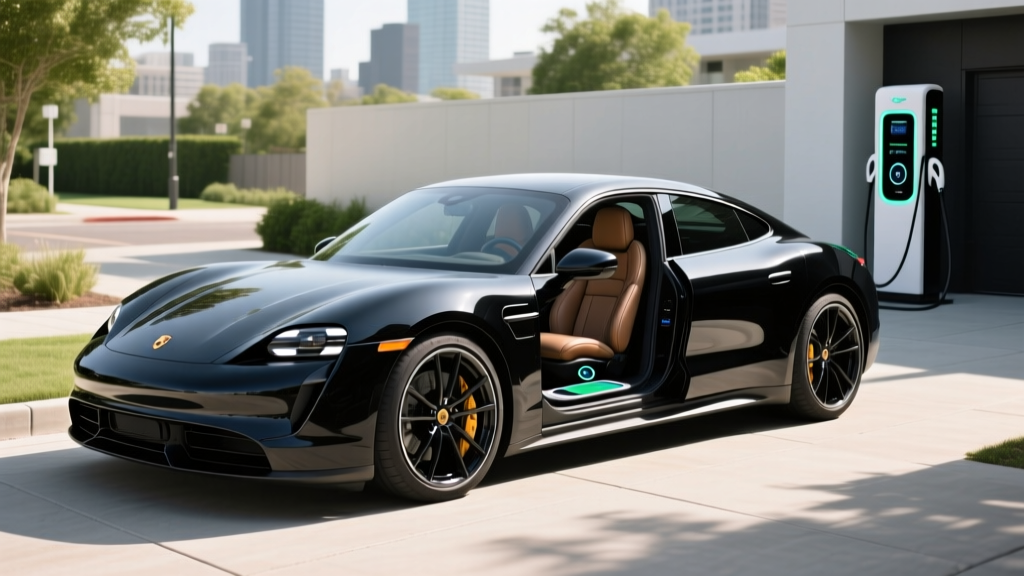
The 2026 Porsche Taycan remains the benchmark for electric sports sedan driving dynamics — a car that prioritizes steering feel, chassis balance, and repeatable performance over maximum range. For many buyers, a Porsche Taycan lease is the most financially rational way into this vehicle. Leasing sidesteps the steep depreciation curve that luxury EVs experience, locks in a predictable monthly cost, and often allows you to capture lease cash incentives that Porsche Financial Services periodically offers — incentives that can sometimes exceed the value of the federal tax credit you'd receive if purchasing outright.
This review covers every number that matters for your lease decision: real-world range across the lineup, the Taycan's class-leading 320 kW DC fast-charging architecture, trim-level pricing, §30D tax credit mechanics, and what ownership actually looks like day to day.
2026 Porsche Taycan: Trims, Pricing, and Lease Economics
The 2026 Taycan lineup spans from the base rear-wheel-drive model to the ferocious Turbo GT. Porsche restructured the lineup for the 2025 model year with significant powertrain and battery upgrades, and those carry into 2026 with minor refinements. Here's how the pricing breaks down before any incentives or negotiated lease terms:
| Trim | Drivetrain | HP (Launch Control) | 0-60 mph | EPA Range | Base MSRP |
|---|---|---|---|---|---|
| Taycan (RWD) | Rear-Wheel Drive | 402 hp | 4.6 sec | 318 mi | $92,950 |
| Taycan 4S | AWD Dual-Motor | 590 hp | 3.5 sec | 316 mi | $109,350 |
| Taycan GTS | AWD Dual-Motor | 690 hp | 3.1 sec | 295 mi | $131,350 |
| Taycan Turbo | AWD Dual-Motor | 870 hp | 2.5 sec | 305 mi | $161,450 |
| Taycan Turbo GT | AWD Dual-Motor | 1,019 hp | 2.1 sec | 269 mi | $210,050 |
All MSRP figures exclude the $1,650 destination charge. Options packages — Premium, Sport Chrono, rear-axle steering, Performance Battery Plus — typically add $8,000-$25,000 to as-tested pricing.
How a Porsche Taycan Lease Actually Works
When you lease a Taycan through Porsche Financial Services, you're paying for the vehicle's depreciation during your lease term (typically 36 months) plus a money factor (the lease equivalent of an interest rate) and fees. A few things to understand:
- Money factor: As of early 2026, expect a money factor around 0.00250-0.00300 for well-qualified lessees, translating to roughly 6.0-7.2% APR equivalent.
- Residual value: Luxury EVs have seen volatile residuals. A 36-month Taycan lease typically carries a 52-57% residual depending on trim. Higher trims like the Turbo GT depreciate faster in percentage terms.
- Lease cash: Porsche periodically offers lease cash (sometimes $5,000-$10,000) on specific Taycan trims. This is applied as a capitalized cost reduction and directly lowers your monthly payment. Check current offers on Porsche's website or with your dealer.
- Mileage: Standard Porsche leases are 10,000 miles/year. Upgrading to 12,000 or 15,000 miles/year adds roughly $30-$60/month.
Federal Tax Credit and the Lease Loophole
Under IRS §30D rules, the Porsche Taycan does not qualify for the $7,500 federal EV tax credit when purchased. The reason: the Taycan is manufactured in Leipzig, Germany, and the §30D credit requires final assembly in North America. Additionally, the Taycan's MSRP exceeds the $55,000 sedan cap for most trims (though the base RWD at $92,950 still clears this threshold — wait, it doesn't; all Taycan trims exceed the $55,000 sedan MSRP cap set by the Inflation Reduction Act).
IRS §30D Requirements the Taycan Fails:
- ❌ Final assembly in North America — Taycan is built in Germany
- ❌ MSRP cap ($55,000 for sedans) — all trims exceed this
- ❌ Battery critical mineral and component sourcing thresholds
However, there's a critical nuance for lessees. Under the commercial clean vehicle credit (§45W), the leasing company (Porsche Financial Services) is technically the "buyer" and may claim a $7,500 commercial credit. Many automakers pass this savings through as lease cash or a capitalized cost reduction. Whether Porsche passes this through varies by month and region — always confirm with your dealer what current lease incentives include. This is often the single biggest financial advantage of leasing vs. buying a Taycan.
For full §30D and §45W rules, consult the IRS clean vehicle credits page and speak with a tax professional.
Real-World Range: What the EPA Sticker Doesn't Tell You
Porsche significantly upgraded the Taycan's battery for the current generation. The base model uses a 97.0 kWh usable capacity Performance Battery (NMC chemistry — nickel manganese cobalt), while the optional Performance Battery Plus (standard on Turbo and Turbo GT) bumps usable capacity to approximately 105.0 kWh. Both use a lithium-ion NMC cell format supplied primarily by LG Energy Solution and CATL.
EPA vs. Real-World Range — 2026 Taycan (RWD, Performance Battery Plus):
- EPA estimated: 318 miles (combined)
- Real-world highway (70-80 mph, moderate temps): ~255-275 miles
- Real-world city/suburban mix: ~280-300 miles
- Cold weather (below 32°F, highway): ~210-240 miles (25-35% reduction)
- Efficiency: 83 MPGe combined / 41 kWh per 100 miles (base RWD)
These numbers deserve context. The Taycan's EPA range improved dramatically with the 2025 refresh — the previous generation base model was rated at just 225 miles. The current 318-mile rating is legitimate, but as with most EVs, sustained highway driving at 75+ mph eats into that figure because the Taycan's two-speed rear axle (unique in the EV segment) optimizes for efficiency at cruise but can't fully overcome the car's 4,800-pound curb weight and wide tires.
In cold weather, expect meaningful range loss. The Taycan does include a heat pump (standard on all trims), which mitigates cabin-heating energy draw, but battery chemistry itself becomes less efficient below freezing. If you live in the upper Midwest or Northeast and regularly drive 200+ miles in winter, plan your charging stops conservatively. Source: fueleconomy.gov — 2026 Porsche Taycan.
Charging Speed: The Taycan's 800-Volt Advantage
This is where the Taycan genuinely excels over most competitors. Porsche's 800-volt architecture allows DC fast-charging rates that remain among the fastest in production:
| Charging Method | Power | Speed / Time | Notes |
|---|---|---|---|
| Level 1 (120V household) | ~1.4 kW | ~3-4 miles per hour | Emergency/trickle only |
| Level 2 (240V home, 48A) | 11.5 kW | ~30-35 miles per hour; full charge in ~9 hrs | Porsche Mobile Charger Connect or hardwired EVSE |
| DC Fast Charge (peak) | 320 kW (Perf. Battery Plus) | 10-80% in ~18 minutes | Requires 350 kW+ station; NACS port standard for 2026 |
| DC Fast Charge (sustained avg) | ~220-250 kW avg (10-80%) | ~130 miles added in 10 min | Charge curve tapers significantly above 80% |
Understanding the charge curve: The Taycan peaks at 320 kW only at low states of charge (roughly 10-30% SoC) and with a battery preconditioned to optimal temperature. The rate then steps down progressively — you'll see roughly 250 kW through 50%, dropping to ~150 kW by 70%, and falling below 100 kW above 85%. This is why manufacturers quote 10-80% times rather than 0-100%: the last 20% can take as long as the first 70%.
For 2026, the Taycan comes equipped with the NACS (North American Charging Standard) port natively, granting access to Tesla Supercharger V4 stations (with 350 kW-capable stalls) in addition to Electrify America, EVgo, and other networks. This is a significant practical advantage over CCS-only vehicles that require adapters for Supercharger access.
At home on a Level 2 charger, the Taycan's 11.5 kW onboard charger is adequate for overnight replenishment. A typical daily commute of 40 miles requires roughly 1.5 hours of Level 2 charging — easily covered by plugging in when you get home. Home Level 2 installation costs typically run $800-$2,500 depending on your electrical panel capacity and run length; a 200-amp panel is usually sufficient, but older homes may need a $1,500-$3,000 panel upgrade.
Performance and Driving Dynamics
Nobody cross-shops a Taycan purely on efficiency. The reason this car commands its price — and the reason a Porsche Taycan lease attracts enthusiasts who might otherwise consider a Tesla Model S Plaid or Audi e-tron GT — is the driving experience.
The base RWD Taycan delivers 402 horsepower (with Launch Control engaged) and reaches 60 mph in 4.6 seconds. That's quick by any standard, but the 4S (590 hp, 3.5 seconds) is the sweet spot for most lessees, offering supercar-rivaling acceleration with the all-weather security of AWD. The Turbo GT, at 1,019 hp and a 2.1-second 0-60, exists in a category of its own.
What separates the Taycan from rivals isn't straight-line speed — it's chassis communication. The electromechanical anti-roll bars (standard on GTS and above, optional on 4S), rear-axle steering, and Porsche's tuning of the adaptive air suspension produce a car that feels lighter than its ~4,800-5,100 lb curb weight. Steering weight builds naturally, the brake pedal feel (blending regen and friction brakes) is the best in the EV segment, and the two-speed rear transmission gives the Taycan a unique character: you can feel the shift under hard acceleration.
Regenerative braking note: The Taycan offers up to 290 kW of regen capacity, but unlike most EVs, it does not default to strong one-pedal driving. Porsche's philosophy is to let the car coast freely (more efficient in many scenarios) and let the driver modulate regen via the brake pedal or steering-wheel paddles. This feels natural to sports-car drivers but frustrates buyers accustomed to Tesla-style one-pedal behavior. You can configure this, but it's a deliberate engineering choice worth knowing before you sign a lease.
Interior, Tech, and Daily Practicality
Cabin and Cargo Space
The Taycan is a low-slung sports sedan, and interior space reflects that. Front passengers get generous legroom (41.3 inches) and well-bolstered seats, but rear legroom is tight at 32.7 inches — adequate for children or shorter adults on brief trips, cramped for six-footers on longer drives. Headroom is limited by the sloping roofline, especially in models equipped with the panoramic glass roof.
Cargo capacity:
- Rear trunk: 14.3 cu ft (sedan) / 15.7 cu ft (Cross Turismo wagon)
- Front trunk (frunk): 2.9 cu ft
- Total: 17.2 cu ft sedan — tight for a car at this price point; a Model S offers 28 cu ft
If cargo versatility matters, consider the Taycan Cross Turismo body style, which adds a hatchback rear and up to 44.6 cu ft with rear seats folded. The Cross Turismo also includes standard all-wheel drive and slightly increased ground clearance.
Infotainment and Driver Assistance
The Taycan runs Porsche Communication Management (PCM) on a 10.9-inch central touchscreen, supplemented by an 8.4-inch haptic touchpanel for climate and handwriting input, and an available 10.9-inch passenger display. The system is responsive, supports wireless Apple CarPlay and Android Auto, and integrates navigation with EV-specific route planning that accounts for charging stops and battery preconditioning.
Driver assistance is comprehensive but firmly SAE Level 2 — meaning you must remain attentive with hands on the wheel at all times:
- Adaptive cruise control with stop-and-go
- Lane-keeping assist with active lane centering
- Porsche InnoDrive (predictive cruise using navigation and road-sign data)
- Surround-view cameras and park assist
- Night Vision Assist (optional, infrared pedestrian/animal detection)
The Taycan does not offer a hands-free driving system comparable to GM's Super Cruise or Ford's BlueCruise. Porsche's approach is more conservative — the driver-assist features are well-calibrated and trustworthy, but they require active supervision. There is no "full self-driving" mode.
Notable Drawbacks
- Options inflation: Porsche's options list is extensive and expensive. A "well-equipped" Taycan 4S often reaches $125,000-$135,000, which significantly impacts lease payments.
- Rear-seat space: Genuinely tight for adults; this is a 2+2 in practice.
- No one-pedal driving default: A dealbreaker for some EV converts from Tesla.
- Tire costs: The Taycan wears through expensive performance tires (often $300-$500 per corner for Pirelli P Zero or Michelin Pilot Sport EV) every 15,000-25,000 miles due to the car's weight and torque.
- Insurance: Expect premiums 20-40% higher than a comparably priced gas Porsche, per industry data on luxury EV insurance.
Pros, Cons, and Who Should Lease
✅ Pros
- Best-in-class driving dynamics and steering feel
- 320 kW peak DC charging — among fastest production EVs
- NACS port standard — native Supercharger access
- 800V architecture enables consistent fast-charge performance
- Repeatable performance (minimal power fade on repeated launches)
- Heat pump standard across all trims
- Build quality and materials at true luxury level
- Leasing avoids steep luxury-EV depreciation
❌ Cons
- No federal §30D tax credit on purchase (assembly in Germany)
- Range trails Tesla Model S and Lucid Air significantly
- Rear seat and cargo space are limited for the class
- Options quickly add $15,000-$30,000 to MSRP
- No hands-free highway driving system
- High tire wear and insurance costs
- Regen behavior requires adaptation for one-pedal-driving fans
Who the Taycan Lease Suits Best
Ideal for: Driving enthusiasts who want an EV that feels like a Porsche first and an electric car second. Commuters with home charging who prioritize handling and build quality over maximum range. Buyers who want to avoid luxury-EV depreciation risk through leasing. Those who road-trip moderately (200-300 miles between stops is comfortable with the 18-minute fast-charge capability).
Look elsewhere if: You need genuine four-adult seating and cargo room (consider the Model S or Lucid Air). You drive 400+ miles regularly between charging stops. You want hands-free highway driving (GM Super Cruise vehicles). You want to maximize federal tax credit value through purchase rather than leasing.
Warranty and Long-Term Reliability
Porsche backs the 2026 Taycan with:
- Limited vehicle warranty: 4 years / 50,000 miles
- Battery warranty: 8 years / 100,000 miles (capacity retention guaranteed above 70% of original capacity)
- Powertrain warranty: 8 years / 100,000 miles (electric motors, power electronics)
- Corrosion warranty: 12 years, unlimited miles
- Complimentary maintenance: 1 year / 10,000 miles (Porsche Scheduled Maintenance)
The 70% battery capacity retention threshold is standard for the luxury EV segment (BMW, Audi, and Mercedes use the same benchmark). Real-world degradation data from earlier-generation Taycans (2020-2024) has been encouraging — most owners report 93-96% state of health after 30,000-50,000 miles, though the 800V architecture's thermal management deserves credit for this. Since a typical lease runs 30,000-45,000 miles over 36 months, battery degradation is unlikely to be a concern during your lease term.
Taycan vs. Key Competitors: Is It Worth the Lease?
| Spec | 2026 Porsche Taycan 4S | 2026 Tesla Model S Long Range | 2026 Audi e-tron GT Premium Plus | 2026 Lucid Air Pure |
|---|---|---|---|---|
| Base MSRP | $109,350 | $82,990 | $108,995 | $74,900 |
| EPA Range | 316 mi | 402 mi | 270 mi | 419 mi |
| 0-60 mph | 3.5 sec | 3.1 sec | 3.9 sec | 3.5 sec |
| Peak DC Charge | 320 kW | 250 kW | 270 kW | 200+ kW |
| 10-80% DC Time | ~18 min | ~27 min | ~23 min | ~30 min |
| Driving Dynamics | Excellent | Good | Very Good | Good |
| Hands-Free Driving | No (Level 2) | FSD Supervised (Level 2) | No (Level 2) | No (Level 2) |
| Cargo (total) | 17.2 cu ft | 28.0 cu ft | 15.7 cu ft | 32.0 cu ft |
Choose the Taycan if: Driving dynamics, build quality, and charging speed are your top priorities. You value the Porsche brand and dealership experience. You're leasing to avoid depreciation and can accept the range trade-off.
Choose the Model S if: Range (402 mi), cargo space, tech features, and Supercharger network access at a lower price are paramount. You want the most range per dollar.
Choose the e-tron GT if: You want a similar platform to the Taycan (they share the J1 architecture) with slightly different styling and a more traditional Audi interior. Pricing is comparable.
Choose the Lucid Air if: Maximum range (419 mi), interior space, and value are your priorities. The Air Pure at $74,900 dramatically undercuts the Taycan on price while exceeding it on range and room.
Frequently Asked Questions
What is the real-world range of the Porsche Taycan?
The EPA rates the 2026 Taycan base RWD at 318 miles and the 4S at 316 miles. In real-world mixed driving, expect 270-300 miles. Sustained highway driving at 75+ mph reduces this to approximately 255-275 miles. In freezing temperatures, plan for 210-240 miles of usable range on highway trips.
How fast does the Taycan charge at home and on the road?
At home on a Level 2 (240V, 48-amp) charger, the Taycan charges at up to 11.5 kW, adding roughly 30-35 miles of range per hour — a full charge takes about 9 hours. On a DC fast charger rated at 350 kW, the Taycan peaks at 320 kW and charges from 10-80% in approximately 18 minutes, adding roughly 130 miles in the first 10 minutes.
Does the Porsche Taycan qualify for the federal EV tax credit?
No — not for purchase. The Taycan is assembled in Germany and exceeds the §30D MSRP cap for sedans ($55,000). However, when leased, the leasing company (Porsche Financial Services) may qualify for the §45W commercial clean vehicle credit and pass savings to you as lease cash or a cap-cost reduction. Always confirm current incentives with your dealer.
How much does a Porsche Taycan lease cost per month?
Lease payments vary widely based on trim, options, money factor, term, mileage, and any lease cash incentives. As a rough benchmark, a base Taycan RWD with no down payment on a 36-month/10,000-mile lease might run $1,100-$1,400/month. A Taycan 4S typically falls in the $1,400-$1,800/month range. Turbo and Turbo GT leases can exceed $2,500-$3,500/month. Current lease cash offers can reduce these figures significantly.
Is it better to buy or lease a Taycan?
For most buyers, leasing is the financially stronger choice. Luxury EVs like the Taycan experience steep depreciation (often 40-55% over three years), and leasing transfers that risk to Porsche Financial Services. Leasing may also unlock commercial credit pass-through savings unavailable to purchasers. Buying makes sense only if you drive very low miles, plan to keep the car 7+ years, and can negotiate a strong purchase price.
What's the biggest drawback of the Taycan?
The most common complaints are limited rear-seat legroom (32.7 inches), modest cargo space (17.2 cu ft total), and range that trails the Tesla Model S and Lucid Air by 80-100+ EPA miles. The Taycan trades range and practicality for driving engagement — understand that trade-off before signing.