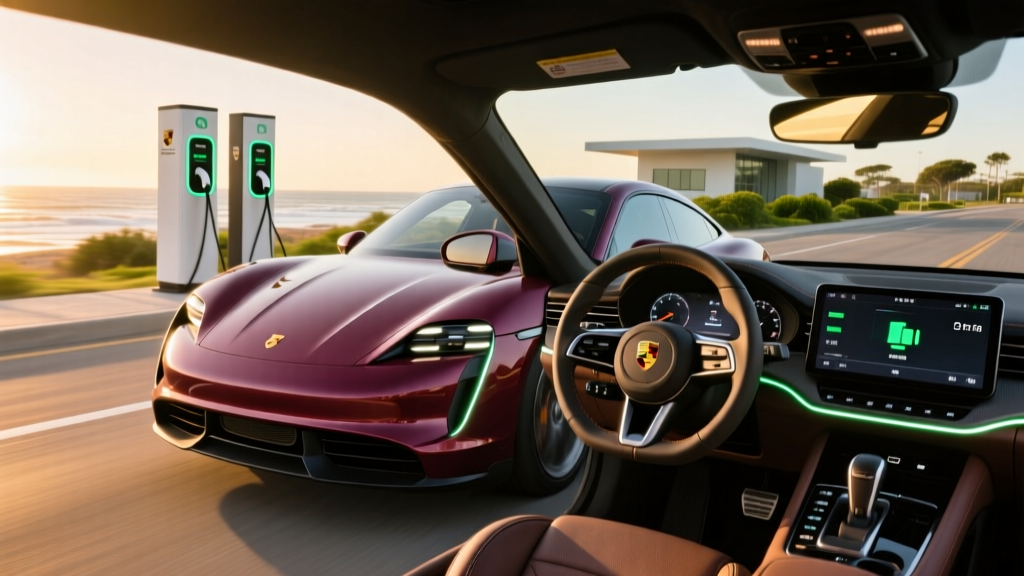
The Porsche Taycan GTS has long occupied the sweet spot in Porsche's electric sports sedan lineup — more aggressive than the 4S, more livable than the Turbo S. For 2026, Porsche carries forward the comprehensive refresh introduced for the 2025 model year, retaining the larger Performance Battery Plus, dramatically improved DC fast-charging speeds, and the adaptive two-chamber air suspension that gives the GTS its dual personality. But with a starting MSRP near $150,000 and no federal tax credit eligibility, the Taycan GTS demands scrutiny beyond its impressive spec sheet. Here's what real ownership looks like.
2026 Porsche Taycan GTS Specifications at a Glance
| Specification | Value |
|---|---|
| EPA Range | 316 miles (Sedan) |
| Real-World Highway Range | ~265–285 miles |
| Battery (Usable) | 97.0 kWh (105.0 kWh gross), NMC lithium-ion |
| Max DC Fast Charge | 320 kW (peak) |
| 10–80% DC Charge Time | ~18 minutes (optimal conditions) |
| Level 2 Home Charging | 11.0 kW (19.2 kW with optional onboard charger) |
| 0–60 mph (Launch Control) | 2.5 seconds |
| Horsepower (Overboost) | 690 hp (with Launch Control) |
| Torque | 590 lb-ft |
| Drivetrain | Dual-motor AWD |
| Efficiency (EPA Combined) | 83 MPGe / 40 kWh/100 mi |
| Base MSRP | $149,195 (incl. destination) |
| Federal Tax Credit (§30D) | Not eligible — exceeds $55,000 sedan MSRP cap |
| Battery Warranty | 8 years / 100,000 miles |
Range and Efficiency: EPA Sticker vs. Reality
The 2026 Taycan GTS sedan carries an EPA-estimated 316 miles of range with the standard Performance Battery Plus (97.0 kWh usable). The Sport Turismo wagon variant drops slightly to approximately 304 miles due to its taller roofline and marginally higher drag coefficient. These figures represent a substantial improvement over the pre-refresh Taycan GTS, which managed just 227 miles on its smaller 83.7 kWh (usable) pack.
- Mixed city/suburban driving (65°F): Expect 290–310 miles. The Taycan's two-speed rear transmission and aggressive regen help in stop-and-go conditions.
- Sustained highway (75 mph, 70°F): Approximately 265–285 miles. The Taycan GTS's 0.25 Cd aero and performance tires work against it at sustained speed compared to efficiency-focused sedans.
- Cold weather (30°F, highway): Plan for 220–250 miles. NMC chemistry loses 15–25% in freezing temps, even with the Taycan's heat pump and battery preconditioning.
- Cold weather + highway + elevation: Worst-case real-world scenarios can push range below 200 miles. Precondition the battery and cabin while plugged in whenever possible.
Efficiency lands at roughly 83 MPGe combined (40 kWh per 100 miles) per the EPA. That's less efficient than a Tesla Model S Long Range (124 MPGe) or Lucid Air Grand Touring (131 MPGe), but competitive with the Audi e-tron GT. Performance tires (standard P Zero or optional P Zero Corsa) and the dual-motor AWD system account for the efficiency penalty relative to lighter, single-motor rivals.
Charging Performance: 320 kW Peak, but Read the Curve
The 2026 Taycan GTS supports a peak DC fast-charge rate of 320 kW via its 800-volt architecture — among the fastest in production. Porsche claims a 10–80% charge time of approximately 18 minutes under optimal conditions (battery preconditioned, ambient temperature 70–85°F, connected to a 350 kW+ charger). This is a meaningful upgrade from the pre-refresh car's 270 kW peak and 22-minute 10–80% time.
| Charging Level | Power / Rate | Miles Added per Hour | Notes |
|---|---|---|---|
| Level 1 (120V, 12A) | ~1.4 kW | ~3–4 mi/hr | Emergency trickle only |
| Level 2 (240V, 48A) | 11.0 kW | ~31 mi/hr | Standard onboard charger |
| Level 2 (240V, 80A, optional) | 19.2 kW | ~54 mi/hr | Requires 100A circuit; $1,080 option |
| DC Fast Charge (peak) | 320 kW | ~550+ mi/hr (at peak) | Requires 350 kW+ station; 800V |
| DC Fast Charge (sustained avg.) | ~220–250 kW | — | Average rate 10–80% with preconditioning |
Here's the nuance most spec sheets omit: the 320 kW figure is a peak, not a sustained rate. In practice, the Taycan GTS holds above 250 kW from roughly 10% to 40% SoC, then tapers progressively. Above 60%, the rate drops below 200 kW; above 80%, it falls sharply to protect the NMC cells. The 18-minute 10–80% claim assumes you've preconditioned the battery (automatic when a DC fast charger is set as your navigation destination) and are connected to a charger capable of delivering 350+ kW — such as Electrify America's latest 350 kW stalls or Tesla Supercharger V4 stations with the NACS adapter Porsche now includes.
For home charging, the standard 11.0 kW onboard charger replenishes the 97.0 kWh usable battery in roughly 9.5 hours from near-empty — practical for overnight top-ups if you're driving 100–150 miles daily. The optional 19.2 kW onboard charger ($1,080) cuts that to about 5.5 hours but requires a dedicated 100-amp circuit, which may necessitate a panel upgrade in older homes (budget $1,500–$4,000 for electrical work on top of the charger hardware).
The Taycan GTS ships with a CCS1 port natively. Porsche now includes a NACS adapter in the box for 2026, granting access to Tesla's Supercharger network — a significant practical advantage for road trips, as Tesla's network remains the most reliable in the U.S.
Performance: 690 HP and the Two-Speed Advantage
The Taycan GTS's dual-motor all-wheel-drive system produces 690 horsepower (515 kW) and 590 lb-ft of torque during Launch Control overboost — up from the pre-refresh model's 590 hp. Normal driving output is approximately 520 hp. The result is a Porsche-claimed 0–60 mph time of 2.5 seconds, placing the GTS within a tenth of the Turbo GT in straight-line acceleration.
What separates the Taycan from its rivals isn't just the 0–60 figure — it's the repeatability. Porsche's 800-volt architecture, two-speed rear axle transmission (first gear for launch, second for highway efficiency), and sophisticated thermal management allow the GTS to perform multiple consecutive full-throttle runs without the power derating that plagues some competitors. On a track or during aggressive canyon driving, the GTS maintains consistent output where a Tesla Model S Plaid, for example, may thermally limit after repeated hard launches.
The adaptive two-chamber, two-valve air suspension (new for the refresh) delivers a wider bandwidth between comfort and sport than the previous single-valve system. In Normal mode, the GTS absorbs highway imperfections with composure approaching a Panamera. In Sport Plus, body roll is nearly eliminated, and the rear-axle steering (standard on GTS) makes the 4,950-lb sedan rotate like a car hundreds of pounds lighter.
Pricing, Tax Credits, and Ownership Cost
The 2026 Porsche Taycan GTS sedan starts at $149,195 including the $1,650 destination charge. The Sport Turismo wagon variant commands a premium, starting around $152,395. As tested with common options — the 19.2 kW onboard charger ($1,080), rear-axle steering (standard on GTS), PCCB ceramic brakes ($9,220), Sport Chrono package (standard on GTS), and Premium Plus package ($4,620) — a well-equipped GTS easily reaches $165,000–$175,000.
- ❌ MSRP cap: The §30D credit caps sedan eligibility at $55,000 MSRP. The Taycan GTS at $149,195 far exceeds this threshold.
- ❌ Battery sourcing: Even if MSRP weren't a barrier, Porsche's battery supply chain (cells from CATL and LG Energy Solution, assembled in Europe) does not currently meet the critical minerals and battery component requirements for the full $7,500 credit.
- ❌ Income cap: Buyer AGI limits ($300K joint / $150K single) are moot — the vehicle itself is ineligible regardless of buyer income.
- ✅ State/local incentives: Some states offer rebates or HOV lane access regardless of price. Check your state's energy office or AFDC incentive database for specifics.
Source: IRS §30D guidelines. Tax rules are subject to change; consult a tax professional for your specific situation.
Without a federal credit, the Taycan GTS's total cost of ownership leans heavily on its residual value (Porsches historically hold value well in the sports-sedan segment), relatively low maintenance costs (no oil changes, minimal brake wear thanks to regen), and electricity costs. At the U.S. average residential rate of ~$0.17/kWh, fully charging the 97 kWh usable battery costs approximately $16.50 — versus roughly $75–$90 to fill a comparable BMW M5's 20-gallon tank at $4.00/gallon. Over 15,000 miles annually, fuel savings run $2,000–$2,500 per year versus a high-performance ICE sedan.
Interior, Cargo, and Daily Livability
The Taycan GTS interior follows Porsche's digital-forward design language: an 11.6-inch curved instrument cluster, a 10.9-inch central touchscreen, and an optional 10.9-inch passenger display. For 2026, Porsche has updated the PCM infotainment with faster processing, wireless Apple CarPlay and Android Auto, and improved native navigation with real-time charger availability and preconditioning integration.
Front passengers enjoy generous headroom (39.0 inches) and legroom (41.2 inches) — comfortable for adults well over six feet tall. Rear accommodations are tighter: 36.5 inches of headroom and 33.3 inches of legroom make the back seat viable for children or shorter adults on longer trips, but cramped for tall passengers. This is a sports sedan, not a limousine.
Cargo space measures 14.3 cubic feet in the rear trunk and 2.8 cubic feet in the front trunk (frunk), for a combined 17.1 cu ft. The Sport Turismo variant improves rear cargo to approximately 15.7 cu ft (44.6 cu ft with rear seats folded), making it meaningfully more practical for gear-heavy lifestyles. Neither figure competes with a Model S (26.3 cu ft rear + 3.1 cu ft frunk) or a Lucid Air (32 cu ft combined).
The GTS-specific interior touches — Race-Tex (Alcantara-like) microfiber upholstery, GTS embossed headrests, deviated stitching, and the GTS Sport Design steering wheel — give the cabin a purposeful, motorsport-adjacent feel that distinguishes it from the more austere 4S.
Driver Assistance and Technology
The Taycan GTS includes Porsche InnoDrive with Active Lane Keeping as standard — Porsche's Level 2 driver-assistance system combining adaptive cruise control, lane centering, and predictive speed adjustment based on navigation data and road-sign recognition. It performs competently on highways but requires constant driver supervision and does not approach the hands-free capability of GM's Super Cruise or Ford's BlueCruise on mapped roads.
The Taycan's InnoDrive is an SAE Level 2 system. You must keep your hands on the wheel and eyes on the road at all times. It does not handle construction zones, unmapped intersections, or complex urban driving. There is no "full self-driving" mode available on any Taycan variant. Porsche has not announced any Level 3 or Level 4 capability for this platform.
Additional tech includes a surround-view camera system, ParkAssist with Reversing Camera, and Night Vision Assist with pedestrian detection (optional). The head-up display projects speed, navigation, and InnoDrive status directly into the driver's sightline — well-executed and legible in direct sunlight.
How the Taycan GTS Stacks Up Against Key Rivals
| Specification | Porsche Taycan GTS | Tesla Model S Plaid | Audi e-tron GT RS | Lucid Air Grand Touring |
|---|---|---|---|---|
| EPA Range | 316 mi | 359 mi | 278 mi | 512 mi |
| Battery (Usable) | 97.0 kWh | ~95 kWh | 93.4 kWh | 112 kWh |
| 0–60 mph | 2.5 sec | 1.99 sec | 3.1 sec | 3.0 sec |
| Horsepower | 690 hp | 1,020 hp | 637 hp | 819 hp |
| Peak DC Charge | 320 kW | 250 kW | 320 kW | 300+ kW |
| Base MSRP | $149,195 | $89,990 | $164,900 | $125,650 |
| Federal Tax Credit | No | Yes (up to $7,500) | No | Partial (check sourcing) |
The Model S Plaid wins on raw acceleration, range, and price — by a wide margin. But it can't match the Taycan's build quality, chassis refinement, or repeatable track performance. The Audi e-tron GT RS shares the Taycan's J1 platform and 800V architecture but trails in power and range while commanding a higher price. The Lucid Air Grand Touring is the efficiency and range champion — over 500 miles EPA — but lacks the Porsche's sporting character and dealer-service infrastructure.
The Taycan GTS's competitive moat is its breadth: a genuine sports car that daily-drives with civility, charges faster than nearly anything on the road, and carries the Porsche crest. If you're cross-shopping a $150K performance sedan and value driving engagement over maximum range or lowest price, the GTS is arguably the most complete package available.
Warranty and Long-Term Battery Outlook
Porsche covers the Taycan GTS with a 4-year / 50,000-mile limited vehicle warranty and an 8-year / 100,000-mile battery warranty. The battery warranty guarantees that the high-voltage pack will retain at least 70% of its original capacity during the coverage period — consistent with industry norms (Tesla, BMW, and Mercedes-Benz all use the same 70% threshold).
Real-world degradation data from pre-refresh Taycan owners (2020–2024 models) is encouraging. Fleet data and owner reports on platforms like TaycanForum suggest typical capacity loss of 5–8% over the first 60,000 miles, well within the 70% warranty floor. The larger 105 kWh gross pack in the 2026 model provides a bigger buffer, meaning even moderate degradation won't meaningfully impact daily usability within the first decade of ownership.
Porsche's scheduled maintenance requirements are minimal: brake fluid flush every 2 years, cabin air filter replacement, tire rotations, and a general vehicle check annually. Porsche offers a complimentary first-year maintenance visit. Long-term maintenance costs are lower than a comparable ICE Porsche 911 or Panamera, though insurance premiums for the Taycan GTS typically run $3,500–$5,000 annually depending on your profile and location.
Who Should Buy the 2026 Porsche Taycan GTS?
- You want the best-driving electric sedan available and can accept a ~270-mile real-world highway range.
- You have reliable home Level 2 charging and access to 350 kW DC fast chargers for road trips.
- Build quality, chassis dynamics, and brand cachet outweigh pure efficiency or maximum range.
- You want a daily-drivable EV that can legitimately handle track days without thermal derating.
- You need 400+ miles of range (choose the Lucid Air Grand Touring or Tesla Model S Long Range).
- Budget is a primary concern — the Model S Plaid delivers more power and range for $60K less.
- You regularly carry four adults — the Taycan's rear seat is tight for grown passengers on long trips.
- Federal tax credit eligibility matters to your purchase calculus — the GTS does not qualify.
Frequently Asked Questions
What is the real-world range of the 2026 Porsche Taycan GTS?
The EPA rates the Taycan GTS sedan at 316 miles. In real-world mixed driving at moderate temperatures, expect 290–310 miles. Sustained highway driving at 75 mph reduces that to approximately 265–285 miles. In freezing weather with highway speeds, plan for 220–250 miles. Always precondition the battery and cabin while plugged in to maximize range in cold conditions.
How fast does the Taycan GTS charge at home and on the road?
On a DC fast charger rated 350 kW or higher, the Taycan GTS peaks at 320 kW and charges from 10–80% in approximately 18 minutes with battery preconditioning. At home on a 240V Level 2 charger, the standard 11.0 kW onboard charger adds about 31 miles per hour (full charge in ~9.5 hours). The optional 19.2 kW onboard charger adds roughly 54 miles per hour but requires a 100-amp dedicated circuit.
Does the 2026 Porsche Taycan GTS qualify for the federal EV tax credit?
No. The IRS §30D federal tax credit caps eligible sedans at $55,000 MSRP. The Taycan GTS starts at $149,195 and is ineligible regardless of buyer income. Additionally, the Taycan's battery supply chain does not currently meet the critical minerals and component sourcing requirements. Some state-level incentives may still apply — check the AFDC state incentive database.
Is the Taycan GTS worth buying over the Tesla Model S Plaid or Lucid Air?
It depends on your priorities. The Model S Plaid is faster (1.99s 0–60), longer-range (359 mi EPA), and $60,000 cheaper — and it qualifies for the $7,500 federal credit. The Lucid Air Grand Touring offers 512 miles of range and superior efficiency. The Taycan GTS wins on driving dynamics, build quality, charging speed (320 kW vs. 250 kW for Tesla), repeatable performance without thermal derating, and Porsche dealer service. If driving engagement matters more than range-per-dollar, the GTS is the stronger choice.
What are the biggest pros and cons of the Taycan GTS?
- Class-leading driving dynamics and chassis balance
- 320 kW peak DC charging — among the fastest available
- Repeatable performance without thermal derating
- Excellent build quality and GTS-specific interior
- Adaptive air suspension with wide comfort-to-sport bandwidth
- NACS adapter included for Tesla Supercharger access
- $149K+ starting price; no federal tax credit
- Real-world highway range ~265–285 mi (trails Lucid/Tesla)
- Rear seat is tight for tall adults
- Modest cargo space (17.1 cu ft combined)
- Driver-assist features lag behind Tesla/GM/Ford
- High insurance premiums ($3,500–$5,000/year)
How does the Taycan GTS handle cold weather?
The Taycan GTS includes a heat pump and battery thermal preconditioning as standard. In freezing temperatures (30°F), expect 15–25% range loss depending on driving style and whether you precondition while plugged in. The heat pump significantly reduces cabin-heating energy draw compared to resistive heaters. DC fast-charging speeds also drop in cold weather — preconditioning via navigation to a charger is essential to achieve anything close to the rated 320 kW peak.