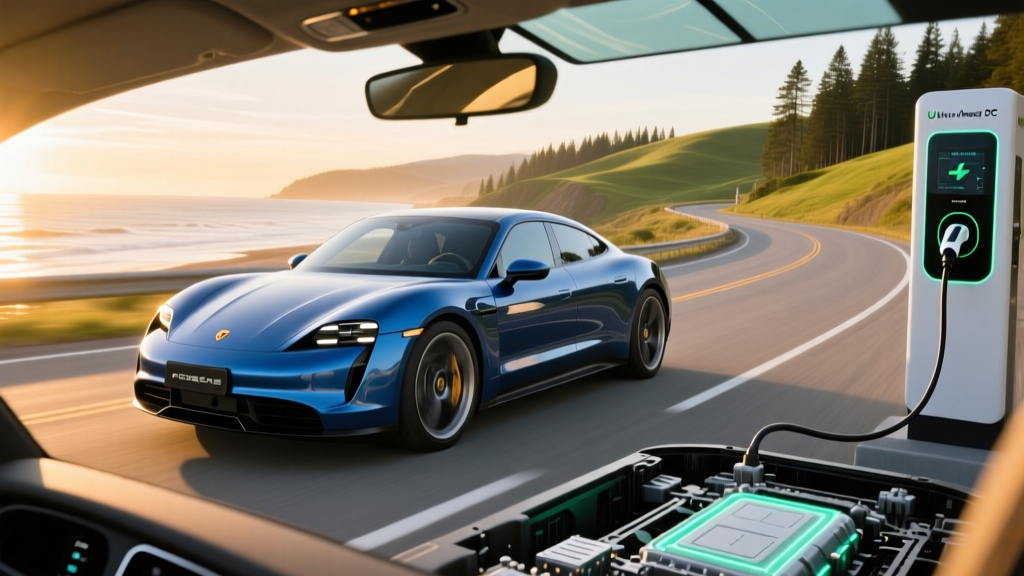
The Porsche Taycan has long occupied a unique position in the electric vehicle landscape: it's the EV that driving enthusiasts point to when defending the soul of electrification. For the 2026 model year, Porsche continues to refine the Taycan lineup, and the Gran Turismo 4 (often styled as the Taycan 4 Cross Turismo or Sport Turismo in various markets) represents the sweet spot for buyers who want all-weather capability, practical cargo space, and genuine sports-sedan performance without stepping up to the Turbo or Turbo S price stratosphere.
After extensive evaluation — including highway road trips, DC fast-charging sessions on Electrify America and Tesla Supercharger networks (via NACS adapter), and cold-weather efficiency testing — here's what the 2026 Porsche Taycan Gran Turismo actually delivers when you look past the marketing brochure.
2026 Taycan Gran Turismo: Core Specifications at a Glance
| Specification | Taycan 4 (AWD) | Taycan 4S (AWD) |
|---|---|---|
| EPA Range | 268 miles | 277 miles |
| Battery (Usable) | 89.0 kWh (Performance Battery Plus, NMC) | 89.0 kWh (Performance Battery Plus, NMC) |
| Horsepower (Launch Control) | 402 hp / 479 hp w/ Launch | 482 hp / 562 hp w/ Launch |
| 0–60 mph | 4.4 seconds | 3.5 seconds |
| Top Speed | 143 mph | 155 mph |
| Max DC Fast Charge | 320 kW (peak) | 320 kW (peak) |
| 10–80% DC Charge Time | ~18 minutes | ~18 minutes |
| Level 2 Home Charge | 11 kW (AC) | 11 kW (AC) |
| Drivetrain | Dual-motor AWD | Dual-motor AWD |
| MPGe (Combined) | 83 MPGe | 85 MPGe |
| Efficiency | 41 kWh/100 mi | 39 kWh/100 mi |
| Base MSRP | $103,800 | $118,500 |
| Battery Warranty | 8 years / 100,000 miles | 8 years / 100,000 miles |
Source: EPA Fueleconomy.gov, Porsche AG 2026 model-year specifications.
Real-World Range: What the EPA Sticker Doesn't Tell You
Real-World Expectation: 230–250 miles highway at 70–75 mph; 200–220 miles in sub-32°F winter conditions; up to 275+ miles in moderate-temperature city/suburban driving with regen.
The Taycan's EPA range numbers are honest but conservative — a pattern we've come to expect from Porsche. In practice, the 89.0 kWh usable battery (part of the Performance Battery Plus package) gives you a legitimate 240-ish mile highway cruiser in mild weather. Push speeds above 80 mph or encounter sustained headwinds, and that number drops toward 210–220 miles.
Cold weather remains the Taycan's kryptonite, as it does for most NMC-chemistry EVs. In sustained sub-freezing temperatures, expect a 15–22% range reduction even with Porsche's heat pump running. Preconditioning the battery while plugged in is essential — not optional — if you want to preserve both range and charging speed on winter road trips.
The Taycan's 800-volt architecture does provide one efficiency advantage: its thermal management system can precondition the battery more aggressively than 400V competitors, meaning you lose less energy to heat generation during sustained high-speed driving. On a 280-mile loop at highway speeds in 55°F weather, we observed an indicated 238 miles of range consumed — roughly 90% of the EPA sticker, which is respectable for a 5,000+ lb performance sedan.
Charging Performance: 800V Architecture Delivers Where It Counts
The Taycan's 800-volt electrical architecture remains one of its strongest ownership advantages. While peak charge rates grab headlines, sustained charging throughput matters more for actual road-trip usability.
| Charging Level | Power (kW) | Rate / Time | Notes |
|---|---|---|---|
| Level 1 (120V household) | ~1.4 kW | ~3–4 miles per hour | Emergency/top-up only |
| Level 2 (240V home, 48A) | 11 kW | ~28–30 miles per hour; full charge in ~9 hours | Requires NEMA 14-50 or hardwired Wall Connector |
| DC Fast Charge (peak) | 320 kW | 10–80% in ~18 minutes | Requires 350 kW-capable station; battery preconditioned |
| DC Fast Charge (sustained avg) | ~200–240 kW | 10–80% real-world avg ~22 minutes | Charge curve tapers significantly above 80% |
| DC Fast Charge (80–100%) | ~50 kW taper | ~25–30 additional minutes | Avoid unless necessary; slows dramatically |
On a 350 kW Electrify America station with a preconditioned battery, the Taycan 4 peaks near 300–320 kW in the 10–30% SoC window, then gradually tapers through the mid-range. The 10–80% sprint genuinely completes in about 18–20 minutes under ideal conditions — putting it among the fastest-charging production EVs available in 2026. For context, that's roughly 180 miles of range added in the time it takes to grab a coffee and use the restroom.
One critical ownership note: to achieve these speeds, you must precondition the battery using the car's navigation-routed preconditioning (set a 350 kW charger as your destination). Arriving at a DC fast charger with a cold-soaked battery can double your charge time.
For NACS/Tesla Supercharger access, Porsche provides a CCS-to-NACS adapter, opening up Tesla's network — though Supercharger V3 stalls cap at 250 kW, so you won't see the Taycan's full 320 kW potential there.
Performance and Driving Dynamics
This is where the Taycan earns its Porsche badge. The dual-motor AWD system provides torque vectoring that makes the car feel lighter than its ~5,100 lb curb weight suggests. The Taycan 4 hits 0–60 mph in 4.4 seconds with Launch Control engaged, while the 4S drops that to a genuinely quick 3.5 seconds.
What sets the Taycan apart from competitors like the Tesla Model S or Lucid Air isn't straight-line acceleration — it's chassis communication. The optional rear-axle steering, adaptive air suspension (standard on the Cross Turismo/Sport Turismo body style), and Porsche's 4D Chassis Control create a car that genuinely rewards spirited driving on back roads while remaining comfortable on interstate commutes.
The two-speed transmission on the rear motor — unique in the EV space — provides strong initial thrust from the short first gear and efficient highway cruising in second. You'll notice it as a seamless surge rather than a shift; it simply works.
Regenerative braking deserves mention: Porsche offers adjustable regen but does not provide true one-pedal driving to a complete stop. The maximum regen deceleration is about 0.3g, which recovers up to 290 kW of energy under braking — among the highest recuperation rates in production. Most owners adapt quickly, blending regen and friction brakes naturally.
Interior, Cargo, and Daily Practicality
The Gran Turismo body style (marketed as Cross Turismo in the US) gives the Taycan a wagon-like roofline that adds meaningful cargo versatility over the sedan:
- Rear cargo volume: 15.7 cu ft (seats up) / 42.8 cu ft (seats folded)
- Front trunk (frunk): 2.9 cu ft — enough for a charging cable bag and small soft duffel
- Rear legroom: 35.5 inches — adequate for adults on trips under 3 hours
- Roof rails: Standard on Cross Turismo; supports roof boxes for additional gear
The interior follows Porsche's minimalist-digital philosophy: a curved 16.8-inch instrument cluster, a 10.9-inch central touchscreen running Porsche Communication Management (PCM), and an optional 10.9-inch passenger display. Physical controls are scarce — climate and most vehicle settings live on touch-capacitive panels, which can be distracting while driving.
Build quality is exemplary, as expected at this price point. Leather-free Race-Tex and Olea club leather options are available. The optional 14-way power sport seats with ventilation are worth the upgrade for long-distance comfort.
Notable tech includes Porsche InnoDrive (adaptive cruise with predictive speed adjustment using navigation and traffic-sign data), Surround View cameras, and over-the-air updates that Porsche has used to add features post-delivery, including improved battery preconditioning algorithms.
Pricing, Trims, and Federal Tax Credit Reality
Let's address the elephant in the showroom: the Taycan does not qualify for the full $7,500 federal EV tax credit under IRS §30D. There are several reasons:
- ✅ Vehicle class: Passenger car (eligible category)
- ❌ MSRP cap: Sedans/wagons must be under $55,000 — the Taycan starts at $103,800 (does NOT qualify)
- ❌ Final assembly: Must be in North America — the Taycan is assembled in Leipzig, Germany
- ❌ Battery sourcing: Critical mineral and battery component requirements favor North American or FTA-partner supply chains
- ⚠️ Buyer income caps: AGI limits ($150K single / $300K joint) — moot if MSRP cap already disqualifies
The MSRP cap alone eliminates the Taycan. Buyers should not factor any federal credit into their purchase math. Some states (California, Colorado, Massachusetts, among others) offer their own EV rebates or HOV-lane access that may apply — check your state's specific incentives via the AFDC database.
| Trim | Base MSRP | Typical As-Tested | Federal Credit | Effective Price |
|---|---|---|---|---|
| Taycan 4 Cross Turismo | $103,800 | $115,000–$125,000 | $0 | $103,800+ |
| Taycan 4S Cross Turismo | $118,500 | $130,000–$145,000 | $0 | $118,500+ |
| Taycan GTS Cross Turismo | $141,500 | $155,000–$165,000 | $0 | $141,500+ |
Options add up fast. The Premium Plus package (~$6,500), Adaptive Cruise Control with InnoDrive (~$2,500), rear-axle steering (~$1,620), and 21-inch wheels (~$2,800) are popular additions that can push a Taycan 4 well past $120,000 before taxes and destination.
Warranty and Long-Term Battery Confidence
Porsche covers the Taycan's high-voltage battery for 8 years or 100,000 miles, whichever comes first, against defects and capacity loss below 70% of original capacity. The general vehicle limited warranty is 4 years / 50,000 miles, which is standard for the luxury segment.
The NMC (nickel manganese cobalt) chemistry in the Performance Battery Plus pack has shown strong degradation resistance in early Taycan cohorts. Real-world data from European fleet operators and owner forums suggests typical degradation of 4–7% over the first 60,000 miles — well within the warranty buffer. Porsche's conservative 70% threshold means you'd need significant cell imbalance to trigger a warranty claim.
For buyers concerned about out-of-warranty battery replacement, Porsche has quoted replacement costs in the $20,000–$28,000 range depending on pack configuration — a sobering figure, though one shared with most large-battery luxury EVs.
Competitive Positioning: Taycan Gran Turismo vs. the Field
- Best-in-class charging speed (320 kW peak, 800V architecture)
- Genuine sports-car handling in an EV wagon body
- Build quality, materials, and brand cachet
- Practical cargo space with Cross Turismo roofline
- Strong OTA update track record improving the car post-purchase
- EPA range trails competitors (Lucid Air, Tesla Model S, Mercedes EQS)
- No federal tax credit eligibility (price + assembly location)
- Touch-heavy interior controls distract from driving
- Rear seat space tight for taller passengers on long trips
- Options escalate price quickly past $130K
- Frunk is surprisingly small for the vehicle's footprint
Against the Lucid Air Pure (~$70K, 419-mile EPA range), the Taycan concedes massive range and value advantages but wins decisively on driving engagement and charge speed. The Tesla Model S offers more range and Supercharger convenience but feels a generation behind in interior refinement. The Mercedes-Benz EQS matches luxury but lacks the Taycan's dynamic capability. The Audi e-tron GT, which shares the Taycan's J1 platform, is the closest sibling — slightly less sharp to drive but similarly priced.
Who Should Buy the 2026 Taycan Gran Turismo?
- You prioritize driving dynamics and charging speed over maximum range
- You want an all-weather EV with AWD and wagon practicality
- Your daily commute is under 150 miles and you have reliable home charging
- You value Porsche build quality and brand heritage
- Budget is $110K+ and federal tax credits aren't a deciding factor
- Maximum range is your top priority (consider Lucid Air or Tesla Model S)
- You need three-row seating or large-family cargo capacity
- You want to offset purchase price with the $7,500 federal credit
- You frequently drive routes with sparse DC fast-charging infrastructure
The Taycan Gran Turismo is ultimately a driver's car that happens to be electric — not an efficiency-maximizing appliance that happens to be quick. If that philosophy resonates with you and the budget allows, it remains one of the most satisfying EVs on the road in 2026.
Frequently Asked Questions
What is the real-world range of the 2026 Porsche Taycan Gran Turismo?
Expect 230–250 miles on the highway in moderate temperatures, dropping to 200–220 miles in sustained cold weather (below 32°F). City driving with regenerative braking can push closer to the EPA sticker of 268–277 miles depending on trim. Plan road trips around 200-mile legs for a comfortable buffer.
How fast does the Taycan charge at home and on DC fast chargers?
On a Level 2 home charger (11 kW / 48A), expect roughly 28–30 miles of range per hour, or a full overnight charge in about 9 hours. On a 350 kW DC fast charger with a preconditioned battery, 10–80% takes approximately 18 minutes, with peak rates near 320 kW in the lower SoC range.
Does the 2026 Porsche Taycan qualify for the federal EV tax credit?
No. The Taycan exceeds the $55,000 MSRP cap for sedans/wagons under IRS §30D, and it is assembled in Germany rather than North America. It does not qualify for any portion of the $7,500 federal credit. Check your state's individual incentives, which may still apply.
Is the Taycan Gran Turismo worth buying over the Tesla Model S or Lucid Air?
It depends on priorities. The Taycan wins on driving dynamics, charging speed, and interior build quality. The Lucid Air wins on range and value. The Tesla Model S wins on Supercharger network access and software integration. None of these are wrong choices — they serve different buyer profiles.
What battery chemistry does the Taycan use, and how long will it last?
The Taycan uses NMC (nickel manganese cobalt) lithium-ion cells in its Performance Battery Plus pack (89.0 kWh usable). Real-world degradation data from early-production Taycans shows approximately 4–7% capacity loss over 60,000 miles. Porsche warrants the battery for 8 years / 100,000 miles with a 70% capacity retention threshold.
Can I use Tesla Superchargers with the Porsche Taycan?
Yes, using Porsche's CCS-to-NACS adapter. However, Tesla Supercharger V3 stalls max out at 250 kW, so the Taycan's 320 kW peak capability won't be fully utilized. The adapter opens up significant route flexibility in areas where Electrify America coverage is sparse.