Quick Verdict: A Statement Color on a Benchmark EV
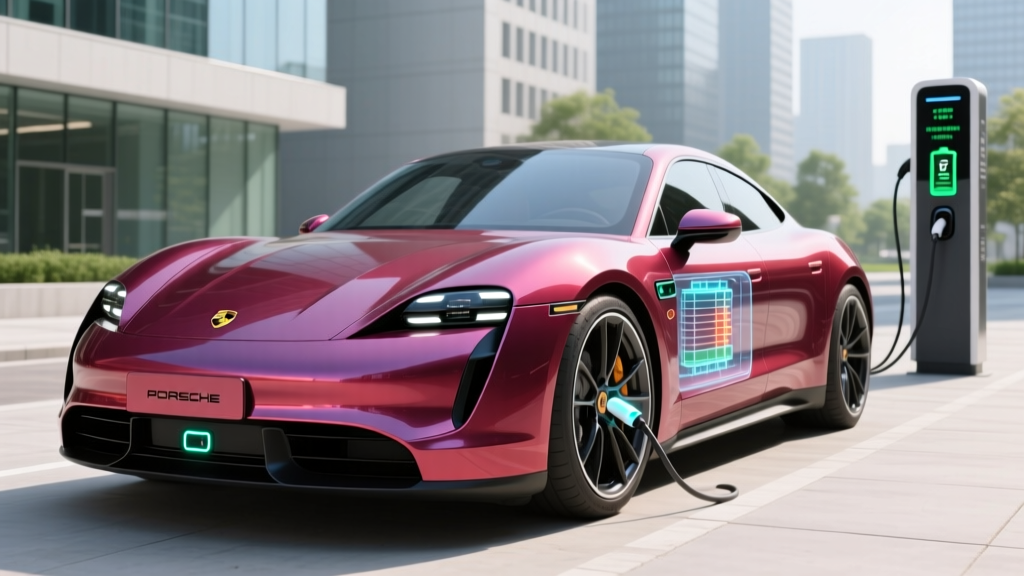
Frozen Berry Metallic is one of Porsche's most polarizing and sought-after paint-to-sample (PTS) hues — a deep, muted burgundy that reads almost purple under overcast skies and shifts toward warm crimson in direct sunlight. For the 2026 model year, it remains available through Porsche's Exclusive Manufaktur program, adding roughly $3,270 to the base MSRP of any Taycan trim. But the color is only the wrapper. The 2026 Taycan itself received a significant mid-cycle refresh that upgraded battery chemistry, charging architecture, and efficiency, making it one of the most capable luxury EVs on the market.
This review covers the full 2026 Taycan lineup through the lens of the Frozen Berry Metallic specification — what the color costs, which trims it pairs best with, and whether the underlying EV justifies the premium.
2026 Porsche Taycan Specifications at a Glance
| Spec | Base RWD | 4S AWD | Turbo GT |
|---|---|---|---|
| EPA Range (est.) | 318 mi | 299 mi | 269 mi |
| Battery (usable) | 97.0 kWh (NMC) | 97.0 kWh (NMC) | 97.0 kWh (NMC) |
| Horsepower | 402 hp (w/ Launch Control) | 590 hp | 1,019 hp |
| 0-60 mph | 4.6 sec | 3.5 sec | 2.1 sec |
| Drivetrain | RWD, single-motor | AWD, dual-motor | AWD, dual-motor |
| Peak DC Charge Rate | 320 kW | 320 kW | 320 kW |
| 10-80% DCFC Time | ~18 min | ~18 min | ~18 min |
| Level 2 Rate | 11 kW (AC) | 11 kW (AC) | 11 kW (AC) |
| MPGe (combined) | 87 MPGe | 82 MPGe | 72 MPGe |
| Base MSRP | $103,800 | $130,400 | $240,000 |
| Battery Warranty | 8 yr / 100,000 mi | 8 yr / 100,000 mi | 8 yr / 100,000 mi |
Sources: fueleconomy.gov, Porsche USA official specifications.
Range and Efficiency: EPA vs. the Real World
Real-World Expectation: 260–285 mi highway at 70 mph; ~220–240 mi in freezing temperatures with cabin heat. The 4S drops to roughly 245–265 mi highway, and the Turbo GT settles around 210–230 mi under aggressive driving.
The 2026 Taycan's revised Performance Battery Plus uses an updated NMC (nickel-manganese-cobalt) cell chemistry with improved energy density over the pre-refresh 93.4 kWh pack. The usable capacity is now 97.0 kWh. Porsche's thermal management system — which includes a heat pump as standard equipment — helps mitigate cold-weather losses, but the Taycan's wide tires and sport-tuned suspension still extract a penalty on the highway compared to more efficiency-focused sedans like the Lucid Air or Tesla Model S.
In mixed suburban driving at moderate speeds (35–55 mph), hitting or slightly exceeding the EPA figure is realistic. On a sustained 75 mph interstate run in 50°F weather, expect roughly 82–88% of the sticker range. Drop the thermometer below 30°F and add seat heaters instead of blasting cabin air, and you'll see closer to 70–75% retention. This is typical for performance-oriented EVs and not a Taycan-specific flaw.
Efficiency for the base RWD model sits at approximately 31 kWh/100 mi (87 MPGe combined), which trails the Hyundai Ioniq 6 Long Range (24 kWh/100 mi) but beats the BMW i7 xDrive60 (35 kWh/100 mi). For a 5,000-lb sports sedan, that's respectable.
Charging: 320 kW Peak, but Read the Curve
| Level | Power | Speed | Notes |
|---|---|---|---|
| Level 1 (120V) | ~1.4 kW | ~4 mi/hr | Emergency/trickle only |
| Level 2 (240V) | 11 kW (onboard) | ~33 mi/hr | Full charge in ~10 hr |
| DC Fast Charge | 320 kW peak | 10-80% in ~18 min | Requires 800V station (350 kW capable) |
The Taycan was the first production EV on an 800-volt architecture, and the 2026 model pushes the DC fast-charge ceiling to 320 kW — up from 270 kW on the pre-refresh generation. At a 350 kW-capable Electrify America or Ionity station, the charge curve is remarkably flat: the Taycan sustains above 280 kW from roughly 10% to 55% state of charge, then tapers gradually rather than falling off a cliff. This means real-world charging sessions are genuinely fast, not just peak-number marketing.
However, a critical caveat: if you plug into a 150 kW CCS station (still common in many networks), you'll max out at 150 kW and your 10-80% time stretches to roughly 30–33 minutes. The 800V architecture's advantage is most fully realized at 350 kW chargers. Porsche includes three years of complimentary 30-minute charging sessions at Electrify America stations, which partially offsets the infrastructure dependency.
For home charging, the 11 kW onboard charger means a full Level 2 session (0–100%) takes about 10 hours on a 48-amp circuit. Most owners will need a NEMA 14-50 outlet or hardwired wall connector installed by a licensed electrician — budget $800–$2,000 for the installation depending on panel capacity and run length.
Performance: From Composed Cruiser to Track Weapon
The 2026 Taycan lineup spans a wide performance envelope:
- Base RWD: 402 hp with Launch Control, 4.6-second 0-60. Rear-wheel drive delivers a more traditional Porsche feel with controllable oversteer on throttle lift.
- 4S (AWD): 590 hp, 3.5-second 0-60. The dual-motor setup adds all-weather confidence and a half-second advantage over the base.
- Turbo GT: 1,019 hp (with Attack Mode), 2.1-second 0-60. This is hypercar territory in a four-door sedan. The Weissach Package strips rear seats for weight savings.
Across all trims, the two-speed transmission on the rear axle (unique among EVs) gives the Taycan a punch off the line and relaxed highway cruising in the tall second gear. Regenerative braking recovers up to 290 kW — among the highest in the industry — enabling genuine one-pedal driving in most conditions, though Porsche deliberately leaves some creep in for drivers transitioning from ICE vehicles.
Ride quality on the standard adaptive air suspension (PASM) is firm but compliant. The optional rear-axle steering ($1,620) tightens the turning circle and makes this 16-foot sedan feel like a compact in parking lots.
Frozen Berry Metallic: Cost, Availability, and Pairing
Frozen Berry Metallic is offered through Porsche's Paint to Sample (PTS) and Exclusive Manufaktur channels. For the 2026 model year, it is available on all Taycan trims, including the Turbo GT. The upcharge is approximately $3,270 over standard metallic colors (which themselves cost $830). This places it in Porsche's "special color" tier — less expensive than a full PTS custom ($12,000+), but significantly more than a standard solid.
The color photographs best on the 4S and GTS trims, where the SportDesign body panels and darker accent trim create contrast. On the base model, the smoother bodywork lets the hue read as more monochromatic. Interior pairing recommendations from Porsche include black or chalk-beige leather with deviated stitching in Carmine Red — a combination that echoes the exterior's warmth without clashing.
Lead times for Frozen Berry Metallic can add 4–8 weeks to production scheduling, as PTS-painted bodies run through a separate paint booth at the Zuffenhausen plant. If you're ordering in early 2026 for summer delivery, factor this into your timeline.
Pricing, Tax Credits, and Total Cost
| Trim | Base MSRP | + Frozen Berry | As-Tested (Typical Options) | §30D Credit Eligible? |
|---|---|---|---|---|
| Base RWD | $103,800 | $107,070 | $118,000–$125,000 | No (MSRP cap: $55,000 sedans) |
| 4S AWD | $130,400 | $133,670 | $145,000–$158,000 | No |
| Turbo GT | $240,000 | $243,270 | $260,000+ | No |
The federal §30D clean vehicle credit has an MSRP cap of $55,000 for sedans (and $80,000 for SUVs/trucks/vans). Since every Taycan trim starts well above $55,000, no version of the 2026 Taycan qualifies for the $7,500 federal EV tax credit. Additionally, the buyer income cap ($150,000 single / $300,000 joint) would eliminate many Taycan purchasers regardless.
Some states offer supplemental rebates or luxury-EV incentives — California's CVRP, for example, has been restructured and currently excludes vehicles above certain price thresholds. Always verify current eligibility on IRS.gov and your state's energy office before counting on incentives.
For total cost of ownership over five years, expect higher insurance premiums (the Taycan averages $3,200–$4,100/year to insure depending on trim and driver profile), premium tire replacement ($400–$600 per corner for the Michelin Pilot Sport EV or Pirelli P Zero Elect), and relatively strong depreciation typical of six-figure luxury EVs — roughly 45–55% over five years according to industry estimates.
Interior, Cargo, and Technology
The Taycan's cabin is a study in Porsche minimalism: a curved 16.8-inch digital instrument cluster, a 12.3-inch center touchscreen running Porsche Communication Management (PCM), and an optional 10.9-inch passenger display. Physical buttons are scarce — climate controls live on a lower touch panel that some drivers find finicky while driving.
Cargo space: The rear trunk offers 14.3 cubic feet (sedan) or 15.7 cubic feet (Sport Turismo/Cross Turismo wagon). The front trunk (frunk) adds 2.8 cubic feet — enough for a charging cable bag and a small duffel. Total cargo volume is modest compared to the Mercedes EQS (22 cu ft trunk) or Tesla Model S (26 cu ft rear + 3.1 cu ft frunk).
Passenger space: Rear legroom measures 32.7 inches — adequate for adults on shorter trips but tight for anyone over 6 feet tall. The Cross Turismo's slightly raised roofline adds about an inch of rear headroom. This is a driver's car first; rear-seat comfort is secondary.
Driver assistance: Porsche InnoDrive with Active Lane Keeping is the Taycan's primary ADAS suite. It is an SAE Level 2 system — the driver must keep hands on or near the wheel and remain fully engaged at all times. It is not autonomous driving. The system handles adaptive cruise, lane centering, and predictive speed adjustment based on navigation data, and it performs competently on highways. However, it trails Tesla's Autopilot and GM's Super Cruise in lane-change automation and hands-free capability.
Pros, Cons, and Who Should Buy
- Best-in-class driving dynamics and steering feel
- 320 kW DC charging is among the fastest available
- 800V architecture enables sustained fast-charge curves
- Build quality and materials are exceptional
- Frozen Berry Metallic is a distinctive, head-turning finish
- Heat pump standard across all trims
- No federal tax credit eligibility (MSRP far exceeds cap)
- Rear seat and cargo space lag competitors
- Real-world highway range trails EPA by 12–18%
- Infotainment touch panels can be distracting
- Insurance and tire replacement costs are high
- PTS paint adds cost and 4–8 week lead time
Best suited for: Enthusiast drivers who prioritize handling, build quality, and exclusivity over maximum range or practicality. The Taycan in Frozen Berry Metallic is a spec for someone who already has a daily-driver SUV and wants an EV sports sedan that stands apart from the Tesla-and-Polestar crowd. It's a strong commuter if your round trip is under 200 miles, and it handles road trips well thanks to its fast charging — provided you plan stops around 350 kW-capable stations.
Look elsewhere if: You need family-hauler space (consider the BMW i5 or Mercedes EQE SUV), you're chasing maximum range per dollar (Lucid Air Pure delivers 419 mi EPA for under $70K), or you want the latest hands-free ADAS technology (GM Super Cruise or Ford BlueCruise).
Frequently Asked Questions
What is the real-world range of the 2026 Porsche Taycan?
The base RWD Taycan carries a 318-mile EPA rating. In real-world highway driving at 70 mph, expect 260–285 miles. In freezing weather with cabin heat, that drops to roughly 220–240 miles. The Turbo GT, driven hard, may return as little as 200 miles between charges.
How fast does the Taycan charge at home and on the road?
At home on a Level 2 (240V, 48-amp) charger, the 11 kW onboard charger adds about 33 miles per hour, filling the 97 kWh battery in roughly 10 hours. On a 350 kW DC fast charger, the Taycan peaks at 320 kW and charges from 10–80% in approximately 18 minutes.
Does the Porsche Taycan qualify for the federal EV tax credit?
No. The §30D credit caps sedan eligibility at $55,000 MSRP. Every 2026 Taycan trim starts above $100,000, making none eligible. Buyer income limits ($150K single / $300K joint) and battery critical-mineral sourcing rules would also disqualify many buyers. Verify current rules at IRS.gov.
Is the Taycan worth it vs. the Tesla Model S or Lucid Air?
If driving dynamics, interior craftsmanship, and exclusivity matter most, yes. The Taycan's steering feel, brake modulation, and suspension tuning remain benchmarks. If range and value are your priority, the Lucid Air Grand Range (516 mi EPA, ~$87K) and Tesla Model S Long Range (402 mi EPA, ~$80K) are more efficient and far cheaper. The Taycan is the driver's choice; the Air is the efficiency choice.
How much does Frozen Berry Metallic add to the price?
Approximately $3,270 over a standard metallic color. It's available across all 2026 Taycan trims but adds 4–8 weeks to production lead time due to the separate PTS paint process at Porsche's Zuffenhausen factory.
What is the Taycan's battery warranty?
Porsche covers the high-voltage battery for 8 years or 100,000 miles, whichever comes first. The warranty guarantees the battery will retain at least 70% of its original capacity during that period. The general vehicle warranty is 4 years / 50,000 miles.