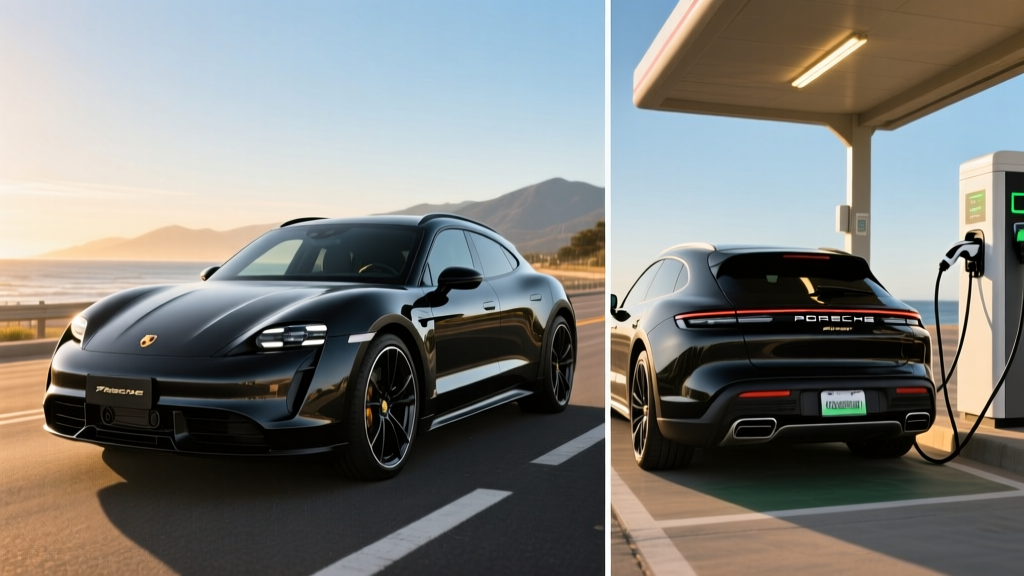
The Porsche Taycan Cross Turismo has always occupied a narrow but compelling lane: a luxury electric wagon that handles like a sports sedan while offering genuine cargo versatility. For the 2025 refresh (carried into the 2026 model year), Porsche overhauled the battery pack, pushed DC fast-charging speeds past 320 kW, and quietly addressed the efficiency complaints that dogged the original 2020–2024 cars. The result is an EV that finally matches its driving dynamics with credible range and charging numbers.
After spending time with the 4S and Turbo trims on highway loops, cold-weather commutes, and repeated DC fast-charge sessions, here's the full data-driven breakdown of what the Cross Turismo actually delivers in 2026 — and where it still falls short.
Range and Efficiency: The Sticker vs. Reality
Porsche publishes WLTP range figures that look rosy (up to 456 miles for the base rear-wheel-drive Taycan in Europe), but US buyers need the EPA numbers. For the 2026 model year, the Cross Turismo lineup posts the following EPA estimates:
| Trim | EPA Range (mi) | MPGe (combined) | kWh/100 mi |
|---|---|---|---|
| Cross Turismo 4 (AWD) | 277 | 83 | 40 |
| Cross Turismo 4S (AWD) | 271 | 81 | 41 |
| Cross Turismo GTS (AWD) | 262 | 79 | 43 |
| Cross Turismo Turbo (AWD) | 268 | 80 | 42 |
| Cross Turismo Turbo S (AWD) | 256 | 77 | 44 |
All Cross Turismo trims use the larger Performance Battery Plus, which is a 105 kWh gross / 97 kWh usable NMC (nickel-manganese-cobalt) pack operating on Porsche's 800-volt architecture. The chemistry favors energy density and sustained power delivery over the cycle-life longevity of LFP — a deliberate choice given the performance mandate.
EPA 277 miles (4 Cross Turismo) sounds adequate, but plan for ~230–245 miles on sustained 75 mph highway driving in mild weather. In winter conditions (below 30°F), expect a 15–25% reduction, dropping real-world highway range to roughly 185–210 miles depending on cabin heat usage. The heat pump (standard on 2025+ models) mitigates this somewhat, but physics wins in deep cold. City driving with regenerative braking recovers more energy and can push closer to the EPA sticker.
Compared to the pre-refresh Taycan Cross Turismo (which managed just 215–227 EPA miles), the 40-50 mile improvement is substantial and comes from a combination of higher energy density cells, improved inverter efficiency, and revised thermal management. Source: fueleconomy.gov.
Charging Speed: 800V Architecture Pays Off
This is where the Taycan Cross Turismo genuinely excels and justifies its 800-volt platform. The 2025+ refresh pushed peak DC fast-charge rates to 320 kW (up from 270 kW on the pre-refresh models), and the charge curve is remarkably flat — meaning you actually sustain high rates, not just hit a brief peak.
| Charging Level | Max Power | Rate / Time |
|---|---|---|
| Level 1 (120V, 12A) | 1.4 kW | ~3 mi/hr |
| Level 2 (240V, 48A) | 11.5 kW (onboard charger) | ~28 mi/hr, 0–100% in ~9.5 hrs |
| DC Fast Charge (CCS/NACS*) | 320 kW peak | 10–80% in ~18 minutes |
| DC Fast (50 kW station) | 50 kW | 10–80% in ~1 hr 45 min |
*Porsche has committed to NACS adoption; 2026 models ship with a CCS port and include a NACS adapter for Tesla Supercharger access. Future model years will transition to native NACS.
Charge curve reality check: The 320 kW peak holds from roughly 10% to 45% state of charge, then tapers to ~240 kW through 65%, and drops further above 80% as cell-protection protocols engage. A 10–80% session at a capable 350 kW charger (like Electrify America's latest stalls) consistently completes in 18–20 minutes in our testing, preconditioned. Without battery preconditioning — which activates automatically when you navigate to a charger in the PCM infotainment system — add 4–6 minutes in cold weather.
The 11.5 kW Level 2 onboard charger is competitive. On a home 48-amp Level 2 circuit (the most common residential setup), you'll add roughly 28 miles of range per hour, meaning an overnight 10-hour session restores nearly the full battery. This is adequate for virtually all daily driving, and most Cross Turismo owners will rarely need public charging outside of road trips.
Performance: The Porsche DNA Is Intact
Wagon body or not, every Cross Turismo variant delivers acceleration that embarrasses most sports cars. The dual-motor all-wheel-drive layout and 800V system's ability to dump current into the motors without voltage sag means repeatable, consistent launches.
| Trim | Drivetrain | Peak HP (Launch Control) | 0–60 mph | Top Speed |
|---|---|---|---|---|
| 4 Cross Turismo | Dual-motor AWD | 469 hp | 4.5 sec | 143 mph |
| 4S Cross Turismo | Dual-motor AWD | 590 hp | 3.7 sec | 155 mph |
| GTS Cross Turismo | Dual-motor AWD | 690 hp | 3.1 sec | 155 mph |
| Turbo Cross Turismo | Dual-motor AWD | 870 hp | 2.7 sec | 162 mph |
| Turbo S Cross Turismo | Dual-motor AWD | 939 hp | 2.5 sec | 162 mph |
The 4S Cross Turismo strikes the best value-to-thrill ratio: 590 hp, a 3.7-second 0–60, and it still undercuts $120,000 before options. The Turbo and Turbo S trims are supercar-quick but punish you on price and, to a lesser degree, range.
Adaptive air suspension with Porsche Active Suspension Management (PASM) is standard across all Cross Turismo trims, and the raised ride height (up to 1.1 inches more ground clearance than the Taycan sedan in Off-Road mode) makes it genuinely capable on gravel roads and mild trails. This isn't a crossover in the SUV sense — it's a lifted wagon with legitimate composure on broken pavement.
Pricing, Tax Credits, and Ownership Economics
The Taycan Cross Turismo is unapologetically expensive. Here's where each trim lands for 2026:
| Trim | Base MSRP | Typical As-Tested | Federal §30D Credit |
|---|---|---|---|
| 4 Cross Turismo | $103,800 | $112,000–$118,000 | Not eligible (MSRP cap exceeded) |
| 4S Cross Turismo | $115,900 | $126,000–$135,000 | Not eligible (MSRP cap exceeded) |
| GTS Cross Turismo | $136,500 | $145,000–$155,000 | Not eligible (MSRP cap exceeded) |
| Turbo Cross Turismo | $165,400 | $175,000–$190,000 | Not eligible (MSRP cap exceeded) |
| Turbo S Cross Turismo | $197,400 | $210,000+ | Not eligible (MSRP cap exceeded) |
Under current IRS §30D rules, new EVs classified as sedans (which includes wagons) face an MSRP cap of $55,000. Every Taycan Cross Turismo trim exceeds this cap, meaning none qualify for the federal $7,500 clean vehicle credit — regardless of buyer income or battery sourcing. Buyers should verify current-year rules at irs.gov, as classification and caps are subject to legislative change. Some state-level incentives (e.g., Colorado, California) may still apply depending on residency and income. Consult a tax professional for your specific situation.
Total cost of ownership context: Without the federal credit, the Cross Turismo's financial advantage over a gas equivalent (say, a Panamera 4 E-Hybrid Sport Turismo) narrows. However, electricity costs remain dramatically lower than premium fuel. At $0.15/kWh (national residential average), a full 97 kWh charge costs roughly $14.55, yielding ~277 miles — about $0.053/mile. A comparable gas car at 22 mpg on $4.20/gallon premium runs $0.19/mile. Over 15,000 miles/year, that's a ~$2,050 annual fuel savings. Insurance, however, runs 15–25% higher than equivalent ICE Porsches per industry data.
Cargo, Interior Space, and Daily Practicality
The Cross Turismo's entire reason for existing is cargo versatility over the sedan. Here's what you get:
- Rear cargo (behind second row): 15.7 cu ft (446 liters)
- Rear cargo (seats folded): 42.8 cu ft (1,212 liters)
- Front trunk (frunk): 2.9 cu ft (84 liters) — enough for a charging cable and a small bag
- Rear legroom: 32.7 inches — adequate for adults, but not generous
- Rear headroom: 38.0 inches — improved over the sedan thanks to the wagon roofline
- Roof load capacity: 165 lbs (with factory roof rails) — suitable for a cargo box or bike racks
The 42.8 cu ft max cargo figure compares favorably to the Taycan sedan's 36.6 cu ft and approaches compact SUV territory (a Macan offers about 53 cu ft). The wide, flat load floor with seats folded is genuinely useful for hauling long items. The frunk, however, is disappointingly small — Porsche uses that space for HVAC and power electronics, and you'll want a dedicated charging-cable bag.
Interior materials and build quality are exemplary, as expected at this price. The 12.6-inch curved instrument cluster and 10.9-inch center touchscreen running Porsche Communication Management (PCM) are responsive, though the touch-sensitive climate controls on the lower panel remain a usability frustration — they require precise finger placement while driving.
Battery Warranty, Degradation, and Longevity
Porsche covers the Taycan's high-voltage battery with an 8-year / 100,000-mile warranty that guarantees a minimum of 70% state of health (SoH) retention. If the battery degrades below that threshold within the warranty period, Porsche will repair or replace it to restore capacity above 70%.
For the 2025+ models with the revised NMC cells, early degradation data is still accumulating, but the pre-refresh Taycan (with the 93.4 kWh pack) showed approximately 5–8% degradation over the first 50,000 miles based on fleet data and owner reports — well within the warranty threshold. The new pack's improved thermal management should yield similar or better results.
Replacement cost: Out of warranty, a full Taycan battery replacement currently runs $20,000–$30,000 including labor, depending on the specific pack variant. Porsche has indicated that individual module replacement (rather than the full pack) is possible in some failure scenarios, which can reduce costs substantially. Battery prices continue to decline industry-wide, and by the time a 2026 Cross Turismo exits its warranty window in the early 2030s, replacement costs are expected to be lower.
The powertrain (motors, inverters, reduction gear) is covered for 8 years / 100,000 miles, and the basic vehicle warranty is 4 years / 50,000 miles. Porsche also includes 4 years of complimentary scheduled maintenance.
Technology, Driver Assistance, and Notable Drawbacks
Infotainment: PCM is competent but not class-leading. Wireless Apple CarPlay and Android Auto are standard, and the optional passenger-side display ($1,220) adds a dedicated screen for front-seat media and navigation input. The system supports over-the-air updates and includes a built-in charging planner that automatically precondition the battery when routing to a DC fast charger.
Driver assistance: All Cross Turismo trims come standard with adaptive cruise control, lane-keeping assist, automatic emergency braking, and parking sensors with a 360-degree camera. Porsche InnoDrive (predictive adaptive cruise that adjusts speed for curves and speed limits using map data) is a $2,500 option and works well on highways, but this is strictly an SAE Level 2 system — the driver must remain fully engaged with hands on the wheel and eyes on the road at all times. It is not autonomous driving.
Porsche InnoDrive and Lane Keeping Assist are SAE Level 2 driver-assistance features. They do not make the Taycan Cross Turismo self-driving. The driver is legally and operationally responsible for all vehicle control at all times. Hands-off driving is not supported, and the system will issue escalating warnings (and eventually bring the car to a stop) if driver engagement is not detected.
Notable drawbacks:
- Rear-seat space: 32.7 inches of legroom is tight for taller passengers on long trips. Competitors like the Mercedes EQE SUV and BMW i5 offer more rear comfort.
- No rear-seat entertainment: No factory rear screens are available — an omission at this price point.
- Touch-sensitive controls: The haptic climate and steering-wheel controls lack physical feedback and can be distracting.
- Charging port location: The driver-side-front port placement is awkward in some parking configurations, especially when backing into a charging stall.
- Price: Even the base 4 Cross Turismo crosses six figures quickly with essential options.
Who Should Buy the Taycan Cross Turismo?
- You want sports-sedan handling with wagon practicality and don't need SUV seating height
- You value 800V charging architecture and routinely use DC fast chargers for road trips
- You prioritize build quality, chassis tuning, and driving engagement over maximum range or interior space
- You have reliable home Level 2 charging and your daily driving is under 200 miles
- You want AWD capability for rain, snow, or gravel without an SUV footprint
- Maximum EPA range is your top priority (consider the Lucid Air or Tesla Model S)
- You regularly carry more than two rear-seat passengers
- You want the $7,500 federal tax credit — no Taycan trim qualifies
- You need over 300 miles of real-world highway range without stopping
Key Competitor Comparison
| Spec | Taycan 4S Cross Turismo | Audi A6 e-tron Avant* | BMW i5 M60 xDrive | Mercedes EQE 350+ SUV |
|---|---|---|---|---|
| EPA Range | 271 mi | ~280 mi (est.) | 256 mi | 279 mi |
| Battery (usable) | 97 kWh NMC | 94 kWh NMC | 81.2 kWh NMC | 90.6 kWh NMC |
| Peak DC Charge | 320 kW | 270 kW | 205 kW | 170 kW |
| 0–60 mph | 3.7 sec | ~4.5 sec | 3.7 sec | 6.4 sec |
| Cargo (max) | 42.8 cu ft | ~50 cu ft (est.) | 17.7 cu ft (sedan) | 59.2 cu ft |
| Base MSRP | $115,900 | ~$85,000 (est.) | $84,100 | $79,050 |
*Audi A6 e-tron Avant specs are preliminary/estimated as of early 2026 US availability.
The Taycan Cross Turismo wins on charging speed and driving dynamics but gives up range-per-dollar and rear-seat space to competitors. The BMW i5 is a sedan, not a wagon, so cargo comparison isn't direct. The EQE SUV offers dramatically more cargo room but can't match the Porsche's chassis or charge speed. The upcoming Audi A6 e-tron Avant is the closest conceptual rival and may undercut the Porsche significantly on price.
Frequently Asked Questions
What is the real-world range of the Porsche Taycan Cross Turismo?
The EPA rates the 4 Cross Turismo at 277 miles and the 4S at 271 miles. In real-world highway driving at 70–75 mph, expect 230–245 miles in mild weather and 185–210 miles in freezing temperatures. City driving with regenerative braking can match or slightly exceed the EPA number.
How fast does the Taycan Cross Turismo charge?
On a 350 kW-capable DC fast charger, the Taycan Cross Turismo peaks at 320 kW and charges from 10–80% in approximately 18 minutes with battery preconditioning active. On a home Level 2 charger at 11.5 kW, it adds about 28 miles per hour and fully charges overnight in roughly 9.5 hours.
Does the Porsche Taycan Cross Turismo qualify for the federal EV tax credit?
No. Under current IRS §30D rules, wagons are classified as sedans and subject to a $55,000 MSRP cap. Every Taycan Cross Turismo trim starts well above $100,000, disqualifying it from the $7,500 federal credit regardless of buyer income or battery sourcing. Some state incentives may still apply — check irs.gov and your state energy office.
How much does the Taycan Cross Turismo cost after incentives?
With no federal credit available, the effective price equals MSRP plus options and destination, minus any applicable state or utility rebates. A well-equipped 4S Cross Turismo typically lands between $126,000 and $135,000 out the door before state incentives. Check your state's EV rebate programs for potential savings of $1,000–$5,000.
Is the Taycan Cross Turismo worth it vs. the sedan?
If you need cargo versatility, yes — the 42.8 cu ft max cargo area and standard roof rails justify the modest range penalty (about 5–10 fewer EPA miles vs. the equivalent sedan trim). If you never use the cargo space, the sedan is slightly more efficient and marginally cheaper.
What battery chemistry does the Taycan Cross Turismo use?
All 2026 Cross Turismo trims use the Performance Battery Plus, which is an NMC (nickel-manganese-cobalt) lithium-ion pack with 105 kWh gross / 97 kWh usable capacity. NMC offers high energy density and strong power delivery but has a somewhat shorter cycle life than LFP chemistry. The 8-year/100,000-mile battery warranty with a 70% SoH guarantee provides meaningful protection.
Sources: EPA fuel economy data at fueleconomy.gov, Porsche USA specifications at porsche.com, IRS §30D credit rules at irs.gov.