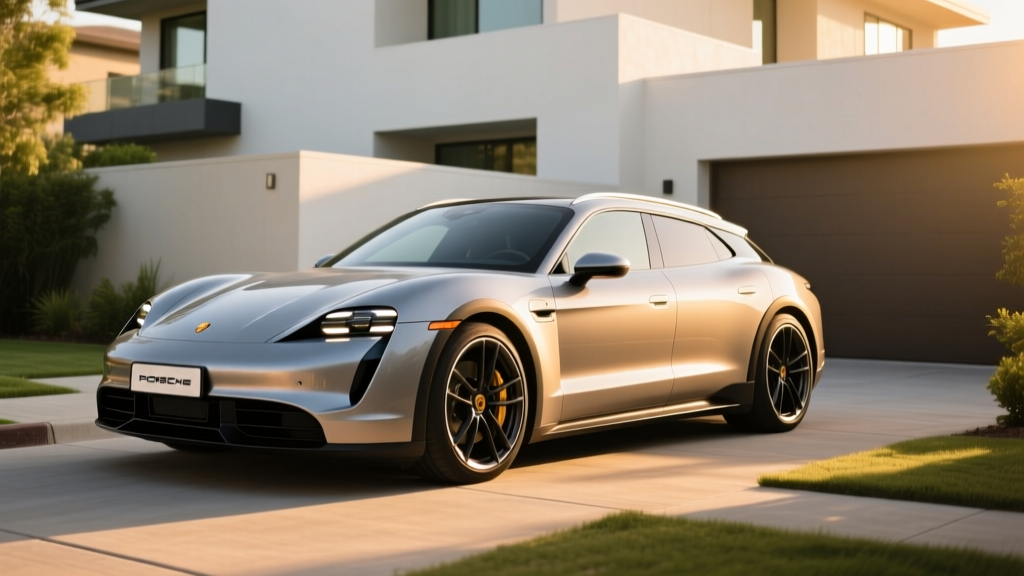
The Porsche Taycan has always been a driver's EV first and a practical car second. The Taycan Cross Turismo — Porsche's wagon/hatchback variant of its electric sports sedan — was designed to close that gap. With a lifted ride height, extended roofline, and a rear hatch that opens to genuine cargo volume, it targets buyers who want Porsche dynamics without sacrificing weekend utility. For the 2025 model year, Porsche overhauled the Taycan lineup with a larger battery, faster charging, and more power across the board. Here's what the numbers actually look like when you live with one.
Quick Verdict: Who the Taycan Hatchback Is For
The Taycan Cross Turismo is not the most efficient, longest-range, or most affordable EV in its class. It is, however, the best-driving one. If your purchase decision centers on steering feel, chassis balance, and sustained performance — and you need a hatchback cargo area for gear, dogs, or luggage — this is effectively the only option that threads that needle. If range-per-dollar or maximum cargo volume is your priority, the Audi e-tron GT (its platform sibling) or a Tesla Model S will serve you better on paper.
Choose the Taycan Cross Turismo if: You prioritize driving dynamics, want a real hatchback, and can charge at home.
Look elsewhere if: You need 350+ miles of range, maximum rear-seat headroom, or are shopping under $80,000.
Range, Battery, and Efficiency
| Spec | Taycan 4 Cross Turismo | Taycan 4S Cross Turismo | Taycan Turbo Cross Turismo | Taycan Turbo S Cross Turismo |
|---|---|---|---|---|
| EPA Range | 287 mi | 277 mi | 282 mi | 268 mi |
| Usable Battery | 97.0 kWh (NMC) | 97.0 kWh (NMC) | 97.0 kWh (NMC) | 97.0 kWh (NMC) |
| Efficiency (MPGe) | 83 MPGe | 80 MPGe | 81 MPGe | 77 MPGe |
| kWh/100 mi | 40 | 42 | 41 | 44 |
| Horsepower (Launch Control) | 469 hp | 590 hp | 870 hp | 939 hp |
| 0-60 mph | 4.5 sec | 3.6 sec | 2.6 sec | 2.3 sec |
| Drivetrain | AWD (dual-motor) | AWD (dual-motor) | AWD (dual-motor) | AWD (dual-motor) |
All 2025 Cross Turismo trims use Porsche's updated Performance Battery Plus — a 105 kWh gross / 97.0 kWh usable nickel-manganese-cobalt (NMC) pack mounted low in the chassis. The jump from the previous 79.2 kWh usable pack is substantial, adding roughly 40 miles of EPA range across the lineup. Porsche stuck with NMC chemistry rather than switching to LFP (lithium iron phosphate), prioritizing energy density and cold-weather performance over the cost and cycle-life advantages of LFP.
EPA Range vs. Real-World Expectation
The base Taycan 4 Cross Turismo carries an EPA rating of 287 miles. In mixed real-world driving (65-75 mph highway, moderate climate), expect 240–265 miles. At sustained 80 mph on flat interstate, plan for 220–240 miles. In freezing temperatures (below 32°F), range drops to approximately 190–215 miles even with preconditioning. Porsche's efficiency of 40–44 kWh/100 mi trails the Tesla Model S (28 kWh/100 mi) and Lucid Air (24 kWh/100 mi) significantly — you're paying an energy tax for 5,000+ lbs of performance-tuned chassis.
Charging Speed: DC Fast, Level 2, and Home Setup
| Charging Level | Max Rate | Speed / Notes |
|---|---|---|
| DC Fast Charge (peak) | 320 kW | 10–80% in ~18 minutes (preconditioned) |
| DC Fast Charge (sustained) | ~180–220 kW avg | Charge curve tapers sharply above 80% |
| Level 2 (240V / 48A) | 11.5 kW onboard | ~30–33 miles of range per hour; 0–100% in ~9.5 hours |
| Level 1 (120V / 12A) | ~1.4 kW | ~4 miles per hour — emergency/trickle only |
The 2025 Taycan's headline upgrade is the 320 kW peak DC fast-charge capability, up from the prior generation's 270 kW. On a 350 kW Electrify America or compatible CCS station with a preconditioned battery, Porsche claims a 10–80% charge in roughly 18 minutes. In practice, the Taycan holds its peak rate longer than most competitors — it sustains above 200 kW through approximately 55% state of charge before tapering. This makes it one of the fastest-charging EVs available, though the Lucid Air (300+ kW sustained longer) and Hyundai Ioniq 5 (240 kW with a lighter, smaller battery) also impress.
For home Level 2 charging, the 11.5 kW onboard charger is adequate but not class-leading (the Ford F-150 Lightning offers 19.2 kW). Expect roughly 30–33 miles of range added per hour of charging, meaning a full overnight session restores the entire pack. You'll need a 60-amp circuit and a hardwired Level 2 station like a ChargePoint Home Flex or Tesla Wall Connector (with J1772 adapter). The Taycan uses the CCS1 connector for DC fast charging and J1772 for Level 2 — no NACS port is offered, though adapters exist for Tesla Supercharger access where permitted.
Performance and Driving Dynamics
This is where the Taycan Cross Turismo justifies its price. Even the base 4 trim hits 60 mph in 4.5 seconds with launch control, and the Turbo S does it in a staggering 2.3 seconds — supercar territory. But straight-line speed is only part of the story. The Taycan's 800-volt architecture, rear-axle two-speed transmission (unique among EVs), and standard adaptive air suspension deliver a driving experience that no Tesla, Lucid, or Audi rival fully matches.
The Cross Turismo adds 0.8 inches of ground clearance over the sedan (up to 7.8 inches total in off-road mode), plus a standard rear-axle steering system on higher trims that shrinks the turning radius. The all-wheel-drive system is rear-biased and can fully disconnect the front motor for efficiency coasting. Regenerative braking recovers up to 290 kW — among the highest in production — and the brake pedal feel remains the most natural in the EV segment, with none of the grabby transition between regen and friction brakes that plagues lesser systems.
Cargo, Passenger Space, and Practicality
The Cross Turismo's hatchback rear opening is the entire point of this body style. With the rear seats upright, you get 14.3 cubic feet of cargo space behind the second row. Fold the 60/40 split rear seats and that expands to 42.8 cubic feet — enough for a full set of golf bags, two large suitcases, or a week's worth of camping gear. The front trunk (frunk) adds another 2.9 cubic feet for charging cables or a small bag.
Passenger space is less generous. Rear legroom measures 32.7 inches — adequate for adults under 6 feet but tight for taller passengers on longer trips. Rear headroom benefits from the wagon roofline: 38.0 inches, a meaningful improvement over the sedan's sloping rear glass. The "foot garage" cutouts in the battery pack let rear passengers sit lower with more natural leg positioning — a clever packaging solution that Porsche pioneered with the original Taycan.
Compared to a Tesla Model S (28 cu ft cargo, 35.4 in rear legroom), the Cross Turismo sacrifices some volume for a lower, sportier seating position and vastly superior build quality. Compared to the Audi e-tron GT Sportback (which shares the J1 platform but uses a liftback rather than a full hatch), the Cross Turismo offers notably more usable cargo space.
Pricing, Tax Credits, and Ownership Costs
| Trim | Base MSRP | As-Tested (typical) | Federal §30D Credit |
|---|---|---|---|
| Taycan 4 Cross Turismo | $103,000 | $115,000–$125,000 | $0 (exceeds $55,000 sedan MSRP cap — classified as sedan) |
| Taycan 4S Cross Turismo | $114,400 | $130,000–$145,000 | $0 |
| Taycan Turbo Cross Turismo | $156,400 | $170,000–$185,000 | $0 |
| Taycan Turbo S Cross Turismo | $196,500 | $210,000+ | $0 |
The Taycan Cross Turismo does not qualify for the IRS §30D federal EV tax credit. The credit caps vehicle eligibility at an MSRP of $55,000 for sedans and $80,000 for SUVs/vans. Porsche classifies the Cross Turismo as a passenger car (sedan-adjacent), and even under the more generous SUV cap, every Cross Turismo trim far exceeds the limit. Additionally, the buyer income caps ($150,000 single / $300,000 joint for §30D) would exclude some buyers regardless. If you're counting on a $7,500 credit to make the math work, this isn't the EV for you. Consult a tax professional and review current IRS §30D guidelines for any rule changes.
Ownership cost reality: Porsche provides a 4-year/50,000-mile limited warranty and an 8-year/100,000-mile battery warranty (covering degradation below 70% state of health). Insurance premiums run $3,500–$5,000 annually depending on your profile — significantly higher than a Tesla Model S. Expect tire replacement every 15,000–20,000 miles given the Taycan's weight and performance rubber (roughly $1,200–$1,800 per set).
Tech, Driver Assists, and Interior
The 2025 Taycan runs Porsche's latest PCM 7.0 infotainment system across a curved 12.6-inch driver display and a 10.9-inch center touchscreen, with an optional 10.9-inch passenger display. Wireless Apple CarPlay and Android Auto are standard, and the system supports over-the-air updates. The interface is responsive and logically laid out, though some climate controls are buried in touchscreen menus — a common complaint.
Driver-assistance features include adaptive cruise control with stop-and-go, lane-keeping assist, and Porsche's InnoDrive predictive cruise (which uses navigation data to adjust speed for upcoming curves and speed limits). These are SAE Level 2 driver-assist systems — the driver must remain fully engaged with hands on the wheel and eyes on the road. This is not autonomous driving; Porsche does not offer a hands-free system comparable to GM's Super Cruise or Ford's BlueCruise.
Standout features: the head-up display with augmented-reality navigation overlays, the optional Burmester 3D surround sound system (21 speakers, 1,455 watts), and the electronic panoramic roof with variable tint control (Sun Control) that eliminates the need for a physical shade while blocking heat effectively.
Taycan Cross Turismo vs. the Competition
Driving Dynamics: Taycan Cross Turismo — nothing else in this price range matches its steering feel, chassis composure, and brake modulation.
Range & Efficiency: Tesla Model S Long Range (402 mi EPA, 28 kWh/100 mi) — dramatically more efficient and nearly 50% more range.
Charging Speed: Taycan Cross Turismo — 320 kW peak with sustained high-rate charging outpaces the Model S (~250 kW) and e-tron GT (~270 kW).
Cargo Practicality: Tesla Model S (28 cu ft) or Audi A6 e-tron Avant (when available) — the Taycan's 14.3 cu ft with seats up is modest for a hatchback.
Value: Audi e-tron GT (starting ~$78,000, shares the J1 platform) — similar underpinnings at a lower entry price, though less powerful and without the Cross Turismo's extra cargo height.
Build Quality: Taycan Cross Turismo — Porsche's interior materials, panel fit, and switchgear are a tier above Tesla and competitive with Audi.
Pros and Cons
Pros
- Best-in-class driving dynamics — steering, suspension, and braking feel unmatched among EVs
- 320 kW peak DC fast charging with strong sustained curve
- 97 kWh usable battery provides solid 287-mile EPA range (base trim)
- 290 kW regenerative braking with seamless pedal blending
- Genuine hatchback utility with 42.8 cu ft max cargo
- Air suspension with adjustable ride height (up to 7.8 in ground clearance)
- 8-year/100,000-mile battery warranty
Cons
- Starting at $103,000 — expensive before options push it well past $130,000
- No federal §30D tax credit eligibility (MSRP cap)
- Efficiency of 40–44 kWh/100 mi trails competitors by 30–40%
- Real-world highway range closer to 220–240 miles, not 287
- Rear legroom (32.7 in) is tight for adults on long trips
- Level 2 only — no hands-free driver-assist like Super Cruise or BlueCruise
- CCS1 port — no native NACS, limiting direct Supercharger access
- Insurance and tire costs are high relative to the segment
Frequently Asked Questions
What is the real-world range of the Taycan Cross Turismo?
The EPA rates the base Taycan 4 Cross Turismo at 287 miles. Real-world mixed driving typically yields 240–265 miles. Sustained highway driving at 75+ mph drops that to 220–240 miles, and cold weather (below 32°F) can reduce range to 190–215 miles. Porsche's onboard thermal management and heat pump help, but the Taycan's weight and performance tuning mean it consumes more energy per mile than efficiency-focused EVs.
How fast does the Taycan Cross Turismo charge?
On a 350 kW DC fast charger with a preconditioned battery, the Taycan peaks at 320 kW and charges from 10–80% in approximately 18 minutes. The charge curve is strong — it sustains above 200 kW through about 55% state of charge before tapering. On a home Level 2 charger (11.5 kW), expect about 30–33 miles of range per hour, or a full charge in roughly 9.5 hours.
Does the Taycan Cross Turismo qualify for the federal EV tax credit?
No. All Cross Turismo trims exceed the IRS §30D MSRP cap of $55,000 for sedans (and $80,000 for SUVs). Buyer income limits and battery-sourcing requirements add additional barriers. See the IRS clean vehicle credit page for current rules. Some states offer separate EV incentives that may apply — check your state's energy office or AFDC state incentive database.
Is the Taycan Cross Turismo worth it over the Taycan sedan?
If you need cargo space and don't mind a slight efficiency and range penalty (roughly 10–15 fewer EPA miles), yes. The hatchback gives you 14.3 cu ft of cargo (vs. the sedan's 12.9 cu ft trunk), more rear headroom, and standard raised ride height for rough roads. The sedan is marginally more efficient and slightly cheaper. Mechanically and dynamically, they're nearly identical.
How does the Taycan Cross Turismo compare to the Audi e-tron GT?
Both ride on the VW Group J1 platform with 800V architecture. The e-tron GT starts ~$25,000 lower, offers a Sportback liftback body style, and is slightly less powerful. The Taycan has the newer, larger 97 kWh battery (the e-tron GT still uses the older 85 kWh usable pack as of 2025), faster 320 kW charging (vs. ~270 kW), and more refined suspension tuning. If budget is a concern, the e-tron GT is the smarter buy. If you want the latest tech and best driving feel, the Taycan wins.
What's the battery replacement cost for the Taycan?
Out-of-warranty battery replacement for the Taycan is estimated at $20,000–$30,000 based on current Porsche service pricing. However, the 8-year/100,000-mile warranty covers degradation below 70% state of health, and NMC packs in thermally managed systems like the Taycan's typically retain 85–90% capacity at 100,000 miles based on industry data. Most owners will never face a full pack replacement.