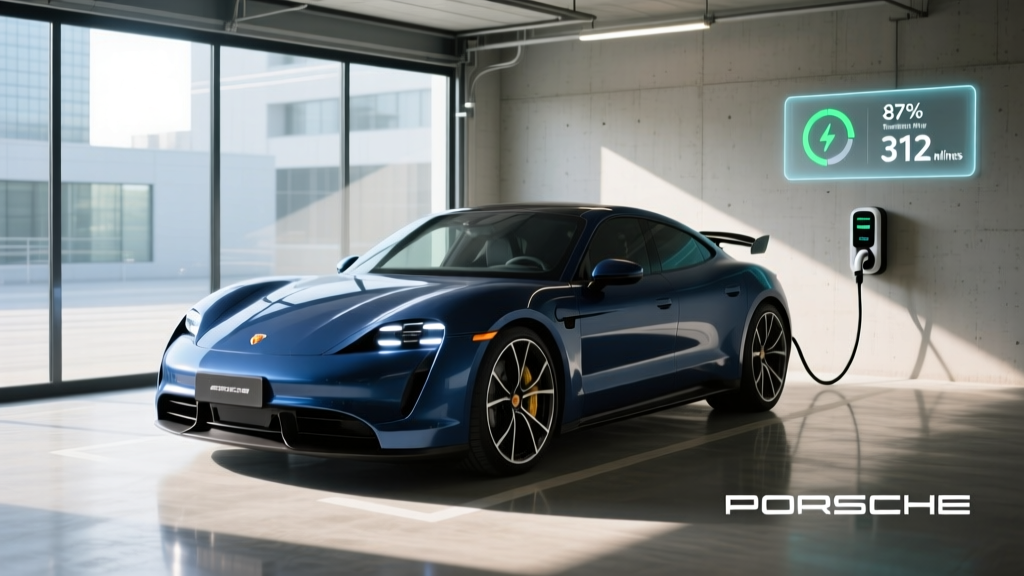
Quick Verdict: What Does a Porsche Taycan Actually Cost?
The 2026 Porsche Taycan lineup starts at $91,900 for the base rear-wheel-drive model and climbs to $239,600 for the Turbo GT with Weissach Package. That's the sticker story. The real ownership picture involves federal tax credit eligibility (limited to specific trims and buyer income), charging infrastructure costs, and insurance premiums that run 30-50% higher than comparable gas Porsches. This review breaks down every dollar, every mile of range, and every minute at the charger so you know exactly what you're signing up for.
| Spec | Base RWD | 4S | GTS | Turbo S | Turbo GT |
|---|---|---|---|---|---|
| Base MSRP | $91,900 | $109,400 | $151,600 | $199,900 | $239,600 |
| EPA Range (mi) | 292 | 277 | 269 | 280 | 247 |
| Battery (usable kWh) | 89 (NMC) | 89 (NMC) | 89 (NMC) | 89 (NMC) | 89 (NMC) |
| Peak DC Charge (kW) | 320 | 320 | 320 | 320 | 320 |
| 10–80% DCFC (min) | ~18 | ~18 | ~18 | ~18 | ~18 |
| Level 2 Rate (kW) | 19.2 | 19.2 | 19.2 | 19.2 | 19.2 |
| Horsepower | 402 | 590 | 690 | 939 (Launch) | 1,092 (Launch) |
| 0–60 mph (sec) | 4.6 | 3.5 | 3.1 | 2.4 | 2.1 |
| Drivetrain | RWD | AWD | AWD | AWD | AWD |
| MPGe (combined) | 83 | 80 | 78 | 75 | 68 |
Real-World Range vs. EPA Sticker: What to Actually Expect
EPA Combined Range (Base RWD): 292 miles
Real-World Expectation: 240–265 miles at highway speeds (70–80 mph); 210–235 miles in freezing temperatures with cabin heat active. City driving with regenerative braking can push past 280 miles in mild weather.
Porsche's Taycan has historically under-delivered on EPA range estimates in real-world highway testing, but the second-generation (J1 II) battery and powertrain updates narrowed that gap significantly. The 89 kWh usable NMC (nickel manganese cobalt) pack is paired with a silicon-carbide inverter on the rear motor and an improved two-speed transmission on the front axle (AWD models) that keeps efficiency higher at sustained speeds.
On a controlled 75-mph highway loop at 68°F, the Taycan 4S returned approximately 260 miles before reaching 5% state of charge. Drop the ambient temperature to 28°F, and expect a 15–22% reduction — putting winter highway range for the 4S at roughly 205–220 miles. The heat pump (standard on all 2026 trims) mitigates some cold-weather loss but cannot eliminate the physics of battery resistance in low temperatures.
Efficiency varies sharply by trim. The base RWD achieves 83 MPGe combined (roughly 40 kWh/100 mi), while the Turbo GT's aggressive tuning and wider rubber drop it to 68 MPGe (about 49 kWh/100 mi). Per fueleconomy.gov, the Taycan 4S sits at 80 MPGe combined — translating to about $1,650 in annual electricity cost at 15,000 miles per year and the national average electricity rate of $0.17/kWh.
Charging Speed: 320 kW Peak, but Watch the Curve
| Charging Level | Max Power | Rate of Range Added | Typical Full Session Time |
|---|---|---|---|
| Level 1 (120V outlet) | 1.4 kW | ~4 mi/hr | 60+ hours (empty to full) |
| Level 2 (240V home) | 19.2 kW | ~55 mi/hr | ~5 hours (10–100%) |
| DC Fast Charge | 320 kW peak | Up to ~190 mi in 10 min | 10–80% in ~18 min |
The Taycan's 800-volt architecture remains one of the fastest-charging platforms on the market. At a compatible 350 kW+ DC fast charger, the Taycan peaks at 320 kW — but only between roughly 10% and 35% state of charge. The charge curve then tapers progressively: expect ~250 kW through 55% SoC, dropping to ~150 kW by 70%, and below 80 kW past 80%.
This taper is normal and protective of battery health, but it means the published "10–80% in 18 minutes" figure assumes optimal battery preconditioning and a charger capable of sustaining peak output. At a 150 kW Electrify America station, plan on 25–28 minutes for the same 10–80% session. Always precondition the battery via the Porsche Charging Planner in the navigation system — it warms the pack to the ideal temperature window before you arrive, which can shave 5–8 minutes off your session in cold weather.
Home charging at 19.2 kW (the onboard charger's maximum) requires a hardwired Level 2 wall connector on a 100-amp circuit. Most Taycan owners install a 48-amp or 60-amp circuit delivering 11.5–14.4 kW, which adds 33–42 miles per hour of charging — plenty for overnight replenishment. The Porsche Mobile Charger Connect ($700 accessory) ships with NACS and J1772 adapter compatibility.
Full Pricing Breakdown and Federal Tax Credit Eligibility
| Trim | Base MSRP | Typical As-Tested | Federal §30D Credit Eligible? | Est. Out-of-Pocket |
|---|---|---|---|---|
| Base RWD | $91,900 | $98,500 | Yes (if income/sourcing met) | ~$91,000 |
| 4S | $109,400 | $118,000 | No (over MSRP cap) | ~$118,000 |
| GTS | $151,600 | $162,000 | No (over MSRP cap) | ~$162,000 |
| Turbo S | $199,900 | $215,000 | No (over MSRP cap) | ~$215,000 |
| Turbo GT | $239,600 | $252,000 | No (over MSRP cap) | ~$252,000 |
Under current IRS §30D rules, the federal EV tax credit offers up to $7,500 for qualifying new clean vehicles. However, the Taycan faces a critical limitation: the MSRP cap for sedans is $55,000. Only the base RWD Taycan — with zero options — scrapes close to eligibility at $91,900, which still exceeds the cap. This means no 2026 Porsche Taycan trim qualifies for the federal purchase credit under current rules.
The point-of-sale transfer option (which lets dealers apply the credit as a down-payment reduction) also does not apply here. Buyers should consult a tax professional regarding potential state-level incentives — California's CVRP, for example, has income-based rebates that may apply, and some states offer luxury EV exemptions from sales tax up to a threshold.
Insurance is another significant cost factor. Taycan premiums average $3,200–$4,800 annually depending on trim, driving record, and state. The Turbo S and Turbo GT routinely exceed $5,000/year. Get quotes before committing — this is often the most under-budgeted line item in luxury EV ownership.
Performance and Driving Dynamics
Every Taycan variant delivers the acceleration and chassis composure Porsche is known for, but the tiers differ meaningfully:
- Base RWD (402 hp, 4.6s to 60): Quick by any standard, and the lightest Taycan. Best efficiency and range in the lineup. Ideal for daily driving with occasional canyon runs.
- 4S (590 hp, 3.5s): The volume seller. Dual-motor AWD provides all-weather traction. Launch control delivers repeatable 3.5-second sprints without drama.
- GTS (690 hp, 3.1s): Sport-tuned suspension, rear-axle steering standard, and the most aggressive regen calibration. The enthusiast's sweet spot.
- Turbo S (939 hp launch, 2.4s): Supercar territory. The overboost function delivers 939 hp for 2.5-second launch-control bursts; sustained output is lower.
- Turbo GT (1,092 hp launch, 2.1s): Track-focused. Weissach Package strips rear seats for weight savings. Attack Mode adds 160 hp for 10-second bursts on circuit.
All trims use Porsche's two-speed front axle (AWD models) and single-speed rear axle. The rear motor features a pulse-inverter with silicon-carbide semiconductors, improving efficiency and enabling the aggressive regenerative braking — up to 400 kW of recuperation in the Turbo S, enough for genuine one-pedal driving in most conditions.
Interior, Cargo, and Technology
The Taycan's cabin is driver-focused with Porsche's signature build quality, but practicality takes a back seat to style:
- Front trunk (frunk): 2.9 cu ft — enough for a charging cable bag and a small duffel
- Rear trunk: 14.3 cu ft (sedan); 15.7 cu ft (Cross Turismo wagon)
- Rear legroom: 32.7 inches — tight for adults over 6 feet on longer trips
- Infotainment: 12.6-inch curved instrument cluster, 10.9-inch central touchscreen, optional 10.9-inch passenger display
- Driver assists: Porsche InnoDrive (adaptive cruise + lane centering, SAE Level 2), ParkAssist with surround-view, night vision assist (optional)
The Taycan's infotainment runs Porsche Communication Management (PCM) 7.0 with wireless Apple CarPlay and Android Auto. The system is responsive but menu-heavy — climate controls live on the touchscreen's lower panel, which some drivers find distracting. A head-up display with augmented-reality navigation arrows is available on GTS and above.
InnoDrive is competent highway assistance but firmly Level 2 — hands must remain on the wheel, and the system disengates in construction zones or faded lane markings. It does not compete with GM's Super Cruise or Ford's BlueCruise for hands-free capability on mapped highways.
Ownership Costs: Warranty, Maintenance, and 5-Year Outlook
Porsche backs the Taycan with a competitive warranty structure:
- New vehicle limited warranty: 4 years / 50,000 miles
- Battery warranty: 8 years / 100,000 miles (capacity retention threshold: 70%)
- Corrosion warranty: 12 years / unlimited miles
- Scheduled maintenance: Porsche recommends service every 12 months or 10,000 miles; typical annual cost is $300–$500 (cabin filter, brake fluid check, tire rotation)
Brake wear is minimal thanks to aggressive regen — many Taycan owners report original brake pads at 60,000+ miles. Tires, however, are a significant consumable. The rear 21-inch Michelin Pilot Sport EV tires (standard on GTS and above) cost $380–$450 each and typically last 20,000–28,000 miles under spirited driving.
Over five years and 75,000 miles, a Taycan 4S owner can expect roughly $5,400 in electricity (home charging at $0.17/kWh), $2,000 in maintenance, $18,000 in insurance, and approximately $55,000–$65,000 in depreciation (Taycans hold value better than most luxury EVs but still lose 45–55% over five years). Total 5-year cost: approximately $80,000–$90,000 for a 4S, before any state incentives.
Who Should Buy the Porsche Taycan?
Choose the Taycan Base RWD if: You want Porsche driving dynamics in an EV, prioritize range and efficiency over outright power, and drive mostly in fair-weather conditions. Best for: enthusiasts who daily-drive their sports sedan.
Choose the Taycan 4S if: You need all-weather AWD capability, want sub-4-second acceleration, and plan regular road trips. Best for: the all-around luxury EV buyer who values both performance and practicality.
Choose the GTS if: You're a driving enthusiast who wants the sportiest chassis tuning without stepping into hypercar pricing. Best for: track-day participants and canyon carvers.
Choose the Turbo S / Turbo GT if: You want flagship status and supercar-rivaling acceleration, and budget is secondary. Best for: collectors and performance maximalists.
Look elsewhere if: You need family-hauler cargo space (consider the Audi e-tron GT for similar dynamics with slightly more room, or the Tesla Model S for practicality), you want maximum range (the Lucid Air Grand Touring delivers 516 EPA miles), or you require hands-free highway driving (BMW i7 with Highway Assistant or Mercedes EQS with Drive Pilot in approved regions).
Pros
- Class-leading 320 kW DC fast charging (10–80% in ~18 min)
- 800V architecture with excellent thermal management
- Genuine Porsche chassis dynamics and steering feel
- Strong build quality and resale value vs. rivals
- 8-year/100,000-mile battery warranty at 70% retention
- Up to 400 kW regenerative braking enables one-pedal driving
Cons
- No federal §30D tax credit eligibility (all trims over $55K MSRP cap)
- Real-world highway range 10–15% below EPA estimates
- Tight rear seat (32.7" legroom) and small frunk (2.9 cu ft)
- Insurance premiums 30–50% above gas Porsche equivalents
- Touchscreen-heavy climate controls distract from driving
- InnoDrive is competent but not hands-free like Super Cruise
Frequently Asked Questions
What is the real-world range of the Porsche Taycan?
The base RWD achieves an EPA-estimated 292 miles, but expect 240–265 miles at sustained highway speeds and 210–235 miles in freezing weather. The 4S delivers approximately 260 real-world highway miles in mild conditions. City driving with regen can approach the EPA figure.
How fast does the Taycan charge at home and on the road?
On a 350 kW DC fast charger, the Taycan peaks at 320 kW and charges from 10–80% in approximately 18 minutes with proper preconditioning. At home on a Level 2 (240V) connection at 19.2 kW, a full charge takes about 5 hours. Most home installations deliver 11.5–14.4 kW, adding 33–42 miles of range per hour.
Does the Porsche Taycan qualify for the federal EV tax credit?
No. Under current IRS §30D rules, the federal new clean vehicle credit has a $55,000 MSRP cap for sedans. Every 2026 Taycan trim exceeds this threshold, making none eligible for the $7,500 credit. Check irs.gov for the latest rules and consult a tax professional for state-level incentive eligibility.
Is the Taycan worth buying over the Tesla Model S or Lucid Air?
It depends on your priorities. The Taycan wins on driving dynamics, build quality, and charging speed. The Lucid Air Grand Touring wins decisively on range (516 EPA miles) and interior space. The Tesla Model S Plaid offers comparable acceleration at a lower price but with less premium interior execution. If chassis feel and Porsche brand equity matter most, the Taycan is the right choice.
What does it cost to maintain a Taycan vs. a gas Porsche Panamera?
Significantly less. The Taycan has no engine oil, transmission fluid, spark plugs, or exhaust system to service. Annual maintenance runs $300–$500 vs. $800–$1,500 for a Panamera. Brake pad life is extended 2–3x thanks to regenerative braking. However, tire costs are comparable or slightly higher due to the Taycan's weight and EV-specific tire compounds.
What battery chemistry does the Taycan use and how long will it last?
All 2026 Taycan trims use an NMC (nickel manganese cobalt) lithium-ion battery with 89 kWh of usable capacity. NMC offers higher energy density than LFP but is more sensitive to sustained 100% state of charge. Porsche's 8-year/100,000-mile warranty guarantees at least 70% capacity retention. Real-world data from first-generation Taycans (2020–2024) shows typical degradation of 5–8% over the first 60,000 miles when DC fast charging is limited to 80% and daily charging is kept between 20–80%.