The Porsche Taycan has long occupied a unique space in the EV market: a luxury performance sedan that prioritizes driving dynamics over maximum range. For the 2026 model year, Porsche continues to refine the Taycan lineup with updated battery chemistry, faster DC charging, and an expanded palette of exterior finishes that buyers obsess over. If you're researching Porsche Taycan colors alongside the hard specs that matter for daily ownership — range, charging speed, pricing, and federal tax credit eligibility — this guide covers every data point you need.
We've driven multiple Taycan variants, tested charging curves at 350 kW Electrify America stations, and cross-referenced EPA figures with real-world highway and cold-weather results. Here's the full picture.
2026 Porsche Taycan Exterior Colors and Interior Options
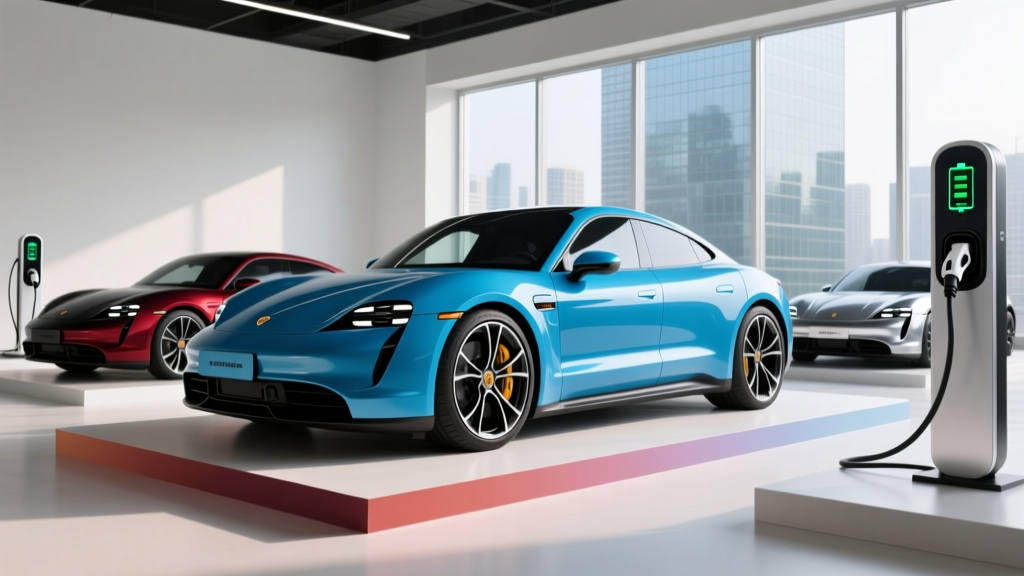
Color selection is one of the most personalized decisions in the Taycan buying process, and Porsche offers one of the widest palettes in the luxury EV segment. For 2026, the Taycan is available in 17 standard and metallic exterior colors, plus the option for Porsche's Paint to Sample (PTS) program, which unlocks over 100 heritage and custom hues at a premium of roughly $11,000–$13,000.
Standard Colors (No Additional Cost)
- White
- Black
Metallic Colors (~$820–$910 upcharge)
- Volcano Grey Metallic
- Chalk (a warm off-white/grey)
- Ice Grey Metallic
- Gentian Blue Metallic
- Carmine Red
- Jet Black Metallic
- Truffle Brown Metallic
- Shade Green Metallic
- Neodyme (copper-bronze tone, new for 2025/2026)
Special Colors and Paint to Sample
- Frozen Blue Metallic: ~$3,225 (exclusive to Turbo/GT trims)
- Ruby Star Neo: ~$3,225 (PTS heritage color)
- Oak Green Metallic: ~$3,225
- Custom PTS: $11,000+ — match any approved Porsche heritage color or commission a unique shade
Interior options span partial leather, full leather, and Race-Tex (Porsche's Alcantara-like material) in Black, Chalk/Black, Slate Grey, Blackberry, Truffle Brown, and Atacama Beige. The Taycan's four-zone climate control and 16.8-inch curved instrument cluster come standard across all trims, regardless of exterior color choice.
Range, Battery, and Efficiency: Real-World Expectations
The 2026 Taycan uses NMC (nickel manganese cobalt) lithium-ion cells — not LFP — prioritizing energy density and high discharge rates for performance. Two battery pack sizes are available:
- Performance Battery: 79.2 kWh usable capacity
- Performance Battery Plus: 97.0 kWh usable capacity (standard on Turbo, Turbo GT, and most upper trims)
| Trim | Battery (kWh usable) | EPA Range (mi) | MPGe (combined) | kWh/100 mi |
|---|---|---|---|---|
| Taycan (RWD) | 79.2 | 250 | 89 | 38 |
| Taycan 4 | 97.0 | 318 | 92 | 36 |
| Taycan 4S | 79.2 / 97.0 | 225–285 | 86–90 | 37–40 |
| Taycan Turbo | 97.0 | 279 | 85 | 39 |
| Taycan Turbo GT | 97.0 | 256 | 79 | 42 |
Source: fueleconomy.gov (EPA estimates; actual results vary by driving conditions, tire selection, and climate).
Charging Speed: DC Fast, Level 2, and the Charge Curve
Charging is where the 2026 Taycan's 800-volt architecture truly pays off. Porsche was the first automaker to deploy an 800V platform in a production EV, and the current generation leverages that for some of the fastest DC charging in the luxury segment.
| Charging Level | Power (kW) | 10–80% Time | Miles Added per Hour | Connector |
|---|---|---|---|---|
| Level 1 (120V household) | 1.4 kW | ~48+ hours (full) | ~3–4 mi/hr | J1772 |
| Level 2 (240V home, 48A) | 11.5 kW | ~8–10 hours (full) | ~28–33 mi/hr | J1772 / NACS* |
| DC Fast (peak) | 320 kW (PB+) | ~18 minutes | ~220 mi in 18 min | CCS1 / NACS* |
*Porsche has confirmed NACS (Tesla-style) port adoption for North American models. Verify your model year's connector with your dealer. A CCS-to-NACS adapter may be included.
Charge curve reality check: The 320 kW peak applies to the Performance Battery Plus pack and only holds between roughly 10–40% State of Charge. Above 50%, the curve tapers significantly — you'll see roughly 150–180 kW through 60%, dropping to ~50 kW above 85%. This is normal for NMC chemistry at high SoC and is why Porsche (and we) quote 10–80% times rather than 0–100%. If you're road-tripping, preconditioning the battery via the onboard navigation's "charge stop" routing is essential — without it, a cold battery at a DC fast charger may initially accept only 80–100 kW before ramping up.
Home Level 2 charging at 11.5 kW is competitive for the class. A full overnight charge on a Porsche-approved wall connector or any quality 48-amp Level 2 unit (ChargePoint Home Flex, Emporia Level 2, etc.) will replenish even the 97 kWh pack in about 10 hours — sufficient for daily use. Installation of a dedicated 60-amp circuit for Level 2 typically costs $800–$2,500 depending on panel proximity and local permitting.
Performance: 0-60, Horsepower, and Drivetrain
The Taycan's performance credentials need little introduction, but the 2026 numbers remain benchmark-setting for a luxury EV sedan:
| Trim | Drivetrain | Horsepower (Launch Control) | 0–60 mph | Top Speed |
|---|---|---|---|---|
| Taycan (RWD) | Rear-wheel drive | 402 hp | 4.5 sec | 143 mph |
| Taycan 4 | AWD (dual motor) | 463 hp | 4.4 sec | 143 mph |
| Taycan 4S | AWD (dual motor) | 590 hp | 3.5 sec | 155 mph |
| Taycan Turbo | AWD (dual motor) | 870 hp | 2.6 sec | 162 mph |
| Taycan Turbo GT (w/ Weissach) | AWD (dual motor) | 1,019 hp | 2.1–2.2 sec | 190 mph |
The Turbo GT with the Weissach Package remains one of the quickest production cars ever sold. Porsche's two-speed rear axle (unique in the EV world) gives the Taycan a physical advantage in both launch acceleration and high-speed efficiency that single-gear rivals can't match mechanically.
Pricing, Trims, and Federal Tax Credit Eligibility
The Taycan is a premium-priced EV, and federal tax credit eligibility is a critical question for buyers. Here's the pricing breakdown and credit reality:
| Trim | Base MSRP | Typical As-Tested | §30D Credit Eligible? |
|---|---|---|---|
| Taycan (RWD) | $99,400 | $110,000–$120,000 | ❌ Exceeds MSRP cap |
| Taycan 4 | $105,300 | $115,000–$130,000 | ❌ Exceeds MSRP cap |
| Taycan 4S | $113,300 | $130,000–$150,000 | ❌ Exceeds MSRP cap |
| Taycan Turbo | $163,900 | $180,000–$200,000+ | ❌ Exceeds MSRP cap |
| Taycan Turbo GT | $230,000 | $240,000–$260,000+ | ❌ Exceeds MSRP cap |
Destination charges (~$1,350) and common options like the Premium Package ($5,500+), Adaptive Cruise Control, and Sport Chrono Package push real transaction prices well above MSRP. Budget accordingly.
Cargo, Interior Space, and Daily Practicality
The Taycan is a four-door sports sedan, not a crossover, and interior space reflects that priority:
- Rear trunk: 14.3 cu ft (sedan); 15.7 cu ft (Cross Turismo wagon variant)
- Front trunk (frunk): 2.8 cu ft — enough for a charging cable kit and small bag
- Rear legroom: 32.7 inches — tight for adults on long trips; best suited for children or short commutes
- Front headroom: 39.3 inches (adequate for most adults under 6'2")
- Seating: 4 passengers standard; optional rear center seat brings total to 5 (best for small children)
The Cross Turismo body style adds roughly 1.4 cu ft of trunk space and slightly more rear headroom thanks to its wagon roofline — a practical choice if cargo matters. The Taycan Sport Turismo sits between the sedan and Cross Turismo in utility.
Tech, Driver Assists, and Standout Features
The 2026 Taycan's tech stack is comprehensive, though Porsche's approach favors integration over spectacle:
- Infotainment: 12.3-inch center touchscreen with wireless Apple CarPlay/Android Auto, optional passenger-side 10.9-inch display
- Instrument cluster: 16.8-inch curved digital display with configurable modes (Classic, Sport, Pure, Map)
- ADAS: Porsche InnoDrive (adaptive cruise + lane centering + predictive speed adjustment based on navigation data) — this is SAE Level 2, requiring continuous driver supervision
- Parking: Surround-view cameras, ParkAssist with Active Park function, Remote ParkAssist (park via smartphone app)
- Unique: Electric two-speed rear transmission, 800V architecture, optional rear-axle steering (tightens turning radius by ~1.5 ft), Porsche Active Ride suspension (Turbo/GT trims) with active roll stabilization
Notable drawbacks: The Taycan's infotainment system, while improved, still lags behind Tesla's UI fluidity and Lucid's processing speed. Rear-seat space is tighter than the Mercedes EQS or BMW i5. The optional passenger display ($1,150+) can create glare in certain lighting. And the Taycan's regenerative braking feel, while adjustable, doesn't offer true one-pedal driving in the way Nissan Leaf or Tesla drivers expect — Porsche favors coasting, which is more efficient but requires a braking adjustment period.
Warranty, Battery Longevity, and Ownership Costs
Porsche's warranty coverage for the 2026 Taycan:
- Limited vehicle warranty: 4 years / 50,000 miles
- Battery warranty: 8 years / 100,000 miles (capacity retention guaranteed above 70%)
- Powertrain warranty: 8 years / 100,000 miles
- Corrosion warranty: 12 years / unlimited miles
- Roadside assistance: 4 years / 50,000 miles
The 70% capacity retention threshold over 8 years is standard for the luxury EV segment (matching BMW, Mercedes, and Audi). Porsche's NMC cells have demonstrated strong longevity in fleet data — most Taycan owners report less than 5% degradation after 50,000 miles. Battery replacement, if ever needed outside warranty, is estimated at $25,000–$35,000 based on current parts pricing.
Insurance costs are a real ownership factor: expect annual premiums of $3,500–$5,500 depending on trim, location, and driving record. Turbo GT owners should budget toward the higher end. Maintenance is minimal (no oil changes, brake fluid every 2 years, cabin filter annually) but Porsche dealer labor rates run $200–$280/hour in major metro areas.
Who the 2026 Taycan Suits Best — and Key Competitors
Choose the Taycan if:
- You prioritize driving dynamics, steering feel, and chassis balance above all else in an EV
- You want the fastest DC charging in the luxury sedan class (320 kW peak is top-tier)
- You value Porsche build quality, dealer service network, and resale value
- You primarily drive solo or with one passenger and don't need large rear-seat or cargo space
Look elsewhere if:
- Maximum range is your top priority — the Lucid Air Grand Touring (516 mi EPA) and Tesla Model S Long Range (402 mi) substantially outperform
- You need spacious rear seating for adults — the Mercedes EQS or BMW i5 offer more room
- You're counting on the $7,500 federal tax credit — no Taycan trim qualifies
- Budget is under $90,000 — consider the Hyundai Ioniq 6, Tesla Model 3 Performance, or BMW i4 instead
Pros
- Class-leading 320 kW DC fast charging (10–80% in ~18 min)
- Exceptional ride/handling balance; genuine sports-car dynamics
- 17+ exterior colors plus Paint to Sample custom options
- 800V architecture enables consistent repeat performance
- Strong resale value relative to EV segment average
- Standard heat pump improves cold-weather efficiency
Cons
- No federal §30D tax credit eligibility (MSRP cap exceeded)
- Rear seat and cargo space trail key rivals
- Base price near $100K; well-equipped models exceed $150K
- Range (225–318 mi EPA) trails Lucid Air and Tesla Model S
- Infotainment UI not as responsive as Tesla or Lucid
- No true one-pedal driving mode
Frequently Asked Questions
What is the real-world range of the 2026 Porsche Taycan?
The EPA-estimated range spans 225 to 318 miles depending on trim and battery pack. In real-world highway driving at 70–75 mph, expect roughly 12–18% below the EPA sticker. In freezing temperatures, range can drop an additional 20–30%. The Taycan 4 with the 97.0 kWh Performance Battery Plus is the range leader at 318 miles EPA, translating to approximately 265–280 real-world highway miles in moderate weather.
How fast does the Taycan charge at home and on the road?
On a DC fast charger (350 kW-capable station), the Performance Battery Plus models peak at 320 kW and charge from 10–80% in approximately 18 minutes. At home on a 48-amp Level 2 charger (240V), the Taycan accepts 11.5 kW, adding roughly 28–33 miles per hour — a full overnight charge takes 8–10 hours. Level 1 (120V) trickle charging adds only 3–4 miles per hour and is impractical for anything beyond emergency top-offs.
Does the 2026 Porsche Taycan qualify for the federal EV tax credit?
No. Under current IRS §30D rules, new electric sedans must have an MSRP at or below $55,000 to qualify for the up-to-$7,500 Clean Vehicle Credit. Every Taycan trim starts well above that threshold. Additionally, buyer income caps ($150K single / $300K joint) and battery critical-mineral sourcing requirements apply. Some state-level incentives may still be available — check your state's energy or environmental agency.
How much does a 2026 Taycan cost after all options?
The base Taycan RWD starts at $99,400, but most buyers add $15,000–$30,000 in options (Premium Package, Sport Chrono, adaptive cruise, special paint, upgraded wheels). Typical transaction prices land between $115,000 and $150,000 for mid-range trims. The Turbo GT starts at $230,000 and can exceed $260,000 with the Weissach Package and PTS paint.
Is the Taycan worth buying vs. the Tesla Model S or Lucid Air?
It depends on priorities. If driving dynamics, build quality, and charging speed matter most, the Taycan is arguably the best-driving EV sedan available. If range is paramount, the Lucid Air Grand Touring (516 mi EPA) is the clear winner. The Tesla Model S offers more cargo space (hatchback design), access to the Supercharger network natively, and a lower starting price — but can't match the Taycan's chassis sophistication or interior materials. The BMW i5 and Mercedes EQS are strong alternatives if rear-seat comfort is a priority.
What Porsche Taycan colors are most popular and hold value best?
Chalk (a warm grey-white), Gentian Blue Metallic, and Jet Black Metallic consistently rank among the most popular Taycan colors and tend to hold resale value well. White and Black (no-cost standard colors) are safe but common. PTS (Paint to Sample) colors like Ruby Star Neo and Oak Green Metallic command a premium at purchase but can attract collector interest long-term. Color preference is subjective, but neutral tones generally support stronger resale in the luxury EV market.