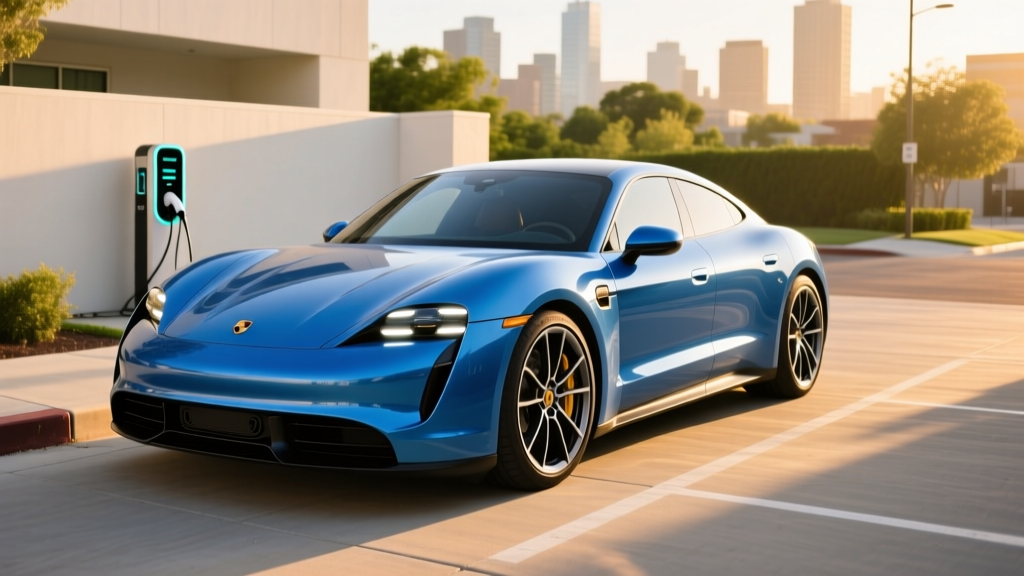
The Porsche Taycan has long occupied a specific niche: the electric sports sedan that prioritizes driving dynamics over maximum range. For the 2025 refresh — which carries into the 2026 model year with minor equipment updates — Porsche introduced new colors and expanded the Performance Battery Plus option across more trims. Among the most sought-after configurations is what enthusiasts and configurators refer to as the Porsche Taycan Blue, typically built in Gentian Blue Metallic or the newer Shade Green (which reads as a blue-green depending on light). This review covers the full Taycan lineup with a focus on what buyers selecting a blue exterior configuration need to know about range, charging, real-world performance, and total cost.
Quick Verdict: The Taycan in 2026
The Taycan remains the benchmark for EV driving feel. Its 800-volt architecture delivers class-leading DC fast-charging speeds, and its chassis tuning is genuinely a cut above anything else in the electric luxury-sedan segment. The trade-off is range efficiency: the Taycan sacrifices some miles per kWh to achieve its performance envelope. If you're cross-shopping a Tesla Model S, BMW i5 M60, or Mercedes EQE AMG, the Taycan wins on charging speed and handling, but loses on range and interior space per dollar.
| Spec | Taycan RWD | Taycan 4S | Taycan Turbo GT |
|---|---|---|---|
| EPA Range | 283 mi | 277 mi | 269 mi |
| Battery (usable / gross) | 84 kWh / 93.4 kWh (Performance Plus) | 84 kWh / 93.4 kWh | 84 kWh / 93.4 kWh |
| Chemistry | NMC (Nickel Manganese Cobalt) | NMC | NMC |
| Peak DC Fast Charge | 320 kW | 320 kW | 320 kW |
| 10–80% DC Time | ~18 min | ~18 min | ~18 min |
| Level 2 AC Charge Rate | 11 kW (9.6 kW std) | 11 kW | 11 kW |
| 0–60 mph | 4.6 sec | 3.5 sec | 2.1 sec (w/ Attack Mode) |
| Horsepower | 402 hp | 590 hp (Launch Control) | 1,019 hp (Launch Control) |
| Drivetrain | RWD, single motor | AWD, dual motor | AWD, dual motor |
| MPGe (combined) | 83 MPGe | 79 MPGe | 68 MPGe |
| Efficiency | 41 kWh/100mi | 43 kWh/100mi | 50 kWh/100mi |
| Base MSRP | $99,400 | $125,200 | $230,000 |
| Battery/Powertrain Warranty | 8 yr / 100,000 mi | 8 yr / 100,000 mi | 8 yr / 100,000 mi |
Source: EPA / fueleconomy.gov, Porsche USA specifications.
Real-World Range: What the EPA Sticker Doesn't Tell You
EPA Combined Range: 283 miles (RWD with Performance Battery Plus)
Real-World Expectations:
- City/mixed driving (65°F): 260–280 miles — regenerative braking recovers well in stop-and-go
- Highway (75 mph sustained, 65°F): 220–245 miles — the Taycan's aerodynamic drag and performance tires reduce efficiency at speed
- Cold weather (30°F, highway): 180–210 miles — expect a 25–35% reduction due to battery thermal management demands and cabin heating
Bottom line: Plan road trips around ~220-mile legs in moderate weather. The Taycan's 800V charging architecture makes short stops viable, but this is not a 300-mile cruiser in practice.
The Taycan's efficiency of 41–50 kWh/100mi (depending on trim) trails the BMW i5 eDrive40 (which achieves 33 kWh/100mi and an EPA 295 miles). Porsche engineers have openly stated that the Taycan prioritizes sustained performance and thermal headroom over peak efficiency. The two-speed rear transmission helps highway efficiency slightly compared to single-speed competitors, but the car's 5,100+ lb curb weight and wide performance tires are fundamental drag factors.
Charging Speed: The Taycan's Genuine Advantage
This is where the Taycan's 800-volt architecture pays dividends. For the 2025 refresh (carried into 2026), Porsche upgraded the peak DC fast-charge rate to 320 kW on models equipped with the Performance Battery Plus — up from 270 kW on earlier models. At an appropriately equipped 350 kW charger (such as Electrify America's latest stalls or Ionity stations in Europe), the Taycan can add 10–80% in approximately 18 minutes.
| Charge Level | Power | Time / Rate | Notes |
|---|---|---|---|
| Level 1 (120V household) | ~1.4 kW | ~3–4 mi/hr | Emergency/trickle only; full charge takes 60+ hours |
| Level 2 (240V, 48A) | 11 kW (9.6 kW on base onboard charger) | ~32–38 mi/hr; 0–100% in ~8.5 hrs | Standard home charging; Porsche Mobile Charger Connect included |
| DC Fast Charge (800V) | Peak 320 kW | 10–80% in ~18 min | Requires 350 kW-capable station; charge curve tapers significantly above 80% |
| DC Fast Charge (50 kW station) | 50 kW | 10–80% in ~90 min | Older CCS stations; Taycan can accept much more than these deliver |
Charging curve reality check: The 320 kW peak is sustained only between roughly 10–40% State of Charge (SoC). From 40–60%, the rate drops to approximately 220–250 kW; from 60–80%, it tapers to roughly 150 kW. Above 80%, charging slows dramatically to protect the NMC cells — expect 80–100% to take an additional 20+ minutes. For road-trip planning, plan your stops around 10–80% cycles, not full charges.
The Taycan uses the CCS1 connector in North America. Porsche has not announced a transition to NACS (Tesla's connector) for the Taycan as of the 2026 model year, though adapters are available for Supercharger access. Home Level 2 charging requires a 240V / 60A circuit to deliver the full 11 kW — a 40A circuit will limit you to ~7.7 kW. Factor in home installation costs of $800–$2,500 depending on panel proximity and local permitting.
Performance and Driving Dynamics
The Taycan's performance credentials need little introduction, but the numbers remain striking. The base RWD model delivers 402 hp and a 4.6-second 0–60 time — quick by any standard, though it's the entry point. The 4S, with dual motors and 590 hp on Launch Control, drops to 3.5 seconds and adds all-weather traction. The Turbo GT with Weissach Package is a 1,019-hp, 2.1-second hypercar-slayer that set a Nürburgring production-sedan lap record.
What separates the Taycan from the Model S Plaid or Lucid Air isn't straight-line speed (those cars match or beat it) but chassis communication. The Taycan's steering feel, brake pedal modulation (critical in a heavy EV with regen blending), and body control through corners remain best-in-class. The optional rear-axle steering and Porsche Dynamic Chassis Control (PDCC) active anti-roll bars make the 5,100-lb mass largely disappear on back roads.
Drawback: The regenerative braking system, while improved for the refresh, still doesn't offer true one-pedal driving to a full stop in all modes. Porsche's philosophy is to let the car coast (which aids efficiency) rather than defaulting to aggressive regen. Drivers accustomed to Tesla or Nissan Leaf one-pedal behavior will need an adjustment period.
Interior, Cargo, and Daily Practicality
The Taycan is a four-door sports sedan, not a family hauler. Interior dimensions reflect the priority list:
- Front legroom: 41.2 inches — generous, with a low-slung driving position
- Rear legroom: 32.7 inches — tight for adults on longer trips; best suited for children or occasional use
- Trunk (rear): 12.9 cu ft — comparable to a compact sedan; the sloping roofline limits vertical space
- Frunk (front trunk): 2.8 cu ft — fits a charging cable and a small bag, not much more
- Total cargo: 15.7 cu ft — significantly less than a Model S (28 cu ft behind rear seats) or Lucid Air (32 cu ft)
The interior tech centers on a curved 12.6-inch digital instrument cluster, a 10.9-inch central touchscreen running Porsche Communication Management (PCM), and an optional 10.9-inch front-passenger display. The system is responsive but menu-heavy; physical shortcut buttons are limited. Wireless Apple CarPlay and Android Auto are standard. An optional head-up display with augmented-reality navigation arrows is worth the upgrade for road-trip use.
Driver assistance: The Taycan comes with Porsche InnoDrive (adaptive cruise with lane centering, traffic-sign recognition, and predictive speed adjustment for curves). This is an SAE Level 2 system — the driver must maintain hands-on-wheel supervision at all times. It is competent for highway cruising but does not offer hands-free operation like GM's Super Cruise or Ford's BlueCruise. Night vision assist and surround-view cameras are optional.
SAE Automation Level: Level 2 (partial automation, driver supervision required). Porsche InnoDrive manages steering, acceleration, and braking on marked roads, but the driver is legally and operationally responsible at all times. This is not a self-driving system.
Pricing, Trims, and Federal Tax Credit Eligibility
The 2026 Porsche Taycan lineup starts at $99,400 for the base RWD and climbs to $230,000 for the Turbo GT with Weissach Package. A well-equipped 4S — the volume sweet spot — typically lands between $135,000 and $150,000 after options (Metallic paint: $830; Performance Battery Plus: included on most trims now; Adaptive Sport Seats Plus: $3,390; PDCC: $5,040).
| Trim | Base MSRP | As-Tested (typical) | §30D Credit Eligible? |
|---|---|---|---|
| Taycan RWD | $99,400 | $108,000–$115,000 | Possible — see rules below |
| Taycan 4S | $125,200 | $135,000–$150,000 | No — exceeds $55,000 sedan MSRP cap |
| Taycan GTS | $149,500 | $158,000–$170,000 | No — exceeds MSRP cap |
| Taycan Turbo | $175,000 | $185,000–$200,000 | No — exceeds MSRP cap |
| Taycan Turbo GT | $230,000 | $240,000+ | No — exceeds MSRP cap |
Federal tax credit reality: Under IRS §30D Clean Vehicle Credit rules, the new-vehicle credit is capped at $7,500 and subject to three constraints:
- MSRP cap for sedans: $55,000. The base Taycan RWD at $99,400 far exceeds this threshold, making it ineligible for the new-vehicle credit.
- Buyer income cap: AGI must not exceed $150,000 (single) / $300,000 (joint) / $225,000 (head of household).
- Battery sourcing requirements: Critical minerals and battery components must meet escalating domestic-content thresholds.
In practice, no new Taycan trim qualifies for the $7,500 federal tax credit due to the MSRP cap. Buyers may find relief through:
- Used EV credit (§25E): Up to $4,000 or 30% of sale price (whichever is less) on a pre-owned Taycan purchased from a dealer for under $25,000 — unlikely given current resale values, but possible on high-mileage 2020–2021 examples.
- State/local incentives: Vary by jurisdiction; check your state's energy office or DMV for current rebates.
- Lease loophole: Some lessors pass through the commercial clean-vehicle credit (§45W) as a lease incentive — consult your dealer and tax professional.
Warranty and Long-Term Ownership
Porsche covers the Taycan's battery and powertrain for 8 years or 100,000 miles, whichever comes first. The battery warranty guarantees that the high-voltage pack will retain at least 70% of its original usable capacity during the coverage period. The limited vehicle warranty is 4 years / 50,000 miles. Porsche also includes 4 years of complimentary scheduled maintenance and 4 years of roadside assistance.
NMC battery chemistry in the Taycan has shown solid degradation performance in real-world fleet data. Early 2020–2021 Taycans with 80,000+ miles are reporting approximately 8–12% capacity loss, which is within expected parameters for a performance-oriented NMC pack with active liquid thermal management. The 800V architecture's thermal headroom during fast charging likely contributes to this favorable longevity.
Insurance costs: Expect premiums 25–40% higher than an equivalent ICE Porsche Panamera, reflecting repair costs for the battery structure and aluminum body. Get quotes before purchasing — insurance can add $3,000–$5,000/year depending on your profile and state.
Pros
- Best-in-class 320 kW DC fast charging (10–80% in ~18 min)
- Driving dynamics, steering feel, and chassis balance unmatched in EV sedans
- 800V architecture ensures future-proof charging compatibility
- Solid NMC battery degradation data from early high-mileage examples
- Distinctive styling; Gentian Blue Metallic is a standout color option
- Two-speed rear transmission aids both launch and highway efficiency
Cons
- EPA range trails competitors (283 mi vs. Model S 402 mi, Lucid Air 516 mi)
- Rear seat and cargo space are tight for the price point
- No federal tax credit eligibility due to MSRP cap
- Regenerative braking doesn't offer full one-pedal driving to a stop
- InnoDrive is competent but not hands-free like Super Cruise/BlueCruise
- Options escalate price rapidly; a well-equipped 4S easily exceeds $150K
Who Should Buy the Porsche Taycan Blue?
Choose the Taycan if:
- You prioritize driving engagement and handling over maximum range
- You have reliable home Level 2 charging and access to 350 kW DC fast chargers for road trips
- You want a luxury EV that doesn't look or feel like a tech appliance
- Your daily commute is under 100 miles round-trip, making the 283-mile EPA range sufficient
- You value 800V charging speed for road-trip viability (18-minute stops vs. 30+ minutes for 400V competitors)
Look elsewhere if:
- Maximum range is your priority (consider Lucid Air Grand Touring at 516 mi EPA or Tesla Model S at 402 mi)
- You need genuine rear-seat space for adults or family cargo (BMW i5, Mercedes EQE, or Lucid Air offer more room)
- Federal tax credit eligibility is a dealbreaker (the Taycan's MSRP disqualifies it)
- You want hands-free highway driving (GM Super Cruise or Ford BlueCruise vehicles offer this; InnoDrive does not)
Frequently Asked Questions
What is the real-world range of the Porsche Taycan?
The EPA rates the 2026 Taycan RWD with Performance Battery Plus at 283 miles combined. In real-world driving, expect approximately 260–280 miles in city/mixed use at moderate temperatures, 220–245 miles on sustained highway driving at 75 mph, and 180–210 miles in cold weather (30°F) highway conditions. The AWD 4S and Turbo trims see a 5–15 mile reduction due to higher weight and power draw.
How fast does the Taycan charge at home and on the road?
On DC fast charging at a 350 kW-capable station, the Taycan peaks at 320 kW and charges from 10–80% in approximately 18 minutes. At home on a 240V / 48A Level 2 charger, the onboard 11 kW charger delivers roughly 32–38 miles of range per hour, fully replenishing the battery in about 8.5 hours. On a standard 120V outlet (Level 1), expect only 3–4 miles per hour — suitable for emergencies only.
Does the Porsche Taycan qualify for the federal EV tax credit?
No. The IRS §30D Clean Vehicle Credit has an MSRP cap of $55,000 for sedans. Since the base Taycan RWD starts at $99,400, no new Taycan qualifies. Additionally, buyer income caps ($150K single / $300K joint) and battery critical-mineral sourcing requirements apply. Some buyers may find savings through state incentives, the used-EV credit (§25E, up to $4,000 on pre-owned examples under $25,000), or lease structures that pass through commercial credits.
Is the Taycan worth it vs. the Tesla Model S or BMW i5?
It depends on your priorities. The Taycan wins on driving dynamics, steering feel, build quality, and DC fast-charging speed. The Model S wins on range (402 mi EPA), interior space, Supercharger network access, and software features. The BMW i5 eDrive40 wins on efficiency (33 kWh/100mi), rear-seat comfort, and price. If driving engagement is paramount and you can accept the range trade-off, the Taycan is the driver's choice.
What color options are available for a "Taycan Blue" configuration?
Porsche offers Gentian Blue Metallic as a standard metallic color ($830) across all Taycan trims. The 2025 refresh also introduced Shade Green, which reads as a blue-green depending on lighting. Through Porsche's Paint to Sample (PTS) program, buyers can commission custom colors — popular blue choices among enthusiasts include Gulf Blue, Mexico Blue, and Miami Blue, though PTS adds $12,000–$15,000 and extends delivery time by several months.
How long will the Taycan's battery last?
Porsche warrants the high-voltage NMC battery for 8 years or 100,000 miles, guaranteeing at least 70% capacity retention. Real-world data from 2020–2021 Taycans with 80,000+ miles shows approximately 8–12% degradation — well within warranty thresholds. The 800V architecture's thermal management and liquid cooling contribute to favorable long-term health. Out-of-warranty battery replacement, if ever needed, is estimated at $20,000–$30,000 based on current Porsche service pricing.
Can I charge the Taycan at Tesla Superchargers?
Not natively. The Taycan uses a CCS1 connector, while Tesla Superchargers use NACS. However, Porsche and third-party vendors offer CCS-to-NACS adapters (typically $200–$300) that enable Supercharger access. Charging speeds through an adapter may be limited compared to native NACS vehicles. Porsche has not announced a factory NACS transition for the Taycan as of the 2026 model year.
Sources: EPA fueleconomy.gov, Porsche USA Taycan specifications, IRS §30D Clean Vehicle Credit rules.