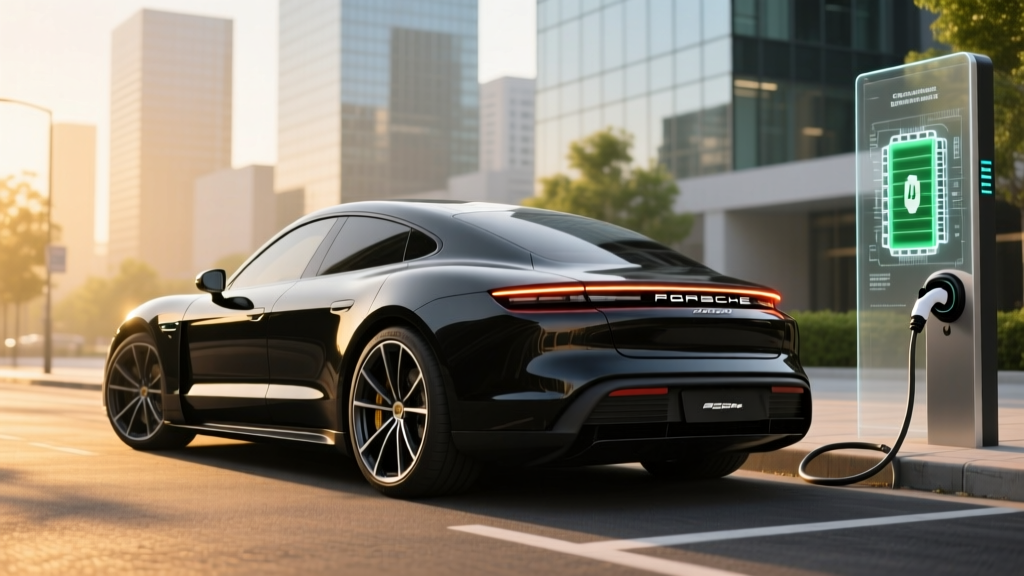
The 2025 Porsche Taycan is no longer the range-challenged luxury EV it was at launch. A substantial mid-cycle refresh has transformed Porsche's electric sports sedan into a genuine road-trip contender, pairing a larger battery with class-leading DC fast-charging speeds that shame most rivals. But at a starting price north of $100,000, buyers need to know exactly what they're getting — and where the Taycan still falls short versus a Tesla Model S or Lucid Air.
After analyzing EPA data, manufacturer specifications, and real-world driving impressions, here is everything you need to decide if the refreshed Taycan belongs in your garage.
2025 Porsche Taycan: Complete Spec Overview
Porsche expanded the Taycan lineup for 2025 with revised battery packs, updated power electronics, and a new Turbo GT flagship. Below are the core specifications across the primary trims sold in the United States.
| Specification | Taycan (RWD) | Taycan 4S | Taycan Turbo | Turbo GT |
|---|---|---|---|---|
| EPA Range | ~318 mi | ~292 mi | ~290 mi | ~269 mi |
| Battery (Usable) | 97.0 kWh (Performance Battery Plus) | 97.0 kWh | 97.0 kWh | 97.0 kWh |
| Chemistry | NMC (Nickel Manganese Cobalt) | NMC | NMC | NMC |
| Horsepower (Launch Control) | 402 hp | 590 hp | 871 hp | 1,019 hp |
| 0-60 mph | 4.6 sec | 3.5 sec | 2.5 sec | 2.1 sec |
| Drivetrain | RWD (single motor) | AWD (dual motor) | AWD (dual motor) | AWD (dual motor) |
| Max DC Charge Rate | 320 kW | 320 kW | 320 kW | 320 kW |
| 10-80% DC Fast Charge | ~18 min | ~18 min | ~18 min | ~18 min |
| Level 2 Charge Rate | 11 kW (~33 mi/hr) | 11 kW (~33 mi/hr) | 11 kW (~33 mi/hr) | 11 kW (~33 mi/hr) |
| MPGe (Combined) | ~92 MPGe | ~86 MPGe | ~83 MPGe | ~78 MPGe |
| Base MSRP | $101,000 | $126,900 | $176,300 | $230,000 |
| Battery Warranty | 8 yr / 100,000 mi | 8 yr / 100,000 mi | 8 yr / 100,000 mi | 8 yr / 100,000 mi |
Real-World Range: Beyond the EPA Sticker
The 2025 refresh replaced the previous 79.2 kWh and 93.4 kWh packs with a single 105 kWh gross / 97.0 kWh usable NMC lithium-ion battery across all trims. This is a significant improvement. The outgoing base Taycan managed just 225 miles EPA; the new RWD model nearly adds 100 miles to that figure.
Efficiency varies meaningfully by trim. The RWD model achieves approximately 33 kWh/100mi on the combined cycle, which is competitive with the BMW i5 eDrive40 and slightly behind the Lucid Air Pure. The Turbo GT, with its wider tires and higher-output motors, drops to around 43 kWh/100mi — a number you'll notice at the charger.
For context, on a 250-mile highway trip at moderate temperatures, the Taycan 4S will arrive with roughly 15-20% state of charge remaining. That's comfortable but not lavish. Road-trippers should plan charging stops at 200-220 mile intervals to avoid dipping below 10% SoC, especially in mountainous terrain where regenerative braking can't fully offset climbing energy demands.
Charging Performance: 320 kW Peak and the Curve That Matters
The headline number is 320 kW peak DC fast-charging — a figure that places the Taycan at the top of the production EV leaderboard alongside the Hyundai Ioniq 5 N and Kia EV6 GT. But peak kW is not sustained kW, and the charge curve tells the real story.
| Charging Level | Power / Rate | Miles Added per Hour | Notes |
|---|---|---|---|
| Level 1 (120V) | ~1.4 kW | ~4 mi/hr | Emergency/trickle only |
| Level 2 (240V, 48A) | 11 kW | ~33 mi/hr | Full overnight charge in ~9.5 hrs |
| DC Fast Charge (peak) | 320 kW | ~900+ mi/hr (at peak) | Requires 800V-capable station |
| DC Fast 10-80% | — | ~18 minutes | With battery preconditioning |
| DC Fast 10-50% | — | ~8 minutes | Peak rate sustained to ~50% |
Porsche's 800-volt architecture is the engineering enabler here. The Taycan sustains above 250 kW from approximately 10% to 55% SoC on a compatible 350 kW charger (such as Electrify America's latest stalls), then tapers progressively. From 80% to 100%, charging slows dramatically — expect 20+ additional minutes for that final 20%. The practical takeaway: set your charge limit to 80% for road trips and move on.
Preconditioning matters. The Taycan's navigation system will automatically warm the battery when a DC fast-charger is set as your destination. Without preconditioning — for example, if you pull into a charger with a cold-soaked battery — peak rates may be limited to 150-200 kW, adding 5-8 minutes to your 10-80% session.
At home on a Level 2 charger, the onboard 11 kW AC charger replenishes the 97 kWh pack in roughly 9.5 hours from empty. Most owners will plug in at 20-30% remaining and wake to a full battery. Porsche includes the Porsche Mobile Charger Connect with the vehicle, though many buyers opt for a hardwired wall unit like the ChargePoint Home Flex or Tesla Wall Connector (with J1772 adapter or NACS adapter depending on your vehicle's port — the 2025 Taycan uses CCS1 in the US market, though Porsche has confirmed NACS adoption for future model years).
Performance and Driving Dynamics
The Taycan's performance credentials are not in question, but the 2025 refresh sharpened them considerably. Porsche introduced a new rear-axle motor with higher power density, revised regenerative braking that can recuperate up to 400 kW, and updated Porsche Active Suspension Management (PASM) across all trims.
The base RWD Taycan's 4.6-second 0-60 time is quick but not startling in a segment where the Tesla Model S Plaid hits 60 in under 2 seconds. Where the Taycan earns its reputation is in sustained performance: Porsche's two-speed rear transmission (unique in the EV segment) allows the Taycan to deliver repeatable hard launches without the power fade that affects single-speed rivals during track sessions.
The Turbo GT, with its 1,019 hp (with Launch Control engaged) and Weissach Package weight reduction, is a genuine hypercar rival. But it's the 4S — at 590 hp and a $126,900 starting point — that represents the performance sweet spot for most buyers. It delivers supercar acceleration with daily-driver usability and all-weather AWD traction.
Regenerative braking behavior deserves a note. Unlike many EVs that offer aggressive one-pedal driving, the Taycan defaults to a coasting mode when you lift off the accelerator. You can enable stronger regen through the steering-wheel recuperation paddles or the drive mode selector, but Porsche's philosophy favors blending regenerative and friction braking seamlessly. Drivers accustomed to the strong one-pedal feel of a Chevrolet Bolt or Nissan LEAF will need an adjustment period.
Interior, Cargo, and Daily Practicality
The Taycan is a sports sedan first, and that priority shows in its packaging. Passenger space is adequate for four adults, but it doesn't rival the BMW i5 or Mercedes EQE for rear-seat comfort.
- Front legroom: 41.2 inches
- Rear legroom: 32.7 inches (tight for tall passengers)
- Front headroom: 38.9 inches (standard roof); less with panoramic glass
- Trunk (rear): 14.3 cu ft
- Frunk (front): 2.9 cu ft (fits a charging cable bag and small soft duffel)
- Cross-Tourer (wagon) variant: 15.7 cu ft rear, expanding to 42.8 cu ft with seats folded
The Cross-Tourer body style is worth serious consideration for buyers who need cargo flexibility. It adds 1.2 inches of ground clearance, standard all-wheel drive, and a more practical hatchback rear — making it a viable alternative to an electric SUV for active-lifestyle buyers who don't need the ride height of a Cayenne.
Infotainment runs on Porsche Communication Management (PCM) with a 12.6-inch curved instrument cluster and a 10.9-inch central touchscreen. A passenger-side 10.9-inch display is optional. The system supports wireless Apple CarPlay and Android Auto, over-the-air updates, and Porsche's voice assistant. It's responsive and well-organized, though not as feature-dense as Tesla's interface or as visually impressive as Lucid's glass cockpit.
Driver assistance includes adaptive cruise control with stop-and-go, lane-keeping assist, and Porsche InnoDrive (predictive cruise that reads road geometry and speed limits). These are SAE Level 2 driver-assist features — the driver must remain attentive and keep hands on or near the wheel at all times. Porsche does not currently offer a hands-free highway driving system comparable to GM's Super Cruise or Ford's BlueCruise.
Pricing, Trims, and Federal Tax Credit Eligibility
The 2025 Taycan lineup starts at $101,000 for the base RWD and climbs steeply. Here's the pricing breakdown before options and destination charges:
| Trim | Base MSRP | Typical As-Tested | §30D Federal Credit |
|---|---|---|---|
| Taycan (RWD) | $101,000 | $115,000-$125,000 | Not eligible (MSRP cap: $55,000 for sedans) |
| Taycan 4S | $126,900 | $140,000-$160,000 | Not eligible |
| Taycan Turbo | $176,300 | $195,000-$220,000 | Not eligible |
| Turbo GT | $230,000 | $250,000+ | Not eligible |
The Taycan also faces the reality that Porsche options add up fast. A well-equipped 4S with the Premium Plus package, adaptive air suspension, and Sport Chrono can easily reach $155,000 before taxes. The base RWD is the value play, but even it will likely leave the dealer above $115,000 once you add metallic paint, larger wheels, and the passenger display.
Taycan vs. the Competition
At this price point, the Taycan competes with a small but formidable group. Here's how it stacks up against key rivals:
| Metric | Porsche Taycan 4S | Tesla Model S Plaid | Lucid Air Grand Touring | BMW i5 M60 |
|---|---|---|---|---|
| EPA Range | ~292 mi | ~396 mi | ~516 mi | ~295 mi |
| 0-60 mph | 3.5 sec | 1.99 sec | 3.0 sec | 3.7 sec |
| Max DC Charge | 320 kW | 250 kW | 300+ kW | 205 kW |
| Base Price | $126,900 | $108,490 | $138,000 | $85,100 |
| Federal Credit | No | No (MSRP cap) | No (MSRP cap) | No (MSRP cap) |
The Lucid Air Grand Touring dominates on range. The Tesla Model S Plaid dominates on acceleration and Supercharger network access. The BMW i5 M60 undercuts on price while delivering strong luxury. So why buy the Taycan?
The answer is driving dynamics and charging speed. The Taycan's steering feel, chassis balance, and brake modulation remain best-in-class for an EV. And its 320 kW peak charge rate, combined with the 800V architecture, means shorter charging stops than any rival on this list. If your priority is engagement behind the wheel and you can accept 250-270 real-world highway miles, the Taycan is the driver's choice.
Pros, Cons, and Who Should Buy
Pros
- Class-leading 320 kW DC fast-charging with excellent sustained curve
- Best-in-class steering feel and chassis dynamics for an EV
- Two-speed rear transmission enables repeatable launches
- Up to 318 mi EPA range (RWD) — a massive improvement over pre-2025 models
- 800V architecture future-proofs for next-gen charging infrastructure
- Strong build quality and Porsche dealer service network
- Cross-Tourer wagon variant adds genuine cargo practicality
Cons
- No federal tax credit eligibility (MSRP exceeds $55K sedan cap)
- Rear seat legroom is tight at 32.7 inches
- One-pedal driving is not the default — requires adjustment
- No hands-free highway driving system (unlike Super Cruise/BlueCruise)
- Frunk is tiny at 2.9 cu ft
- Options escalate price rapidly; a "base" Taycan is rarely sold at base MSRP
- CCS1 connector today; NACS adapter needed for Tesla Superchargers
Ownership Costs and Warranty
Porsche covers the Taycan's battery and powertrain for 8 years or 100,000 miles, whichever comes first, with a capacity retention threshold of 70%. The limited vehicle warranty runs 4 years / 50,000 miles. Porsche also includes 3 years of complimentary scheduled maintenance and roadside assistance.
Insurance costs are substantial. Expect annual premiums in the $3,500-$5,500 range depending on your location, driving record, and trim level. The Turbo GT will push higher. Get quotes before purchasing.
Charging costs vary widely. At the national average residential electricity rate of ~$0.17/kWh, a full home charge costs approximately $16.50 for 97 kWh. On Electrify America or similar DC networks at $0.48-$0.58/kWh, a 10-80% session (roughly 68 kWh) runs $33-$39. For comparison, fueling a similarly powerful gas sedan at 18 mpg and $3.50/gallon costs about $19 per 100 miles; the Taycan 4S at ~36 kWh/100mi costs $6-$17 per 100 miles depending on your electricity source.
Long-term battery degradation data for the 2025 pack is not yet available (the vehicle is still relatively new). However, the outgoing Taycan's NMC packs showed approximately 5-8% degradation over 100,000 miles in fleet data — well within Porsche's 70% warranty threshold. The 800V architecture's lower current draw per cell is theoretically beneficial for long-term cell health.
Frequently Asked Questions
What is the real-world range of the 2025 Porsche Taycan?
The EPA rates the base RWD Taycan at approximately 318 miles and the 4S at 292 miles. In real-world highway driving at 70-75 mph, expect 250-275 miles from the RWD and 230-255 miles from the 4S. Cold weather (below freezing) reduces these figures by 20-30%. Always plan road trips around 200-220 mile charging intervals for a comfortable buffer.
How fast does the 2025 Taycan charge at home and on the road?
At home on a Level 2 (240V) charger, the Taycan charges at up to 11 kW, adding roughly 33 miles of range per hour — a full charge takes about 9.5 hours. On a DC fast charger rated at 350 kW, the Taycan peaks at 320 kW and charges from 10-80% in approximately 18 minutes, provided the battery is preconditioned via the navigation system.
Does the 2025 Porsche Taycan qualify for the federal EV tax credit?
No. Under current IRS §30D rules, new electric sedans must have an MSRP at or below $55,000 to qualify for the $7,500 federal tax credit. Every 2025 Taycan trim starts above $100,000, disqualifying the entire lineup. Buyer income caps and battery sourcing requirements are additional barriers, though they are moot given the MSRP cap. Check IRS.gov for the latest rules.
Is the Taycan worth buying over a Tesla Model S or Lucid Air?
It depends on your priorities. Choose the Taycan if driving dynamics, steering feel, and the fastest DC charging in the segment matter most. Choose the Lucid Air if range is paramount (516 mi EPA on the Grand Touring). Choose the Tesla Model S if you want Supercharger network convenience, the quickest acceleration (Plaid), and lower starting prices. The Taycan trades range and price for engagement and charging speed.
Does the Taycan use NACS or CCS for charging?
The 2025 Taycan uses the CCS1 connector in the US market. Porsche has announced NACS adoption for future model years. Current Taycan owners can access Tesla Superchargers using a CCS-to-NACS adapter, though charge rates will be limited by the adapter's rating. For optimal 320 kW speeds, use Electrify America, Ionity (in Europe), or other 800V-compatible CCS networks.
How long will the Taycan's battery last?
Porsche warranties the battery for 8 years or 100,000 miles with a minimum 70% capacity retention. Based on data from the previous-generation Taycan, NMC battery degradation averages 5-8% over 100,000 miles. With proper care — avoiding frequent 100% charges, using battery preconditioning for DC fast-charging, and limiting exposure to extreme heat — the pack should deliver well over 150,000 miles before approaching the warranty threshold. Full battery replacement, if needed outside warranty, is estimated at $20,000-$30,000+ based on current Porsche service pricing.