Quick Answer: Should You Buy a Porsche EV?
Porsche currently sells two fully electric vehicles in the U.S.: the Taycan sedan/cross-turismo (EPA range up to 318 miles, starting at $91,900) and the Macan EV SUV (EPA range up to 308 miles, starting at $78,800). Both use an 800-volt architecture enabling peak DC fast charging up to 320 kW (Taycan) and 270 kW (Macan EV), with 10–80% charges in roughly 18–21 minutes at compatible chargers. Neither qualifies for the §30D federal tax credit due to MSRP caps and overseas battery sourcing. Buy a Porsche EV if you prioritize driving dynamics and ultra-fast charging; consider a plug-in hybrid Cayenne or Panamera if you need longer range flexibility without charging infrastructure.
The 2026 Porsche EV Lineup: Taycan and Macan EV
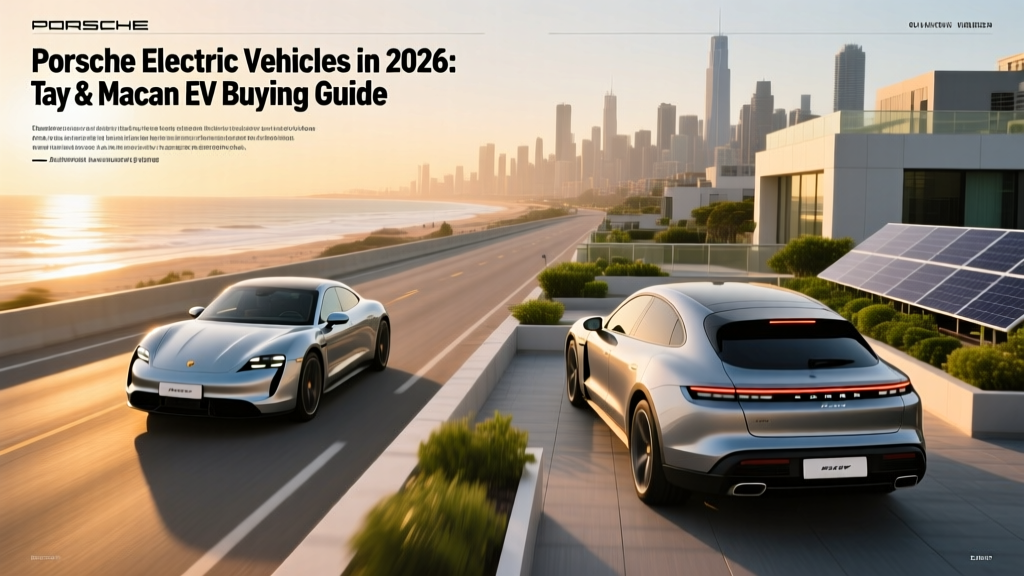
Porsche's electric portfolio in 2026 consists of two distinct models aimed at different buyers. The Taycan, now in its second generation following a significant 2025 refresh, is the brand's performance flagship — a sports sedan that competes with the Tesla Model S Plaid, Audi e-tron GT, and BMW i7. The Macan EV, which launched for the 2025 model year, replaces the gas Macan in Porsche's lineup and targets the luxury compact SUV segment against the BMW iX, Genesis GV60, and Mercedes EQB.
Both vehicles share Porsche's J1 (Taycan) and PPE (Macan EV) platforms, respectively, and both use 800-volt electrical architectures — a significant advantage over the more common 400-volt systems found in most competitors. Higher voltage allows faster charging at lower current, reducing heat buildup and enabling sustained fast-charging performance.
| Spec | 2026 Taycan (Base RWD) | 2026 Taycan 4S | 2026 Macan EV (Base) | 2026 Macan 4 EV |
|---|---|---|---|---|
| EPA Range | 318 mi | 283 mi | 308 mi | 288 mi |
| Battery (usable) | 97.0 kWh (NMC) | 97.0 kWh (NMC) | 95.0 kWh (NMC) | 95.0 kWh (NMC) |
| Horsepower | 402 hp | 590 hp | 402 hp | 509 hp |
| 0–60 mph | 4.6 sec | 3.5 sec | 4.9 sec | 3.9 sec |
| Peak DC Charge Rate | 320 kW | 320 kW | 270 kW | 270 kW |
| 10–80% DC Time | ~18 min | ~18 min | ~21 min | ~21 min |
| Level 2 Rate | 19.2 kW (AC) | 19.2 kW (AC) | 11 kW (AC) | 11 kW (AC) |
| Starting MSRP | $91,900 | $108,900 | $78,800 | $89,600 |
Real-World Range vs. EPA Sticker
Porsche's EPA range estimates are among the most conservative in the industry — a pattern we've seen since the original Taycan launched. In independent real-world highway testing, Taycan models routinely exceed their EPA figures by 10–15% in moderate temperatures at speeds around 70 mph. Expect approximately 330–350 highway miles from the Taycan RWD in 65°F weather. However, cold weather (below 32°F) will reduce range by roughly 15–25% depending on cabin heating demands and whether you precondition the battery. The Macan EV, being a heavier SUV with more frontal area, sees slightly less real-world upside — expect roughly EPA-matching or slightly above results in temperate conditions, with similar cold-weather losses.
Charging Infrastructure: The 800-Volt Advantage
The primary ownership advantage of Porsche's 800-volt architecture is sustained DC fast-charging speed. Most 400-volt EVs peak at their maximum charge rate for only a narrow band of the battery's state of charge (SoC), then taper aggressively. Porsche's thermal management system allows the Taycan to sustain above 200 kW from roughly 10% to 55% SoC at a compatible 350 kW Electrify America or Ionity charger before tapering begins.
This means your average charging speed during a 10–80% session is meaningfully higher than an EV with a similar peak rate but a 400-volt system. On a road trip, this translates to shorter stops — typically 18–22 minutes at a high-power charger versus 25–35 minutes for competitors with comparable battery sizes but lower sustained rates.
| Charging Level | Power | Taycan (Miles/Hour) | Macan EV (Miles/Hour) | Typical Location |
|---|---|---|---|---|
| Level 1 (120V) | ~1.4 kW | ~3 mi/hr | ~3 mi/hr | Standard outlet |
| Level 2 (240V, 48A) | 11.5 kW | ~28 mi/hr | ~26 mi/hr | Home / workplace |
| Level 2 (240V, 80A)* | 19.2 kW | ~47 mi/hr | N/A (11 kW max) | Home (Taycan only) |
| DC Fast (350 kW station) | Peak 320 / 270 kW | 10–80% in ~18 min | 10–80% in ~21 min | Electrify America, Ionity |
*Taycan supports 19.2 kW AC charging with optional onboard charger; Macan EV is limited to 11 kW AC.
For home charging, a Level 2 wall connector on a 60-amp circuit (delivering 48 amps continuous) will fully recharge a Taycan overnight in roughly 5–6 hours and a Macan EV in about 8–9 hours. Installation costs for a Level 2 home charger typically range from $800 to $2,500 depending on panel proximity and whether your electrical panel requires an upgrade to 200 amps. Porsche does not currently include a complimentary home charger with new EV purchases, so budget approximately $600–$800 for a quality Level 2 unit like the ChargePoint Home Flex or Emporia Vue.
EV vs. Gas Porsche: The Ownership Cost Reality
The most common cross-shopping decision for Porsche EV buyers is whether to go electric or stick with a gasoline Porsche — particularly the gas Macan, Cayenne, or Panamera. Let's compare real numbers over a 5-year, 60,000-mile ownership period.
| Cost Category | 2026 Macan 4 EV ($89,600) | 2026 Macan S (Gas, ~$68,500) |
|---|---|---|
| Purchase Price (MSRP) | $89,600 | $68,500 |
| Federal Tax Credit (§30D) | $0 (exceeds MSRP cap) | $0 |
| Fuel/Energy (60k mi) | $2,700 (home L2, $0.13/kWh avg) | $9,900 (premium gas, $4.50/gal, 22 MPG) |
| Maintenance (5 yr) | $1,800 (tire rotations, cabin filter, fluid checks) | $5,200 (oil changes, brakes, spark plugs, belts) |
| Insurance (5 yr est.) | $14,500 | $12,000 |
| Estimated Depreciation | $38,000 | $28,000 |
| 5-Year Total Cost | ~$148,600 | ~$123,600 |
The Macan EV costs roughly $25,000 more over five years, driven primarily by the higher purchase price and steeper depreciation. The energy and maintenance savings — approximately $10,600 combined — offset part of the premium but don't close the gap. This math shifts if you have access to free or subsidized workplace charging, live in a state with high gas prices (California, New York), or if Porsche's residual values for EVs improve as the market matures.
However, the ownership experience differs qualitatively. Macan EV owners who charge at home report never visiting a gas station, experiencing less brake wear due to regenerative braking, and enjoying instant torque from a stop. The trade-off is the upfront premium and the need to plan longer road trips around DC fast-charging stations.
Tax Credits and Incentives: What Porsche EV Buyers Should Know
Under current IRS §30D rules, neither the Taycan nor the Macan EV qualifies for the $7,500 federal new clean vehicle credit. There are three independent reasons:
- MSRP Cap: The §30D credit applies only to SUVs priced at or below $80,000 and sedans at or below $55,000. The Macan EV starts at $78,800 (base), but any options push it above $80,000. The Taycan sedan starts at $91,900 — well above the $55,000 sedan cap.
- Battery Sourcing: The credit requires critical minerals and battery components to meet escalating domestic-content and FEOC (foreign entity of concern) thresholds. Porsche's battery cells are sourced from suppliers that do not currently meet these requirements.
- Final Assembly: The Taycan is assembled in Zuffenhausen, Germany. The Macan EV is assembled in Bratislava, Slovakia. Both fail the North American final assembly requirement.
Some state-level incentives may partially offset the cost. For example, certain utility companies offer rebates of $500–$1,500 for purchasing an EV and installing a Level 2 charger. Check your state energy office and local utility for current programs, as these vary widely and change frequently.
If you're considering a used Taycan (model year 2022 or earlier), the §25E used clean vehicle credit offers up to $4,000 (30% of sale price, capped) for EVs priced at $25,000 or less — a threshold that very few used Taycans currently meet given strong residual values.
Common Misconceptions About Porsche EVs
| Myth | Fact |
|---|---|
| "Porsche EVs have poor range compared to Tesla." | The 2026 Taycan RWD achieves 318 miles EPA — competitive with the Model S Long Range (320 mi). Porsche's conservative EPA testing methodology means real-world range often exceeds the sticker, unlike some competitors whose real-world results fall short. |
| "You can't road-trip a Porsche EV." | With 10–80% charging in ~18 minutes and access to Electrify America's 350 kW network (Porsche includes 3 years of complimentary 30-minute charging sessions at EA), road-tripping is practical. A 600-mile trip requires roughly two 20-minute stops. |
| "The battery will need expensive replacement soon." | Porsche provides an 8-year / 100,000-mile battery warranty covering defects and capacity loss below 70% of original capacity. NMC batteries in thermally managed systems like Porsche's typically degrade 1–2% per year under normal use, retaining ~85–90% capacity at 100,000 miles. |
| "Electric Porsches aren't 'real' Porsches." | The Taycan holds Nürburgring lap records for its class and delivers sustained performance without the power derating that affects some EVs after repeated hard launches. The two-speed rear transmission is unique among EVs and enables both strong launch acceleration and efficient highway cruising. |
| "Home charging is too expensive to install." | Most Level 2 installations on existing 200-amp panels cost $800–$1,500. If your panel is adjacent to the garage, costs can be as low as $500–$800. A 200-amp panel upgrade adds $1,500–$3,500 but is only required on older homes with 100-amp or 150-amp service. |
Real-World Ownership Considerations
Before purchasing a Porsche EV, honestly assess these four factors:
Home charging access: This is the single biggest determinant of EV satisfaction. If you can install a Level 2 charger at home (garage or dedicated driveway outlet), a Porsche EV is seamless — you start every morning with a full battery. If you rely solely on apartment or street parking with no charging access, public DC fast charging for a Taycan or Macan EV costs roughly $0.35–$0.55/kWh at Electrify America, making it significantly more expensive than home charging and less convenient. We do not recommend EV ownership without reliable home or workplace charging.
Climate: In cold-winter climates (Minnesota, Maine, Colorado mountains), expect 15–25% range reduction when temperatures stay below freezing. Porsche's heat pump (standard on both models) mitigates cabin-heating energy draw, but battery chemistry inherently loses efficiency in cold. If your commute is 200+ miles in winter conditions, the range buffer narrows considerably. Preconditioning the battery while plugged in — a feature Porsche supports via the My Porsche app — recovers some of this loss.
Driving patterns: Porsche EVs reward highway cruising with excellent efficiency. The Taycan RWD achieves approximately 2.8–3.0 mi/kWh on the highway (roughly 84 MPGe combined per fueleconomy.gov). City driving with frequent regenerative braking opportunities actually improves efficiency. If you primarily drive short urban trips and charge at home, the EV experience is ideal. If you regularly tow or carry heavy loads, range will drop — Porsche rates the Macan EV for 4,400 lbs towing capacity, but expect a 30–40% range reduction at max tow weight.
Insurance costs: Porsche EVs carry higher insurance premiums than their gas counterparts — typically 15–25% more. Average annual premiums for the Taycan range from $2,600 to $3,400 depending on state, driving record, and coverage level. Get quotes before purchasing to avoid surprises.
Decision Framework: Which Porsche EV (or Gas Alternative) Is Right for You?
Choose the Taycan if: You want a performance sedan with class-leading charging speed, prioritize driving dynamics over cargo space, have home Level 2 charging, and your budget allows $95,000–$130,000+ after options.
Choose the Macan EV if: You need SUV practicality (cargo, ground clearance, optional towing), want Porsche dynamics in a daily-driver package, have home charging, and your budget is $80,000–$105,000.
Choose a gas Macan or Cayenne instead if: You lack home charging access, frequently drive 400+ miles in a single day through areas with sparse charging infrastructure, tow heavy loads regularly, or need to minimize upfront cost and depreciation risk.
Choose a Panamera E-Hybrid (PHEV) if: You want electric daily commuting (30–35 miles electric-only range) with gas-engine flexibility for road trips, and you don't want to depend on public charging infrastructure at all.
Battery Longevity, Warranty, and Residual Values
Porsche's EV battery warranty covers 8 years or 100,000 miles (whichever comes first) against defects and capacity loss below 70% of original capacity. This is competitive with BMW (8/80,000) and slightly better than Mercedes-Benz (8/100,000 at 70%). Tesla offers 8 years with unlimited miles on the Model S battery, though its capacity retention threshold is also 70%.
Based on data from first-generation Taycan owners (2020–2024 models), NMC batteries with Porsche's active thermal management show degradation of approximately 1–2% per year under typical mixed-use driving. Owners reporting at 80,000–100,000 miles commonly see State of Health (SoH) readings between 87–92%. Heavy DC fast-charging use (daily 150+ kW sessions) may accelerate this slightly, but Porsche's preconditioning and thermal limits protect the cells.
Out-of-warranty battery replacement costs remain high: approximately $20,000–$30,000 for a Taycan pack and $18,000–$25,000 for a Macan EV pack, based on current parts pricing. However, module-level repair (replacing individual degraded cell modules rather than the entire pack) is possible at Porsche-certified service centers and typically costs $3,000–$8,000 depending on the number of modules replaced.
Residual values for Porsche EVs have been volatile. The first-generation Taycan experienced steeper-than-expected depreciation in 2023–2024 as newer competitors entered the market and used EV supply grew. The refreshed 2025+ Taycan with improved range and charging has shown stronger retention. The Macan EV, being newer, lacks long-term depreciation data, but Porsche brand strength and limited supply suggest moderate retention — expect approximately 50–55% of MSRP at the 5-year mark, per current Kelley Blue Book projections.
Frequently Asked Questions
Does Porsche offer any electric vehicles besides the Taycan and Macan EV?
As of 2026, only the Taycan and Macan EV are fully electric. Porsche has confirmed that a fully electric 718 Boxster/Cayman (announced) is expected to arrive in the 2027 model year, and an electric Cayenne is in development. The Cayenne and Panamera currently offer plug-in hybrid (PHEV) variants with 30–45 miles of electric-only range.
Can I use Tesla Superchargers with a Porsche EV?
Porsche EVs currently use the CCS1 connector for DC fast charging. Tesla opened select Supercharger stations to non-Tesla CCS vehicles via the built-in Magic Dock adapter, and availability is expanding. You can also use an approved NACS-to-CCS adapter (such as the Lectron or A2Z adapter) for access to V3 Superchargers. Porsche has announced that future models will adopt the NACS connector natively, but the 2026 Taycan and Macan EV remain CCS1.
What does it cost to charge a Porsche Taycan at home?
The Taycan's 97 kWh usable battery, charged from 10% to 90% on a home Level 2 charger at the U.S. average electricity rate of $0.16/kWh, costs approximately $12.40. This provides roughly 260–280 real-world miles. Per-mile energy cost is approximately $0.045–$0.05 — about one-third the per-mile cost of premium gasoline in a comparable gas Porsche.
Is the Porsche Taycan faster than a Tesla Model S?
The Taycan Turbo S (0–60 in 2.4 seconds, 942 hp on overboost) is competitive with the Model S Plaid (0–60 in 1.99 seconds, 1,020 hp) in straight-line acceleration, with the Tesla holding a slight edge. However, the Taycan's two-speed rear axle and thermal management give it an advantage in sustained performance — it can repeat full-power launches without the power derating that some EVs experience after 2–3 hard accelerations. On a road course, the Taycan generally outperforms the Model S due to its lower center of gravity, more aggressive brake regen tuning, and Porsche's chassis tuning.
How does the Macan EV compare to the BMW iX?
The Macan 4 EV (288 mi EPA, 509 hp, $89,600) is smaller and sportier than the BMW iX xDrive50 (324 mi EPA, 516 hp, $87,250). The iX offers more cargo space (35.5 vs. 28.4 cu ft behind the rear seats), slightly longer range, and a more comfortable ride. The Macan EV counters with sharper handling, faster peak charging relative to its battery size, and a more driver-focused interior. If you prioritize driving engagement, the Macan EV wins; if you prioritize family practicality and range, the iX is the stronger choice. See fueleconomy.gov for official efficiency comparisons.
Should I lease or buy a Porsche EV?
Leasing can be advantageous for Porsche EVs for two reasons: (1) some lease deals effectively pass through the $7,500 commercial EV credit (§45W) as a lease incentive even when the buyer wouldn't qualify for §30D purchase credit, and (2) leasing transfers depreciation risk to Porsche Financial Services. If you plan to keep the vehicle beyond 4 years and drive fewer than 12,000 miles annually, buying may still make sense — but run the numbers with your dealer's current lease rates versus purchase APR before deciding.