Quick Answer: Is a Porsche Electric Vehicle Worth It?
A Porsche electric vehicle delivers class-leading driving dynamics and ultra-fast 800-volt DC charging (up to 320 kW on the Taycan, 10-80% in ~18 minutes), but it comes at a premium. Expect $80,000-$190,000+ depending on model and trim, no federal §30D tax credit eligibility (MSRP exceeds the $55,000/$80,000 caps), and real-world range of 220-280 miles highway. Compared to a gas Porsche 911 or Cayenne, you'll save roughly $1,800-$2,500 annually on fuel and maintenance, but insurance runs 15-25% higher. A Porsche EV makes sense if you have Level 2 home charging, prioritize performance over maximum range, and accept the upfront premium for engineering quality.
Current Porsche Electric Vehicle Lineup: Taycan vs Macan EV
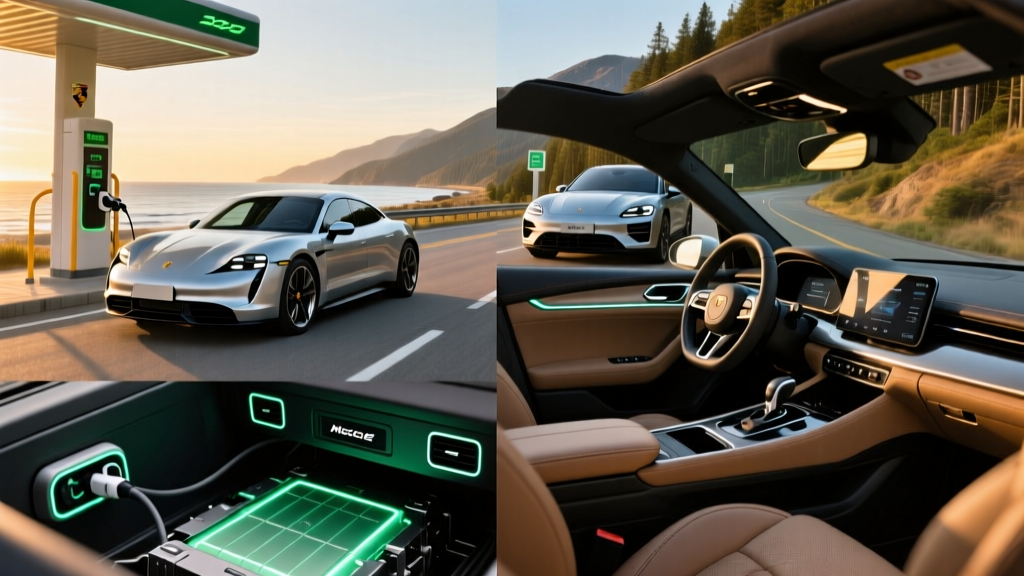
Porsche offers two fully electric models for 2026: the Taycan sedan/cross-tourer and the all-new Macan EV. Both use 800-volt architectures enabling some of the fastest DC charging in the industry. Here's how they stack up on paper and in practice.
| Spec | Taycan (Base RWD) | Taycan 4S | Taycan Turbo GT | Macan 4 EV | Macan Turbo EV |
|---|---|---|---|---|---|
| EPA Range | 292 mi | 283 mi | 269 mi | 308 mi | 288 mi |
| Battery (usable kWh) | 89 kWh (NMC) | 89 kWh (NMC) | 89 kWh (NMC) | 95 kWh (NMC) | 95 kWh (NMC) |
| Peak DC Charge Rate | 320 kW | 320 kW | 320 kW | 270 kW | 270 kW |
| 10-80% DC Fast Charge | ~18 min | ~18 min | ~18 min | ~21 min | ~21 min |
| Level 2 AC Rate | 11 kW (19.2 optional) | 11 kW (19.2 optional) | 11 kW (19.2 optional) | 11 kW | 11 kW |
| 0-60 mph | 4.6 sec | 3.5 sec | 2.1 sec | 4.9 sec | 3.3 sec |
| Horsepower | 402 hp | 590 hp | 1,019 hp (launch) | 402 hp | 630 hp |
| Base MSRP | $92,950 | $108,850 | $234,200 | $78,800 | $102,500 |
| Battery Warranty | 8 yr / 100k mi | 8 yr / 100k mi | 8 yr / 100k mi | 8 yr / 100k mi | 8 yr / 100k mi |
Real-World Range vs EPA Sticker
EPA estimates are tested under controlled conditions. In real-world driving, expect:
- Highway (70-80 mph): Subtract 15-20% from EPA. A Taycan 4S rated at 283 mi will deliver ~230-240 mi at sustained interstate speeds.
- Cold weather (below 32°F): Subtract 20-30%. The same Taycan 4S drops to ~190-210 mi in freezing temps without preconditioning.
- City/mixed with regen: You may match or slightly exceed EPA in stop-and-go driving thanks to strong regenerative braking (up to 290 kW regen on Taycan).
Porsche's thermal management system is excellent — preconditioning the battery while navigating to a DC charger recovers significant cold-weather range and enables peak charge rates.
EV vs Gas Porsche: Cost and Performance Comparison
How does going electric in a Porsche compare to sticking with internal combustion? Let's run the numbers on a Taycan 4S versus a comparable Panamera 4 E-Hybrid (gas/electric) and a 911 Carrera (gas-only baseline).
| Category | Taycan 4S (EV) | Panamera 4 E-Hybrid | 911 Carrera (Gas) |
|---|---|---|---|
| Base MSRP | $108,850 | $109,400 | $115,300 |
| Federal Tax Credit (§30D) | $0 (over MSRP cap) | $0 (over MSRP cap) | $0 |
| Fuel/Energy (5 yr, 12k mi/yr) | $4,800 (electricity) | $7,200 (gas + electric) | $12,500 (premium gas) |
| Maintenance (5 yr) | $2,100 | $5,800 | $6,500 |
| Insurance (5 yr avg) | $18,500 | $16,200 | $17,800 |
| Estimated Depreciation (5 yr) | $52,000 | $48,000 | $42,000 |
| 5-Year Total Cost | $186,250 | $186,600 | $194,100 |
Key takeaways: The Taycan 4S and Panamera 4 E-Hybrid nearly tie on total cost over five years, but the Taycan wins on driving refinement (instant torque, no transmission shifts, lower NVH). The 911 holds value better but costs more to fuel and maintain. Source: fueleconomy.gov for energy estimates; insurance via industry averages.
Charging a Porsche EV: Home Setup and Public Networks
Porsche's 800-volt platform is the standout feature for daily ownership. But you need the right infrastructure to benefit.
Home Charging (Level 2)
Every Porsche EV ships with a Porsche Mobile Charger Connect (up to 11 kW). For a full overnight charge on a Taycan's 89 kWh battery, 11 kW takes ~8.5 hours (0-100%). Optional 19.2 kW onboard chargers cut this to ~5 hours but require a 100-amp dedicated circuit — most homes need a panel upgrade ($1,500-$3,000) to support this.
Realistic home install cost:
- Standard 50-amp circuit with 11 kW charger: $800-$1,500 (electrician + permit)
- Upgraded 100-amp circuit for 19.2 kW: $2,500-$4,500 (panel upgrade often required)
- Always get a licensed electrician to assess your panel capacity first.
DC Fast Charging (Public)
At a 350 kW Electrify America or compatible CCS/NACS station, the Taycan peaks at 320 kW and sustains above 200 kW well past 50% state of charge. This is exceptional — most competitors taper sharply after 40-50%. The charge curve looks like this:
- 10-50% SoC: Sustained 250-320 kW (~8-10 minutes)
- 50-80% SoC: Tapers to 150-200 kW (~8-10 minutes)
- 80-100% SoC: Drops below 50 kW (avoid charging past 80% on road trips)
The Macan EV peaks at 270 kW with a similar sustained curve. Both models use the CCS1 connector natively; NACS adapters are available from Porsche for Tesla Supercharger access (expanding network significantly).
Tax Credits, Incentives, and What You Actually Pay
Here's where Porsche EV buyers face reality: no federal §30D tax credit applies. The IRS caps the credit at vehicles under $55,000 (sedans) or $80,000 (SUVs/vans). The Macan EV starts at $78,800 (just under the SUV cap), but battery sourcing and critical mineral requirements for 2026 likely disqualify it. The Taycan, starting at $92,950, exceeds the sedan cap entirely.
§30D Federal EV Tax Credit Requirements (2026)
- Vehicle MSRP under $55,000 (sedans) or $80,000 (SUVs/vans/pickups) — Most Porsches exceed this
- Buyer AGI under $150,000 (single) / $300,000 (joint) — Many Porsche buyers exceed this
- Battery components manufactured in North America (percentage thresholds increase yearly)
- Critical minerals sourced from US or FTA partners
- Credit can be transferred to dealer at point-of-sale for an upfront price reduction
Source: IRS §30D guidelines. Consult a tax professional for your specific situation.
State incentives may apply. California's CVRP offers up to $7,000 for income-qualified buyers (but MSRP caps still apply). Colorado, New York, and others have their own programs. Check your state's energy office for current availability.
Common Misconceptions About Porsche EVs
| Myth | Fact |
|---|---|
| "Porsche EVs have terrible range compared to Tesla." | The 2026 Macan EV achieves 308 mi EPA (vs Model Y Long Range at 310 mi). Taycan range is lower (269-292 mi) but offset by 320 kW charging that adds ~180 mi in 10 minutes. |
| "You can't take a Porsche EV on road trips." | The 800V architecture enables 10-80% charges in 18-21 minutes. On a 500-mile trip, you'll stop twice for ~20 minutes each — comparable to gas stops for food/restroom breaks. |
| "EV batteries need replacement every 5 years." | Porsche warranties the battery for 8 years/100,000 miles with a 70% capacity retention guarantee. Real-world data shows NMC batteries degrade ~10-15% over 150,000 miles with proper care (avoiding frequent 100% charges and DC fast charging in extreme heat). |
| "Porsche EVs don't handle like real Porsches." | The Taycan Turbo GT set a Nürburgring lap record for production EVs (7:07.55). Low center of gravity, rear-axle steering, and torque vectoring deliver authentic Porsche dynamics. |
| "Charging at home is too expensive to install." | A basic 50-amp Level 2 install runs $800-$1,500. Over 5 years at 12,000 miles/year, home charging saves $7,700 vs premium gas (at $4.50/gal and $0.14/kWh national average). |
Decision Framework: Should You Buy a Porsche EV?
Choose a Porsche EV If:
- You have Level 2 home charging (or can install it). Public-only charging is viable but adds 20-40 minutes per session and costs 2-3x more per kWh.
- You value driving dynamics over maximum range. The Taycan's chassis, steering, and regen calibration are best-in-class. If you want 400+ miles, look at Lucid Air or Tesla Model S.
- You take road trips 3-6 times per year. The 800V charging speed minimizes downtime. If you drive 500+ miles weekly, a PHEV like the Cayenne E-Hybrid offers more flexibility.
- You can absorb the upfront cost without a tax credit. Budget $80,000-$120,000 for a well-equipped Taycan or Macan EV.
- You live in a moderate or warm climate. Cold-weather range loss is real (20-30%), though Porsche's heat pump mitigates this better than most.
Look Elsewhere If:
- You need 350+ miles of real-world range. Consider Lucid Air Grand Touring (450+ mi real-world) or Tesla Model S Long Range.
- You want federal tax credit savings. BMW i4, Hyundai Ioniq 6, and Ford Mustang Mach-E qualify (depending on trim and sourcing).
- You lack home charging access and your area has sparse DC infrastructure. Check Alternative Fuels Data Center for charger density near you.
- You prioritize cargo space and practicality. The Taycan's frunk + trunk totals ~14 cu ft. The Macan EV offers ~22 cu ft. For family hauling, the Rivian R1S or BMW iX are more spacious.
First-Time Porsche EV Buyer: What You Need to Know
If you're transitioning from a gas Porsche (or any ICE vehicle) to electric, here's what changes:
- Regenerative braking is adjustable. Porsche doesn't force one-pedal driving. You can set regen to auto (uses navigation and radar to adjust), low (coasting), or high (near one-pedal). Most owners settle on auto after a week.
- Preconditioning matters. Use the Porsche Connect app to start battery warming 15-20 minutes before DC fast charging or cold-weather departure. This preserves range and enables peak charge rates.
- Charging etiquette on road trips. Don't charge past 80% at busy stations — the curve tapers sharply and you're blocking others. Plan stops using the Porsche Charging Planner (built into navigation) or A Better Routeplanner.
- Tire wear increases. EVs are heavier and deliver instant torque. Expect tire replacement every 25,000-35,000 miles (vs 40,000-50,000 on gas cars). Budget $1,200-$2,000 for a set of Porsche-spec N-rated tires.
- Insurance is higher. EV repair costs (especially battery-related) drive premiums up 15-25%. Get quotes from GEICO, Progressive, and Hagerty before purchasing.
- Software updates improve the car. Porsche issues over-the-air updates for battery management, infotainment, and driver-assist features. Your car may gain range or features post-purchase.
Frequently Asked Questions
Does the Porsche Taycan qualify for any tax credits in 2026?
No. The Taycan's MSRP ($92,950+) exceeds the federal §30D cap of $55,000 for sedans. The Macan EV ($78,800 base) is under the $80,000 SUV cap but likely fails battery sourcing requirements. Some state incentives (like Colorado's $5,000 credit) have no MSRP cap — check your state.
How long does it take to charge a Porsche Taycan at home?
With the standard 11 kW Level 2 charger on a 50-amp circuit, a full 0-100% charge takes ~8.5 hours for the 89 kWh battery. Most owners charge from 20-80% daily, which takes ~5 hours. The optional 19.2 kW charger cuts this to ~3 hours but requires a 100-amp circuit and likely a panel upgrade.
Is the Macan EV better than the Taycan for daily driving?
For most buyers, yes. The Macan EV offers 308 mi EPA range (vs 283 mi for Taycan 4S), more cargo space (22 cu ft vs 14 cu ft), easier ingress/egress, and a lower starting price ($78,800 vs $108,850). The Taycan wins on outright performance (Turbo GT: 1,019 hp) and sedan styling preference.
What happens if the battery degrades significantly?
Porsche warranties the high-voltage battery for 8 years/100,000 miles with a 70% state-of-health guarantee. If capacity drops below 70% within that period, Porsche replaces or repairs modules at no cost. Out-of-warranty replacement runs $18,000-$28,000 depending on model, though module-level repair (replacing only degraded cells) costs $5,000-$12,000.
Can I use Tesla Superchargers with a Porsche EV?
Yes, with a NACS adapter (available from Porsche for ~$250). As of 2026, Tesla has opened most Superchargers to non-Tesla EVs via the NACS standard. The Taycan and Macan EV charge at up to 150 kW on V3 Superchargers (limited by adapter protocol, not the car's capability).
How does cold weather affect Porsche EV range?
Expect 20-30% range loss below 32°F. A Taycan 4S rated at 283 mi EPA drops to ~190-210 mi in freezing temps. Porsche's heat pump and battery preconditioning mitigate this better than most competitors, but physics limits lithium-ion performance in cold. Garage parking and preconditioning while plugged in recover significant range.
Is Porsche's driver-assist system self-driving?
No. Porsche InnoDrive is a Level 2 SAE system (like Tesla Autopilot or GM Super Cruise). It handles adaptive cruise, lane centering, and traffic sign recognition, but you must remain engaged and keep hands on the wheel. It does not navigate intersections, construction zones, or complex urban environments autonomously. Only Level 4 services like Waymo operate without a driver.
Final Verdict: Who Should Buy a Porsche Electric Vehicle?
A Porsche EV is a rational choice for performance-oriented buyers who have home charging, take occasional road trips, and can absorb the $80,000-$120,000 price without a federal tax credit. The 800-volt charging architecture is genuinely best-in-class, and real-world driving dynamics justify the premium over Tesla, BMW, or Mercedes-Benz EVs. However, if maximum range, tax credit eligibility, or cargo space are priorities, competitors like Lucid Air, BMW i5, or Rivian R1S offer compelling alternatives. Test drive both the Taycan and Macan EV with a full battery and an empty one — the charging speed difference will shape your ownership experience more than the 0-60 time.