Quick Answer: Should You Buy a Porsche Electric?
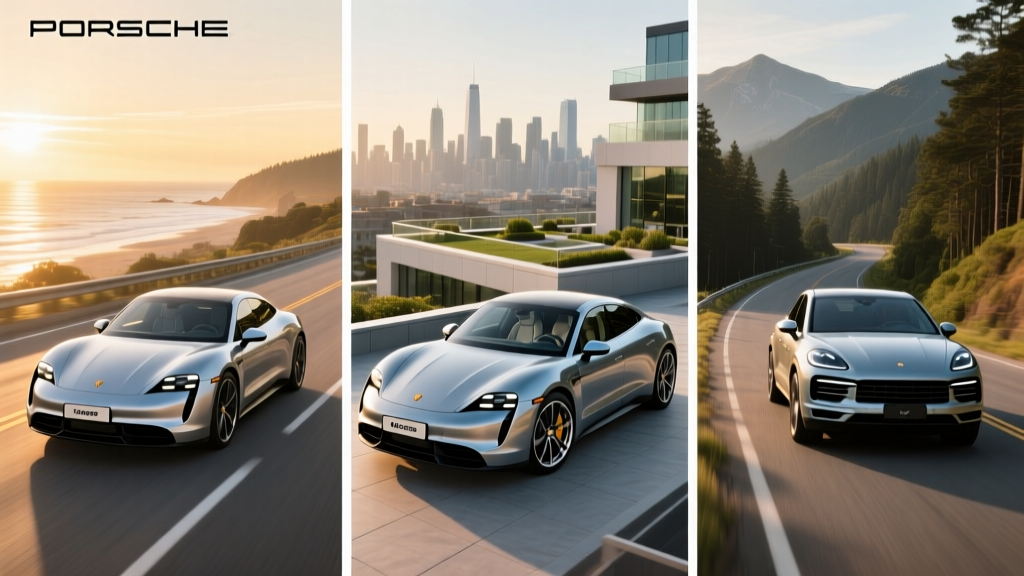
Porsche's electric lineup in 2026 spans three models: the Taycan sedan/cross-turismo (EPA 225–318 miles, $102,400–$200,100), the Macan Electric SUV (EPA 288–308 miles, $78,800–$106,300), and the newly arriving Cayenne Electric (EPA est. 300+ miles, ~$85,000+). Porsche EVs do not qualify for the $7,500 federal §30D tax credit due to MSRP caps and battery-sourcing rules. Real-world range typically runs 10–20% below EPA on highways and in cold weather. Home Level 2 charging is strongly recommended; public DC fast charging peaks at 270–320 kW depending on model, with 10–80% in 18–21 minutes under ideal conditions.
The 2026 Porsche Electric Lineup at a Glance
Porsche has committed heavily to electrification, and by the 2026 model year the brand fields three distinct EV platforms. Each targets a different buyer profile, and the specs vary significantly across trims.
| Model | Battery (kWh usable) | EPA Range | Peak DC Charge | 10–80% Time | 0–60 mph | HP | Base MSRP |
|---|---|---|---|---|---|---|---|
| Taycan (base) | 82.3 (NMC) | 225 mi | 270 kW | ~20 min | 5.1s | 402 | $102,400 |
| Taycan 4S | 97.0 (NMC, Performance Battery Plus) | 318 mi | 320 kW | ~18 min | 3.5s | 590 | $118,900 |
| Taycan Turbo GT | 97.0 (NMC) | 269 mi | 320 kW | ~18 min | 2.1s | 1,019 | $200,100 |
| Macan Electric (base) | 95.0 (NMC) | 308 mi | 270 kW | ~21 min | 5.4s | 355 | $78,800 |
| Macan 4 Electric | 95.0 (NMC) | 288 mi | 270 kW | ~21 min | 4.9s | 402 | $86,600 |
| Macan Turbo Electric | 95.0 (NMC) | 288 mi | 270 kW | ~21 min | 3.1s | 630 | $106,300 |
| Cayenne Electric (announced) | ~100+ (NMC est.) | ~300+ mi (est.) | ~350 kW (est.) | ~17 min (est.) | ~3.5s (est.) | TBD | ~$85,000+ (est.) |
Sources: EPA / fueleconomy.gov, Porsche USA. Cayenne Electric figures are preliminary estimates for the announced model; final specs pending launch.
Real-World Range: What the EPA Sticker Doesn't Tell You
Porsche publishes EPA range figures, but real-world results depend heavily on driving style, temperature, and terrain. The Taycan 4S with the larger 97.0 kWh Performance Battery Plus posts an impressive 318-mile EPA rating, but owners should expect approximately 250–280 miles on sustained highway driving at 70–80 mph. In freezing temperatures (below 32°F), expect a further 15–25% reduction, dropping effective range to roughly 200–240 miles for the 4S.
Range Reality Check: Taycan 4S
EPA Rating: 318 miles
Real-world highway (70°F): ~260–280 miles
Real-world highway (25°F): ~200–240 miles
City/mixed (moderate climate): ~290–310 miles
The Taycan's 800-volt architecture and two-speed rear transmission help it sustain efficiency at highway speeds better than many competitors, but physics still applies. Aggressive driving and elevation changes will reduce range further.
The Macan Electric fares slightly better in real-world conditions thanks to its more aerodynamic crossover profile and standard heat pump. Expect roughly 250–275 highway miles from the base model in moderate weather.
Charging Speeds and Infrastructure
Porsche's 800-volt platform remains one of the fastest-charging architectures available. However, peak kW figures are just that — peaks. The charge curve tapers significantly above 80% State of Charge (SoC) to protect battery longevity.
| Level | Power | Miles Added/Hour | Typical Use Case |
|---|---|---|---|
| Level 1 (120V) | ~1.4 kW | ~3–4 mi/hr | Emergency/overnight trickle only |
| Level 2 (240V, 48A) | ~11.5 kW | ~30–35 mi/hr | Home daily charging; full charge in 8–10 hrs |
| Level 2 (240V, 80A) | ~19.2 kW | ~50–55 mi/hr | Home with Porsche Mobile Charger Connect |
| DC Fast (Taycan peak) | 320 kW | ~180+ mi in 10 min | Road trips; 10–80% in ~18 min |
| DC Fast (Macan peak) | 270 kW | ~160+ mi in 10 min | Road trips; 10–80% in ~21 min |
Critical note on preconditioning: Porsche's navigation system will precondition the battery when a DC fast charger is set as your destination. This warms the battery to optimal temperature for peak charge acceptance. Without preconditioning — especially in cold weather — your actual charge rate may peak at only 100–150 kW, nearly doubling your stop time. Always navigate to the charger rather than just driving there.
For home charging, Porsche EVs use the NACS (Tesla-style) connector as of the 2025 model year refresh, with CCS1 compatibility via adapter. Home Level 2 installation with a 60-amp circuit (48A continuous) typically costs $800–$2,500 depending on panel proximity and local permitting. If your home's electrical panel requires an upgrade from 100A to 200A service, add $1,500–$3,500.
EV vs. Gas: Porsche Ownership Cost Comparison
The most common cross-shopping question: how does a Porsche EV compare to its gas counterpart on total cost? Let's compare the Macan Electric against the gas Macan over five years and 75,000 miles.
| Category | Macan 4 Electric ($86,600) | Gas Macan ($62,900 base) |
|---|---|---|
| Purchase price | $86,600 | $62,900 |
| Federal tax credit (§30D) | $0 (exceeds MSRP cap) | $0 |
| Fuel/energy (75k mi) | ~$4,200 (at $0.14/kWh avg) | ~$10,500 (at $3.50/gal, 22 MPG) |
| Maintenance | ~$1,800 (no oil, fewer wear items) | ~$4,500 (oil, filters, brakes) |
| Insurance (avg annual) | ~$2,800/yr ($14,000 total) | ~$2,200/yr ($11,000 total) |
| Estimated depreciation | ~$35,000 (40%) | ~$28,000 (45%) |
| 5-Year Total | ~$141,600 | ~$116,900 |
Fuel costs based on national averages. Electricity rates vary significantly by region — California owners may pay $0.25–0.35/kWh, while Midwest rates can be $0.10–0.12/kWh. Check fueleconomy.gov for personalized estimates.
The Macan Electric saves roughly $10,000 in fuel and maintenance over five years, but the higher purchase price and insurance premiums mean the gas Macan still comes out ahead on pure economics. The EV makes financial sense primarily for buyers who prioritize driving refinement, instant torque, lower emissions, and reduced maintenance hassle — not dollar-for-dollar savings.
Tax Credit Reality for Porsche EVs
Federal §30D Tax Credit: Porsche Eligibility
- MSRP Cap: SUVs (Macan, Cayenne) capped at $80,000; sedans (Taycan) capped at $55,000 — no Porsche EV qualifies at base price
- Income Limits: $300K joint / $225K head of household / $150K individual AGI
- Battery Sourcing: Critical minerals and battery components must meet phased-in domestic/free-trade thresholds
- Point-of-Sale Transfer: Available for eligible vehicles, but moot for Porsche due to MSRP cap
Source: IRS.gov §30D. Rules are subject to legislative change. Consult a tax professional for your specific situation.
This is the single biggest misconception among Porsche EV shoppers: no new Porsche EV currently qualifies for the $7,500 federal tax credit. Every model exceeds the MSRP cap. Some states offer additional incentives (California's CVRP, Colorado's innovative motor vehicle credit, etc.), but these vary by jurisdiction and often have their own income or price caps. Check your state's energy office or DMV for current programs.
Common Porsche EV Myths, Corrected
| Myth | Fact |
|---|---|
| "Porsche EVs get full EPA range on the highway." | Expect 10–20% less at sustained 70–80 mph speeds. Cold weather adds another 15–25% reduction. |
| "I'll get the $7,500 tax credit." | No Porsche EV qualifies due to MSRP caps ($55K sedans, $80K SUVs). All Porsche models exceed these limits. |
| "The battery will need expensive replacement within a few years." | Porsche warranties the battery for 8 years/100,000 miles with a 70% capacity retention threshold. Real-world data from Taycan owners shows minimal degradation (~5–8%) in the first 60,000 miles. |
| "DC fast charging always hits 320 kW." | Peak rate requires preconditioning, optimal ambient temperature, and a capable charger. Expect 150–250 kW average in real-world conditions. Rate tapers sharply above 80% SoC. |
| "Porsche EVs are self-driving." | Porsche InnoDrive is SAE Level 2 driver assistance. The driver must remain engaged with hands on the wheel at all times. It is not autonomous. |
| "I don't need home charging; public chargers are enough." | Public DC fast charging costs 2–4x more per kWh than home charging. Relying solely on public charging erodes cost savings and adds significant time. Home Level 2 is strongly recommended. |
Who Should Buy a Porsche Electric — Decision Framework
Choose a Porsche EV If:
- You have reliable home Level 2 charging access (garage or driveway with 240V circuit)
- Your daily commute is under 150 miles round-trip, keeping you within one-charge comfort
- You value acceleration smoothness, low NVH (noise/vibration/harshness), and instant torque
- You road-trip 4–6 times per year and can plan 20-minute DC fast-charge stops
- You live in a moderate or warm climate, or accept 15–25% cold-weather range reduction
- You're cross-shopping luxury performance EVs (Tesla Model S Plaid, BMW i5, Mercedes EQS) and want Porsche build quality
Consider Gas, Hybrid, or a Different Brand If:
- You lack home charging and rely exclusively on apartment/street parking — public charging costs and inconvenience add up fast
- You regularly drive 300+ miles in a single day in cold weather — range planning becomes a burden
- You need the $7,500 federal tax credit to justify the purchase — look at the BMW i5, Hyundai Ioniq 6, or Tesla Model 3 Performance instead
- You prioritize lowest total cost of ownership over driving dynamics — a gas Macan or Cayenne will cost less over five years
- You tow frequently — the Taycan is not rated for towing, and Macan Electric towing capacity is limited to 4,409 lbs (vs. 7,700 lbs for the gas Cayenne)
Battery Longevity and Warranty
Porsche equips its EVs with NMC (nickel manganese cobalt) battery chemistry, which offers higher energy density than LFP (lithium iron phosphate) at the cost of slightly faster degradation over very high cycle counts. In practice, this is rarely an issue for typical owners.
The battery warranty covers 8 years or 100,000 miles against defects and capacity loss below 70% of original capacity. Based on data from early Taycan owners and IIHS reliability tracking, degradation in the first 50,000–60,000 miles averages 5–8%. Porsche's thermal management system — liquid cooling with active heating and cooling — is among the most sophisticated in the industry, which helps preserve long-term battery health.
Out-of-warranty battery replacement costs remain high: approximately $20,000–$30,000 for a Taycan pack depending on trim. However, module-level repair (replacing individual degraded cells rather than the full pack) may reduce costs, and independent EV repair shops are increasingly offering this service.
Frequently Asked Questions
Does the Porsche Taycan qualify for any tax credits?
The Taycan does not qualify for the federal §30D new clean vehicle credit because its MSRP exceeds the $55,000 sedan cap. Some state-level incentives may apply depending on your jurisdiction. Used Taycan models under $25,000 may qualify for the up-to-$4,000 used EV credit, though inventory at that price is currently limited.
How much does it cost to charge a Porsche EV at home?
A full charge of the Taycan 4S (97 kWh usable) at the national average residential rate of $0.14/kWh costs approximately $13.60, yielding roughly 318 EPA miles — or about $0.043 per mile. Compare that to a gas Taycan competitor getting 22 MPG at $3.50/gallon: $0.159 per mile. Home charging is roughly one-third the per-mile cost of gasoline.
Can I road-trip a Porsche EV cross-country?
Yes, with planning. The Taycan 4S can add roughly 180+ miles in a 10-minute DC fast-charge stop at a 320 kW-capable station. Porsche's charging network access includes Electrify America and Tesla Superchargers (via NACS). Cross-country trips typically require a 15–20 minute stop every 200–250 miles of highway driving. Use A Better Routeplanner or the Porsche Charging Planner in the car's navigation to optimize stops.
Is the Macan Electric better than the gas Macan?
It depends on your priorities. The Macan Electric delivers superior acceleration, lower NVH, and reduced maintenance. The gas Macan costs less upfront, qualifies for no EV-specific disadvantages (no charging needs), and offers higher towing capacity. On five-year total cost, the gas Macan wins by roughly $20,000–$25,000 unless electricity is very cheap in your area and you drive high annual miles.
What's the difference between kW and kWh?
This is the most common EV confusion. kW (kilowatts) measures power — how fast energy flows, like the flow rate of a gas pump nozzle. A 320 kW DC fast charger delivers energy very quickly. kWh (kilowatt-hours) measures energy — how much is stored, like the gallons in a fuel tank. The Taycan 4S has a 97.0 kWh battery. Think of kW as the hose diameter and kWh as the bucket size.
Will my Porsche EV battery need to be replaced?
Unlikely within typical ownership periods. NMC batteries in Porsche EVs with active thermal management are projected to retain 80–85% of original capacity after 150,000 miles. The 8-year/100,000-mile warranty with a 70% retention floor provides additional protection. Most owners will sell the vehicle before battery replacement becomes necessary.
What is Porsche InnoDrive and is it self-driving?
Porsche InnoDrive is an SAE Level 2 driver-assistance system combining adaptive cruise control, lane-keeping, and predictive speed adjustment based on navigation data. It is not self-driving. The driver must remain fully attentive with hands on the steering wheel. Only Level 4 systems (like Waymo's robotaxi service) operate without driver supervision, and those are limited to geofenced areas.
Pricing and specifications reflect 2026 model year data available at time of publication. Federal and state incentive rules are subject to change. Verify current eligibility at IRS.gov and your state energy office before purchasing.