Quick Answer: Should You Buy a Porsche Electric Car?
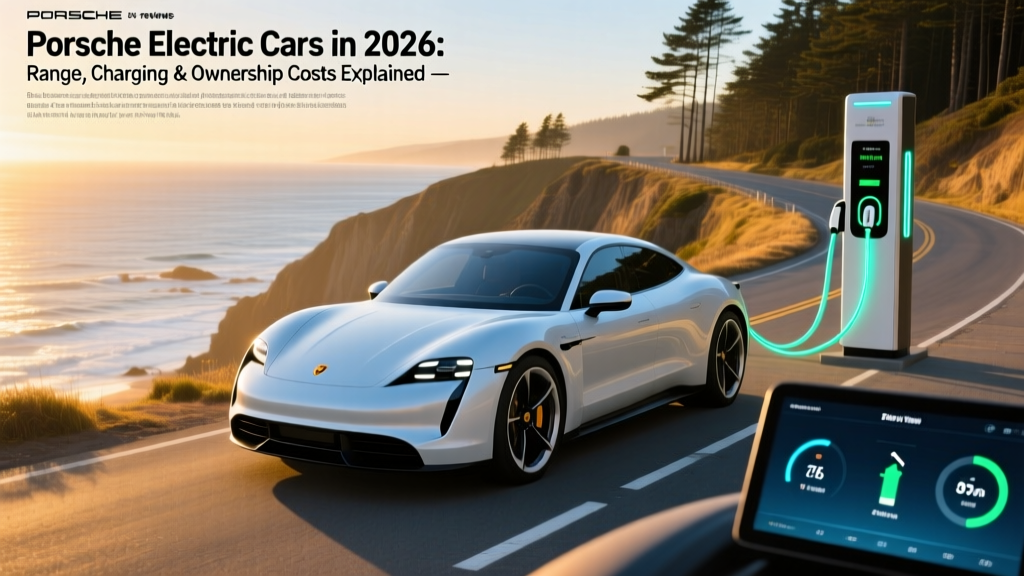
Porsche's 2026 electric lineup centers on the Taycan sedan/cross-turismo and the Macan EV compact SUV. Expect EPA ranges from 225 to 318 miles (Taycan) and up to 308 miles (Macan EV), DC fast-charging peaks of 270–320 kW on 800-volt architectures, and starting MSRPs between $92,000 and $105,000. These are performance-first EVs that prioritize driving dynamics over maximum efficiency. They do not qualify for the $7,500 federal §30D tax credit due to MSRP caps and battery-sourcing rules. If you want a luxury performance EV with class-leading charging speeds and don't need 400+ miles of range, a Porsche EV is a strong pick. If you need maximum range or federal incentives, look to Lucid, Tesla, or the BMW iX.
The 2026 Porsche EV Lineup: Taycan and Macan EV
Porsche offers two fully electric model families for 2026, both built on the Volkswagen Group's 800-volt PPE (Premium Platform Electric) architecture. Here's how the core variants stack up on paper and in practice.
| Model | Battery (kWh usable) | EPA Range | Peak DC Charge | 10–80% Time | 0–60 mph | HP | Base MSRP |
|---|---|---|---|---|---|---|---|
| Taycan (RWD) | 84 kWh (NMC) | 225 mi | 270 kW | ~18 min | 5.1 sec | 402 | $92,250 |
| Taycan 4S | 84 kWh (NMC) | 252 mi | 270 kW | ~18 min | 3.8 sec | 522 | $107,400 |
| Taycan Turbo | 84 kWh (NMC) | 280 mi | 270 kW | ~18 min | 3.0 sec | 670 | $153,900 |
| Taycan Turbo GT | 84 kWh (NMC) | 269 mi | 320 kW | ~16 min | 2.1 sec | 1,019 | $231,000 |
| Macan EV (RWD) | 95 kWh (NMC) | 308 mi | 270 kW | ~21 min | 5.5 sec | 355 | $78,800 |
| Macan 4 EV | 95 kWh (NMC) | 288 mi | 270 kW | ~21 min | 4.9 sec | 402 | $86,400 |
| Macan Turbo EV | 95 kWh (NMC) | 268 mi | 270 kW | ~21 min | 3.1 sec | 630 | $105,300 |
Source: fueleconomy.gov and Porsche USA specifications. Real-world range will vary — see below.
Real-World Range vs. EPA Sticker
The EPA numbers above assume mixed driving. In practice:
- Highway cruising (75 mph): Expect 10–15% less than EPA. A Taycan 4S rated at 252 miles will deliver roughly 215–230 miles at sustained highway speed.
- Cold weather (below 32°F): NMC chemistry loses 15–25% range in freezing temps without preconditioning. A Macan EV rated at 308 miles may drop to 230–260 miles in a Midwest winter.
- Performance driving: Aggressive acceleration and track use can cut range by 30–40%. The Turbo GT's 269-mile EPA rating can fall below 170 miles under hard use.
Porsche's thermal management system is among the best in the industry, which helps mitigate cold-weather losses — but physics always wins.
Charging Speed: Porsche's 800V Advantage
Porsche was an early adopter of 800-volt battery architecture, and it pays off at the DC fast charger. While many competitors peak at 150–200 kW and taper sharply above 50% state of charge (SoC), the Taycan and Macan EV sustain high charge rates deeper into the curve.
| Charging Level | Power | Miles Added per Hour | Where |
|---|---|---|---|
| Level 1 (120V household) | ~1.4 kW | ~4–5 mi/hr | Emergency / overnight trickle |
| Level 2 (240V home) | 9.6–11.5 kW | ~28–38 mi/hr | Home garage, workplace |
| DC Fast (CCS/NACS adapter) | Up to 270–320 kW | ~600+ mi/hr (peak) | Electrify America, Tesla Supercharger (w/ adapter) |
Charge curve reality check: The "10–80% in ~18 minutes" figure assumes you arrive at a 350 kW-capable Electrify America station with a warm battery (preconditioned via navigation routing). If the battery is cold, peak rates may start at 80–120 kW and ramp up. Above 80% SoC, charging slows dramatically — going from 80% to 100% can take as long as the 10–80% portion. For battery longevity, Porsche recommends daily charging to 80–85% and using 100% only for long trips.
Connector note: Porsche currently ships with CCS1 connectors in North America. A NACS adapter enables access to Tesla's Supercharger network, which is critical for road-trip charging coverage in many regions.
EV vs. Gas: How Porsche Electric Cars Compare to the Cayenne and Panamera
Buyers cross-shopping a Macan EV or Taycan are often considering the gas-powered Cayenne or Panamera. Here's a data-driven comparison.
| Metric | Macan 4 EV | Gas Macan (4-cyl) | Taycan 4S | Panamera 4 |
|---|---|---|---|---|
| Base MSRP | $86,400 | $67,900 | $107,400 | $103,800 |
| 0–60 mph | 4.9 sec | 5.8 sec | 3.8 sec | 4.8 sec |
| EPA Combined | 87 MPGe | 21 MPG | 83 MPGe | 21 MPG |
| Fuel/Energy Cost (15k mi/yr) | ~$720/yr | ~$2,350/yr | ~$780/yr | ~$2,350/yr |
| Annual Maintenance | ~$400 | ~$1,100 | ~$400 | ~$1,200 |
| 5-Year Fuel + Maint Savings | Macan EV saves ~$10,000 | Taycan saves ~$10,500 | ||
Energy costs based on $0.15/kWh national average and $3.80/gallon premium fuel. Your local rates will vary. Source: fueleconomy.gov.
The EV versions carry a $15,000–$20,000 price premium upfront, but the energy and maintenance savings recover $10,000+ over five years. The break-even point arrives faster if you charge at home on off-peak electricity rates (as low as $0.08–$0.10/kWh in some utilities). If you rely exclusively on public DC fast charging at $0.35–$0.50/kWh, the annual energy cost jumps to $1,400–$2,000, narrowing the advantage significantly.
Real Ownership Costs: What Porsche EV Buyers Actually Pay
Sticker price is just the entry fee. Here's a realistic 5-year total cost of ownership (TCO) breakdown for a Macan 4 EV, assuming 15,000 miles/year, 70% home charging, and 30% public DC fast charging.
| Cost Category | Macan 4 EV (5 yr) | Gas Macan (5 yr) |
|---|---|---|
| Purchase Price (base) | $86,400 | $67,900 |
| Federal Tax Credit (§30D) | $0 (exceeds MSRP cap) | $0 |
| Insurance (avg annual) | $3,200 × 5 = $16,000 | $2,400 × 5 = $12,000 |
| Energy / Fuel | $4,800 | $11,750 |
| Maintenance | $2,000 | $5,500 |
| Estimated Depreciation | ~$38,000 | ~$30,000 |
| Total 5-Year Cost | ~$149,200 | ~$127,150 |
Key takeaway: Even with substantial fuel and maintenance savings, the Macan EV costs roughly $22,000 more over five years, driven primarily by the higher purchase price, steeper insurance premiums (EVs cost 15–25% more to insure on average), and faster depreciation. This is typical for luxury EVs — the financial case improves if you plan to keep the car beyond five years or if you secure a favorable lease.
Battery warranty: Porsche covers the high-voltage battery for 8 years / 100,000 miles, guaranteeing at least 70% state of health (SoH) retention. A full battery replacement outside warranty runs $20,000–$30,000 — a risk factor for second owners.
Federal Tax Credit: Why Porsche EVs Don't Qualify
This is a frequent source of confusion. Under current IRS §30D rules, no Porsche EV qualifies for the $7,500 federal tax credit. Here's why:
- MSRP Cap: The §30D credit applies only to SUVs priced under $80,000 and sedans under $55,000. The Macan EV starts at $78,800, but most trims with options exceed the cap. The Taycan starts at $92,250 — well over the sedan limit.
- Battery Sourcing: Even if MSRP qualified, the battery must meet critical-mineral and component sourcing requirements that favor North American supply chains. Porsche's batteries are primarily sourced through European and Asian suppliers.
- Income Limits: Buyer AGI must be under $150,000 (single) or $300,000 (joint) — a threshold many Porsche buyers exceed.
Always verify current rules at irs.gov before purchasing. Rules change annually.
Common Misconceptions About Porsche EVs
| Myth | Fact |
|---|---|
| "The Taycan has terrible range." | The base Taycan's 225-mile EPA rating is modest, but the Turbo trim achieves 280 miles, and the Macan EV hits 308 miles. For 95% of daily driving (average US commute is 37 miles round-trip), even the base model has ample range with home charging. |
| "Porsche EVs charge slowly compared to Tesla." | Porsche's 800V architecture actually charges faster than most Teslas at non-Tesla DC stations. The Taycan Turbo GT peaks at 320 kW — faster than the Model S Plaid's ~250 kW peak. However, Tesla's Supercharger network has more 250+ kW stalls nationwide. |
| "Electric Porsches don't drive like real Porsches." | The Taycan Turbo GT set a Nürburgring production-EV lap record. The instant torque, low center of gravity, and rear-axle steering deliver a driving experience that many reviewers consider superior to the gas Panamera in handling feel. |
| "Battery replacement will cost $50,000." | Current estimates for a Taycan battery pack replacement are $20,000–$30,000, not $50,000. And with the 8-year/100,000-mile warranty covering degradation below 70% SoH, most first owners will never face this cost. |
| "I can't road-trip in a Porsche EV." | With a NACS adapter, Porsche EVs access Tesla's 6,000+ Supercharger stations. Combined with Electrify America's network, coast-to-coast road trips are practical — plan for 20-minute charging stops every 180–220 miles. |
First-Time EV Buyer Checklist for Porsche
If you're coming from a gas Cayenne or Panamera, here's what you need to prepare:
- Home charging is essential. A Level 2 (240V) home charger is non-negotiable for daily convenience. Budget $800–$2,500 for a Porsche-recommended charger and professional installation. If your electrical panel needs an upgrade to 200A, add $1,500–$3,000. Relying solely on public charging is expensive and impractical for daily use.
- Download the charging apps. You'll need Electrify America, PlugShare, and (with a NACS adapter) the Tesla app. Porsche's built-in navigation handles route planning with charging stops, but backup apps are critical for finding reliable stations.
- Understand preconditioning. When you navigate to a DC fast charger, the car warms the battery to optimal temperature. This is the difference between peaking at 270 kW and being stuck at 80 kW. Always use the built-in nav for charging stops.
- Plan for cold weather. If you live where winters drop below freezing, budget 15–25% less range from November through February. The Macan EV's heat pump (standard) helps, but cabin heating still draws from the battery.
- Check your insurance quotes before buying. Porsche EVs carry higher premiums due to repair costs and battery replacement risk. Get a quote from your insurer and compare with EV-specialty carriers like Lemonade or Root.
Decision Framework: Which Porsche EV Is Right for You?
Choose the Taycan if: You want a performance sedan with the lowest center of gravity, the quickest charging (Turbo GT at 320 kW), and you primarily drive solo or with one passenger. The Turbo trim offers the best range-to-performance balance at 280 miles EPA and a 3.0-second 0–60.
Choose the Macan EV if: You need SUV cargo space (17.1 cu ft rear, 39.8 cu ft folded), prefer a higher seating position, and want the longest range in the lineup (308 miles on the base RWD). The Macan 4 EV is the value sweet spot at $86,400 with AWD and 288 miles.
Choose the Taycan Cross Turismo if: You want wagon-like cargo versatility (15.7 cu ft) with Taycan driving dynamics and standard AWD. It's a niche body style but uniquely practical for the platform.
Look elsewhere if: You need 400+ miles of range (consider the Lucid Air Grand Touring at 516 miles EPA), you want to qualify for the $7,500 federal tax credit (consider the Tesla Model X or BMW iX), or you lack access to home or workplace Level 2 charging.
How long does it take to charge a Porsche Taycan at home?
On a Level 2 (240V, 48A) home charger delivering 11.5 kW, a fully depleted Taycan (84 kWh battery) charges from 0–100% in roughly 8–9 hours. In practice, most owners plug in each evening and wake up with a full battery, since daily driving rarely depletes more than 20–30% of the pack.
Does the Porsche Macan EV have a frunk?
Yes, but it's small — approximately 2.9 cubic feet. It's useful for charging cables and small bags, but don't expect the cargo capacity of a Tesla Model Y's front trunk.
Can I tow with a Porsche EV?
The Macan EV is rated to tow up to 4,409 pounds when properly equipped. The Taycan is not rated for towing. Note that towing reduces range by 30–50% depending on trailer weight and aerodynamics.
Is Porsche's InnoDrive adaptive cruise any good?
Porsche InnoDrive is a Level 2 driver-assistance system (per SAE classification) that combines adaptive cruise with lane centering and predictive speed adjustment based on road data. It works well on highways but requires constant driver supervision. It is not autonomous or "self-driving."
What happens if the battery degrades?
Porsche's battery warranty guarantees at least 70% state of health for 8 years or 100,000 miles. Independent data from early Taycan owners suggests degradation of roughly 5–8% over the first 60,000 miles — well within warranty thresholds. NMC chemistry in Porsche's thermal management system shows strong longevity compared to passively cooled packs.