Quick Answer: Does Porsche Make an Electric Car?
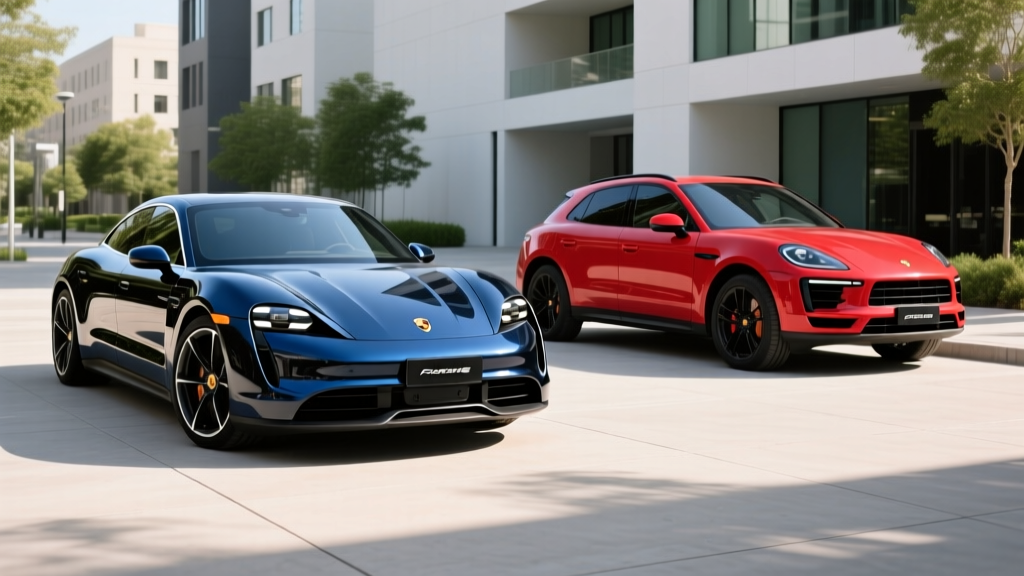
Yes. As of the 2026 model year, Porsche sells two fully electric vehicles in the U.S.:
- Porsche Taycan (sedan/cross-turismo) — EPA range up to 318 miles, 800V architecture, peak DC charging up to 320 kW, starting around $99,400.
- Porsche Macan Electric (SUV) — EPA range up to 308 miles, shared 800V PPE platform with Audi, peak DC charging up to 270 kW, starting around $78,800.
Porsche also offers plug-in hybrid (PHEV) versions of the Cayenne and Panamera, but the Taycan and Macan EV are its only zero-tailpipe-emission battery electric vehicles (BEVs). A fully electric 718 Boxster/Cayman is expected later in the decade but is not yet available for purchase.
Porsche's Electric Lineup: Taycan vs. Macan EV at a Glance
Both models share Porsche's 800-volt electrical architecture, which enables some of the fastest DC fast-charging speeds in the industry. Here's how they stack up for 2026:
| Spec | 2026 Taycan (Base RWD) | 2026 Taycan 4S | 2026 Macan Electric (Base) | 2026 Macan 4 Electric |
|---|---|---|---|---|
| Drivetrain | RWD | AWD | RWD | AWD |
| Battery (usable, kWh) | ~89 kWh (Performance Battery Plus) | ~89 kWh | ~94 kWh | ~94 kWh |
| Chemistry | NMC (nickel-manganese-cobalt) | NMC | NMC | NMC |
| EPA Range (max) | ~318 mi | ~283 mi | ~308 mi | ~288 mi |
| Peak DC Fast Charge | 320 kW | 320 kW | 270 kW | 270 kW |
| 10–80% DC Charge Time | ~18 min | ~18 min | ~21 min | ~21 min |
| Level 2 AC Charge (kW) | 11 kW (optional 22 kW) | 11 kW (optional 22 kW) | 11 kW | 11 kW |
| 0–60 mph | 4.6 sec | 3.5 sec | 5.5 sec | 4.5 sec |
| Horsepower | 402 hp | 590 hp (Launch Control) | 335 hp | 402 hp |
| Starting MSRP | $99,400 | $123,900 | $78,800 | $85,800 |
| Battery/Powertrain Warranty | 8 yr / 100,000 mi | 8 yr / 100,000 mi | 8 yr / 100,000 mi | 8 yr / 100,000 mi |
Sources: fueleconomy.gov, Porsche USA. EPA range varies by trim and wheel option. Real-world highway range is typically 15–25% lower than EPA, especially at sustained 75+ mph speeds or in cold weather.
Real-World Range Reality Check
The Taycan's 318-mile EPA figure is impressive on paper, but plan for roughly 250–275 miles of usable highway range in moderate temperatures. In freezing conditions (below 32°F), expect a further 15–25% reduction, bringing effective range to approximately 200–230 miles. The Macan EV shows similar patterns — its 308-mile EPA rating translates to roughly 245–265 real-world highway miles. Porsche's thermal management system with heat pump (standard on most trims) helps mitigate cold-weather losses, but physics is physics: cold batteries are less efficient.
Porsche EV vs. Gas Porsche: What the Ownership Cost Actually Looks Like
If you're cross-shopping a Taycan against a gas-powered Panamera, or a Macan EV against the gas Macan, the math isn't just about sticker price. Here's a five-year ownership snapshot comparing the Taycan 4S against the Panamera 4:
| Cost Category (5 years / 75,000 mi) | Taycan 4S (EV) | Panamera 4 (Gas) |
|---|---|---|
| Purchase Price (MSRP) | $123,900 | $107,000 |
| Federal Tax Credit (§30D) | $0 – $7,500 (see eligibility below) | $0 |
| Fuel / Electricity | ~$3,400 (home charging at $0.14/kWh avg) | ~$10,500 (premium at $4.50/gal, 22 MPG combined) |
| Maintenance (scheduled) | ~$1,800 (cabin filter, brake fluid, tires) | ~$5,200 (oil, spark plugs, belts, brakes) |
| Insurance (avg annual × 5) | ~$16,500 ($3,300/yr avg) | ~$13,500 ($2,700/yr avg) |
| Estimated Depreciation | ~$55,000 | ~$48,000 |
| Total 5-Year Cost (est.) | ~$180,600 | ~$184,200 |
Assumes 15,000 mi/yr, home Level 2 charging at national average electricity rates. Insurance premiums for EVs — especially performance EVs — run 15–25% higher than gas equivalents. Depreciation estimates based on historical luxury-EV curves; actual values vary by market conditions.
The Taycan's fuel savings are substantial — roughly $7,000 over five years — but they're largely offset by higher insurance and steeper depreciation. If you qualify for the full §30D federal tax credit, the EV pulls ahead. Without it, five-year costs are nearly identical. The Macan EV vs. gas Macan comparison follows a similar pattern, though the smaller price gap makes the EV more competitive from day one.
Federal Tax Credit: Will You Actually Get $7,500?
This is where Porsche buyers need to pay close attention. The §30D credit has strict eligibility requirements, and Porsche's battery sourcing has historically been a hurdle.
§30D Credit Requirements (2026 Tax Year)
- MSRP cap: Sedans must be ≤ $55,000; SUVs/pickups/vans ≤ $80,000. The Taycan exceeds the sedan cap on all trims. The Macan EV base ($78,800) qualifies under the SUV cap, but the Macan 4 Electric ($85,800) does not.
- Buyer income cap: Modified AGI ≤ $150,000 (single), $225,000 (head of household), $300,000 (married filing jointly).
- Battery sourcing: Increasing percentages of critical minerals and battery components must be sourced from the U.S. or FTA-partner countries. Porsche's supply chain has been gradually shifting, but eligibility varies by model year and production batch.
- Point-of-sale transfer: You can transfer the credit to the dealer at purchase for an immediate price reduction, rather than waiting to claim it on your tax return.
Bottom line: The Taycan does not qualify due to its MSRP exceeding the $55,000 sedan cap. The Macan EV base model may qualify for partial or full credit depending on battery-sourcing compliance at time of delivery. Always verify current eligibility on fueleconomy.gov and consult a tax professional before relying on the credit in your purchase decision.
Charging a Porsche EV at Home and on the Road
Porsche's 800V architecture is a genuine engineering advantage, but you need the right infrastructure to benefit from it.
Home Charging
At 11 kW on a Level 2 home charger (240V, 48A), a full Taycan battery recharge from 10–100% takes roughly 8.5 hours — ideal for overnight charging. Porsche offers the optional 22 kW onboard charger on Taycan models, which cuts this to about 4.5 hours if your home electrical panel supports a 100A circuit (most residential panels do not without an upgrade).
| Home Charging Setup | Equipment Cost | Electrician + Permit | Total Estimate |
|---|---|---|---|
| Level 2, 48A (11 kW) on existing 60A circuit | $500–$800 (Porsche Mobile Charger Connect or ChargePoint Home Flex) | $500–$1,500 | $1,000–$2,300 |
| Level 2, 48A with new 60A circuit run | $500–$800 | $1,500–$3,500 | $2,000–$4,300 |
| Panel upgrade (200A to 400A) if needed | — | $3,000–$7,000 | $3,000–$7,000 |
Always get a quote from a licensed electrician. Older homes with 100A service panels may require an upgrade before adding a 48A EV circuit.
DC Fast Charging on the Road
The Taycan's 320 kW peak charge rate is among the fastest of any production EV. On a 350 kW Electrify America or Tesla Supercharger (NACS adapter required for non-Tesla vehicles) station, you can add roughly 100 miles of range in under 5 minutes under ideal conditions. The full 10–80% session takes approximately 18 minutes.
However, the charge curve tapers significantly above 80%. A 10–100% session can take 35–40 minutes because Porsche's battery management system slows charging to protect long-term battery health. For road trips, plan to charge to 80% and move on — that's where the time-to-range ratio is most favorable.
Common Misconceptions About Porsche Electric Cars
| Myth | Fact |
|---|---|
| "The Taycan is just a re-badged Audi." | The Taycan and Audi e-tron GT share the J1 platform, but Porsche engineered its own suspension tuning, two-speed rear transmission, and thermal management. The Macan EV uses the newer PPE platform co-developed with Audi but shares no body panels or interior. |
| "EV batteries need replacing every 5 years." | Porsche warranties its batteries for 8 years/100,000 miles with a capacity retention floor of 70%. Real-world data from early Taycan owners shows degradation of roughly 5–8% over the first 60,000 miles. Full battery replacement (if out of warranty) costs $20,000–$30,000+ depending on pack size. |
| "You can't take a Porsche EV on road trips." | With 250+ real-world highway miles and 18-minute fast-charge stops, a Taycan road trip requires roughly one 20-minute stop every 2.5 hours. That's comparable to rest stops and meal breaks on a long drive. The key limitation is charging-desert coverage in rural areas — plan your route using PlugShare or A Better Routeplanner. |
| "Porsche EVs qualify for the full $7,500 tax credit." | The Taycan does not qualify (MSRP exceeds $55K sedan cap). The Macan EV base may qualify, but battery-sourcing rules are strict and subject to change. Always check fueleconomy.gov before purchasing. |
| "Electric Porsches aren't real Porsches." | The Taycan set a Nürburgring lap record for its class, and its dual-motor AWD system delivers torque-vectoring performance that rivals the 911 Turbo in launch acceleration. The driving dynamics are distinctly Porsche — just without the exhaust note. |
Who Should Buy a Porsche EV — and Who Shouldn't
Decision Framework
Choose the Taycan if:
- You want a performance sedan with sub-4-second 0–60 capability and class-leading charging speed.
- You have reliable home Level 2 charging access.
- You drive fewer than 300 miles between overnight stops on most trips.
- You value driving dynamics and are willing to pay a premium for them.
Choose the Macan EV if:
- You need SUV cargo space (17.1 cu ft rear, 39.8 cu ft with seats folded) and a higher ride height.
- You want Porsche's electric driving experience at a lower entry price (~$78,800 vs. $99,400+).
- You may qualify for the §30D tax credit on the base trim.
Consider a gas Porsche or wait if:
- You live in an apartment or condo with no charging access and no realistic path to installing a Level 2 charger.
- You regularly drive 400+ miles in a single day through areas with sparse DC fast-charging infrastructure.
- You want a 718 or Cayenne EV — neither is available yet as a BEV (Cayenne EV expected ~2027, 718 EV TBD).
What First-Time Porsche EV Buyers Need to Know
Beyond the spec sheet, here are the ownership realities that brochures don't emphasize:
Tires wear faster. The Taycan's instant torque and heavy curb weight (~4,800 lbs for the 4S) consume rear tires in 15,000–25,000 miles under spirited driving. Budget $1,200–$1,800 for a set of Michelin Pilot Sport EV or Pirelli P Zero Elect tires every 20,000 miles or so.
Preconditioning matters. Use Porsche's scheduled departure feature to warm the battery before a DC fast-charging stop. A cold battery at a fast charger will peak at 50–80 kW instead of the rated 320 kW, potentially doubling your charge time. The car's navigation-based preconditioning helps, but it only activates when a charger is set as your destination.
The NACS transition. Porsche has confirmed NACS (Tesla-style) charging port adoption for future models. Current 2026 Taycan and Macan EV models use CCS1 in North America. Porsche offers a NACS adapter for Supercharger access, but check compatibility for your specific model year.
Insurance is higher — get quotes early. Performance EVs carry elevated insurance premiums due to repair costs (specialized body shops, aluminum construction, sensor recalibration after bodywork). Expect $2,800–$4,000 annually depending on your driving record and location. Get three quotes before signing a purchase agreement.
Frequently Asked Questions
Does Porsche make a fully electric SUV?
Yes. The Porsche Macan Electric launched for the 2025 model year and continues into 2026. It offers up to 308 miles of EPA range, 270 kW DC fast charging, and starts at $78,800. The larger Cayenne is available only as a PHEV (plug-in hybrid) for now; a fully electric Cayenne is expected around 2027.
Is the Porsche Taycan worth it over a Tesla Model S?
It depends on priorities. The Taycan charges faster (320 kW vs. 250 kW peak), has a more premium interior, and delivers sharper handling dynamics. The Model S offers more range (up to 402 mi EPA), access to the Supercharger network natively, more rear-seat space, and starts at a lower price (~$79,990). If driving engagement and build quality matter most, the Taycan wins. If range and value matter most, the Model S has the edge.
How long does a Porsche EV battery last?
Porsche warranties its high-voltage batteries for 8 years or 100,000 miles with a minimum 70% capacity retention. Based on NMC chemistry degradation curves and early owner reports, expect 10–15% total degradation over 100,000 miles under normal use. Avoid routinely charging to 100% and storing the car at very low or very high states of charge to maximize longevity.
Can I charge a Porsche EV at a Tesla Supercharger?
Yes, with a NACS adapter. Current Porsche EVs use CCS1 connectors, and Porsche provides or sells a NACS adapter for Supercharger V3/V4 access. Native NACS ports are expected on future Porsche models.
Does the Porsche Taycan qualify for any tax incentives?
The Taycan does not qualify for the federal §30D new clean vehicle credit because its MSRP exceeds the $55,000 sedan cap. It may qualify for certain state-level incentives (e.g., California's CVRP, Colorado's state credit), which have their own income and price rules. Check your state's energy or DMV website for current programs. The Macan EV base trim ($78,800) falls under the $80,000 SUV cap and may be eligible depending on battery-sourcing compliance.