Quick Answer: What the Porsche Cayenne EV Interior Reveal Means for Buyers
The Porsche Cayenne EV interior reveal confirms a fully digital, screen-dominant cabin anchored by a 12.6-inch curved instrument cluster, a 14.25-inch central infotainment display, and an available 10.9-inch passenger screen — all running Porsche's latest PCM 7.0 software. But beyond the screens, the interior signals a vehicle built around an 800-volt architecture (shared with the Macan EV and Taycan), a projected battery capacity of over 100 kWh, and DC fast-charging capability peaking above 270 kW. The Cayenne EV is expected to start near $85,000 when it arrives for the 2026 model year, positioning it against the BMW iX, Mercedes EQS SUV, and Tesla Model X. Below, we break down the real ownership math, charging expectations, and how it compares to the gas Cayenne you might be cross-shopping.
Inside the Cabin: Screens, Materials, and the EV-Specific Layout
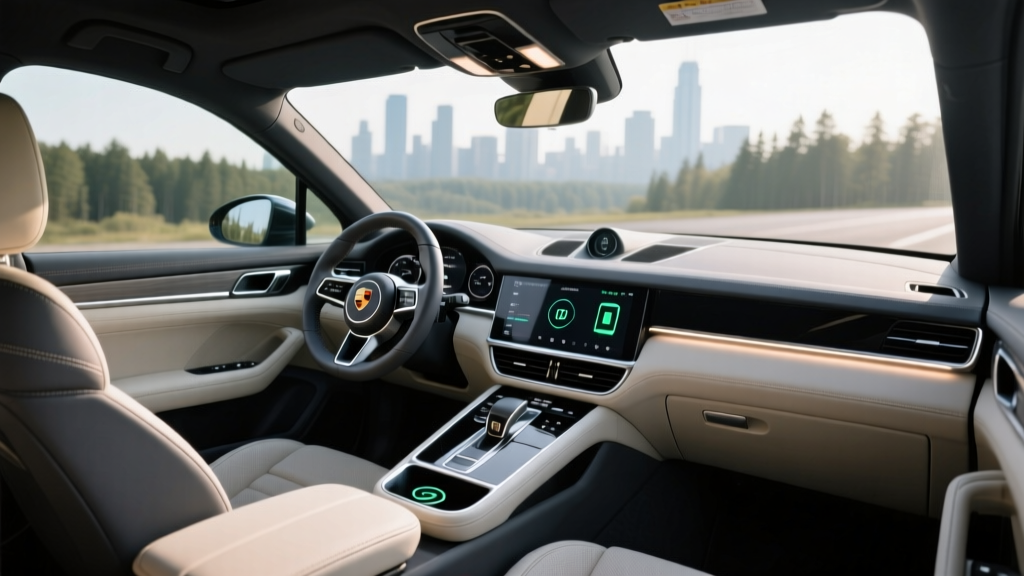
The Porsche Cayenne EV interior reveal shows a cabin that's both familiar and radically rethought. The dashboard ditches the traditional center stack for a wide, layered display architecture that Porsche calls its "digital cockpit." Here's what we know from the official reveal and subsequent press materials:
- 12.6-inch curved instrument cluster: Mounted directly in the driver's sightline, replacing analog gauges entirely. It displays speed, range, navigation, and drive-mode data with configurable layouts.
- 14.25-inch central touchscreen: Handles infotainment, climate controls (yes, climate is now screen-based — a trend we'd flag as a usability concern for some buyers), navigation with real-time charge routing, and vehicle settings.
- 10.9-inch passenger display (optional): A dedicated screen for the front passenger, similar to the setup in the refreshed Taycan and the new Panamera. It streams media and shows navigation data without distracting the driver.
- Flat floor and expanded storage: Because the Cayenne EV rides on Porsche's PPE (Premium Platform Electric) architecture — co-developed with Audi — there's no transmission tunnel. This yields a flat rear floor and a front trunk (frunk) estimated at roughly 3.0 cubic feet, supplementing the rear cargo area.
- Sustainable material options: Porsche is offering Race-Tex (a microfiber material) and leather-free interiors, consistent with the brand's push toward sustainable sourcing in its EV lineup.
The steering wheel retains physical buttons and a mode selector dial — a welcome choice, since Porsche has kept tactile controls for drive modes and regen settings rather than burying everything in menus. The center console features a compact toggle-style gear selector, freeing up space for wireless charging and cupholders.
Projected Specs: Battery, Range, and Charging Performance
Because the Cayenne EV has not yet entered production as of early 2026, all specifications below are based on Porsche's official announcements, PPE platform data from the Macan EV, and industry analysis. Final EPA figures will be confirmed closer to the on-sale date.
| Specification | Porsche Cayenne EV (Projected) |
|---|---|
| Platform | PPE (Premium Platform Electric), 800V architecture |
| Battery Capacity | ~100–110 kWh (usable), NMC chemistry |
| EPA Range (Est.) | 280–320 miles (varies by trim/wheel size) |
| Peak DC Fast Charge Rate | Up to ~270 kW |
| 10–80% DC Charge Time (Est.) | ~21 minutes (with preconditioning) |
| Level 2 AC Charge Rate | 11 kW (standard), 22 kW (optional onboard charger) |
| Horsepower (Base / Turbo) | ~402 hp / ~600+ hp (estimated) |
| 0–60 mph (Est.) | ~5.0 sec (base) / ~3.5 sec (Turbo variant) |
| Starting MSRP (Est.) | ~$85,000 (base) / ~$110,000+ (Turbo) |
| Battery/Powertrain Warranty | 8 years / 100,000 miles (Porsche standard) |
Real-World Range Expectations
If the Cayenne EV achieves an EPA estimate of 300 miles, expect real-world highway driving at 70–80 mph to yield approximately 250–270 miles in moderate temperatures. In cold weather (below 30°F), plan for a 15–25% reduction, bringing usable range to roughly 210–240 miles depending on cabin heating demands and whether the vehicle is equipped with a heat pump (expected standard on PPE vehicles). Porsche's 800V architecture and thermal management system should mitigate some cold-weather charging slowdown, but physics still applies — always budget conservatively on winter road trips.
The Ownership Cost Picture: Cayenne EV vs. Gas Cayenne
Most Cayenne EV shoppers are cross-shopping the gasoline Cayenne (starting around $79,200 for 2026) or considering a switch from a luxury ICE SUV. Here's how the costs compare over a realistic 5-year ownership period, assuming 12,000 miles per year and national average energy prices.
| Cost Category | Cayenne EV (Est.) | Gas Cayenne V6 (2026) |
|---|---|---|
| Base MSRP | ~$85,000 | ~$79,200 |
| Federal Tax Credit (§30D) | Up to $7,500 (see eligibility below) | $0 |
| Effective Purchase Price | ~$77,500 | ~$79,200 |
| Fuel/Energy (5 yr, 60k mi) | ~$5,400 (home charging at $0.16/kWh avg) | ~$11,250 (premium gas at $4.10/gal, 20 MPG combined) |
| Maintenance (5 yr) | ~$1,800 (no oil changes, fewer brake replacements) | ~$4,500 (scheduled service, brakes, fluids) |
| Insurance (5 yr avg) | ~$18,000 (EVs typically 10–15% higher premiums) | ~$15,750 |
| Estimated Depreciation (5 yr) | ~$34,000 (40%) | ~$31,700 (40%) |
| 5-Year Total Cost | ~$136,700 | ~$142,400 |
Key takeaway: The Cayenne EV's higher insurance premiums partially offset its fuel and maintenance savings. Over five years, the EV comes out slightly ahead — but the margin is narrow, roughly $5,700. The real financial advantage grows if you charge primarily at home on off-peak electricity rates, which can drop your per-mile energy cost to $0.04–$0.06/mile versus $0.19–$0.22/mile for premium gasoline.
Federal Tax Credit: Does the Cayenne EV Qualify?
The Cayenne EV's eligibility for the §30D federal clean vehicle credit depends on several factors that are subject to change. Based on current 2026 IRS rules:
- MSRP cap: SUVs must have an MSRP at or below $80,000 to qualify. A base Cayenne EV at ~$85,000 would exceed this cap — meaning it may not qualify for the full $7,500 credit unless Porsche prices a base trim at or under $80,000.
- Buyer income limits: Modified adjusted gross income must not exceed $300,000 (joint filers), $225,000 (head of household), or $150,000 (individual).
- Battery sourcing requirements: The vehicle must meet critical minerals and battery component sourcing thresholds that tighten annually. Porsche's PPE platform supply chain will determine compliance — this is confirmed on a per-vehicle basis at the time of purchase.
- Point-of-sale transfer: If eligible, the credit can be transferred to the dealer at purchase, reducing your out-of-pocket cost immediately rather than waiting for tax filing.
Bottom line: Do not assume the Cayenne EV qualifies for the full $7,500 credit. The MSRP cap is the most likely barrier. Check the official fueleconomy.gov tax credit database once the vehicle is officially listed, and consult a tax professional before factoring the credit into your purchase decision.
EV vs. Gas: What Changes in Your Daily Routine
| Factor | Cayenne EV | Gas Cayenne |
|---|---|---|
| "Refueling" Time | 10–80% in ~21 min (DC fast); 8+ hours on Level 2 at home | 5 minutes at a gas station |
| Home Charging | Requires 240V Level 2 setup (NACS connector starting 2025+) | Not applicable |
| Home Charging Install Cost | $500–$2,500 (charger + electrician; panel upgrade may add $1,500–$3,000) | $0 |
| Cold-Weather Impact | 15–25% range loss; preconditioning mitigates charging slowdown | Minimal range impact; slight MPG decrease |
| Road Trip Stops | Every 200–250 miles for 20–25 min; route planning required | Every 350–400 miles for 5–10 min |
| Regenerative Braking | One-pedal driving capable; reduces brake wear significantly | Traditional friction braking only |
| Over-the-Air Updates | Yes — software improvements, feature additions | Limited; dealer visits for most updates |
Common Misconceptions About the Cayenne EV
| Myth | Fact |
|---|---|
| "The battery will need replacing in 5 years." | Porsche's PPE battery is warrantied for 8 years/100,000 miles with a minimum 70% capacity retention threshold. Real-world data from Taycan owners shows degradation of approximately 5–8% over the first 100,000 miles with NMC chemistry. |
| "I can charge on any public charger." | Porsche is transitioning to the NACS (Tesla-style) connector for its North American EVs starting 2025. You'll have access to Tesla Superchargers via native port, but older CCS-only networks may require an adapter. |
| "It'll charge at 270 kW the whole time." | No EV sustains peak charge rate. The Cayenne EV's 800V system will peak near 270 kW at low state-of-charge (around 10–30% SoC) and taper progressively. Expect an average rate of ~180–200 kW across the 10–80% window, which is still excellent. |
| "I'll save $10,000+ in fuel." | At 12,000 miles/year and national average electricity rates, savings versus premium gasoline are roughly $1,100–$1,300 annually — meaningful, but not a windfall. Public DC fast charging at $0.35–$0.50/kWh erodes savings significantly. |
Who Should Buy the Cayenne EV — and Who Should Wait
Actionable Decision Framework
Choose the Cayenne EV if:
- You have access to home Level 2 charging (a garage or driveway with a 240V circuit) — this is non-negotiable for convenient EV ownership in this price segment.
- Your daily driving is under 150 miles round-trip, meaning you'll rarely need public fast charging for routine use.
- You value Porsche driving dynamics and want a luxury electric SUV that prioritizes handling over maximum range.
- You're upgrading from a gas Cayenne or similar luxury SUV and want to reduce maintenance complexity and fuel costs.
Wait or look elsewhere if:
- You rely exclusively on street parking or apartment living without charging access — public charging costs and inconvenience will negate most EV benefits.
- You regularly tow (the Cayenne EV's towing capacity is expected around 4,400 lbs, but range drops 30–50% under load).
- You need maximum range above all else — the Rivian R1S (EPA 352+ mi) or Tesla Model X (EPA 326+ mi) offer more buffer.
- The MSRP exceeds the §30D $80,000 SUV cap and the tax credit is essential to your budget math.
Frequently Asked Questions
When will the Porsche Cayenne EV go on sale?
Porsche has confirmed the Cayenne EV for the 2026 model year, with deliveries expected to begin in late 2025 or early 2026 in Europe, followed by North America. Exact timing varies by market and trim. Reservations and configurator access are expected to open several months before deliveries.
Will the Cayenne EV have a frunk?
Yes. The PPE platform's packaging allows for a front trunk. Based on the Macan EV's frunk volume of approximately 2.9 cubic feet, expect a similar or slightly larger compartment in the Cayenne EV — enough for charging cables, a small bag, or groceries.
How does the Cayenne EV compare to the Macan EV?
The Cayenne EV is larger, more powerful, and more expensive. It shares the PPE 800V platform but will feature a larger battery (~100–110 kWh vs. the Macan EV's ~95 kWh usable), more cargo space, and higher towing capacity. Think of it as the Macan EV's bigger sibling — similar technology, scaled up for a full-size luxury SUV segment.
What connector does the Cayenne EV use in North America?
Porsche has committed to adopting the NACS (North American Charging Standard) connector for its EVs in North America. The Cayenne EV is expected to ship with a native NACS port, granting access to Tesla's Supercharger network — currently the most reliable DC fast-charging infrastructure in the U.S. For legacy CCS stations, an adapter may be required.
Is the Cayenne EV eligible for the $7,500 federal tax credit?
Eligibility is uncertain due to the §30D MSRP cap of $80,000 for SUVs. If the base Cayenne EV starts above $80,000 (currently projected at ~$85,000), it would not qualify. Porsche could potentially price a base variant at or below the cap. Always verify on fueleconomy.gov and consult a tax professional before relying on the credit in your purchase budget.
What home charging setup do I need?
For optimal daily use, install a Level 2 wallbox charger on a dedicated 240V/48A circuit. This delivers approximately 11 kW of power, adding roughly 30–35 miles of range per hour of charging — enough to fully replenish the battery overnight. Installation costs typically range from $500 to $2,500 depending on your electrical panel's proximity to the charging location. If your panel needs upgrading (common in older homes with 100A service), budget an additional $1,500–$3,000. Always hire a licensed electrician and pull the required local permits.