The Short Answer: Porsche Cayenne Electric Interior & Ownership
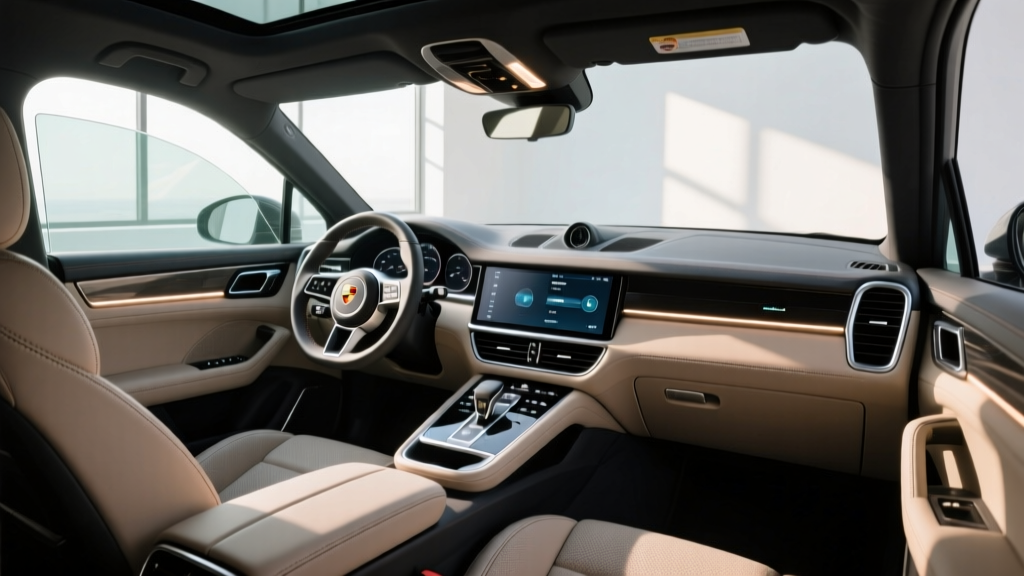
The 2026 Porsche Cayenne Electric wraps a next-generation curved digital cockpit — a 12.6-inch driver display, a 14.9-inch central touchscreen, and an available 10.9-inch passenger screen — in a cabin that retains the premium materials and build quality of the gas Cayenne while adding EV-specific features like a frunk and over-the-air updates. The electric Cayenne starts at an estimated $89,900 MSRP, carries a usable battery of approximately 100 kWh (NMC chemistry), and targets an EPA range near 300 miles. Peak DC fast charging reaches up to 270 kW, enabling a 10–80% charge in roughly 20 minutes on a capable station. Because the Cayenne Electric exceeds the $80,000 MSRP cap for SUVs under IRS §30D rules, buyers should not expect the $7,500 federal tax credit — making total cost of ownership comparisons against the gas Cayenne critical before purchase.
Cabin Technology and the Digital Cockpit
Porsche has fully redesigned the Cayenne Electric's interior around its latest-generation infotainment architecture. The driver faces a curved 12.6-inch instrument cluster that replaces traditional gauges with configurable EV readouts: real-time energy flow, state of charge (SoC), estimated range, and navigation-integrated charge planning. The center stack is dominated by a 14.9-inch touchscreen running Porsche Communication Management (PCM) with native route planning that factors in battery preconditioning, terrain, and charger availability along your route.
An optional 10.9-inch passenger display lets front-seat occupants control media or view navigation without distracting the driver — a feature borrowed from the Taycan and 911. A head-up display with augmented-reality overlays projects turn-by-turn directions and charge-station distances directly into the driver's sightline.
Material quality remains a Porsche hallmark: standard partial leather with available full leather, Race-Tex (Alcantara-like microfiber), and olive-leaf-tanned leather options. Ambient lighting with 14 zones and a panoramic fixed glass roof with variable tint control are available. The center console houses a wireless charging pad, two USB-C ports, and a redesigned drive-mode selector with dedicated regen-braking settings.
Space, Cargo, and Practicality
The Cayenne Electric sits on Volkswagen Group's PPE (Premium Platform Electric) architecture — the same underpinning as the Audi Q6 e-tron. This dedicated EV skateboard frees up interior packaging:
| Dimension | Cayenne Electric (est.) | Gas Cayenne (2025) |
|---|---|---|
| Front headroom | 40.4 in | 40.2 in |
| Rear legroom | 38.2 in | 35.7 in |
| Cargo (rear seats up) | 26.0 cu ft | 27.2 cu ft |
| Cargo (rear seats folded) | 60.5 cu ft | 60.3 cu ft |
| Frunk (front trunk) | ~2.8 cu ft | None |
| Wheelbase | 114.0 in | 113.9 in |
The flat floor — no transmission tunnel — gives rear passengers noticeably more footroom than the gas Cayenne. The modest frunk is best suited for charging cables and a small bag rather than a full suitcase. Cargo volume behind the rear seats is slightly reduced by the battery pack's packaging, but folded-seat capacity is essentially identical.
Range, Charging, and Real-World Expectations
Porsche targets an EPA-estimated range of approximately 300 miles for the base Cayenne Electric, with higher-output trims likely rated between 260 and 280 miles due to wider tires and more aggressive powertrain tuning. Here's how that translates in practice:
EPA estimate: ~300 miles (base trim)
Real-world highway (70 mph, mild weather): ~250–270 miles
Cold weather (below 30°F, highway): ~210–240 miles
Mixed city/highway, moderate climate: ~270–290 miles
Real-world range varies with speed, temperature, elevation, and HVAC use. Porsche's heat pump (standard) helps mitigate cold-weather losses.
The Cayenne Electric uses an 800-volt architecture, enabling DC fast charging at up to 270 kW on compatible CCS/NACS stations. On a 350 kW-capable Electrify America or Tesla Supercharger (with NACS adapter, as Porsche is adopting the North American Charging Standard for 2025+ models), the 10–80% charge takes approximately 20 minutes. Level 2 AC charging peaks at 11 kW via the onboard charger, adding roughly 35 miles of range per hour — a full overnight session from 20% to 100% takes about 8–9 hours.
| Level | Power | Miles Added per Hour | Time (10–80%) |
|---|---|---|---|
| Level 1 (120V) | ~1.4 kW | ~4 mi/hr | ~60+ hours |
| Level 2 (240V, 48A) | 11 kW | ~35 mi/hr | ~7 hours |
| DC Fast (peak) | 270 kW | ~800+ mi/hr (peak) | ~20 min |
As with all EVs, the charging curve tapers significantly above 80% SoC to protect the NMC battery. Charging from 80–100% can add another 25–30 minutes — plan to unplug at 80% on road trips for optimal time efficiency.
Ownership Cost Breakdown: Electric Cayenne vs. Gas Cayenne
The sticker price tells only part of the story. Here's a 5-year total cost of ownership (TCO) comparison using realistic assumptions for a luxury SUV buyer driving 12,000 miles per year:
| Category | Cayenne Electric | Gas Cayenne (Base) |
|---|---|---|
| MSRP (base) | $89,900 | $79,200 |
| Federal tax credit (§30D) | $0 (exceeds $80K SUV cap) | $0 |
| Fuel/energy (5 yrs, 60K mi) | $5,400 (home + public mix) | $12,600 (premium, $4.20/gal, 19 MPG) |
| Maintenance (5 yrs) | $2,800 | $5,500 |
| Insurance (5 yrs avg.) | $14,500 | $12,000 |
| Depreciation (est. 5-yr) | $38,000 | $34,000 |
| Total 5-yr TCO | ~$150,600 | ~$143,300 |
The electric Cayenne saves roughly $7,200 in fuel and $2,700 in maintenance over five years — nearly $10,000 combined. However, its higher purchase price (roughly $10,700 more), elevated insurance premiums, and steeper projected depreciation erase those savings. The electric model breaks even against the gas Cayenne around year 6–7 for high-mileage drivers, or sooner if you charge primarily at home on low electricity rates (below $0.14/kWh).
Sources: fueleconomy.gov for gas Cayenne MPG data; electricity costs based on U.S. average residential rate of ~$0.16/kWh and public DC fast charging at ~$0.40/kWh.
EV vs. Gas: What Cayenne Buyers Need to Decide
| Factor | Cayenne Electric | Gas Cayenne |
|---|---|---|
| 0–60 mph | ~3.7 sec (base) | 5.9 sec (base) / 4.4 sec (S) |
| Horsepower | ~402 hp (base) / ~536 hp (Turbo) | 348 hp (base) / 468 hp (S) |
| Driving feel | Instant torque, silent, heavier | Engine note, lighter, familiar shifts |
| Refueling/recharging | Home: 8 hrs; DC fast: 20 min 10–80% | Gas station: 5 min |
| Cold-weather impact | 15–25% range loss below 30°F | Minimal (slightly lower MPG) |
| Towing capacity | ~7,700 lbs (est.) | 7,700 lbs |
| Over-the-air updates | Yes | Limited |
The electric Cayenne delivers sharper acceleration and a quieter cabin but adds roughly 500 lbs of battery weight, which affects handling dynamics at the limit. For daily commuting and highway cruising, the EV's instant torque and one-pedal regenerative driving are noticeably more refined. For track use or sustained high-speed Autobahn-style driving, the gas Cayenne's lighter weight and established thermal management remain advantages.
Common Misconceptions About the Cayenne Electric
| Myth | Fact |
|---|---|
| "It qualifies for the $7,500 federal tax credit." | The Cayenne Electric's MSRP exceeds the $80,000 SUV cap under §30D. No federal credit applies. State incentives may be available — check your local DMV or energy office. |
| "300 miles of range means I'll always get 300 miles." | EPA estimates assume mixed driving in moderate conditions. Highway driving at 75+ mph, cold weather, and mountain terrain can reduce range by 15–30%. |
| "Charging at home is free." | At the U.S. average of $0.16/kWh, a full 100 kWh charge costs about $16. Still far cheaper than premium gasoline, but not free. |
| "The battery will need replacing soon." | Porsche warranties the battery for 8 years/100,000 miles with a 70% capacity retention guarantee. Modern NMC packs are designed for 200,000+ miles with gradual degradation. |
| "I can charge on any public charger." | Porsche is transitioning to NACS. Most new Cayenne Electrics will ship with a NACS port; CCS adapters are available for older infrastructure. |
Decision Framework: Should You Buy the Cayenne Electric?
Choose the Cayenne Electric if:
- You have access to Level 2 home charging (a 240V/48A circuit, ~$500–$1,500 installation) and can wake up to a full battery daily.
- Your typical daily driving is under 100 miles, with occasional road trips where you can plan DC fast-charging stops.
- You prioritize instant acceleration, a silent cabin, and lower per-mile energy costs over raw long-distance convenience.
- You live in a moderate or warm climate where range loss is minimal, or you accept the 15–25% cold-weather reduction.
- You value over-the-air updates and the latest digital cockpit technology.
Stick with the Gas Cayenne if:
- You lack reliable home or workplace charging and would depend entirely on public infrastructure.
- You frequently tow heavy loads over long distances in cold weather, where EV range drops significantly under load.
- You live in a region with sparse DC fast-charging networks (rural areas, certain mountain corridors).
- You plan to keep the vehicle 3–5 years and want to avoid the steeper early depreciation projected for the electric model.
- The $10,700+ price premium of the electric model stretches your budget without offsetting fuel savings in your timeframe.
Consider a Cayenne E-Hybrid (PHEV) if:
- You want some electric-only driving (estimated 25–30 miles on the latest E-Hybrid) for daily commutes but need gas-engine range flexibility for long trips.
- You're not ready to commit to full electric but want lower emissions and some fuel savings.
First-Time EV Buyer Essentials for the Cayenne Electric
If the Cayenne Electric is your first battery-electric vehicle, plan for these ownership realities:
Home charging is non-negotiable for convenience. A Level 2 home charger (240V, 48A) adds roughly 35 miles of range per hour. Budget $500–$800 for the charger hardware (Porsche's Mobile Charger Connect or a third-party unit like ChargePoint Home Flex) and $500–$2,000 for electrician installation, depending on whether your electrical panel needs an upgrade to support a 60A circuit.
Public charging requires planning. Use apps like PlugShare, EVgo, or the Porsche Charging Service to map DC fast chargers along common routes. Expect to pay $0.30–$0.55/kWh at public DC stations — roughly $30–$55 for a 10–80% charge.
Preconditioning matters. The Cayenne Electric can precondition its battery before you arrive at a DC fast charger (set via navigation). This warms the NMC cells to optimal temperature and can shave 5–8 minutes off your charging session, especially in cold weather.
Tire costs are higher. EV-specific tires (designed for lower rolling resistance and higher load ratings) typically cost $250–$400 per corner and may wear 15–20% faster than gas-car tires due to the Cayenne Electric's additional weight and instant torque.
Battery warranty protects you. Porsche's 8-year/100,000-mile battery warranty guarantees at least 70% state of health (SoH). If degradation exceeds 30% within that period, Porsche will repair or replace the pack at no cost.
Frequently Asked Questions
How many screens does the Porsche Cayenne Electric interior have?
The standard configuration includes two screens: a 12.6-inch curved digital instrument cluster and a 14.9-inch central touchscreen. An optional 10.9-inch front passenger display is available, bringing the total to three. A head-up display with augmented-reality navigation overlays is also available.
Does the Cayenne Electric qualify for any tax credits?
The Cayenne Electric does not qualify for the $7,500 federal §30D tax credit because its MSRP exceeds the $80,000 cap for SUVs. State and utility incentives may apply — check your state energy office and local utility for rebates that can range from $500 to $4,000 depending on jurisdiction.
What is the real-world range of the Cayenne Electric?
While Porsche targets an EPA estimate of approximately 300 miles for the base model, expect 250–270 miles during highway driving at 70+ mph, and 210–240 miles in cold weather below 30°F. Mixed city/highway driving in moderate temperatures should yield 270–290 miles.
How long does it take to charge the Cayenne Electric at home?
On a Level 2 home charger (240V, 48A, 11 kW), a full charge from 20% to 100% takes approximately 8–9 hours. Most owners charge overnight and wake up to a full battery. Level 1 (standard 120V outlet) is impractical for daily use, adding only about 4 miles per hour.
Is the Cayenne Electric more expensive to insure than the gas Cayenne?
Yes, typically 15–25% more. EV insurance premiums are higher due to elevated repair costs, specialized parts, and the vehicle's higher MSRP. Expect annual premiums of $2,600–$3,200 for the Cayenne Electric versus $2,200–$2,600 for the gas model, depending on your driving record and location.
Can the Cayenne Electric tow?
Yes. Porsche estimates towing capacity at approximately 7,700 lbs, matching the gas Cayenne. However, towing significantly reduces range — expect a 30–50% reduction depending on trailer weight, speed, and terrain.