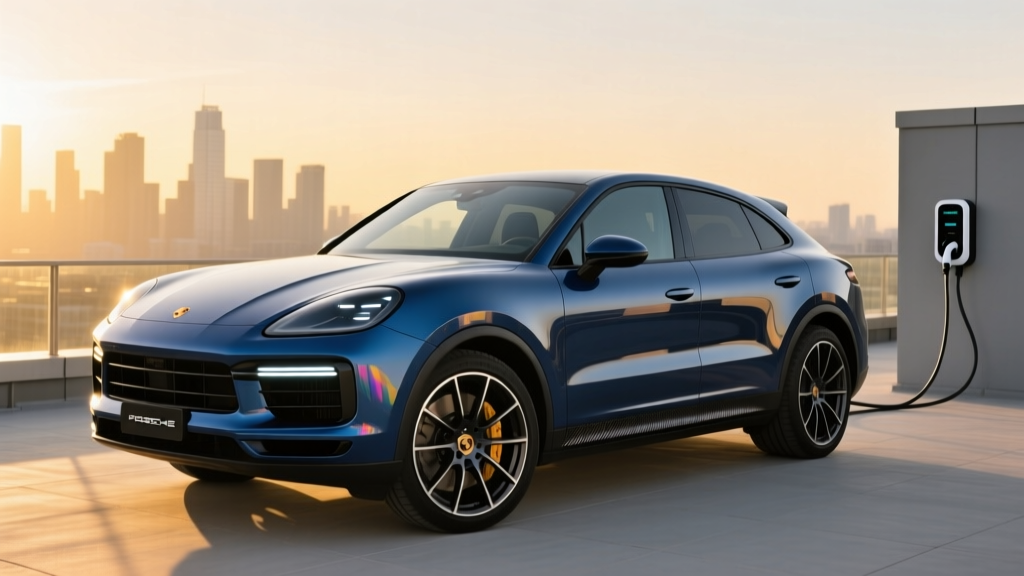
The short answer: The 2026 Porsche Cayenne Coupe Electric is Porsche's first all-electric Cayenne variant, built on the PPE (Premium Platform Electric) architecture shared with the Macan EV. Expect an EPA-estimated range of approximately 270–310 miles depending on trim and wheel size, peak DC fast charging near 270 kW (10–80% in roughly 21 minutes), and a starting MSRP in the mid-$80,000s before options. It qualifies for no federal §30D tax credit due to its price exceeding the $80,000 SUV MSRP cap. This is a performance luxury EV for buyers who already have home Level 2 charging and prioritize driving dynamics over maximum range.
What the 2026 Cayenne Coupe Electric Actually Is
Porsche confirmed the all-electric Cayenne lineup alongside the existing internal-combustion and plug-in hybrid Cayenne models. The Coupe variant adopts the sloped-roof silhouette that has defined the Cayenne Coupe since 2019, now paired with a fully battery-electric powertrain. Unlike the Macan Electric, which targets a slightly smaller and more affordable segment, the Cayenne Coupe Electric sits as a mid-size luxury performance SUV competing directly with the BMW iX M60, Mercedes-Benz EQE SUV, and the Tesla Model X.
The PPE platform, co-developed with Audi, underpins the vehicle. It features an 800-volt electrical architecture — the same hardware advantage Porsche proved with the Taycan — enabling faster DC charging and more efficient power delivery compared to 400-volt competitors. The battery pack is a lithium-ion NMC (nickel manganese cobalt) unit with approximately 100 kWh of usable capacity (roughly 108 kWh gross).
Range, Efficiency, and the Real-World Numbers
Porsche has historically been conservative with EPA range estimates, and the Taycan's real-world performance often exceeded its sticker number. The Cayenne Coupe Electric follows a similar trajectory, but SUV aerodynamics and weight work against highway efficiency.
| Metric | Cayenne Coupe Electric (Base AWD) | Cayenne Coupe Electric (Turbo) |
|---|---|---|
| Battery (usable / gross) | ~100 kWh / ~108 kWh (NMC) | ~100 kWh / ~108 kWh (NMC) |
| EPA Range (est.) | ~300 miles | ~270 miles |
| Efficiency (est.) | ~82 MPGe (36 kWh/100mi) | ~75 MPGe (40 kWh/100mi) |
| Real-World Highway (70 mph) | ~250–270 miles | ~220–240 miles |
| Cold-Weather Range (20°F) | ~210–240 miles | ~185–210 miles |
| Drivetrain | Dual-motor AWD | Dual-motor AWD |
| Horsepower | ~402 hp (with launch control) | ~630 hp (with launch control) |
| 0–60 mph | ~4.7 seconds | ~3.1 seconds |
Real-world range reality check: The EPA estimate of ~300 miles for the base AWD trim assumes a mix of city and highway driving in moderate temperatures. On a sustained 75–80 mph highway trip in summer conditions, expect 250–270 miles before needing to charge. In winter conditions (20°F or below), battery chemistry limitations and cabin heating demands reduce usable range by 20–30%, dropping the base model to roughly 210–240 miles. Porsche's heat pump (standard) mitigates some of this loss, but physics is physics. Plan road trips around 200-mile charging intervals in cold weather for a comfortable buffer.
Charging Speed: 800-Volt Architecture in Practice
The 800-volt platform is the Cayenne Coupe Electric's most practical ownership advantage. While competitors on 400-volt systems typically peak at 150–200 kW, Porsche targets a peak DC fast-charge rate of approximately 270 kW on compatible CCS or NACS chargers. Here is what that translates to in real charging time:
| Charging Level | Power (kW) | Charge Time | Miles Added |
|---|---|---|---|
| Level 1 (120V household) | ~1.4 kW | ~72 hours (0–100%) | ~3–4 miles/hour |
| Level 2 (240V, 48A home) | ~11.5 kW | ~9.5 hours (0–100%) | ~28 miles/hour |
| Level 2 (240V, 80A home) | ~19.2 kW | ~5.5 hours (0–100%) | ~47 miles/hour |
| DC Fast (150 kW station) | ~150 kW (capped) | ~30 min (10–80%) | ~170 miles in 30 min |
| DC Fast (350 kW station) | ~270 kW peak | ~21 min (10–80%) | ~190 miles in 21 min |
Understanding the charge curve: The 270 kW figure is a peak rate, not a sustained one. Lithium-ion batteries accept charge fastest at low states of charge (SoC). Expect the Cayenne Coupe Electric to sustain 200+ kW from roughly 10% to 50% SoC, then taper progressively. From 80% to 100%, charging slows dramatically to protect the battery — this is universal across all EVs and is why road-trip strategy targets 10–80% charges rather than full fills.
For home charging, a Level 2 wallbox rated at 11.5 kW (48 amps on a 60-amp circuit) will replenish the full battery overnight in about 9.5 hours. Most owners will never charge from 0% at home; a typical daily top-up of 30–50% takes 3–5 hours. Porsche includes access to the Electrify America network, and the PPE platform's NACS adapter compatibility opens Tesla Supercharger access — a significant practical advantage for road trips as of 2025–2026.
Pricing, Tax Credits, and Total Cost of Ownership
The Cayenne Coupe Electric sits firmly in luxury territory, and that has direct implications for federal incentive eligibility.
| Trim | Est. Base MSRP | §30D Federal Credit | Est. After Credit |
|---|---|---|---|
| Cayenne Coupe Electric (AWD) | ~$86,000 | $0 (exceeds $80K SUV cap) | ~$86,000 |
| Cayenne Coupe Electric S | ~$98,000 | $0 | ~$98,000 |
| Cayenne Coupe Electric Turbo | ~$125,000 | $0 | ~$125,000 |
Under current IRS §30D rules, new clean vehicle credits are capped at $80,000 MSRP for SUVs, vans, and pickups. Every Cayenne Coupe Electric trim clears that threshold, meaning no federal purchase credit applies regardless of buyer income or battery sourcing. State incentives vary — California's CVRP, for example, has its own income and price caps. Check your state's energy office or the DOE's alternative fuels incentive database for local programs.
Five-Year Cost Comparison: Cayenne Coupe Electric vs. Gas Cayenne Coupe
To put ownership costs in perspective, here is a five-year comparison against the gasoline Cayenne Coupe (base 3.0L V6, ~20 MPG combined) assuming 12,000 miles/year, $3.50/gallon regular, and $0.14/kWh home electricity (national average):
| Cost Category | Cayenne Coupe Electric (AWD) | Cayenne Coupe (Gas, AWD) |
|---|---|---|
| Purchase Price (est.) | $86,000 | $84,000 |
| Federal Tax Credit | $0 | $0 |
| Fuel/Energy (5 yrs, 60K mi) | ~$4,200 (home charging) | ~$12,600 ($3.50/gal, 20 MPG) |
| Maintenance (5 yrs) | ~$2,500 | ~$5,500 |
| Insurance (5 yrs, est.) | ~$18,000 | ~$15,000 |
| Estimated Depreciation (5 yrs) | ~$38,000 | ~$35,000 |
| Total 5-Year Cost | ~$148,700 | ~$152,100 |
Key takeaway: The electric Cayenne Coupe saves roughly $8,400 on fuel and $3,000 on maintenance over five years — approximately $11,400 total. However, higher insurance premiums (EVs typically cost 15–25% more to insure due to repair complexity and parts costs) and steeper projected depreciation partially offset those savings. The net five-year advantage is modest — roughly $3,400 in favor of the EV — and that assumes reliable access to home charging at residential electricity rates. Public DC fast charging at $0.40–$0.60/kWh erases most of the fuel savings advantage.
What First-Time EV Buyers Need to Know Before Committing
If the Cayenne Coupe Electric is your first EV, several ownership realities deserve honest attention before you sign a purchase order.
Home Charging Is Non-Negotiable for This Vehicle
At a purchase price north of $86,000, relying solely on public charging infrastructure is both impractical and expensive. A Level 2 home charger installation typically costs $800–$2,500 (equipment plus licensed electrician), but may require a panel upgrade ($1,500–$3,500 additional) if your home's electrical service is below 200 amps. Budget $1,200–$5,000 total for a proper home charging setup. If you live in a condo or apartment without dedicated parking and charging access, the Cayenne Coupe Electric's ownership experience degrades significantly.
Battery Degradation and Warranty Coverage
Porsche provides an 8-year/100,000-mile battery warranty guaranteeing at least 70% capacity retention — consistent with industry norms. NMC chemistry typically degrades 1.5–2.5% per year under normal use, meaning a 2026 Cayenne Coupe Electric with 300 miles of EPA range should still deliver roughly 255–270 miles at year eight. Real-world data from Taycan owners suggests Porsche's thermal management system keeps degradation on the lower end of that spectrum. A full battery replacement outside warranty, however, would cost $20,000–$30,000 — a figure worth noting for second owners or high-mileage drivers.
Cold Weather and Range Planning
If you live in the upper Midwest, Northeast, or mountain states where winter temperatures regularly drop below freezing, plan for 20–30% range loss. The Cayenne Coupe Electric's heat pump helps, but battery chemistry fundamentally slows in cold temperatures. Preconditioning the battery while plugged in (a feature Porsche supports via the My Porsche app) mitigates this — the car warms the battery using grid power before you drive, preserving range and enabling faster charging. On a road trip in January, plan stops at roughly 180-mile intervals rather than the 250-mile intervals you would use in July.
Common Misconceptions About the Cayenne Coupe Electric
| Myth | Fact |
|---|---|
| "It qualifies for the $7,500 federal tax credit." | No. All trims exceed the $80,000 SUV MSRP cap under §30D. No federal purchase credit applies regardless of buyer income. |
| "The 800V system means it charges at 270 kW the entire session." | Peak rate is ~270 kW at low SoC. Charging tapers significantly above 50%, and slows dramatically above 80%. A 10–80% charge takes ~21 minutes; 10–100% takes over 45 minutes. |
| "I can use any public charger without an adapter." | The Cayenne Coupe Electric uses the CCS1 connector natively. NACS (Tesla Supercharger) access requires an adapter or Porsche-supplied solution, which Porsche has confirmed for PPE-platform vehicles as of 2025. |
| "EVs don't need any maintenance." | Tires wear 20–30% faster on heavy EVs due to instant torque. Cabin air filters, brake fluid, coolant, wiper blades, and the 12V battery still require service. Budget ~$500/year, not zero. |
| "The battery will need replacing in 5 years." | NMC batteries in thermally managed systems like Porsche's typically retain 80–85% capacity at 8 years. Out-of-warranty replacement is expensive but rarely needed within the first decade. |
Decision Framework: Is the Cayenne Coupe Electric Right for You?
Choose the Cayenne Coupe Electric if:
- You have Level 2 home charging (or can install it) and drive under 60 miles daily
- You prioritize driving dynamics, build quality, and brand prestige over maximum range per dollar
- You take road trips 3–5 times per year and can plan around DC fast-charging stops
- You want an EV but find the Tesla Model X's interior quality and panel gaps unacceptable
- Your budget accommodates $86,000+ without relying on federal tax credits
Consider the gas or PHEV Cayenne Coupe instead if:
- You lack reliable home charging access (condo, apartment, street parking)
- You regularly drive 300+ miles in a single day in areas with sparse DC fast-charging infrastructure
- You live in extreme cold climates where range loss compounds charging-desert anxiety
- You want the flexibility of gas-and-go without route planning
Consider a competitor (BMW iX, Tesla Model X) if:
- Maximum range matters more than badge prestige (BMW iX xDrive50 offers ~320 EPA miles)
- You want access to the full Tesla Supercharger network natively without adapters
- Budget is closer to $70,000 and you need the federal tax credit to make the math work
Frequently Asked Questions
Does the 2026 Cayenne Coupe Electric support one-pedal driving?
Porsche offers adjustable regenerative braking, but the Cayenne Coupe Electric does not default to full one-pedal driving the way a Nissan LEAF or Chevrolet Bolt does. Regen strength can be adjusted via steering-wheel controls or the drive mode selector. Porsche's philosophy is that the driver should control braking feel rather than the car imposing it — a preference that splits EV owners.
Can I tow with the Cayenne Coupe Electric?
Porsche rates the electric Cayenne platform for approximately 5,500–6,600 pounds of towing capacity (final figures pending EPA certification), comparable to the gas Cayenne. However, towing reduces range by 30–50% depending on trailer weight and aerodynamics. A 300-mile range drops to roughly 160–200 miles when towing near max capacity — plan accordingly.
What ADAS features does it include?
The Cayenne Coupe Electric comes with Porsche InnoDrive, which includes adaptive cruise control, lane centering, and traffic sign recognition. This is a SAE Level 2 driver-assistance system — you must keep your hands on the wheel and eyes on the road at all times. It is not self-driving. Porsche does not currently offer a hands-free highway system comparable to GM's Super Cruise or Ford's BlueCruise, though an updated InnoDrive with expanded capabilities is expected for the 2027 model year.
How does insurance cost compare to the gas Cayenne?
Expect EV insurance premiums to run 15–25% higher than the equivalent gas model. For the Cayenne Coupe Electric, that translates to roughly $3,200–$4,200 per year depending on your driving record, location, and coverage level, compared to $2,600–$3,400 for the gas Cayenne Coupe. Get quotes from your insurer before committing — the variance by provider is significant.
Is the Cayenne Coupe Electric available to order now?
Porsche began accepting reservations for the electric Cayenne lineup in late 2025, with first deliveries expected in mid-to-late 2026 for the standard Coupe variants. Exact MSRP by trim, EPA certification numbers, and final specification sheets will be published closer to delivery. The figures cited in this guide are based on Porsche's announced PPE platform specifications and preliminary estimates — check Porsche's official Cayenne page for confirmed production specs.