Quick Answer: Is There a Porsche 911 EV?
As of early 2026, Porsche has not yet released a fully electric 911. However, the company has confirmed that an electrified 911 is in development, with a hybrid variant (the 911 Carrera GTS with T-Hybrid powertrain) already on sale for the 2025 model year. A fully electric 911 (BEV) is widely expected to arrive by the 2027–2028 timeframe, likely riding on a dedicated sports-car EV architecture. This guide covers what is confirmed, what is projected based on Porsche's current EV platform data, and what prospective buyers should weigh when considering an electric sports car in this price bracket.
What Porsche Has Confirmed About an Electric 911
Porsche CEO Oliver Blume has stated publicly that the 911 will be "the last Porsche to go fully electric," but that electrification of the lineup is inevitable. The brand's current roadmap includes:
- 2025 911 Carrera GTS T-Hybrid: A performance hybrid using a 1.9 kWh (net) battery and an electric motor integrated into the 8-speed PDK transmission. This is a mild/performance hybrid, not a plug-in — it cannot drive on electric power alone for meaningful distances and has no external charge port. Total system output: 532 hp, 0–60 mph in 2.9 seconds.
- Future BEV 911 (announced, not yet available): Expected to use a next-generation electric platform, possibly a derivative of the SSP Sport architecture that underpins the electric 718 Boxster/Cayman (themselves delayed to approximately 2027). Preliminary projections suggest a dual-motor AWD layout with 800-volt architecture.
No official EPA range, battery capacity, pricing, or release date has been published for a fully electric 911. All specifications discussed below for the BEV variant are projections based on Porsche's existing EV technology and platform announcements.
Projected EV Specs: What the Numbers Might Look Like
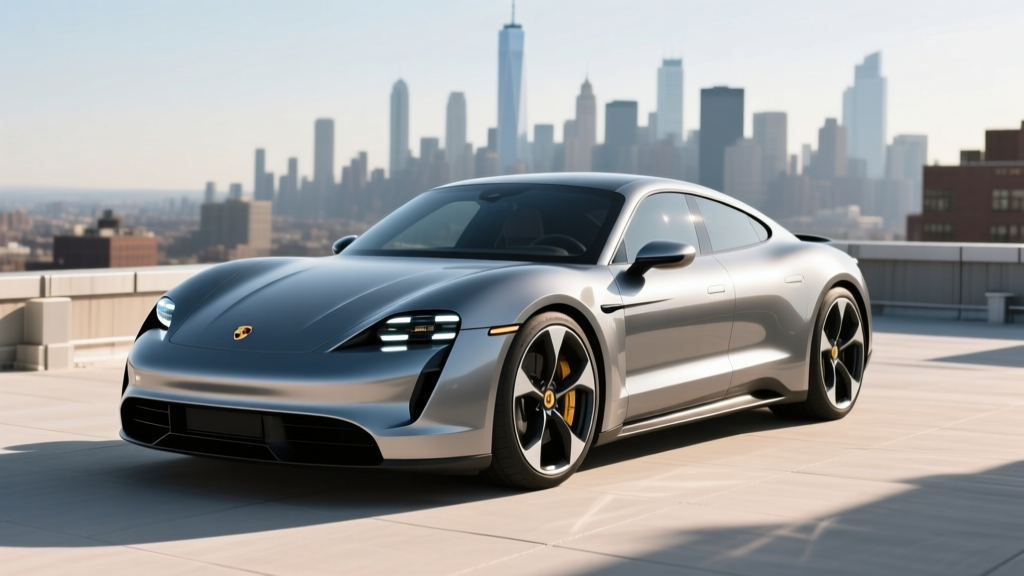
Using the Porsche Taycan (the brand's current electric sports sedan) and the upcoming SSP Sport platform as reference points, here is a reasonable projection for a battery-electric 911:
| Specification | Projected Estimate | Reference Basis |
|---|---|---|
| Battery Capacity (usable) | ~85–100 kWh | Taycan Performance Battery Plus (84 kWh usable, NMC) |
| Chemistry | NMC (Nickel Manganese Cobalt) | All current Porsche BEVs use NMC for energy density |
| Architecture | 800-volt | Taycan, Macan EV, and SSP Sport all use 800V |
| EPA Range (est.) | 250–310 miles | Taycan 4S: 277 mi EPA; 911 is lighter, more aero-efficient |
| Peak DC Fast Charge | ~270–320 kW | Updated Taycan peaks at 320 kW |
| 10–80% DC Charge Time | ~16–20 minutes | Updated Taycan: 18 min at 320 kW |
| Level 2 AC Charge Rate | 11 kW (standard), 22 kW (optional) | Current Taycan/Macan EV capability |
| System Output | 550–700+ hp | Taycan Turbo GT: 1,019 hp; 911 likely more conservative |
| 0–60 mph | ~2.5–3.5 seconds | Taycan Turbo GT: 2.1s; 911 Turbo S (gas): 2.6s |
| Drivetrain | Dual-motor AWD (likely) | Porsche sports-car EV pattern |
| Estimated Base MSRP | $140,000–$180,000+ | Gas 911 Carrera starts ~$120k; Taycan starts ~$99k |
Note: These are analyst projections, not manufacturer-confirmed specifications. Porsche has not published official figures for a BEV 911. Source for Taycan reference data: Porsche USA Taycan.
The 2025 911 T-Hybrid: What's Actually Available Now
If you want an electrified 911 today, the 2025 Porsche 911 Carrera GTS with T-Hybrid is the only option. It is critical to understand what this system is — and what it is not.
| Attribute | 2025 T-Hybrid GTS | 2024 Gas 911 GTS (992.1) |
|---|---|---|
| Powertrain | 3.6L flat-6 + electric motor (T-Hybrid) | 3.0L twin-turbo flat-6 |
| Horsepower | 532 hp | 473 hp |
| 0–60 mph | 2.9 seconds | 3.2 seconds |
| EPA Fuel Economy | ~20/26/22 MPG (est.) | 18/24/20 MPG |
| Electric-Only Driving | None (performance hybrid) | N/A |
| Plug-In Capable | No | No |
| Battery | 1.9 kWh net (lithium-ion) | None |
| Base MSRP | ~$164,900 | ~$150,500 (discontinued) |
| Federal EV Tax Credit (§30D) | Not eligible (not a PHEV/BEV) | Not eligible |
The T-Hybrid system uses a small battery and an electric motor integrated into the PDK transmission to eliminate turbo lag and provide torque fill. It does not offer plug-in capability, electric-only range, or eligibility for the federal §30D clean vehicle tax credit, which requires a battery electric vehicle (BEV) or plug-in hybrid (PHEV) with minimum battery capacity and critical-mineral sourcing requirements.
Real Costs of Electric 911 Ownership (Projected)
For buyers considering a future BEV 911, here is a projected cost framework based on Taycan ownership data and the luxury EV segment:
| Cost Category | Projected 911 BEV | Gas 911 Carrera S (~$135k) |
|---|---|---|
| Purchase Price (est.) | $155,000 | $135,000 |
| Federal Tax Credit | $0 (MSRP exceeds §30D $55k sedan / $80k SUV cap) | $0 |
| Energy/Fuel (5 yr, 60k mi) | ~$5,400 (at $0.15/kWh, 3.5 mi/kWh) | ~$12,000 (at $4.00/gal, 20 MPG) |
| Maintenance (5 yr) | ~$3,500 (no oil, fewer brake jobs w/ regen) | ~$7,500 (oil, spark plugs, brake wear) |
| Insurance (5 yr avg.) | ~$28,000 (luxury EV premium) | ~$24,000 |
| Depreciation (5 yr, est.) | ~$70,000 (EV luxury depreciation is steep) | ~$55,000 (911 gas holds value exceptionally well) |
| Total 5-Year Cost | ~$261,900 | ~$233,500 |
Key takeaway: The projected BEV 911 will likely cost more to own over 5 years than its gas counterpart, primarily due to a higher purchase price and steeper depreciation. Energy and maintenance savings are real but modest relative to the purchase premium. The gas 911 is one of the best-holding-value cars in the industry, which makes the depreciation gap significant.
Source for fuel economy baselines: fueleconomy.gov.
EV vs. Gas 911: Driving Experience and Practical Considerations
| Myth | Fact |
|---|---|
| "An electric 911 will weigh too much to handle well." | Battery weight is real (Taycan: ~5,100 lbs), but Porsche engineers have demonstrated with the Taycan and electric Cayenne prototype that low center-of-gravity and rear-biased torque vectoring can produce excellent dynamics. The 911 BEV will likely weigh 4,500–4,800 lbs vs. ~3,400 lbs for a gas Carrera — a significant gap that will affect feel. |
| "It will qualify for the $7,500 tax credit." | Almost certainly not. The §30D credit has an MSRP cap of $55,000 for sedans and $80,000 for SUVs/trucks. A 911 EV will far exceed these limits. Income caps also apply ($150k single / $300k joint AGI). |
| "I'll be able to charge at any public station." | Porsche's current BEVs use the CCS1 connector. If the 911 EV follows suit, it will access Electrify America, EVgo, and ChargePoint DC networks. Tesla Supercharger access (NACS) requires an adapter for CCS vehicles — Porsche has not committed to NACS adoption for all models as of early 2026. |
| "The range will be 400+ miles." | Unlikely for a sports car. Aerodynamic efficiency at highway speeds and battery packaging constraints in a rear-engine layout make 250–310 miles EPA more realistic. Expect 200–250 miles real-world at sustained 75+ mph highway speeds, and further reduction (15–25%) in freezing temperatures. |
| "EVs don't need maintenance." | EVs need less maintenance (no oil changes, fewer brake replacements due to regenerative braking), but still require tire rotation, cabin air filters, coolant system service, and 12V battery monitoring. Porsche's scheduled maintenance intervals will still apply. |
Real-World Range Expectations
Based on Taycan real-world testing data, a 911 BEV with an EPA rating of ~280 miles would likely deliver:
- City/mixed driving (moderate climate): ~270–290 miles — regenerative braking recovers energy in stop-and-go traffic
- Sustained highway (75 mph, 70°F): ~220–250 miles — aerodynamic drag dominates at speed
- Cold weather highway (30°F): ~180–210 miles — battery resistance increases, cabin heating draws energy (heat pump expected, which mitigates some loss)
- Track use: Range drops dramatically under sustained high-power output — expect 80–120 miles of hard driving before needing a charge
Charging at Home: What a 911 EV Owner Needs
Most Porsche BEV owners charge primarily at home. A realistic setup:
- Level 2 home charger (240V, 48A circuit): Adds ~30–35 miles of range per hour of charging. An overnight charge (10 hours) fully replenishes a ~100 kWh battery.
- Installation cost: $1,200–$3,500 for a standard install (charger + electrician + permit). Older homes may need a panel upgrade ($2,000–$5,000+) to support a 60A dedicated circuit.
- No home charging? Relying solely on public DC fast charging is feasible but adds time (16–20 min per session), cost ($0.30–$0.50/kWh vs. $0.15/kWh residential), and inconvenience. This is a deal-breaker for many luxury EV buyers.
Decision Framework: Should You Wait for the 911 EV?
Choose the Gas 911 (992.2) If:
- You want a 911 now — the BEV is likely 2+ years away
- Track driving is a priority — gas 911s are lighter (~3,400 lbs vs. projected 4,500+ lbs for BEV) and have established lap-record pedigrees
- Resale value matters — gas 911s depreciate far less than luxury EVs
- You lack reliable home charging access
- The sound and mechanical feel of a flat-six engine are central to your 911 experience
- You regularly drive in areas with sparse DC fast-charging infrastructure
Choose the 911 T-Hybrid (Available Now) If:
- You want electrified performance today with no range anxiety
- You value the torque-fill and turbo-lag elimination the electric motor provides
- You want the latest 992.2 technology and don't need plug-in capability
- You accept a ~$15,000 premium over the prior gas GTS for the performance gains
Wait for the 911 BEV If:
- You have reliable Level 2 home charging and access to DC fast chargers for road trips
- Instant torque and silent, effortless acceleration appeal to you more than engine sound
- You're willing to accept steeper depreciation and a higher purchase price for EV technology
- You can wait until 2027–2028 for initial availability (and likely limited allocation)
- Reducing tailpipe emissions is a personal priority
What First-Time EV Buyers in This Segment Should Know
If a 911 EV would be your first electric vehicle, understand these fundamentals before committing:
- kW vs. kWh: kW (kilowatts) measures power — how fast you charge or accelerate. kWh (kilowatt-hours) measures energy — the battery's total capacity. A 100 kWh battery charged at 300 kW fills faster than one charged at 150 kW, but both hold the same total energy.
- Charging curves matter more than peak kW: A car that peaks at 320 kW may only sustain that rate from 10–30% state of charge, then taper significantly. The 10–80% time is the more useful metric. Porsche's updated Taycan is among the best in the industry at sustaining high charge rates.
- Cold weather reduces range 15–30%: This is physics, not a defect. Lithium-ion batteries have higher internal resistance in cold temperatures, and cabin heating draws from the traction battery. A heat pump (expected on a 911 BEV) helps but doesn't eliminate the loss.
- Tax credits won't help at this price point: The federal §30D credit caps eligible vehicles at $55,000 MSRP (sedans) or $80,000 (SUVs/trucks/vans). A 911 EV will exceed these limits. Some states offer additional incentives that are not MSRP-capped — check your state's energy office for specifics.
- Insurance costs more for luxury EVs: Expect 10–20% higher premiums than equivalent gas vehicles due to higher repair costs, specialized parts, and battery replacement risk. Get quotes before purchasing.
- Tires wear faster on EVs: Instant torque and heavier vehicle weight accelerate tire wear by 20–30% compared to gas equivalents. Budget for tire replacement every 20,000–30,000 miles.
Frequently Asked Questions
When will the Porsche 911 EV be available to buy?
Porsche has not announced an official release date. Based on the brand's electrification timeline and the SSP Sport platform development (which has faced delays), a fully electric 911 is most likely to arrive for the 2028 or 2029 model year. The T-Hybrid is available now.
Will the electric 911 be faster than the gas 911 Turbo S?
In straight-line acceleration, almost certainly yes. Electric motors deliver instant torque, and a dual-motor setup with 600+ hp could challenge the Turbo S's 2.6-second 0–60 time. On a road course, the heavier EV may face challenges matching the gas car's lap times due to weight, though Porsche's engineering track record with the Taycan suggests competitive handling.
Will the 911 EV use NACS (Tesla) or CCS charging?
Unconfirmed. Porsche currently uses CCS1 on the Taycan and Macan EV. The industry is shifting toward NACS, and several automakers have committed to adopting it by 2025–2026. Porsche's final connector decision for the 911 BEV has not been publicly announced. CCS vehicles can access most Tesla Superchargers via a Magic Dock adapter at participating stations.
Will the electric 911 have a frunk (front trunk)?
Very likely yes. Removing the flat-six engine from the rear and placing the battery in a skateboard-style platform (or a modified rear-biased layout) would free space for a front cargo area. The gas 911 already has a small front trunk (~4.6 cu ft); a BEV version could offer comparable or slightly larger front storage.
What will a Porsche 911 EV cost?
No official pricing exists. Based on the current gas 911 lineup ($120,000–$240,000+) and the Taycan's positioning ($99,000–$240,000+), a reasonable estimate for a base 911 BEV is $140,000–$180,000, with performance variants (Turbo, GT3-equivalent) pushing well above $200,000. It will not qualify for the federal §30D tax credit due to MSRP caps.
Should I buy a Taycan instead while waiting for the 911 EV?
If you want a Porsche EV today, the updated 2025 Taycan is an excellent choice — it now offers up to 318 miles of EPA range (Taycan 4), peaks at 320 kW DC charging, and delivers 10–80% in approximately 18 minutes. It is a grand tourer, not a sports car, so the driving dynamics differ significantly from a 911. If the 911's size, weight, and handling precision are what you want, the Taycan is a different experience.