Why San Jose Drivers Are Looking at Polestar in 2026
The South Bay has one of the highest EV adoption rates in the United States, and for good reason: short freeway commutes on the 101 and 280, robust public charging from Electrify America, ChargePoint, and Tesla Superchargers (now open to NACS adapters), and a statewide $2,000 Clean Fuel Rebate stacked on top of federal incentives. If you've been searching "Polestar San Jose" to figure out which model fits your commute from Willow Glen to Palo Alto—or your weekend runs to Santa Cruz—this guide covers the current 2026 lineup with the exact numbers that matter.
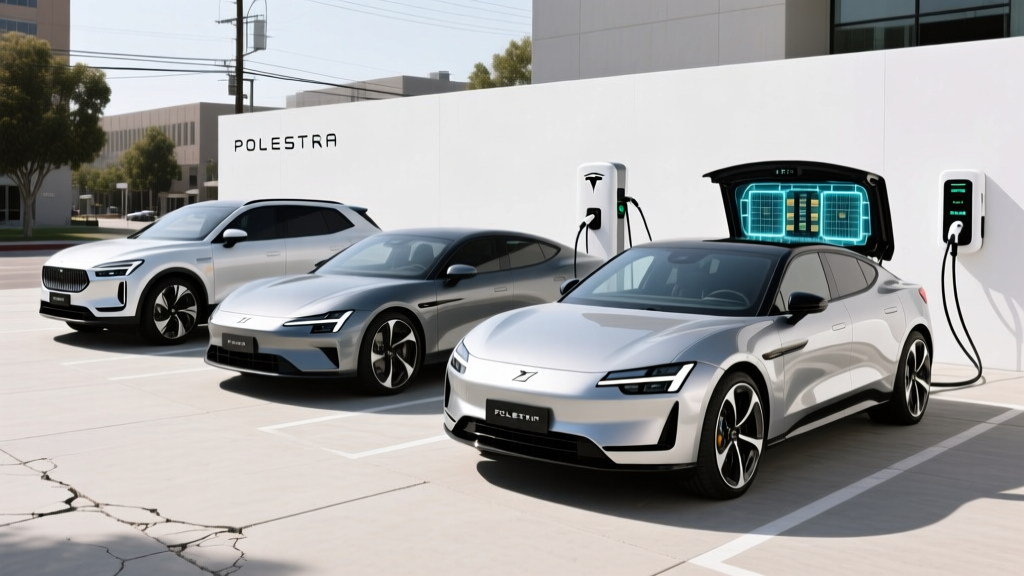
Polestar sells three models in the US market for 2026: the Polestar 2 (compact fastback sedan), the Polestar 3 (mid-size performance SUV), and the Polestar 4 (coupe-SUV with no rear window). Below, we break down EPA range, real-world efficiency, DC fast-charge curves, home charging, pricing after the §30D federal tax credit, and which model actually makes sense for Bay Area ownership.
2026 Polestar Lineup: Spec Comparison at a Glance
| Spec | Polestar 2 LRSM | Polestar 2 LRDM | Polestar 3 LRDM | Polestar 4 LRDM |
|---|---|---|---|---|
| EPA Range | 320 mi | 298 mi | 315 mi (est.) | 300 mi (est.) |
| Battery (usable) | 79 kWh, NMC | 79 kWh, NMC | 107 kWh, NMC | 100 kWh, NMC |
| Drivetrain | RWD, single motor | AWD, dual motor | AWD, dual motor | AWD, dual motor |
| Horsepower | 299 hp | 421 hp | 489 hp | 544 hp |
| 0–60 mph | 5.9 s | 4.3 s | 4.7 s | 3.8 s |
| Peak DC charge | 200 kW | 200 kW | 250 kW | 210 kW |
| 10–80% DC time | ~27 min | ~27 min | ~30 min | ~29 min |
| Level 2 rate | 11 kW AC | 11 kW AC | 11 kW AC | 11 kW AC |
| MPGe (combined) | 107 MPGe | 98 MPGe | 89 MPGe | 92 MPGe |
| Cargo (rear seats up) | 14.4 cu ft + 1.4 frunk | 14.4 cu ft + 1.4 frunk | 17.1 cu ft + 1.1 frunk | 18.3 cu ft (no frunk) |
| Base MSRP | $49,900 | $53,400 | $67,900 | $59,900 |
LRSM = Long Range Single Motor; LRDM = Long Range Dual Motor. All prices before destination.
Real-World Range: What the EPA Sticker Doesn't Tell You
EPA: 320 miles. Expect ~265–285 miles at sustained 70–80 mph freeway speeds on I-280 or US-101, and ~230–250 miles in cold/rainy winter conditions (common in the Bay Area from December through February). City driving with regenerative braking recovers closer to the EPA number, often 300+.
The Polestar 2's 79 kWh usable NMC pack delivers strong efficiency—roughly 25–27 kWh/100 mi on the freeway—but the fastback shape carries a higher drag coefficient than a Tesla Model 3 or Hyundai Ioniq 6, which shows up above 70 mph. The Polestar 3 and 4, being heavier SUVs, will see more pronounced highway drop-off: budget roughly 15–20% below EPA for sustained freeway trips to Tahoe or Los Angeles.
For the typical San Jose commute (15–30 miles round trip), any Polestar model delivers a full work week without plugging in, assuming nightly Level 2 top-ups at home.
Charging Speed: DC Fast Charge and Home Level 2
| Charging Level | Polestar 2 | Polestar 3 | Polestar 4 | Miles Added per Hour |
|---|---|---|---|---|
| Level 1 (120V / 12A) | 1.4 kW | 1.4 kW | 1.4 kW | ~4 mi/hr |
| Level 2 (240V / 48A) | 11 kW | 11 kW | 11 kW | ~30–35 mi/hr |
| DC Fast (peak) | 200 kW | 250 kW | 210 kW | n/a (minutes-based) |
| 10–80% DC time | ~27 min | ~30 min | ~29 min | n/a |
All 2026 Polestars sold in the US ship with a NACS charge port, granting native access to Tesla Supercharger stalls (150 kW and 250 kW V3/V4) without an adapter. This is a significant practical advantage in Northern California, where Supercharger density dwarfs other networks along Highway 17 to Santa Cruz and I-5 north to Sacramento.
Charging-curve reality check: The Polestar 2's 200 kW peak is only sustained between roughly 10–40% State of Charge (SoC). Expect the rate to taper to ~120 kW by 60% and ~70 kW by 80%. The 27-minute 10–80% claim assumes a preconditioned battery and a stall capable of delivering the full curve. On a 150 kW Electrify America stall, plan for 32–36 minutes.
At home on a 48-amp Level 2 circuit (hardwired, 60-amp breaker), any Polestar will add roughly 30–35 miles of range per hour. A full 10–100% charge on the Polestar 2 takes about 8 hours overnight; the larger Polestar 3 pack needs closer to 10–11 hours. If your San Jose home has a 200-amp panel, you likely have headroom for a Level 2 install without a panel upgrade—budget $800–$1,500 for the circuit run depending on garage-to-panel distance.
Pricing, Trims, and Federal Tax Credit Eligibility
Polestar's 2026 US pricing positions the brand between mainstream EVs (Hyundai, Kia, VW) and luxury competitors (BMW iX, Audi Q8 e-tron). Here's how the numbers work after incentives:
| Model / Trim | Base MSRP | §30D Federal Credit | CA Clean Fuel Rebate | Effective Price |
|---|---|---|---|---|
| Polestar 2 LRSM | $49,900 | Up to $7,500* | $2,000 | ~$40,400 |
| Polestar 2 LRDM | $53,400 | Up to $7,500* | $2,000 | ~$43,900 |
| Polestar 4 LRDM | $59,900 | Up to $7,500* | $2,000 | ~$50,400 |
| Polestar 3 LRDM | $67,900 | Up to $7,500* | $2,000 | ~$58,400 |
*Critical §30D caveats (per IRS rules):
- MSRP caps: Sedans (Polestar 2) must be under $55,000 MSRP. SUVs/vans (Polestar 3 and 4, classified as SUVs) must be under $80,000. The Polestar 2 LRDM at $53,400 clears the sedan cap; adding the Plus or Pilot package can push it over, disqualifying the credit.
- Buyer income caps: AGI must not exceed $150,000 (single), $225,000 (head of household), or $300,000 (joint). Many San Jose tech earners will exceed these thresholds.
- Battery sourcing: The full $7,500 requires meeting both critical-mineral and battery-component sourcing requirements. Polestar sources from CATL and LG Energy Solution; check the latest fueleconomy.gov eligibility list before purchasing, as partial credits ($3,750) may apply if only one requirement is met.
- Point-of-sale transfer: You can transfer the credit to the dealer at purchase, reducing your out-of-pocket cost immediately rather than waiting for tax filing.
The Polestar 2 LRSM is the safest bet for the full $7,500 credit. The Polestar 3 and 4, classified as SUVs, have more MSRP headroom but still require income and sourcing compliance. Always verify with a tax professional before relying on the credit.
Driving Dynamics, Tech, and Daily Livability
The Polestar 2 remains one of the best-steering EVs in its class. The RWD single-motor variant (new for 2025, carried into 2026) trades the dual-motor's straight-line punch for better efficiency and a more natural rear-drive balance. On the twisty sections of Highway 9 through the Santa Cruz Mountains, the Öhlins-equipped Performance Pack ($5,000, includes 20-inch forged wheels, Brembo brakes, and manually adjustable dampers) transforms the car. Without it, the standard suspension is firm but compliant—appropriate for Bay Area potholes and speed bumps.
Infotainment: Polestar uses a Google Automotive OS-based 11.2-inch center display with native Google Maps navigation, Google Assistant voice control, and the Google Play Store for apps. This is a genuine advantage: Google Maps with real-time EV range prediction and automatic battery preconditioning for DC fast charging is among the best navigation implementations in any EV. Apple CarPlay is wireless; Android Auto is redundant given the native Google integration.
Driver assistance: Polestar's Pilot Pack includes adaptive cruise control with stop-and-go, lane-centering assist, and Pilot Assist (SAE Level 2). This is not self-driving—you must keep hands on the wheel and eyes on the road. It's competent for 101 freeway traffic but less assertive than Tesla Autopilot or Ford BlueCruise in cut-in scenarios. Polestar does not currently offer a hands-free highway driving system.
Cargo and space: The Polestar 2 is a fastback, not a hatchback in the traditional sense—the trunk opening is narrow, and the 14.4 cu ft rear cargo area is smaller than a Model 3's 23 cu ft. The 1.4 cu ft frunk is useful for charging cables. Rear legroom (35.6 inches) is adequate for adults on shorter trips but tight for tall passengers. The Polestar 4's coupe-SUV shape offers 18.3 cu ft of cargo space and more generous rear headroom, though the lack of a rear window (replaced by a digital camera mirror) takes adjustment.
Warranty: Polestar covers all 2026 models with a 4-year/50,000-mile limited warranty and an 8-year/100,000-mile battery and drive-unit warranty, retaining at least 70% capacity over that period. This matches industry norms (Tesla, Hyundai, VW) and provides adequate peace of mind for the battery pack.
Polestar San Jose Ownership: Pros, Cons, and the Verdict
- NACS native charging — full Supercharger network access without adapters
- Google Automotive OS with best-in-class navigation and preconditioning
- Distinctive Scandinavian design — stands out in a sea of Tesla Model Ys
- Strong build quality (Luqiao, China plant; Volvo/Polestar engineering)
- Polestar 2 LRSM qualifies for full §30D credit when optioned conservatively
- Öhlins Performance Pack offers genuine enthusiast dynamics
- Polestar 2 cargo space (14.4 cu ft) trails Model 3, Ioniq 6, and BMW i4
- No hands-free Level 2+ system to match BlueCruise or Super Cruise
- Firm ride on standard suspension without Öhlins upgrade
- Limited service centers in the South Bay — closest is Polestar San Jose on Winchester Blvd, plus Mobile Service vans
- Polestar 4's camera-based rear mirror is polarizing and reduces visibility in rain
- Higher insurance premiums vs. Tesla (average ~$2,200–$2,800/year in Santa Clara County)
Who Should Buy a Polestar in San Jose?
Polestar 2 LRSM is ideal for: single professionals or couples commuting 20–50 miles daily on the 101/280 corridor, who value design and driving dynamics over maximum cargo space and want native Supercharger access. At ~$40,400 after incentives, it undercuts a comparably equipped Model 3 Long Range while offering a more premium interior.
Polestar 4 suits: buyers who want SUV ride height and cargo practicality without the bulk of a Polestar 3, and who find the camera-rear-mirror acceptable. It competes directly with the Genesis Electrified GV70 and Audi Q4 e-tron.
Polestar 3 is for: families needing more interior space and willing to pay a premium (~$58,400 after incentives). However, at this price, the BMW iX xDrive50 (307 mi EPA, ~$6,000 more before credit) and Tesla Model X offer more range and established service networks.
Look elsewhere if: you need maximum range (Hyundai Ioniq 6 SE offers 361 mi EPA for $10,000 less), hands-free highway driving (Ford Mustang Mach-E with BlueCruise), or the lowest total cost of ownership (Tesla Model 3 RWD remains the efficiency and depreciation benchmark).
Frequently Asked Questions
Is there a Polestar dealership in San Jose?
Yes. Polestar operates a Space (showroom and service) on Winchester Blvd in San Jose, plus a mobile service fleet that handles software updates, minor repairs, and tire work at your home or office. Larger body and high-voltage work routes to the San Jose Space or the Polestar Service Center in Fremont.
Does the Polestar 2 qualify for the $7,500 federal tax credit in 2026?
The Polestar 2 LRSM at $49,900 base MSRP qualifies if the buyer's AGI is under the IRS income caps ($150K single / $300K joint) and the battery meets sourcing requirements. Adding expensive option packages can push the MSRP above the $55,000 sedan cap, disqualifying the credit. Verify current sourcing compliance on fueleconomy.gov before purchase.
How much does it cost to charge a Polestar at home in San Jose?
PG&E's EV-A rate plan (time-of-use) offers off-peak rates around $0.14–$0.18/kWh overnight. Fully charging a Polestar 2's 79 kWh pack from 10–100% costs roughly $11–$14 at home, equating to about $0.04–$0.05 per mile. Compare that to $0.14–$0.16 per mile for a 30 MPG gas car at $4.20/gallon.
Can I use Tesla Superchargers with a Polestar?
Yes. All 2026 Polestars sold in the US feature a native NACS charge port, providing direct access to Tesla's Supercharger network without any adapter. This includes V3 (250 kW) and V4 stalls across Northern California.
What's the real-world range on a road trip from San Jose to Lake Tahoe?
The ~190-mile drive to South Lake Tahoe via US-50 involves significant elevation gain (7,000+ feet) and sustained 65–70 mph speeds. Expect the Polestar 2 LRSM to arrive with roughly 50–70 miles of remaining range in summer, less in winter with cabin heat and snow. Plan one DC fast-charge stop in Placerville or Sacramento (15–20 minutes) for a comfortable margin. The Polestar 3's larger 107 kWh pack can complete the trip without stopping in fair weather.
How does Polestar's warranty compare to Tesla and Hyundai?
Polestar offers 4 years/50,000 miles bumper-to-bumper and 8 years/100,000 miles on the battery and drive units (70% capacity retention). Tesla matches this with 4/50 and 8/120K (70% retention). Hyundai leads with 5/60K basic and 10/100K battery. Polestar's warranty is competitive but not class-leading.