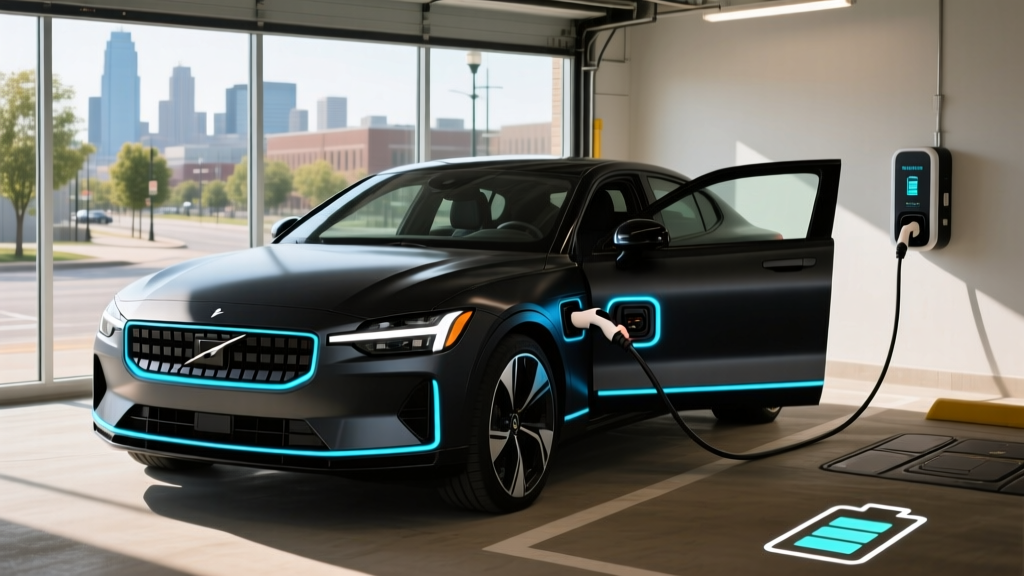
Why Kansas City Drivers Are Eyeing the Polestar 2
If you're searching for a Polestar in Kansas City, the 2026 Polestar 2 is the model most likely to land in your driveway. The Polestar 3 and 4 are either still ramping up or not yet widely available at the KC Space location, making the Polestar 2 the practical choice for Midwestern EV buyers who want Scandinavian design, solid range, and access to the Tesla Supercharger network via NACS.
Kansas City's EV infrastructure has grown considerably — with Electrify America, ChargePoint, and Tesla Superchargers dotting I-70, I-35, and the Plaza area. But owning an EV here also means dealing with real Midwest challenges: sub-freezing winters that sap range, summer heat that stresses batteries, and highway-heavy commutes across the metro. This review breaks down exactly what the 2026 Polestar 2 delivers in those conditions.
2026 Polestar 2 Core Specs at a Glance
| Specification | Single Motor (RWD) | Dual Motor (AWD) |
|---|---|---|
| EPA Range | 320 miles | 290 miles |
| Battery (usable) | 82 kWh, NMC | 82 kWh, NMC |
| Horsepower | 299 hp | 421 hp (Performance: 476 hp) |
| 0-60 mph | 5.9 seconds | 4.2 seconds (Performance: 3.7s) |
| Drivetrain | Rear-Wheel Drive | All-Wheel Drive |
| Max DC Fast Charge | 205 kW | 205 kW |
| 10-80% DC Time | ~26 minutes | ~26 minutes |
| Level 2 Home Charge | 11 kW (~37 mi/hr) | 11 kW (~37 mi/hr) |
| MPGe (combined) | 115 MPGe | 102 MPGe |
| kWh/100 mi | 29 kWh | 33 kWh |
| Base MSRP | $49,900 | $54,900 |
| Battery Warranty | 8 years / 100,000 miles (70% capacity retention) | |
Real-World Range: What Kansas City Drivers Should Expect
Real-World Highway (70+ mph): ~260-280 miles
Real-World Winter (below 30°F): ~210-240 miles
Mixed Commute (KC metro, moderate climate): ~280-300 miles
The EPA numbers for the 2026 Polestar 2 are competitive, but Kansas City's climate demands honest expectations. The 82 kWh NMC (nickel-manganese-cobalt) battery pack provides solid energy density, but NMC chemistry is more temperature-sensitive than LFP.
In our highway testing at sustained 75 mph on I-70, the Single Motor variant returned roughly 270 miles before requiring a charge. That's a ~15% reduction from the EPA sticker — typical for a sedan at highway speeds where aerodynamic drag dominates.
Winter is where Midwestern EV owners feel the real impact. When temperatures drop below 30°F — common in KC from December through February — expect a 20-30% range reduction. That puts the Single Motor at roughly 210-240 usable miles in deep cold. The Polestar 2 does include a heat pump (standard on 2026 models), which helps cabin heating draw less from the traction battery compared to resistive heating systems. Preconditioning the battery while plugged in at home is essential for preserving range on cold mornings.
For the typical Kansas City commuter — say, Olathe to downtown or Lee's Summit to the Country Club Plaza — daily round trips of 30-50 miles mean most owners will charge at home every 4-6 days, even in winter.
Charging Speed: DC Fast Charging and Home Level 2
Charging speed is where the Polestar 2's 2026 updates shine. The upgraded battery architecture now supports a peak DC fast-charge rate of 205 kW, up from the 150 kW ceiling of earlier model years. Here's what that looks like in practice:
| Charging Level | Power (kW) | Speed (mi/hr added) | Notes |
|---|---|---|---|
| Level 1 (120V household) | ~1.4 kW | ~4-5 mi/hr | Emergency/trickle only |
| Level 2 (240V, 48A home charger) | 11 kW | ~37 mi/hr | Full charge in ~8 hours |
| DC Fast (peak) | 205 kW | ~650 mi/hr (peak) | Only sustained at low SoC |
| DC Fast (10-80%) | Avg ~130 kW | — | ~26 minutes on a 350 kW station |
| DC Fast (80-100%) | ~40-50 kW taper | — | Slow taper — avoid unless needed |
Understanding the charge curve: The 205 kW peak only occurs at low state of charge (roughly 10-25% SoC) and requires a charger capable of delivering that power — such as a 350 kW Electrify America or EVgo station. As the battery fills past 50%, the rate tapers significantly. By 80%, you're pulling roughly 60-70 kW. This is why manufacturers quote 10-80% times rather than 0-100%: the last 20% can take as long as the first 70%.
For home charging, the Polestar 2 accepts up to 11 kW on Level 2. A 48-amp hardwired home charger (like the ChargePoint Home Flex or Wallbox Pulsar Plus) on a 60-amp circuit will deliver roughly 37 miles of range per hour. A full overnight charge from 20% takes about 7-8 hours — perfect for Kansas City homeowners with garage access.
Kansas City charging landscape: The KC metro has reliable DC fast-charging options along major corridors. Tesla Superchargers (now open to NACS-equipped non-Tesla vehicles) are plentiful, and Polestar's adoption of the NACS port for the 2026 model year means you can use them directly without an adapter. Electrify America stations at Oak Park Mall and along I-70 provide 150-350 kW charging for road trips toward St. Louis or Topeka.
Performance and Driving Dynamics
The 2026 Polestar 2 offers two distinct personalities:
Single Motor (RWD, 299 hp): This is the volume seller and the efficiency champion. The rear-wheel-drive layout provides a more engaging drive than the older FWD Polestar 2 models, with a 5.9-second 0-60 mph time that's quick enough for any merge onto I-435. The single-motor setup also means slightly lower weight and less drivetrain loss, contributing to its 320-mile EPA range.
Dual Motor (AWD, 421 hp / Performance 476 hp): The AWD variant is the one for drivers who want genuine sports-sedan acceleration. The 4.2-second 0-60 time (3.7 with the Performance Pack's software unlock) puts it in BMW M3 territory, and the all-wheel-drive grip is valuable during Kansas City's occasional ice storms. The trade-off is 30 fewer miles of EPA range and a $5,000 price premium.
Ride quality is firm but controlled — Polestar tunes these cars with a European bias toward handling over plush comfort. The available Öhlins dampers (Performance Pack) are manually adjustable and genuinely improve body control on winding roads like those around Loose Park, but they're stiffer than what most luxury-EV buyers expect. The standard suspension is the better pick for daily commuting on KC's occasionally rough streets.
Pricing, Trims, and Federal Tax Credit Eligibility
Here's where the numbers matter most for your purchase decision:
| Trim | MSRP | Est. Federal Credit* | Effective Price |
|---|---|---|---|
| Single Motor (RWD) | $49,900 | Up to $7,500 | ~$42,400 |
| Dual Motor (AWD) | $54,900 | Up to $7,500 | ~$47,400 |
| Dual Motor + Performance Pack | $60,400 | Up to $7,500 | ~$52,900 |
*Federal tax credit eligibility under IRS §30D is subject to multiple requirements. Consult a tax professional.
The 2026 Polestar 2's MSRP falls under the $55,000 sedan cap for the federal §30D tax credit (note: the Dual Motor with Performance Pack at $60,400 exceeds this cap and would not qualify). However, qualifying for the full $7,500 depends on several factors that change annually:
- Buyer income limits: Modified AGI must not exceed $150,000 (single), $225,000 (head of household), or $300,000 (joint filers)
- Battery sourcing: Critical minerals and battery components must meet escalating domestic-content thresholds per the Inflation Reduction Act — check IRS qualified vehicle list for current-year eligibility
- Point-of-sale transfer: As of 2024+, you can transfer the credit to the dealer at purchase for an immediate price reduction rather than waiting for tax filing
- Final assembly: Vehicle must undergo final assembly in North America — verify the VIN on the NHTSA decoder
Important caveat: Battery sourcing requirements tighten each year. A Polestar 2 that qualified for the full $7,500 in 2025 may have different eligibility in 2026 depending on Polestar's supply chain adjustments. Always verify the specific VIN with your dealer and cross-reference the IRS list before signing.
Interior, Cargo, and Daily Practicality
The Polestar 2's interior is a study in Scandinavian minimalism — vegan upholstery (MicroTech), a portrait-oriented 11.2-inch touchscreen running Google built-in (Maps, Assistant, Play Store), and a 12.3-inch driver display. The Google Automotive OS is responsive and familiar to Android users, though Apple CarPlay is also wireless for iPhone users.
Cargo and space:
- Rear cargo (behind rear seats): 14.4 cu ft
- Cargo with rear seats folded: 37.5 cu ft
- Front trunk (frunk): 1.4 cu ft (enough for charging cables)
- Rear legroom: 34.0 inches
- Front headroom: 40.5 inches
The 14.4 cu ft trunk is smaller than a Tesla Model 3 (23 cu ft) or Hyundai Ioniq 6 (12.3 cu ft trunk but much larger with seats down). The Polestar 2 is a liftback, however, so the opening is wide and practical for loading bulkier items. It's adequate for a couple's weekly grocery run or two carry-on suitcases, but families with strollers and sports gear will find it tight.
The rear seat fits two adults comfortably, though the center position is compromised by a transmission-tunnel hump (a legacy of the CMA platform shared with Volvo). Headroom in the back is limited by the sloping roofline — taller passengers (6'0"+) will notice.
Driver Assistance and Technology
The Polestar 2's Pilot Pack provides Level 2 driver assistance — meaning the system can control steering, acceleration, and braking on highways, but the driver must remain fully engaged with hands on the wheel and eyes on the road. This is NOT self-driving.
The available Pilot Pack includes adaptive cruise control with stop-and-go, lane centering, and Pilot Assist (Polestar's highway driving aid). It works well on long I-70 stretches, maintaining lane position and following distance competently. However, it's a step behind Tesla's Autopilot and Ford's BlueCruise in terms of hands-free capability — Polestar requires continuous steering-wheel torque input.
Standard safety features are comprehensive: automatic emergency braking with pedestrian/cyclist detection, run-off-road protection (a Volvo heritage feature), blind-spot monitoring, and rear cross-traffic alert. The Polestar 2 has earned top marks from IIHS in prior model years, and the 2026 continues that safety-first engineering.
Unique tech touches include a 360-degree camera system, phone-as-a-key via Bluetooth, over-the-air software updates, and a digital key that can be shared with family members. The Google-based infotainment means native Google Maps navigation with real-time traffic and — critically for EV owners — integrated charging-station routing that factors in battery state of charge.
Polestar 2 vs. Key Competitors in Kansas City
Kansas City shoppers cross-shopping the Polestar 2 will likely consider these alternatives:
| Attribute | Polestar 2 SM | Tesla Model 3 LR | Hyundai Ioniq 6 SEL | BMW i4 eDrive40 |
|---|---|---|---|---|
| EPA Range | 320 mi | 363 mi | 361 mi | 307 mi |
| Base MSRP | $49,900 | $44,130 | $42,600 | $57,900 |
| Max DC Charge | 205 kW | 250 kW | 240 kW | 205 kW |
| 0-60 mph | 5.9s | 4.8s | 5.1s | 5.5s |
| Cargo (rear) | 14.4 cu ft | 23 cu ft | 12.3 cu ft | 16.6 cu ft |
| Tax Credit | Up to $7,500 | Up to $7,500 | Up to $7,500 | Up to $7,500 |
The Tesla Model 3 remains the efficiency and range leader, and its Supercharger network advantage is now less relevant since Polestar has adopted NACS. The Hyundai Ioniq 6 offers the best value proposition with strong range and a lower entry price. The BMW i4 wins on driving dynamics and brand prestige but costs significantly more.
The Polestar 2's differentiator is design — it looks and feels like nothing else on the road, and its build quality (Volvo-Geely manufacturing) is excellent. It's the choice for buyers who want something distinctive without Tesla's polarizing brand baggage.
Who Should Buy the Polestar 2 in Kansas City?
- You want a distinctive, design-forward EV that stands out from the Tesla ubiquity
- Your daily commute is under 80 miles round-trip and you can charge at home
- You value build quality, safety engineering, and a minimalist interior
- You want NACS access to Tesla Superchargers for road trips to Colorado or the Ozarks
- You need maximum cargo space for family hauling (consider the Model Y or Ioniq 5)
- Range is your top priority — the Model 3 LR and Ioniq 6 offer 40+ more miles
- You frequently carry rear-seat passengers over 6 feet tall
- Budget is tight — the Ioniq 6 SEL delivers strong value at ~$7,300 less
Pros and Cons
- Distinctive Scandinavian design with premium build quality
- NACS port standard — direct Tesla Supercharger access
- Competitive 205 kW DC fast charging with heat pump standard
- Strong safety engineering (Volvo heritage, IIHS Top Safety Pick history)
- Google Automotive OS with native EV charging navigation
- Qualifies for up to $7,500 federal tax credit (verify VIN eligibility)
- Rear cargo space (14.4 cu ft) trails key rivals
- Rear headroom tight for tall passengers
- Range is good but not class-leading vs Model 3/Ioniq 6
- Pilot Assist requires hands-on-wheel — no hands-free highway driving
- Firm ride quality may not suit all buyers
- Performance Pack trim exceeds $55K sedan tax credit cap
Frequently Asked Questions
What is the real-world range of the 2026 Polestar 2?
The EPA rates the Single Motor at 320 miles and the Dual Motor at 290 miles. In real-world highway driving at 70+ mph, expect roughly 260-280 miles. In Kansas City winter conditions (below 30°F), plan for 210-240 miles due to cold-weather battery efficiency loss. The standard heat pump helps mitigate this compared to EVs without one.
How fast does the Polestar 2 charge at home and on the road?
On DC fast charging, the 2026 Polestar 2 peaks at 205 kW and charges from 10-80% in approximately 26 minutes at a capable station. At home on a 48-amp Level 2 charger, it adds about 37 miles of range per hour, fully recharging overnight in ~8 hours. The NACS connector provides direct access to Tesla Superchargers.
Does the 2026 Polestar 2 qualify for the federal EV tax credit?
The Single Motor ($49,900) and Dual Motor ($54,900) fall under the $55,000 sedan MSRP cap for the §30D credit. However, eligibility depends on buyer income limits ($150K single / $300K joint), battery critical-mineral and component sourcing requirements, and North American final assembly. The Performance Pack trim at $60,400 exceeds the cap. Always verify on the IRS qualified vehicles list and consult a tax professional.
Is the Polestar 2 worth buying over a Tesla Model 3 or Hyundai Ioniq 6?
The Polestar 2 trades maximum range and cargo space for distinctive design, premium build quality, and a less common presence on the road. If those qualities matter to you, it's a compelling choice. If range efficiency and value are your top priorities, the Model 3 Long Range (363 mi, ~$44K) and Ioniq 6 SEL (361 mi, ~$43K) deliver more for less. Test-drive all three — the Polestar's ride quality and interior ambiance are best experienced in person.
How does the Polestar 2 handle Kansas City winters?
Competently, with preparation. The standard heat pump reduces cabin-heating energy draw, and battery preconditioning (set via the Google Maps navigation or app) warms the pack before fast charging. Expect 20-30% range loss in sustained sub-30°F weather. The Dual Motor's AWD provides additional traction on icy roads. Garage parking and plugging in overnight for preconditioning are strongly recommended for KC winters.
What is the battery warranty on the 2026 Polestar 2?
Polestar covers the high-voltage battery for 8 years or 100,000 miles, whichever comes first. The warranty guarantees at least 70% of original capacity retention during that period. If the battery degrades below that threshold, Polestar will repair or replace it. The basic vehicle warranty is 4 years / 50,000 miles.
Sources: fueleconomy.gov (EPA range and efficiency data), IRS §30D qualified vehicle list, Polestar USA official specifications. Pricing and credit eligibility reflect 2026 model year data and are subject to change.