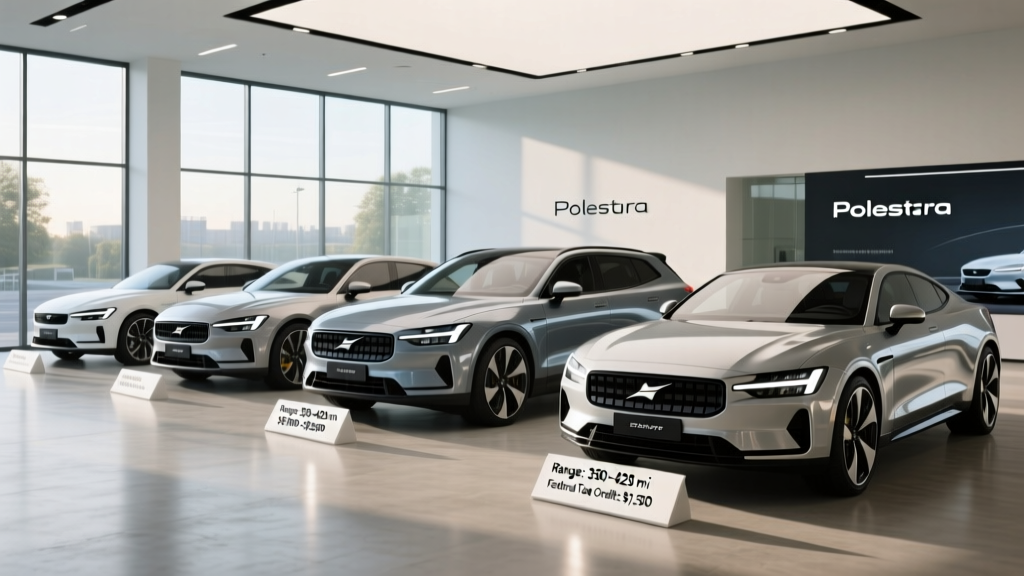
If you've searched for Polestar Detroit, you're likely exploring the Swedish-Chinese EV brand's growing presence in Michigan. Polestar operates a dedicated Space (showroom) in the Detroit metro area, giving local buyers hands-on access to a lineup that now spans three distinct models for 2026: the compact-fastback Polestar 2, the midsize SUV Polestar 3, and the sleek performance crossover Polestar 4. This guide covers the exact specs, real-world range expectations, charging performance, pricing, and federal tax credit eligibility for every model you can walk in and test-drive at the Detroit Polestar Space today.
2026 Polestar Lineup at a Glance: Spec Comparison
Before we get into the weeds on each model, here's the side-by-side data that matters most to EV buyers. All figures reflect the latest EPA and manufacturer data available for 2026 model-year vehicles.
| Spec | Polestar 2 (LRDM) | Polestar 3 (LRDM) | Polestar 4 (LRDM) |
|---|---|---|---|
| EPA Range | 320 mi | 315 mi | 300 mi |
| Battery (usable) | 79 kWh (NMC) | 107 kWh (NMC) | 94 kWh (NMC) |
| Peak DC Charge | 200 kW | 250 kW | 200 kW |
| 10–80% DC Time | ~27 min | ~30 min | ~28 min |
| Level 2 Rate | 11 kW (~37 mi/hr) | 11 kW (~33 mi/hr) | 11 kW (~31 mi/hr) |
| 0–60 mph | 5.8 sec | 4.8 sec | 4.7 sec |
| Horsepower | 421 hp | 517 hp | 544 hp |
| Drivetrain | AWD Dual-Motor | AWD Dual-Motor | AWD Dual-Motor |
| Efficiency (MPGe) | 107 MPGe | 89 MPGe | 95 MPGe |
| Cargo (rear seats up) | 14.4 cu ft | 25.7 cu ft | 18.3 cu ft |
| Base MSRP | $51,300 | $68,900 | $56,300 |
Source: fueleconomy.gov and Polestar USA specifications. RWD single-motor trims are also available for the Polestar 2 and 4 with higher range and lower pricing — see individual model sections below.
Polestar 2: The Entry Point for Detroit EV Buyers
The Polestar 2 remains the brand's most accessible model and the one most Detroit shoppers cross-shop against the Tesla Model 3, Hyundai Ioniq 6, and BMW i4. For 2026, the Long Range Dual Motor (LRDM) trim delivers 320 miles of EPA-estimated range from its 79 kWh NMC (nickel manganese cobalt) battery pack.
EPA sticker: 320 miles. In mixed highway driving at 70–75 mph, expect roughly 275–290 miles before needing a charge stop. In Michigan's winter (20–30°F), range can drop to 220–250 miles due to cabin heating demand and reduced battery efficiency, even with the Polestar 2's standard heat pump. City/regenerative driving yields results closer to or slightly above the EPA number.
Charging Performance
The Polestar 2 peaks at 200 kW on a DC fast charger, reaching 10–80% State of Charge in approximately 27 minutes under ideal thermal conditions. The charge curve is relatively flat through 50% SoC, then tapers noticeably above 80% — a common NMC behavior to protect cell longevity. If you're planning a road trip along I-75 to Traverse City, budget about 30 minutes per charge stop at an Electrify America or Tesla Supercharger (with NACS adapter).
At home on a Level 2 charger (240V, 48A circuit), the Polestar 2's 11 kW onboard charger adds roughly 37 miles of range per hour, meaning a full 10–100% charge takes about 8.5 hours overnight.
Interior, Tech & Practicality
The Polestar 2 runs a Google Android Automotive OS infotainment system with native Google Maps, Google Assistant, and over-the-air updates. The 11.2-inch portrait touchscreen is responsive, and the 12.3-inch digital driver display is clear in Detroit's harsh winter glare. Standard driver assistance includes adaptive cruise control, lane-keeping assist, and Pilot Pack (a Level 2 SAE system — not self-driving; the driver must remain engaged at all times).
Cargo space is 14.4 cu ft behind the rear seats with a hatchback liftgate that's practical for grocery runs in Ann Arbor or weekend gear. Rear legroom is 34.0 inches — adequate for adults on shorter trips but tighter than a Model Y. The optional Performance Pack ($5,500) adds Öhlins dampers, Brembo brakes, and 20-inch forged wheels, dropping the 0–60 time but reducing range by roughly 10–15 miles.
Polestar 2 Pricing & Tax Credit
| Trim | MSRP | §30D Credit Eligibility | Effective Price* |
|---|---|---|---|
| Standard Range SM | $46,800 | Check IRS sourcing rules | Varies |
| Long Range SM | $49,800 | Check IRS sourcing rules | Varies |
| Long Range DM | $51,300 | Check IRS sourcing rules | Varies |
*Effective price depends on your individual IRS §30D eligibility. The credit is up to $7,500 but is subject to battery component and critical mineral sourcing requirements, buyer income caps ($150K single / $300K joint AGI), and the $55,000 sedan MSRP cap. The Polestar 2 qualifies on MSRP for sedan limits. Point-of-sale transfer is available at participating dealers. Always confirm current eligibility with a tax professional before purchase.
Polestar 3: The Premium SUV for Michigan Families
The Polestar 3 is the brand's flagship SUV, positioned against the BMW iX, Audi Q8 e-tron, and Tesla Model X. For Detroit families needing three-across rear seating and serious cargo volume, this is the Polestar to test-drive.
The Long Range Dual Motor model packs a massive 107 kWh usable NMC battery — one of the largest in any consumer EV sold in the U.S. — delivering an EPA-estimated 315 miles of range despite the vehicle's 5,500+ lb curb weight.
EPA sticker: 315 miles. Highway cruising at 75 mph yields approximately 265–280 miles in mild weather. In sub-freezing Michigan winters, expect 210–240 miles — the large battery helps buffer cold-weather losses, but the SUV's aerodynamic drag and cabin-heating load are substantial. The heat pump is standard and reduces the winter penalty compared to resistance-heated EVs.
Charging the Big Battery
The Polestar 3 supports up to 250 kW DC fast charging — the highest rate in the Polestar lineup — and can reach 10–80% in approximately 30 minutes. That's impressive for a 107 kWh pack, sustained by an 800-volt-class electrical architecture that keeps charge rates high through the middle of the curve. At a 350 kW Electrify America station, you'll see peak rates near 240–250 kW in the 10–40% SoC window, tapering to ~120 kW by 70%.
Level 2 home charging at 11 kW adds about 33 miles per hour. A full overnight charge from 10% takes roughly 10 hours — plan your charging window accordingly if you're on a time-of-use utility rate with DTE Energy or Consumers Energy.
Space, Comfort & Driver Assists
Cargo volume behind the second row is 25.7 cu ft, expanding to over 50 cu ft with the 60/40 split rear seats folded. Rear legroom is a generous 38.2 inches. The available Bowers & Wilkins 25-speaker audio system and panoramic glass roof (with electrochromic dimming) give the cabin a premium feel that rivals the BMW iX.
The Polestar 3 offers the Pilot Pack with LiDAR (Luminar-sourced) as an option, providing enhanced mapping for highway driver-assist features. This remains a SAE Level 2 system — the driver must keep hands on or near the wheel and eyes on the road at all times. It does not make the vehicle autonomous.
Polestar 3 Pricing
The 2026 Polestar 3 LRDM starts at $68,900 before destination. With the Plus and Pilot packages, expect as-tested prices in the $78,000–$84,000 range. At this MSRP, the Polestar 3 falls under the IRS §30D $80,000 SUV MSRP cap, meaning it can potentially qualify for the full $7,500 credit if battery sourcing and buyer income requirements are met. A Performance Pack variant with 517 hp starts higher and may push close to or above the cap depending on options — verify with your Polestar Detroit Space advisor before configuring.
Polestar 4: The Design-Forward Performance Crossover
The Polestar 4 is the brand's most visually striking model, notable for its eliminated rear window — replaced by a high-definition camera feed displayed on the rearview mirror screen. It targets buyers who find the Model Y too common and want something with genuine design distinction.
The Long Range Dual Motor variant uses a 94 kWh NMC battery and produces 544 hp, rocketing to 60 mph in just 4.7 seconds. EPA-estimated range is 300 miles.
EPA sticker: 300 miles. Real-world highway driving nets approximately 255–270 miles in moderate temperatures. The Polestar 4's aggressive roofline and wide tires create more drag than the Polestar 2, so highway efficiency drops faster at speed. Winter range in Michigan: expect 200–230 miles.
Charging & Drivetrain
DC fast charging peaks at 200 kW, with a 10–80% time of approximately 28 minutes. The charge curve is similar to the Polestar 2's, with sustained high rates through 50% SoC. Home Level 2 charging at 11 kW adds roughly 31 miles per hour.
The dual-motor AWD system features torque vectoring on the rear axle, giving the Polestar 4 genuinely engaging handling on twisty roads — something you'll appreciate on M-14 between Ann Arbor and Detroit.
Cargo & the Rear-Window Question
Cargo space behind the second row is 18.3 cu ft, with a flat load floor. The camera-based rear "mirror" takes a few days to adjust to but offers a wider, unobstructed field of view than a conventional mirror, especially in rain or when cargo blocks the traditional sightline. Some buyers love it; others find the digital feed fatiguing on long drives. Test it thoroughly during your Polestar Detroit Space demo.
The Polestar 4 LRDM starts at $56,300. As a crossover/SUV classification, it falls under the $80,000 MSRP cap for §30D credit eligibility.
Federal Tax Credit (§30D) Eligibility for Polestar in 2026
Federal EV tax credit rules under IRS §30D are complex and change as battery sourcing supply chains evolve. Here's what Detroit-area buyers need to know:
- MSRP Caps: Sedans (Polestar 2) must be ≤$55,000; SUVs/crossovers (Polestar 3, 4) must be ≤$80,000. Options and destination charges count toward the cap.
- Buyer Income Limits: Modified AGI must not exceed $150,000 (single), $225,000 (head of household), or $300,000 (married filing jointly).
- Battery Sourcing: The credit is split into two halves — $3,750 for battery components manufactured in North America, and $3,750 for critical minerals sourced from the U.S. or FTA partners. Polestar's supply chain sourcing changes periodically; confirm current eligibility on the IRS clean vehicle report or with your dealer at purchase.
- Point-of-Sale Transfer: Eligible buyers can transfer the credit to the dealer at purchase, reducing the purchase price directly rather than waiting for a tax refund.
- VIN Verification: The dealer must provide a time-of-sale report confirming the vehicle's VIN meets all requirements.
Important: Polestar vehicles are manufactured in China (Polestar 2, 4) and China/Sweden (Polestar 3). Battery component and critical mineral sourcing compliance varies by model year and production batch. Always verify current eligibility on the DOE's fueleconomy.gov tax credit page before committing to a purchase. Consult a tax professional for your specific situation.
Detroit Ownership Practicalities: Charging, Service & Winter
Public Charging in Metro Detroit
Detroit's public charging infrastructure has expanded significantly. Electrify America stations along I-75, I-94, and I-96 cover road-trip corridors, and Tesla Superchargers (open to NACS-equipped vehicles or via adapter) provide additional coverage. Polestar vehicles use the CCS1 connector natively. If you frequently use Tesla Superchargers, you'll need the NACS adapter Polestar offers for newer models — confirm adapter availability with the Detroit Space for your specific model year.
Home Charging Setup
For any Polestar, we recommend a 48-amp Level 2 home charger on a dedicated 60-amp circuit. Expect installation costs of $800–$2,500 depending on whether your electrical panel needs an upgrade (many older Detroit-area homes have 100-amp panels that may require a $1,500–$3,000 upgrade to 200 amps). Polestar partners with ChargePoint and Wallbox for recommended home units.
Winter Driving & Battery Care
Michigan winters are the single biggest factor for Detroit Polestar owners. All three models include a heat pump (standard or included in the Plus package depending on trim), which significantly reduces range loss from cabin heating compared to resistive heaters. Preconditioning the battery while plugged in — using the Polestar app to warm the pack before departure — preserves range and improves regenerative braking performance in cold weather. Plan for 20–30% range reduction in sustained sub-freezing driving.
Warranty Coverage
Polestar provides a 4-year/50,000-mile limited vehicle warranty and an 8-year/100,000-mile battery warranty covering defects and capacity loss below 70% of original capacity. This battery warranty is competitive with Tesla, BMW, and Hyundai, though Hyundai's 10-year/100,000-mile powertrain coverage is longer. Roadside assistance is included for 4 years.
Pros, Cons & Verdict: Is a Polestar Right for You?
Pros
- Distinctive Scandinavian design — nothing else looks like a Polestar on I-94
- Google Android Automotive OS is fast, intuitive, and receives OTA updates
- Strong build quality and premium interior materials across all three models
- Heat pump standard/included — critical for Michigan winters
- Competitive DC fast-charge speeds, especially the Polestar 3 at 250 kW
- Available LiDAR-enhanced driver assist on Polestar 3
- Performance Pack options offer genuine track-capable dynamics
Cons
- CCS1 connector — NACS adapter needed for Tesla Supercharger access
- Limited service center network compared to Tesla; Detroit metro has one main location
- Polestar 2 rear seat is tighter than competitors (Model Y, Ioniq 5)
- Polestar 4's eliminated rear window is polarizing — not for everyone
- Tax credit eligibility uncertain due to China-manufactured battery sourcing
- Higher starting prices than comparable Hyundai/Kia EVs
- Brand awareness still low — expect questions from curious neighbors
Which Polestar Should Detroit Buyers Choose?
Choose the Polestar 2 if: You want an affordable-premium EV commuter with distinctive style, don't need massive cargo space, and your daily round-trip is under 80 miles.
Choose the Polestar 3 if: You need a family SUV with three-across seating, serious cargo room, maximum range for Michigan road trips, and are willing to pay $70K+ for a premium experience.
Choose the Polestar 4 if: You prioritize design and performance above all else, find the Model Y too ubiquitous, and want a fast crossover that turns heads at every stoplight on Woodward Avenue.
Frequently Asked Questions
What is the real-world range of Polestar EVs in Michigan winters?
Expect a 20–30% reduction from EPA estimates in sustained sub-freezing temperatures. The Polestar 2 LRDM drops from 320 to roughly 220–250 miles; the Polestar 3 from 315 to 210–240 miles; the Polestar 4 from 300 to 200–230 miles. Preconditioning while plugged in mitigates some of this loss.
How fast do Polestar models charge at home and on the road?
All three models accept 11 kW on Level 2 (adding 31–37 miles per hour overnight). DC fast charging ranges from 200 kW (Polestar 2 and 4) to 250 kW (Polestar 3), with 10–80% times of 27–30 minutes under ideal conditions.
Does Polestar qualify for the $7,500 federal EV tax credit?
Eligibility depends on current IRS §30D rules, including battery component sourcing, critical mineral origin, buyer income, and MSRP caps. Because Polestar vehicles are manufactured in China, battery sourcing compliance varies. Check fueleconomy.gov and consult a tax professional before purchase.
Is there a Polestar service center in Detroit?
Polestar operates a Space (showroom and service point) in the Detroit metro area. Mobile service and roadside assistance are also available. Service network density is lower than Tesla or legacy luxury brands — factor this into your ownership decision if you live outside the immediate metro area.
Can I use Tesla Superchargers with a Polestar?
Polestar models use the CCS1 connector natively. Tesla has opened select Superchargers to non-Tesla EVs via the built-in Magic Dock adapter, and Polestar offers a NACS adapter for newer models. Confirm adapter compatibility with your specific model year at the Detroit Space.
Is Polestar's driver-assist system self-driving?
No. Polestar's Pilot Pack and available LiDAR-enhanced systems are SAE Level 2 driver-assistance features. The driver must remain fully engaged, with hands on or near the steering wheel and eyes on the road. No consumer Polestar vehicle is autonomous or self-driving.