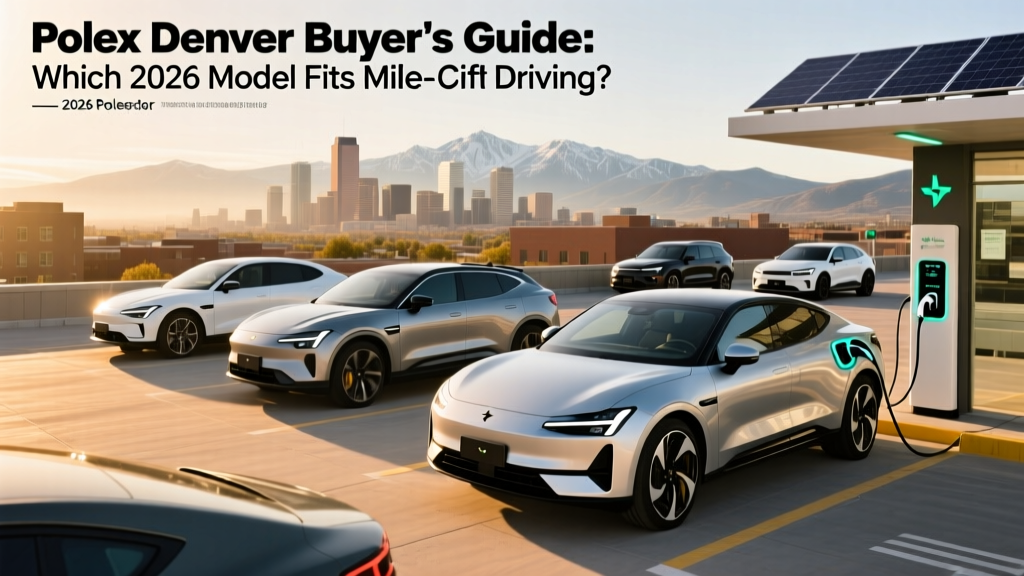
Why Denver Drivers Are Looking at Polestar in 2026
Denver's EV market has matured quickly. With over 1,200 public charging ports across the metro area and Colorado's state EV tax credit stacked on top of federal incentives, the question for local buyers has shifted from "can I own an EV here?" to "which one handles the Front Range best?" Polestar — the Volvo-Geely-backed EV brand — offers three distinct models in the US for 2026, and each answers that question differently depending on whether your week involves I-25 commutes, weekend ski runs to Breckenridge, or cargo-heavy Costco runs in Lakewood.
This guide breaks down the 2026 Polestar lineup through the lens of a Denver owner: real-world range at altitude and in cold weather, DC fast-charging speed along the I-70 corridor, AWD capability for snow, and what you'll actually pay after the IRS §30D federal tax credit and Colorado incentives.
The 2026 Polestar Lineup at a Glance
| Spec | Polestar 2 (LRDM) | Polestar 3 LRDM | Polestar 4 LRDM |
|---|---|---|---|
| EPA Range | 320 mi | 315 mi (est.) | 300 mi (est.) |
| Battery (usable) | 79 kWh NMC | 107 kWh NMC | 100 kWh NMC |
| Drivetrain | Dual Motor AWD | Dual Motor AWD | Dual Motor AWD |
| Horsepower | 421 hp | 489 hp | 544 hp |
| 0–60 mph | 4.3 sec | 4.7 sec | 3.8 sec |
| Peak DC Charge | 205 kW | 250 kW | 200 kW |
| 10–80% DC Time | ~27 min | ~25 min | ~28 min |
| Level 2 Rate | 11 kW (~37 mi/hr) | 11 kW (~38 mi/hr) | 11 kW (~34 mi/hr) |
| MPGe (combined) | 100 MPGe | 89 MPGe (est.) | 92 MPGe (est.) |
| Cargo Volume | 14.4 cu ft + 1.4 frunk | 17.1 cu ft + 1.1 frunk | 16.2 cu ft + 0.8 frunk |
| Base MSRP (LRDM) | $54,300 | $74,900 | $61,200 |
| Battery Warranty | 8 yr / 100,000 mi | 8 yr / 100,000 mi | 8 yr / 100,000 mi |
Source: Polestar US spec sheets and fueleconomy.gov. Estimates noted where final EPA certification is pending for 2026 model year.
Real-World Range: What Denver's Altitude and Cold Actually Do
The EPA sticker is a starting point, not a guarantee. For the Polestar 2 Long Range Dual Motor, the 320-mile EPA figure assumes moderate temperatures and mixed driving. In Denver's dry, cold winters (average January low: 18°F), battery chemistry — specifically the NMC (nickel manganese cobalt) cells Polestar uses across its lineup — loses efficiency. The battery management system reserves energy for thermal preconditioning, and cabin heating draws from the pack unless you've preconditioned while plugged in.
On a typical Denver-to-Vail run (106 miles, 4,700 ft elevation gain), a Polestar 3 with its 107 kWh pack will arrive with roughly 35–40% state of charge in summer, but closer to 20–25% in February. The larger battery in the Polestar 3 provides a meaningful buffer for mountain driving that the Polestar 2's 79 kWh pack can't match without a charging stop in Silver Plume.
Practical Denver range expectations (AWD trims):
- Polestar 2 LRDM: ~270 mi summer mixed / ~240 mi winter mixed / ~220 mi cold highway
- Polestar 3 LRDM: ~275 mi summer mixed / ~240 mi winter mixed / ~215 mi cold highway
- Polestar 4 LRDM: ~265 mi summer mixed / ~230 mi winter mixed / ~210 mi cold highway
Charging Speed and Infrastructure: From Home to I-70
Polestar uses the CCS1 connector standard across its 2026 US lineup, which matters for Denver buyers: the city has robust Electrify America, EVgo, and ChargePoint DC fast-charger coverage, all CCS-compatible. Tesla Superchargers with Magic Dock adapters are also accessible, though peak speeds may be limited by the adapter handshake.
| Charging Level | Power | Miles Added/Hour | Use Case |
|---|---|---|---|
| Level 1 (120V) | 1.4 kW | ~4 mi/hr | Emergency / overnight trickle |
| Level 2 (240V, 48A) | 11 kW | ~34–38 mi/hr | Home daily charging |
| DC Fast (Polestar 2) | Peak 205 kW | ~180 mi in 15 min | Road trips, I-70 corridor |
| DC Fast (Polestar 3) | Peak 250 kW | ~210 mi in 15 min | Road trips, mountain passes |
| DC Fast (Polestar 4) | Peak 200 kW | ~170 mi in 15 min | Road trips, I-25 corridor |
Charging curve reality: Peak kW is not sustained. The Polestar 3's 250 kW peak holds from roughly 10–35% state of charge, then tapers to ~150 kW through 60%, and drops sharply above 80%. If you're charging at the Electrify America station in Wheat Ridge on a cold morning, preconditioning the battery via the Polestar app 20 minutes before arrival will unlock faster peak rates. Skip this step, and your first 10 minutes may average under 80 kW as the pack warms.
For Denver home charging, most Polestar owners install a 48-amp Level 2 charger on a 60-amp circuit. Expect $800–$2,200 for installation depending on panel proximity and whether your home's 200-amp service needs an upgrade — a common requirement in older Denver bungalows and Capitol Hill condos.
Performance and AWD: Built for Snow and Elevation
All three Polestar models offer dual-motor AWD, which is non-negotiable for Denver buyers who drive west on I-70 or navigate unplowed side streets after a March blizzard. The dual-motor setup provides torque vectoring that outperforms traditional mechanical AWD in low-traction scenarios, with instant torque distribution between axles.
The Polestar 4 is the performance standout: 544 hp and a 3.8-second 0–60 time make it the quickest Polestar available, though its firmer suspension tuning trades some ride comfort for cornering composure on twisty canyon roads like Lookout Mountain Road. The Polestar 3 prioritizes comfort with adaptive air suspension (optional on Performance Pack trims), which smooths out Denver's frost-heave pavement and provides adjustable ride height for snow clearance.
The Polestar 2 remains the value performance pick: 421 hp, 4.3-second 0–60, and a lower center of gravity from its sedan/fastback form factor. It's the most efficient of the three and the easiest to park in LoDo garages.
Driver assistance note: Polestar's Pilot Pack includes adaptive cruise, lane-centering, and blind-spot intervention — all SAE Level 2 systems requiring active driver supervision. This is not autonomous driving. The system performs well on I-25 but requires hands-on-wheel engagement and will disengage in construction zones or faded lane markings common on Colorado highways.
Pricing, Tax Credits, and Total Cost
| Model / Trim | Base MSRP | Federal §30D Credit* | CO State Credit** | Effective Price |
|---|---|---|---|---|
| Polestar 2 LRDM | $54,300 | Up to $7,500 | Up to $5,000 | ~$41,800 |
| Polestar 3 LRDM | $74,900 | Up to $7,500 | Up to $5,000 | ~$62,400 |
| Polestar 4 LRDM | $61,200 | Up to $7,500 | Up to $5,000 | ~$48,700 |
*Federal §30D credit rules (2026): Eligibility depends on three factors — buyer income caps ($150K single / $300K joint AGI), vehicle MSRP caps ($55K for sedans like Polestar 2; $80K for SUVs like Polestar 3 and 4), and battery critical-mineral and component sourcing requirements that phase in annually. The Polestar 2's sedan MSRP cap of $55K means higher trims or optioned builds may exceed the threshold. Point-of-sale transfer is available, reducing your dealer price directly. Always verify current eligibility at irs.gov and consult a tax professional.
**Colorado state credit: Colorado offers an innovative motor vehicle tax credit for EVs; amounts and income tiers vary by vehicle price and buyer income. Check the Colorado Energy Office for current-year specifics before purchase.
Interior, Tech, and Daily Livability
Polestar's interior philosophy is Scandinavian minimalism: vegan upholstery, recycled materials, and a portrait-oriented 14.5-inch infotainment screen running Google built-in (Maps, Assistant, Play Store). The Google Maps integration is particularly strong for EV routing — it factors in elevation changes, which matters enormously for Denver-to-mountain trips where a 5,000-foot climb can consume 30% more energy than the same distance on flat terrain.
Cargo and space: The Polestar 2's fastback design limits rear headroom for taller passengers (38.0 inches) and cargo volume to 14.4 cubic feet — adequate for groceries and carry-ons, tight for ski gear. The Polestar 3 and 4 offer SUV-proportioned cabins with 40+ inches of rear legroom and hatchback cargo areas that swallow four sets of skis with seats folded.
Notable tech: Polestar's over-the-air updates have improved charging curve management and battery preconditioning logic through 2025–2026, a tangible ownership benefit. The optional Bowers & Wilkins audio and head-up display are well-integrated, though the lack of physical climate controls (all touchscreen) frustrates some drivers during gloved winter use.
Who Should Buy Which Polestar in Denver?
Choose Polestar 2 If:
- Your budget is under $55K before credits
- You commute solo or with one passenger
- Efficiency matters more than cargo space
- You want the lowest effective price after credits
Choose Polestar 3 If:
- You need SUV cargo for family/ski gear
- You drive I-70 to the mountains frequently
- Air suspension comfort is a priority
- Budget allows $70K+ before credits
Choose Polestar 4 If:
- Performance (3.8s 0–60) is your priority
- You want SUV utility with sports-sedan acceleration
- You value the unique rear-camera digital mirror
- Budget sits in the $60K range
Polestar Denver FAQ
Does Polestar have a Denver service center?
Polestar operates a service point in the Denver metro area, with mobile service available for minor repairs and software updates. Major warranty work may require travel to the nearest full-service Polestar facility. Check current service locations on Polestar's US site before purchasing if dealer proximity is a concern.
How does altitude affect Polestar range?
EVs actually gain slight efficiency at altitude due to reduced aerodynamic drag in thinner air. However, Denver's cold winters and mountain elevation gains (which require sustained high-power output uphill) offset this advantage. Expect net range similar to sea-level driving in summer, and reduced range in winter.
Can I charge a Polestar at Tesla Superchargers in Colorado?
Polestar uses CCS1 connectors. Tesla Superchargers with Magic Dock adapters can charge CCS vehicles, but availability varies by station and peak speeds may be limited. For reliable fast charging along I-70, Electrify America and EVgo stations in Georgetown, Silverthorne, and Vail are CCS-native and consistently available.
Is the Polestar 2 eligible for the full $7,500 federal tax credit?
Eligibility depends on your AGI, the specific trim's MSRP relative to the $55K sedan cap, and battery sourcing compliance for the 2026 model year. Lower trims typically qualify; fully optioned builds may exceed the MSRP cap. Verify at irs.gov and confirm with your dealer before purchase.
What's the battery warranty on a 2026 Polestar?
All 2026 Polestar models carry an 8-year / 100,000-mile battery and powertrain warranty, covering defects and capacity loss below 70% state of health. This is competitive with Volvo, BMW, and Tesla's standard coverage.