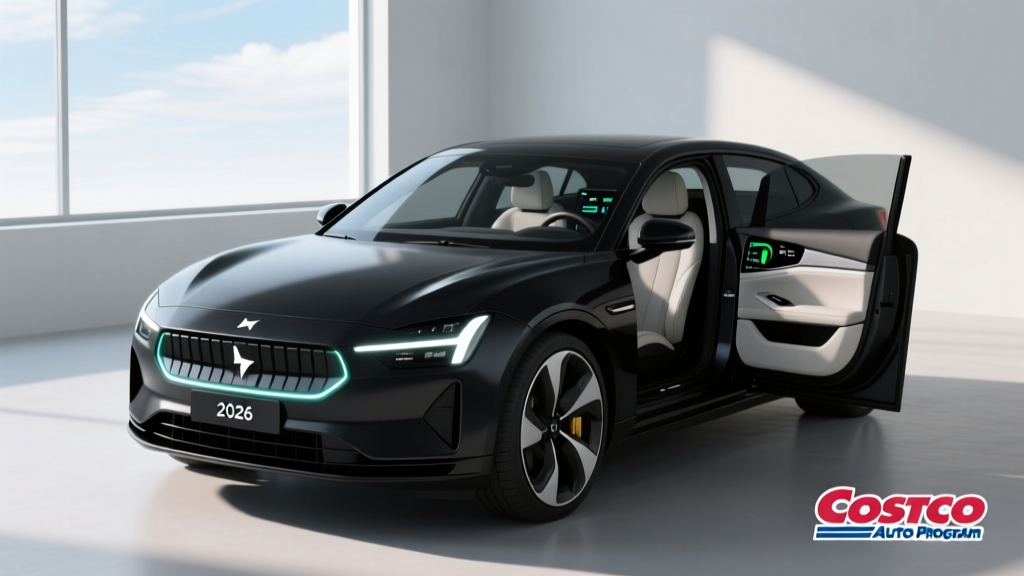
If you've been searching for a Polestar Costco deal, you're not alone. The Costco Auto Program has become one of the most popular ways for EV buyers to negotiate pricing without the dealership runaround — and Polestar, with its direct-to-consumer sales model, presents a unique case. In this 2026 review, we'll break down exactly how the Costco Auto Program applies to Polestar's lineup (primarily the Polestar 4), what you can expect to pay, and whether the savings are real — all while delivering the full technical profile of the vehicle itself.
How the Polestar Costco Auto Program Actually Works
Costco's Auto Program partners with participating dealerships to offer pre-negotiated pricing to Costco members. However, Polestar operates differently from legacy automakers: it sells primarily through its own website and a network of "Polestar Spaces" (not traditional franchised dealers). As of early 2026, Polestar does not have a formal nationwide partnership with the Costco Auto Program the way brands like Toyota, Ford, or GM do.
That said, some regional Polestar Spaces or authorized service/delivery partners may participate informally or through third-party broker arrangements that Costco members can access. The practical path for most Costco members looking at a Polestar is:
- Check the Costco Auto Program website (costcoauto.com) and search for Polestar in your ZIP code — availability varies by region and changes quarterly.
- Stack incentives: Even without a Costco-specific discount, you can combine the federal §30D tax credit (up to $7,500 at point of sale), state/local rebates, and Polestar's own promotional offers (lease bonuses, loyalty credits).
- Use Costco's member-only insurance and financing referrals as leverage, even if the vehicle purchase itself isn't through the program.
The bottom line: don't expect a flat "$1,000 off MSRP" Costco coupon for a Polestar 4. But membership can still help you save through indirect channels. Let's focus on what matters most — the car itself and its true cost.
2026 Polestar 4: Range, Battery, and Real-World Efficiency
The 2026 Polestar 4 is the brand's midsize electric SUV-coupe, positioned against the Tesla Model Y, BMW iX, and Genesis Electrified GV70. It rides on the SEA (Sustainable Experience Architecture) platform shared with the Volvo EX30 and Zeekr 001.
| Spec | Polestar 4 Long Range Single Motor | Polestar 4 Long Range Dual Motor |
|---|---|---|
| EPA Range | 300 miles | 270 miles |
| Battery (usable) | 100 kWh (NMC) | 100 kWh (NMC) |
| Drivetrain | RWD | AWD (dual motor) |
| Horsepower | 272 hp | 544 hp |
| 0–60 mph | 7.1 sec | 3.8 sec |
| MPGe (combined) | 102 MPGe | 89 MPGe |
| kWh/100 mi | 33 kWh | 38 kWh |
The 100 kWh NMC (nickel manganese cobalt) pack provides strong energy density but is heavier than an LFP alternative. Polestar does not currently offer an LFP variant of the 4. NMC chemistry supports faster DC charging and higher performance but benefits from keeping state of charge between 20–80% for daily use to maximize longevity.
Charging Speed: DC Fast Charging and Home Level 2
Charging capability is where the Polestar 4 holds its own against rivals. Here are the hard numbers:
| Charging Level | Power / Rate | Speed |
|---|---|---|
| Level 1 (120V household) | ~1.4 kW | ~4 miles per hour |
| Level 2 (240V home) | 11 kW (onboard charger) | ~30 miles per hour; full charge in ~10 hours |
| DC Fast Charge (CCS) | Peak 200 kW | 10–80% in ~30 minutes |
| DC Fast Charge (NACS w/ adapter) | Peak ~150 kW (adapter-limited) | 10–80% in ~38 minutes |
The 200 kW peak DC rate is competitive but not class-leading — the Hyundai Ioniq 5 peaks at 240 kW and the Tesla Model Y at 250 kW. More importantly, the Polestar 4's charge curve tapers noticeably above 60% SoC. In real-world DC fast charging, you'll see 200 kW only in the 10–30% window; by 50%, it drops to roughly 130 kW, and above 80% it slows to under 50 kW. This is standard NMC behavior, but it means the advertised "30 minutes to 80%" is accurate only under ideal conditions (preconditioned battery, moderate ambient temperature, a charger capable of sustained 200+ kW output).
Home charging tip: The 11 kW onboard charger means you'll want a 48-amp Level 2 home charger on a 60-amp circuit to unlock the full charge rate. A standard 32-amp Level 2 unit (like many included with EV purchases) will charge at ~7.7 kW, adding roughly 21 miles per hour — still sufficient for overnight charging.
Pricing, Tax Credits, and True Cost of Ownership
The 2026 Polestar 4 starts at a competitive price point for the premium electric SUV segment. Here's the trim breakdown:
| Trim | MSRP | Est. Federal Credit (§30D) | Effective Price |
|---|---|---|---|
| Long Range Single Motor (Core) | $54,990 | Up to $7,500 | ~$47,490 |
| Long Range Single Motor (Plus) | $59,990 | Up to $7,500 | ~$52,490 |
| Long Range Dual Motor (Plus) | $64,990 | Up to $7,500 | ~$57,490 |
| Long Range Dual Motor (Performance Pack) | $69,990 | Up to $7,500 | ~$62,490 |
Federal §30D tax credit eligibility — critical caveats:
- MSRP cap: SUVs must be under $80,000 MSRP. All Polestar 4 trims qualify.
- Buyer income cap: AGI must not exceed $150,000 (single), $225,000 (head of household), or $300,000 (joint). Verify against your current-year tax situation.
- Battery sourcing: The §30D credit is split into two halves — $3,750 for critical minerals and $3,750 for battery component assembly. As of 2026, Polestar (manufactured in China via Geely's SEA platform) faces challenges meeting the domestic-content and FEOC (foreign entity of concern) sourcing requirements. Check the latest IRS qualified vehicles list before purchasing — eligibility can change with model-year battery sourcing updates.
- Point-of-sale transfer: If eligible, you can transfer the credit to the dealer at purchase, reducing your out-of-pocket cost immediately rather than waiting for tax filing.
For a complete picture, consult the EPA's fueleconomy.gov listing for the Polestar 4 and verify current credit status with a tax professional.
Interior, Cargo, and Daily Practicality
The Polestar 4's coupe-SUV silhouette creates a distinctive design but imposes real trade-offs in cargo utility compared to boxier competitors:
- Cargo volume (behind rear seats): ~19.0 cu ft — noticeably less than the Tesla Model Y (30.2 cu ft) or Hyundai Ioniq 5 (27.2 cu ft)
- Cargo volume (rear seats folded): ~50.0 cu ft
- Front trunk (frunk): None — the SEA platform's front motor area (in dual-motor) and electronics packaging eliminate frunk space
- Rear legroom: ~37.8 inches — adequate for adults but tighter than the Model Y (41.6 in)
- Rear headroom: The sloping roofline cuts headroom for passengers over 6 feet
The cabin materials are premium — vegan upholstery, recycled aluminum trim, and a minimalist Scandinavian aesthetic. The 15.4-inch center touchscreen runs Polestar's Android Automotive OS (Google built-in), which provides native Google Maps navigation, Google Assistant, and access to the Play Store for apps like Spotify and PlugShare.
Notable tech: The Polestar 4 replaces the traditional rear window with a digital rearview mirror fed by a roof-mounted camera. This improves the aerodynamic profile but takes adjustment — some drivers find the latency and fixed focal distance disorienting initially. A conventional rear glass is not offered.
Driver Assistance and Safety
The Polestar 4 comes equipped with the Polestar Pilot Assist suite — a Level 2 driver-assistance system per SAE classification. It includes:
- Adaptive cruise control with stop-and-go
- Lane centering assist
- Blind-spot monitoring with rear cross-traffic alert
- Automatic emergency braking (front, rear, pedestrian, cyclist)
- 360-degree surround camera
The Polestar 4 has not yet been crash-tested by the NHTSA or IIHS at the time of this writing (early 2026). Given Volvo/Polestar's strong historical safety performance, strong ratings are anticipated but not confirmed.
Warranty and Battery Longevity
Polestar provides warranty coverage in line with the premium EV segment:
- Basic vehicle warranty: 4 years / 50,000 miles
- Battery & powertrain warranty: 8 years / 100,000 miles (covers battery capacity retention above 70% of original)
- Corrosion warranty: 12 years, unlimited mileage
- Roadside assistance: 4 years / unlimited mileage
The 70% capacity retention threshold over 8 years is standard for the segment (Tesla uses the same benchmark). Based on NMC degradation data from similar SEA-platform vehicles, expect approximately 8–12% total capacity loss over the first 100,000 miles under normal use patterns — meaning a 300-mile EPA vehicle would still deliver roughly 265–275 miles at the 8-year mark. Avoiding repeated DC fast charging above 90% SoC and frequent deep discharges below 10% will extend battery life.
Pros, Cons, and the Verdict
- Striking coupe-SUV design with premium Scandinavian interior
- 544 hp dual-motor variant is genuinely fast (3.8 sec 0–60)
- Google Android Automotive OS is responsive and well-integrated
- Competitive 300-mile EPA range (single motor)
- All trims under the $80K §30D MSRP cap
- Significantly less cargo space than Model Y or Ioniq 5
- No frunk — a miss at this price point
- Digital rearview mirror requires adaptation
- 200 kW peak DC charge rate trails segment leaders
- §30D credit eligibility uncertain due to China manufacturing and FEOC sourcing rules
- Limited service center network vs. Tesla or legacy brands
Who Should Buy the Polestar 4?
- Choose the Polestar 4 if: You want a distinctive, design-forward electric SUV that stands apart from the Model Y ubiquity; you value Scandinavian minimalism and Google-native tech; your daily commute is under 100 miles round-trip; you don't regularly haul bulky cargo or rear-seat passengers over 6 feet.
- Look elsewhere if: Maximum cargo utility is a priority (Model Y, Ioniq 5); you need hands-free highway driving (GM Super Cruise, Ford BlueCruise); you live in an area without a nearby Polestar Space for service; you require guaranteed full $7,500 federal credit eligibility (consider domestically assembled alternatives).
Frequently Asked Questions
Can I actually buy a Polestar through Costco in 2026?
Polestar does not have a formal nationwide Costco Auto Program partnership. Some regional partners may participate, but availability is inconsistent. Check costcoauto.com for your ZIP code, but plan to purchase directly through Polestar's website or a Polestar Space regardless.
What is the real-world range of the Polestar 4?
The EPA rates the single-motor Polestar 4 at 300 miles. Expect 255–275 miles in real-world highway driving and 220–240 miles in freezing temperatures. The dual-motor AWD variant is rated at 270 miles EPA with proportionally lower real-world figures.
Does the Polestar 4 qualify for the $7,500 federal EV tax credit?
All trims are under the $80,000 SUV MSRP cap. However, battery-sourcing and FEOC (foreign entity of concern) rules may reduce or eliminate eligibility since the Polestar 4 is manufactured in China. Always check the current IRS qualified vehicle list before committing to a purchase.
How fast does the Polestar 4 charge at home and on the road?
At home on a 240V Level 2 charger, the 11 kW onboard charger adds roughly 30 miles per hour (full charge in ~10 hours). On a DC fast charger, it peaks at 200 kW and reaches 10–80% in approximately 30 minutes under ideal conditions.
Is the Polestar 4 worth it versus the Tesla Model Y?
The Polestar 4 offers more distinctive design and a more premium interior, but the Model Y provides significantly more cargo space, access to the Supercharger network (without adapters), faster DC charging, and a more established service network. If design exclusivity and cabin quality matter more than utility, the Polestar 4 is compelling. If practicality and charging convenience are paramount, the Model Y remains the segment benchmark.