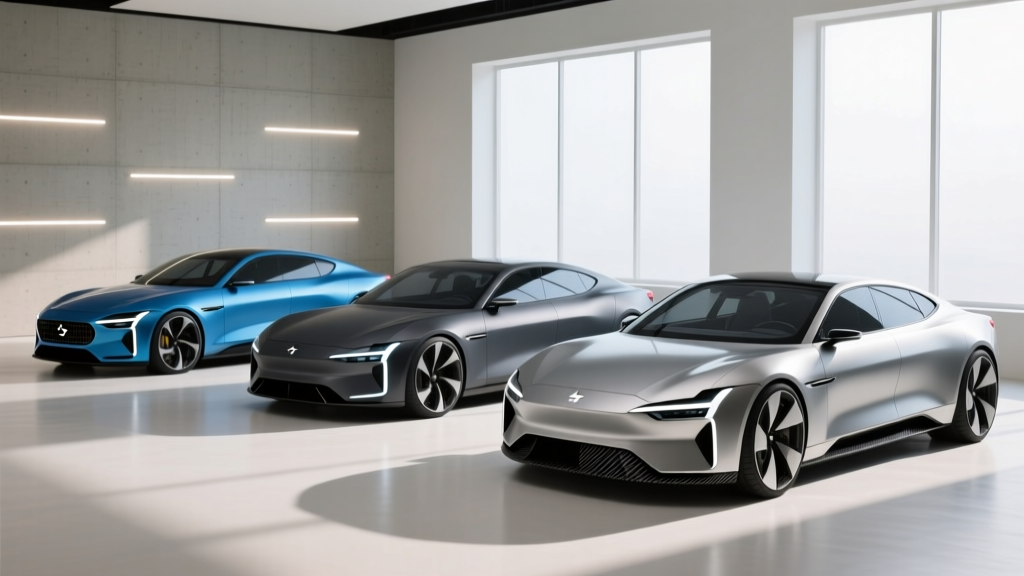
Polestar has built its brand on the gap between the auto-show floor and the dealership lot. Since spinning off from Volvo, the Swedish-Chinese automaker has unveiled a string of striking Polestar concept vehicles — from the original Precept show car to the striking O₂ roadster and the production-intent Polestar 4 sedan-SUV. For EV shoppers in 2026, the practical question isn't which concept looks best on Instagram; it's which ones you can actually buy, what they cost after federal incentives, and whether their real-world range and charging speeds justify the premium badge.
This guide tracks every major Polestar concept from reveal to reality, with the exact numbers buyers need: EPA range, usable battery kWh, peak DC charge rates, 10-80% minutes, MSRP by trim, and IRS §30D tax-credit eligibility under current 2026 rules.
From Concept to Curb: Polestar's Lineup Explained
Polestar's design language traces directly to two concept cars. The Precept, shown in early 2020, previewed the sleek fastback sedan that became the Polestar 4. The O₂, unveiled in March 2022, teased a retractable-hardtop roadster that Polestar later confirmed as the forthcoming Polestar 6. Meanwhile, the production Polestar 2 (the brand's volume seller) and Polestar 3 (its luxury SUV) drew from earlier design studies rather than single named concepts.
As of 2026, here is what is actually on sale versus what remains in the pipeline:
- Available now: Polestar 2 (sedan/fastback), Polestar 3 (SUV), Polestar 4 (coupe-SUV)
- Announced, not yet on sale: Polestar 6 (roadster, expected ~2027 model year), Polestar 7 (compact SUV, announced for 2028+)
- Concept-only (no production confirmed): Polestar Synergy (2023 design study)
Let's break down the buyable models with full specs.
Polestar 4: The Precept Concept Brought to Production
The Polestar 4 is the closest thing on the road to a production Precept. It drops the rear window entirely — replaced by a high-def camera feed displayed on a screen behind the steering wheel — and rides on Geely's SEA platform with an 800-volt electrical architecture.
| Attribute | Long Range Single Motor | Long Range Dual Motor |
|---|---|---|
| EPA Range | 300 mi (est.) | 270 mi (est.) |
| Battery (usable) | 100 kWh, NMC | 100 kWh, NMC |
| Peak DC Fast Charge | 200 kW | 200 kW |
| 10–80% DC Time | ~29 min | ~29 min |
| Level 2 Home Rate | 11 kW (~35 mi/hr) | 11 kW (~35 mi/hr) |
| Horsepower | 272 hp | 544 hp |
| 0–60 mph | 7.1 sec | 3.8 sec |
| Drivetrain | RWD | AWD (dual motor) |
| Efficiency | ~105 MPGe (32 kWh/100mi) | ~93 MPGe (36 kWh/100mi) |
| Cargo (behind rear seats) | 18.6 cu ft | 18.6 cu ft |
| Rear Legroom | 38.4 in | 38.4 in |
| Base MSRP | $56,900 | $62,900 |
Polestar 2 and Polestar 3: Specs That Matter in 2026
The Polestar 2 received a substantial refresh for the 2024 model year (new rear-wheel-drive base option, larger battery) and carries forward into 2026. The Polestar 3, a midsize luxury SUV aimed at the BMW iX and Audi Q8 e-tron, entered US deliveries in late 2024 and is now widely available.
| Model | EPA Range | Battery | Peak DC kW | 10–80% | 0–60 | Base MSRP |
|---|---|---|---|---|---|---|
| Polestar 2 Standard Range SM | 276 mi | 69 kWh (NMC) | 135 kW | ~30 min | 7.0 sec | $49,950 |
| Polestar 2 Long Range SM | 320 mi | 82 kWh (NMC) | 155 kW | ~28 min | 6.2 sec | $52,950 |
| Polestar 2 Long Range DM | 298 mi | 82 kWh (NMC) | 155 kW | ~28 min | 4.3 sec | $56,950 |
| Polestar 3 LR Dual Motor | 315 mi | 111 kWh (NMC) | 250 kW | ~30 min | 5.0 sec | $79,900 |
| Polestar 3 LR DM Performance | 300 mi | 111 kWh (NMC) | 250 kW | ~30 min | 4.7 sec | $84,900 |
| Polestar 4 LR SM | 300 mi (est.) | 100 kWh (NMC) | 200 kW | ~29 min | 7.1 sec | $56,900 |
| Polestar 4 LR DM | 270 mi (est.) | 100 kWh (NMC) | 200 kW | ~29 min | 3.8 sec | $62,900 |
Sources: fueleconomy.gov (EPA data for Polestar 2/3), Polestar USA specifications pages.
Charging Deep Dive: What 800V Actually Gets You
The Polestar 4's 800-volt architecture is its most consequential technical advantage over the Polestar 2 (400V). Here's what that means at a public DC fast charger:
| Model | Architecture | Peak DC kW | 10–80% Time | Avg Sustained kW (10–60%) | Level 2 Rate |
|---|---|---|---|---|---|
| Polestar 2 (all trims) | 400V | 135–155 kW | 28–30 min | ~110–120 kW | 11 kW |
| Polestar 3 | 400V | 250 kW | ~30 min | ~170 kW | 11 kW |
| Polestar 4 | 800V | 200 kW | ~29 min | ~175 kW | 11 kW |
Key nuance: Peak kW is a headline number; sustained charge rate matters more on road trips. The Polestar 4's 800V system holds a flatter charge curve through the 10–60% state-of-charge window, meaning real highway stops are competitive with the Polestar 3's higher peak figure. All three models taper charging significantly above 80% SoC — a universal lithium-ion behavior to protect cell longevity. For daily driving, a home Level 2 charger at 11 kW adds roughly 35 miles of range per hour, fully replenishing any Polestar overnight on a 40-amp or 48-amp circuit.
Connector note: All 2026 Polestar models sold in the US use the NACS (Tesla-style) charge port, granting native access to Tesla Superchargers without an adapter. CCS adapters are included for legacy networks.
Pricing, Trims, and Federal Tax Credit Eligibility
Here's where the math gets specific. Under current IRS §30D rules for 2026, the federal clean vehicle credit offers up to $7,500 — but eligibility hinges on three moving targets:
- MSRP cap: Sedans and fastbacks (Polestar 2, Polestar 4) must have an MSRP at or below $55,000. SUVs and trucks (Polestar 3) qualify up to $80,000.
- Buyer income cap: Modified AGI must not exceed $150,000 (single), $225,000 (head of household), or $300,000 (joint).
- Battery sourcing: A percentage of critical minerals and battery components must meet North American/free-trade-partner sourcing thresholds, which tighten annually. The dollar amount of credit depends on meeting one or both sourcing requirements ($3,750 each).
| Model / Trim | Base MSRP | Under MSRP Cap? | Est. Max Credit | Effective Price (if eligible) |
|---|---|---|---|---|
| Polestar 2 Std Range SM | $49,950 | Yes ($55K cap) | Up to $7,500 | ~$42,450 |
| Polestar 2 Long Range SM | $52,950 | Yes | Up to $7,500 | ~$45,450 |
| Polestar 2 Long Range DM | $56,950 | No (over $55K) | $0 | $56,950 |
| Polestar 3 LR Dual Motor | $79,900 | Yes ($80K SUV cap) | Up to $7,500 | ~$72,400 |
| Polestar 3 Performance | $84,900 | No (over $80K) | $0 | $84,900 |
| Polestar 4 LR SM | $56,900 | No (over $55K)* | $0 | $56,900 |
| Polestar 4 LR DM | $62,900 | No | $0 | $62,900 |
*Polestar 4 classification note: The 4 is a coupe-SUV; if the IRS classifies it as an SUV (based on GVWR and body style), the $80,000 cap would apply. Check fueleconomy.gov for the definitive IRS classification before purchasing, as this determines credit eligibility.
Point-of-sale transfer: As of 2024 and continuing in 2026, eligible buyers can transfer the credit to the dealer at purchase, reducing the out-of-pocket price immediately rather than waiting for tax filing. Confirm eligibility with your tax professional — the credit is non-refundable and depends on your tax liability.
Technology, Driver Assistance, and Interior
All 2026 Polestar models run Polestar OS, built on Android Automotive with Google Maps, Google Assistant, and the Play Store embedded natively. The 15.4-inch landscape touchscreen (Polestar 3/4) or 11.2-inch portrait screen (Polestar 2) handles climate, navigation, and media without phone dependency.
Driver assistance (SAE Level 2): Polestar's Pilot Pack includes adaptive cruise control with lane-centering steering assist, automated emergency braking, blind-spot intervention, and Pilot Assist for highway use. This is a Level 2 system per SAE definitions — the driver must remain fully engaged with hands on or near the wheel and eyes on the road at all times. It is not autonomous or "self-driving."
Standout features:
- Polestar 4's rear-camera "digital mirror" eliminates the rear blind spot from a traditional window while enabling a lower roofline
- Polestar 3 includes a LiDAR sensor (from Luminar) on vehicles equipped with the Pilot Pack, enabling future over-the-air feature upgrades
- All models support over-the-air software updates for powertrain, infotainment, and ADAS calibration
- Polestar 2 and 4 offer a plus pack with Harman Kardon audio, panoramic roof, and heat pump standard on most trims
Notable drawbacks:
- Polestar 2 rear-seat headroom is tight for passengers over 6'1" (37.8 in) due to the sloping roofline
- Infotainment can lag during cold-start in sub-freezing temperatures (Android Automotive boot time ~15–20 seconds)
- No frunk on Polestar 2; Polestar 3 and 4 include a small front trunk (~1.0–1.5 cu ft)
- Dealer/service network remains thin outside major metro areas — verify local service availability before purchase
Pros, Cons, and Who Should Buy a Polestar
Pros
- Distinctive Scandinavian design that stands out from the Tesla/Hyundai mainstream
- Polestar 4's 800V charging architecture delivers competitive road-trip replenishment
- Standard Google Automotive OS with native Google Maps navigation and route-based preconditioning
- NACS charge port for native Supercharger access across the full lineup
- Polestar 3 offers genuine luxury-SUV space (31 cu ft cargo, 5-seat comfort)
- Strong build quality with recycled and bio-based interior materials
Cons
- Most trims exceed IRS MSRP caps, limiting federal tax credit eligibility
- Service and dealer network still sparse in rural and mid-size metro areas
- Polestar 2 cargo and rear-seat space trails competitors (Tesla Model 3, Hyundai Ioniq 6)
- Driver-assist system competent but not class-leading vs. GM Super Cruise or Tesla Autopilot
- Polestar 4's camera-based rear view requires adaptation; some drivers prefer a physical mirror
- Premium pricing without the brand cachet of Porsche, BMW, or Mercedes
Who Should Buy a Polestar?
- Choose the Polestar 2 if: You want a premium compact EV sedan with distinctive styling, Google-native infotainment, and ~320 miles of EPA range, and you can stay under $55K MSRP for tax-credit eligibility.
- Choose the Polestar 3 if: You need a luxury electric SUV with family space (31 cu ft cargo, 5 passengers), 300+ mile range, and 250 kW DC charging, and your budget is $75K–$85K.
- Choose the Polestar 4 if: You prioritize design and driving dynamics, want 800V charging for road trips, and don't need a traditional rear window. Best for couples or solo commuters who value style over maximum cargo volume.
- Wait for the Polestar 6 if: You want an electric roadster (announced, not yet on sale — expected ~2027). Do not plan a purchase around this model until official pricing and EPA data are released.
Warranty and Long-Term Ownership
Polestar provides a competitive warranty package across its lineup:
- Basic vehicle warranty: 4 years / 50,000 miles
- Battery and drive-unit warranty: 8 years / 100,000 miles, covering defects and capacity loss below 70% state-of-health
- Corrosion warranty: 12 years (unlimited miles)
- Roadside assistance: 4 years / unlimited miles
The 70% capacity-retention threshold is industry-standard (matching Tesla, Hyundai, and Ford). Real-world NMC degradation data from early Polestar 2 owners suggests approximately 8–12% capacity loss over the first 100,000 miles under normal use patterns (mix of Level 2 home charging and occasional DC fast charging). Polestar does not currently offer an LFP (lithium iron phosphate) battery option, which would trade energy density for longer cycle life.
Polestar 6 and Beyond: The Concept Pipeline
The Polestar 6 roadster (derived from the O₂ concept) remains announced but not yet on sale as of 2026. Preliminary specs suggest an 800V architecture, dual-motor AWD, and a target 0–60 time under 3.2 seconds. Pricing is expected well above $100,000, and no EPA range or battery capacity figures have been officially confirmed. Treat any pre-production numbers as estimates until Polestar publishes final specifications.
The Polestar 7, a compact SUV positioned below the Polestar 3, has been announced for a 2028+ launch window. No US pricing, range, or charging details are available. Neither model should factor into a near-term purchase decision.
Frequently Asked Questions
What is the real-world range of a Polestar in 2026?
The Polestar 2 Long Range Single Motor achieves an EPA-estimated 320 miles; expect roughly 270–290 miles on sustained highway driving and 240–260 miles in freezing temperatures. The Polestar 3 (315 mi EPA) and Polestar 4 (300 mi est.) follow similar real-world patterns: highway speeds and cold weather reduce range 10–25% depending on conditions.
How fast does a Polestar charge at home and on the road?
On DC fast chargers, the Polestar 4 peaks at 200 kW (10–80% in ~29 min), the Polestar 3 peaks at 250 kW (~30 min), and the Polestar 2 peaks at 135–155 kW (~28–30 min). At home on a Level 2 charger, all models charge at up to 11 kW, adding about 35 miles of range per hour — sufficient for a full overnight charge on a 48-amp circuit.
How much does a Polestar cost after the federal tax credit?
If you qualify under IRS §30D rules (income caps, MSRP caps, and battery-sourcing requirements), the Polestar 2 Standard Range and Long Range Single Motor trims can see up to $7,500 off, bringing the effective price to roughly $42,450–$45,450. The Polestar 3 LR Dual Motor at $79,900 also qualifies (under the $80K SUV cap). Most Polestar 4 trims and the Polestar 2 Dual Motor exceed the $55K sedan cap and do not qualify for the new-vehicle credit unless reclassified as SUVs.
Is Polestar worth buying versus Tesla, BMW, or Hyundai?
Polestar wins on design differentiation, build quality, and Google-native software integration. It trails Tesla on charging-network convenience (though NACS adoption narrows this gap), trails BMW on driver-assist sophistication, and trails Hyundai/Kia on value-per-dollar and tax-credit accessibility. If you want something that doesn't look like every other EV in the grocery-store lot and can absorb the premium, Polestar delivers.
Does Polestar qualify for the federal EV tax credit in 2026?
Select trims do. The Polestar 2 Standard Range SM ($49,950) and Long Range SM ($52,950) fall under the $55,000 sedan MSRP cap. The Polestar 3 LR Dual Motor ($79,900) falls under the $80,000 SUV cap. However, eligibility also depends on your income, the battery's critical-mineral and component sourcing (which changes annually), and your tax liability. Always verify current eligibility on fueleconomy.gov and consult a tax professional before relying on the credit.
What is the biggest difference between a Polestar concept and the production car?
The most dramatic concept-to-production transition was the Precept becoming the Polestar 4. The production car retained the concept's sleek roofline, rear-camera system, and minimalist interior but gained practical ground clearance, a usable rear seat, crash-structure engineering, and production-viable materials. The O₂ concept (Polestar 6) has not yet reached production as of 2026.