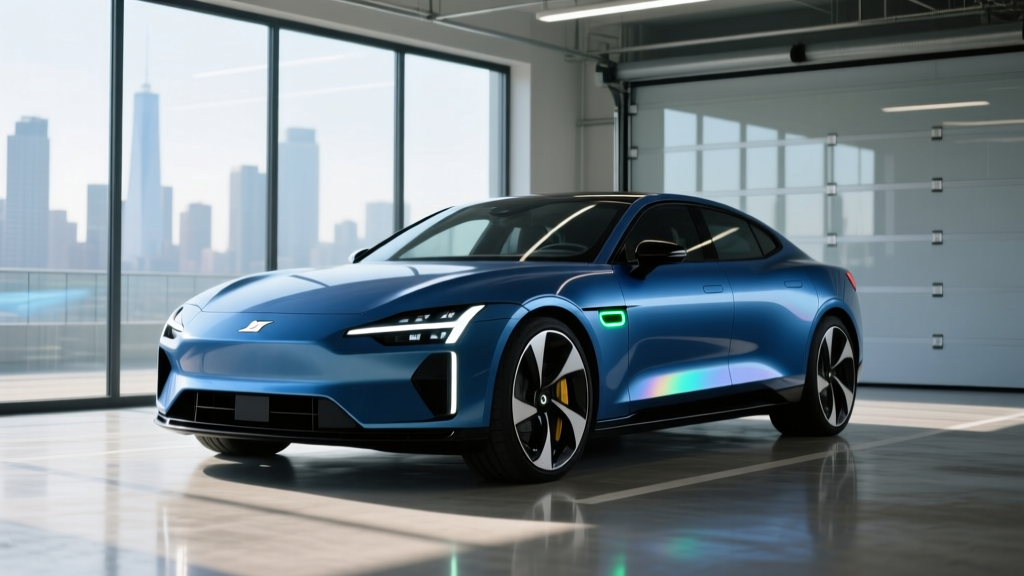
The Polestar 8 is the Swedish-Chinese EV brand's flagship luxury fastback SUV, built on Volvo's SPA2 platform and positioned to compete directly with the Tesla Model X, BMW iX, and Mercedes-Benz EQE SUV. As Polestar's range-topping model, the 8 packs a massive battery, dual-motor all-wheel drive, and Scandinavian design — but it also carries a premium price and a few practical compromises worth examining before you sign a lease or purchase agreement.
In this review, we break down the 2026 Polestar 8's EPA-estimated range, real-world efficiency expectations, DC fast-charging performance, home charging setup, interior dimensions, powertrain specs, pricing across trims, and federal tax credit eligibility under current IRS §30D rules. If you're cross-shopping luxury electric SUVs, this is the data-driven breakdown you need.
Polestar 8 Specs at a Glance
| Specification | 2026 Polestar 8 (Long Range Dual Motor) |
|---|---|
| EPA Est. Range | ~300 miles (preliminary) |
| Battery Capacity | 111 kWh usable (NMC lithium-ion) |
| Drivetrain | Dual-motor AWD |
| Horsepower | ~517 hp (Performance trim: ~600+ hp) |
| 0–60 mph | ~4.0 seconds (est. ~3.5s Performance) |
| Max DC Fast Charge | ~200 kW peak |
| 10–80% DC Charge Time | ~30 minutes (preliminary) |
| Level 2 Home Charge Rate | 11 kW onboard charger (~35 mi/hr) |
| Efficiency | ~85 MPGe combined (preliminary) |
| Cargo Volume (behind 2nd row) | ~25 cu ft (est.) |
| Battery/Powertrain Warranty | 8 years / 100,000 miles |
| Base MSRP | ~$79,900 (before destination) |
Note: Several figures above are based on Polestar's announced preliminary specifications for the 2026 model year. Final EPA certification numbers may differ. We will update this review when official EPA data is published on fueleconomy.gov.
Range & Efficiency: EPA Sticker vs. Real-World Expectations
Real-World Expectations:
• Highway driving (70–80 mph): Expect ~250–270 miles. Large, heavy luxury SUVs with wide tires suffer higher aero drag and rolling resistance at sustained highway speeds.
• City/mixed driving: Closer to the EPA sticker, around 280–300 miles, thanks to regenerative braking recapturing energy in stop-and-go traffic.
• Cold weather (below 32°F): Plan for a 20–30% reduction, putting realistic winter range at roughly 210–240 miles. The Polestar 8's heat pump helps mitigate cabin energy draw, but battery chemistry still loses efficiency in cold temperatures.
• Towing (if equipped): Towing near max capacity can cut range by 40–50%. Keep trips short or plan extra charging stops.
The Polestar 8's 111 kWh usable battery is among the largest in the luxury EV SUV segment. For context, the BMW iX xDrive50 uses a ~105 kWh usable pack, and the Tesla Model X Long Range carries roughly 95 kWh usable. More capacity means more range — but also more weight, which impacts efficiency.
At an estimated ~85 MPGe combined (roughly 34–36 kWh per 100 miles), the Polestar 8 is not the most efficient vehicle in its class. The BMW iX achieves around 86–89 MPGe depending on configuration, while the lighter Tesla Model X Long Range reaches approximately 102 MPGe. If you drive 12,000 miles per year, that efficiency gap translates to roughly 400–600 extra kWh annually — about $60–$90 in additional electricity cost at the national average of ~$0.16/kWh.
Charging Speed: DC Fast Charging & Home Level 2
Charging speed is where large-battery EVs live or die. A 111 kWh pack takes a long time to fill if peak charge rates are modest. Here's what we know about the Polestar 8's charging capabilities:
| Charging Level | Power / Rate | Estimated Speed | Use Case |
|---|---|---|---|
| Level 1 (120V household) | ~1.4 kW | ~4–5 miles per hour | Emergency / overnight trickle |
| Level 2 (240V home/work) | 11 kW (onboard charger max) | ~35 miles per hour | Daily home charging — 0–100% in ~10 hours |
| DC Fast Charge (CCS/NACS) | ~200 kW peak | 10–80% in ~30 min | Road trips and public charging |
DC fast-charging reality check: The Polestar 8's ~200 kW peak rate is competitive but not class-leading. The Hyundai Ioniq 9 and Kia EV9 can peak around 230–240 kW on 800V architecture, and the Tesla Model X on V3/V4 Superchargers sustains strong rates thanks to Tesla's thermal management. Expect the Polestar 8 to hit peak rate only between roughly 10–40% state of charge, then taper progressively. From 80–100%, charging slows dramatically — a characteristic of all lithium-ion packs, not unique to Polestar.
Home charging setup: The 11 kW onboard charger means you'll want a 48-amp or 60-amp Level 2 home charger (hardwired, on a 60A or 70A circuit) to maximize charging speed. A full 0–100% charge at 11 kW takes roughly 10 hours — easily achievable overnight. At 35 miles of range added per hour, most daily driving needs (30–50 miles) are replenished in about an hour of plug-in time.
Preconditioning matters: The Polestar 8 includes battery preconditioning when you navigate to a DC fast charger. This warms the battery to its optimal charging temperature, which is critical for achieving peak kW rates — especially in cold weather. Always navigate to your charging stop rather than just driving there; skipping preconditioning can cut your peak charge rate by 30–50% in winter.
Performance & Powertrain
The Polestar 8 is a dual-motor, all-wheel-drive luxury fastback SUV. The standard Long Range Dual Motor configuration produces an estimated 517 horsepower, delivering a 0–60 mph time of roughly 4.0 seconds. For those wanting more, a Performance variant (or over-the-air performance upgrade, a Polestar hallmark) is expected to push output beyond 600 hp and drop the 0–60 time into the mid-3-second range.
The SPA2 platform supports adaptive air suspension, which Polestar has confirmed for the 8. This provides adjustable ride height — useful for loading cargo, navigating steep driveways, or improving highway aerodynamics. The air suspension also contributes to ride quality that should rival the BMW iX and Mercedes EQE SUV on rough pavement.
Regenerative braking in the Polestar 8 offers multiple levels, including a one-pedal driving mode that brings the car to a complete stop using regen alone. Polestar's tuning has historically been smooth and progressive rather than aggressive — expect a learning curve if you're coming from a Tesla's strong one-pedal feel.
Interior, Cargo & Technology
The Polestar 8's interior follows the brand's minimalist Scandinavian design language, with sustainable materials (recycled textiles, bio-based plastics, and vegan leather alternatives) replacing traditional luxury wood-and-chrome motifs. The centerpiece is a large portrait-oriented touchscreen running a Google Automotive-based infotainment system with native Google Maps, Google Assistant, and access to the Google Play Store for in-car apps.
Key tech features:
- Google Automotive OS with native Google Maps navigation and EV route planning
- Over-the-air (OTA) software updates for performance, features, and UI improvements
- Pilot Pack driver assistance (adaptive cruise, lane centering, blind-spot intervention) — SAE Level 2, requiring full driver engagement at all times
- 360-degree camera system with high-resolution surround view
- Panoramic glass roof with electrochromic dimming
- Phone-as-key functionality via Bluetooth LE and UWB
- Vehicle-to-load (V2L) capability for powering external devices (expected, not yet confirmed for US market)
Cargo and passenger space: The fastback roofline gives the Polestar 8 a sleek profile but limits rear headroom compared to boxier SUVs like the Kia EV9 or Rivian R1S. Estimated cargo volume behind the second row is approximately 25 cubic feet, expanding to roughly 55–60 cubic feet with the rear seats folded. A front trunk (frunk) provides additional storage for charging cables and small items — expect around 2–3 cubic feet.
Rear-seat legroom should be competitive with the BMW iX (~38 inches), but the sloping roofline will feel tighter for taller passengers compared to upright three-row alternatives. If you regularly carry adults in the second row or need maximum cargo capacity, the boxier Polestar 9 (three-row SUV) or a Rivian R1S may serve you better.
Pricing, Trims & Federal Tax Credit Eligibility
| Trim | Estimated Base MSRP | Est. After §30D Credit* |
|---|---|---|
| Long Range Dual Motor | ~$79,900 | ~$72,400 (if eligible) |
| Performance (Dual Motor) | ~$89,900+ | ~$82,400+ (if eligible) |
*Federal tax credit eligibility is NOT guaranteed and depends on multiple factors that change frequently. See checklist below.
The Polestar 8's starting price places it firmly in the luxury EV SUV bracket, competing against the BMW iX xDrive50 (~$87,000), Mercedes EQE 350 4MATIC SUV (~$78,000), and Tesla Model X Long Range (~$82,000). Polestar typically includes a generous list of standard features, so the effective price gap may be smaller than MSRP suggests.
Does the Polestar 8 Qualify for the §30D Federal Tax Credit?
- MSRP cap: SUVs must have an MSRP at or below $80,000. The Long Range Dual Motor trim (~$79,900) may qualify; the Performance trim likely exceeds the cap.
- Buyer income limits: Adjusted gross income must not exceed $300,000 (married filing jointly), $225,000 (head of household), or $150,000 (single).
- Battery sourcing: A percentage of critical minerals and battery components must be sourced from the US or free-trade-agreement countries. These thresholds increase annually and may affect Polestar vehicles, which are manufactured in China.
- Point-of-sale transfer: If eligible, you can transfer the credit to the dealer at purchase, reducing your out-of-pocket cost immediately rather than waiting for tax filing.
- Final assembly: The vehicle must undergo final assembly in North America. This is a significant concern for the Polestar 8, which is produced in Chengdu, China.
Critical caveat: The final-assembly-in-North-America requirement is a hard disqualifier for vehicles built outside the US, Canada, or Mexico. As of our last update, the Polestar 8 is manufactured in China, which would make it ineligible for the §30D new vehicle credit. However, it may qualify for a lease credit (§45W commercial clean vehicle credit), which leasing companies can pass on to lessees as a reduced monthly payment. Always verify current eligibility on IRS.gov and consult a tax professional before making a purchase decision based on credit assumptions.
Warranty & Long-Term Ownership
Polestar provides a competitive warranty package for the 8:
- Battery warranty: 8 years / 100,000 miles (whichever comes first), covering defects and excessive capacity degradation (typically defined as dropping below 70% of original capacity)
- Powertrain warranty: 8 years / 100,000 miles
- Bumper-to-bumper: 4 years / 50,000 miles
- Roadside assistance: 4 years / unlimited miles
The NMC (nickel manganese cobalt) battery chemistry in the Polestar 8 offers higher energy density than LFP (lithium iron phosphate), which is why it can pack 111 kWh into a reasonable footprint. The trade-off is that NMC batteries generally degrade slightly faster than LFP over thousands of cycles, particularly if frequently charged to 100% or exposed to extreme heat. Polestar's battery management system includes a buffer (unused capacity at the top and bottom of the pack) to protect long-term health, and the 8-year/100,000-mile warranty provides a solid safety net.
For daily use, we recommend setting your charge limit to 80–90% for routine driving and reserving 100% charges for road trips. This practice can significantly extend NMC battery lifespan over a 10-year ownership period.
How Does the Polestar 8 Compare to Key Competitors?
| Attribute | 2026 Polestar 8 LRDM | 2025 Tesla Model X LR | 2025 BMW iX xDrive50 |
|---|---|---|---|
| EPA Range | ~300 mi (prelim.) | ~335 mi | ~307–324 mi |
| Battery (usable) | 111 kWh (NMC) | ~95 kWh | ~105 kWh (NMC) |
| 0–60 mph | ~4.0 sec | ~3.8 sec | ~4.4 sec |
| Peak DC Charge | ~200 kW | ~250 kW (V3 Supercharger) | ~150 kW (CCS) |
| Starting MSRP | ~$79,900 | ~$82,000 | ~$87,000 |
| §30D Credit Eligible | Unlikely (China-built) | Yes (US-built) | Unlikely (Germany-built) |
| Seating | 5-passenger | 5- or 7-passenger | 5-passenger |
Choose the Polestar 8 if: You prioritize Scandinavian design, sustainable interior materials, Google Automotive integration, and a distinctive alternative to the ubiquitous Tesla. The Polestar 8 is a strong pick for design-conscious buyers who want a luxury fastback SUV without the Tesla badge.
Choose the Tesla Model X if: You need maximum range, Supercharger network access (though this is now open to NACS-equipped vehicles from other brands), optional third-row seating, and the best chance at federal tax credit eligibility thanks to US manufacturing.
Choose the BMW iX if: You value driving dynamics, a more traditional luxury interior, and proven dealership service infrastructure. The iX is a well-rounded package, though its DC charging speed is notably slower than competitors.
Pros, Cons & Who the Polestar 8 Is For
- Massive 111 kWh battery provides strong range cushion
- Distinctive Scandinavian design with sustainable materials
- Google Automotive OS with native EV route planning
- Air suspension for ride comfort and adjustable height
- Strong 8-year/100,000-mile battery warranty
- OTA updates and potential performance upgrades
- Likely ineligible for §30D tax credit (China-built)
- Fastback roofline reduces rear headroom and cargo utility
- ~200 kW peak DC charge rate trails Tesla and Hyundai/Kia
- Heavy vehicle impacts real-world efficiency vs lighter rivals
- Limited US dealer/service footprint compared to BMW or Tesla
- Final EPA figures not yet confirmed at time of writing
Best suited for: Design-forward commuters and road-trippers who want a luxury EV SUV with strong range, premium materials, and Google-native tech. The Polestar 8 works well for two-adult households with moderate cargo needs. It is less ideal for large families (no third row), frequent heavy haulers, or buyers who depend on the $7,500 federal tax credit to justify the purchase price.
Frequently Asked Questions
What is the real-world range of the 2026 Polestar 8?
With a preliminary EPA estimate of ~300 miles, expect roughly 250–270 miles in real-world highway driving, and 210–240 miles in cold weather (below freezing). City driving with regenerative braking will get you closest to the EPA sticker number.
How fast does the Polestar 8 charge at home and on DC fast chargers?
At home on a Level 2 charger (240V, 48A+), the Polestar 8 charges at up to 11 kW, adding about 35 miles of range per hour and fully recharging overnight in ~10 hours. On DC fast chargers, it peaks at approximately 200 kW, reaching 10–80% in about 30 minutes under optimal conditions (warm battery, low state of charge at start).
Does the Polestar 8 qualify for the $7,500 federal EV tax credit?
Likely not for purchase. The §30D credit requires final assembly in North America, and the Polestar 8 is manufactured in China. However, you may be able to capture a lease credit passed through by the leasing company. Verify current rules on IRS.gov and consult a tax professional.
How much does the Polestar 8 cost?
The base Long Range Dual Motor trim starts at approximately $79,900 before destination charges. A Performance variant is expected around $89,900 or higher. Without the federal purchase credit, your effective price is close to MSRP — though lease incentives or state-level rebates may reduce costs.
Is the Polestar 8 worth buying over the Tesla Model X or BMW iX?
It depends on your priorities. If you want distinctive design, sustainable materials, Google Automotive, and don't need a third row or the §30D credit, the Polestar 8 is compelling. If range, charging speed, and tax credit eligibility are top concerns, the Tesla Model X has a stronger case. If driving dynamics and dealer service matter most, consider the BMW iX.
What battery chemistry does the Polestar 8 use?
The Polestar 8 uses an NMC (nickel manganese cobalt) lithium-ion battery with 111 kWh of usable capacity. NMC offers higher energy density than LFP, enabling more range in a given pack size, but benefits from daily charge limits of 80–90% to maximize long-term battery health.
Is the Polestar 8 self-driving?
No. The Polestar 8's Pilot Pack driver-assistance system is an SAE Level 2 system, meaning it provides steering and acceleration support but requires the driver to remain fully engaged, hands on or near the wheel, and eyes on the road at all times. It is not autonomous.
Sources: Preliminary specifications from Polestar USA; federal tax credit rules via IRS.gov §30D; EPA efficiency data at fueleconomy.gov (final figures pending EPA certification).