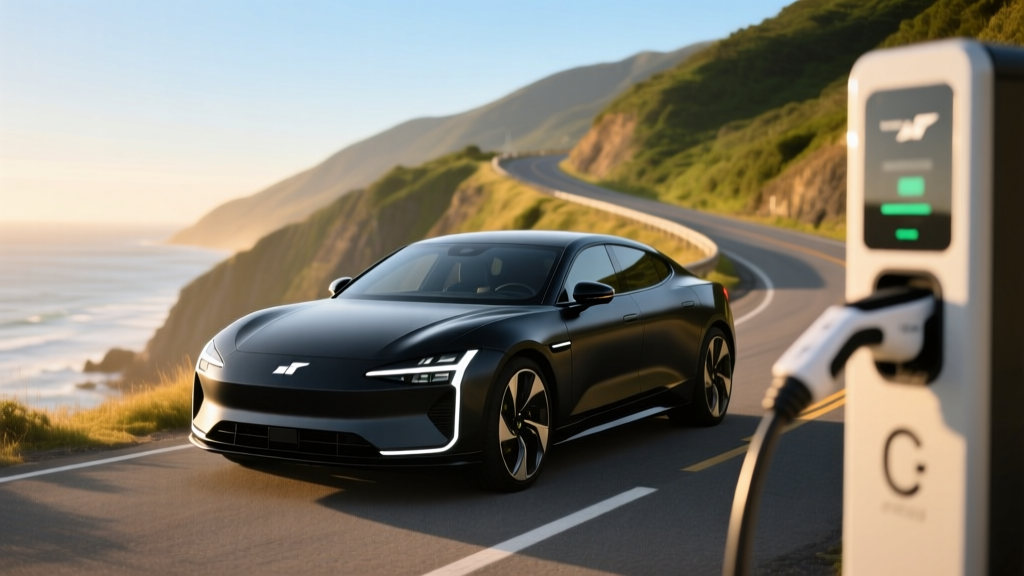
The Polestar 5 is the Swedish-Chinese automaker's flagship electric grand tourer — a low-slung, four-door performance sedan aimed squarely at the Porsche Taycan and Tesla Model S. Built on a bonded-aluminum platform developed in the UK and powered by an 800-voltage architecture, the Polestar 5 promises rapid DC fast charging, serious straight-line speed, and Scandinavian design restraint. But flagship aspirations mean flagship pricing, and at well over $100,000, buyers need to know exactly what they're getting beyond the badge. This review breaks down the Polestar 5's real-world range, charging behavior, performance data, and ownership economics so you can decide whether it earns a spot in your garage.
Polestar 5 Specs at a Glance
| Specification | Polestar 5 Long Range Dual Motor |
|---|---|
| Base MSRP | $121,900 (Performance trim) |
| EPA Est. Range | ~300 miles (preliminary) |
| Battery Capacity | 103 kWh usable (NMC, 800V) |
| Drivetrain | Dual-motor AWD |
| Horsepower | 884 hp (660 kW) |
| Torque | 737 lb-ft |
| 0–60 mph | 3.1 seconds (est.) |
| Max DC Fast Charge | 250 kW (peak) |
| 10–80% DC Charge Time | ~18 minutes |
| Level 2 Home Charge Rate | 11 kW (~35 mi/hr) |
| MPGe (combined, prelim.) | ~90 MPGe |
| Efficiency | ~37 kWh/100 mi |
| Battery/Powertrain Warranty | 8 years / 100,000 miles |
| Federal Tax Credit (§30D) | Likely ineligible (MSRP cap) |
Range and Efficiency: What the EPA Sticker Doesn't Tell You
Real-World Expectation: Plan for approximately 250–270 miles on sustained highway driving at 70–75 mph. In cold weather (below 32°F / 0°C), expect a further 15–25% reduction, bringing effective range to roughly 200–230 miles on winter road trips. City driving with regenerative braking can push closer to the EPA figure or slightly above.
The Polestar 5 uses a 103 kWh usable battery pack built with nickel-manganese-cobalt (NMC) chemistry, chosen for its high energy density — critical in a performance GT where weight distribution and packaging matter. The 800V architecture reduces current for a given power level, which means thinner cabling, less resistive heat loss, and faster charging capability.
Efficiency in a car producing 884 hp will never rival a Hyundai Ioniq 6's 140 MPGe, but the Polestar 5's estimated ~37 kWh per 100 miles is competitive within the luxury performance sedan segment. For context, the Porsche Taycan Turbo S returns roughly 39 kWh/100 mi, and the Tesla Model S Plaid sits around 34 kWh/100 mi. The Polestar 5 lands between them — respectable for a car with a bonded-aluminum chassis and a focus on grand-touring comfort over hypermiling.
One ownership note: the NMC chemistry in the Polestar 5 means you'll want to follow the 80% daily charge guideline for routine use, reserving 100% charges for road trips. Unlike LFP (lithium iron phosphate) packs found in some base-model Teslas, NMC cells degrade faster when held at high states of charge for extended periods. Polestar's battery management system includes a top-buffer to mitigate this, but habitually charging to 100% and leaving the car parked for days will accelerate capacity loss over time.
Charging Speed: 800V Architecture in Practice
| Charging Level | Power / Rate | Speed |
|---|---|---|
| Level 1 (120V household) | ~1.4 kW | ~4 miles per hour |
| Level 2 (240V home, 48A) | 11 kW | ~35 miles per hour (full charge in ~10 hrs) |
| DC Fast Charge (peak) | 250 kW | 10–80% in ~18 minutes |
| DC Fast Charge (sustained avg.) | ~175–200 kW | 10–90% in ~25 minutes |
The 800V system is the Polestar 5's charging headline. At a compatible 350 kW DC fast charger (Electrify America, EVgo, or Tesla Supercharger with NACS adapter), the Polestar 5 can accept up to 250 kW at peak. However, as with every EV, peak is not sustained. The charge curve tapers significantly above 80% state of charge to protect cell longevity. Expect the 10–80% sprint to take approximately 18 minutes under ideal conditions — battery preconditioned, ambient temperature between 60–80°F, and a charger capable of sustaining the rate.
In real-world fast charging, thermal management matters as much as peak kW. The Polestar 5's liquid-cooled battery pack and heat pump system precondition the battery when you navigate to a charger in the infotainment system. Always use this feature — arriving at a DC fast charger with a cold battery can double your charging time, particularly in winter. On back-to-back fast charges (road trip days with 3+ stops), expect some tapering as the thermal system manages cumulative heat buildup.
For home charging, the 11 kW onboard AC charger is standard. On a 48-amp Level 2 wall connector (requiring a 60-amp dedicated circuit), you'll add roughly 35 miles of range per hour, or fully replenish the 103 kWh pack in about 10 hours. Most Polestar 5 owners will charge overnight and rarely need DC fast charging for daily use. Budget $500–$1,500 for professional Level 2 installation depending on your electrical panel capacity — a 200-amp panel is typically sufficient, but older homes may need a panel upgrade adding $1,500–$3,000.
Performance and Driving Dynamics
The Polestar 5's dual-motor all-wheel-drive powertrain produces 884 horsepower and 737 lb-ft of torque. Polestar targets a 0–60 mph time of approximately 3.1 seconds, placing it in direct competition with the Porsche Taycan Turbo (3.0 sec) and well ahead of most luxury sedans. The top speed is electronically limited to approximately 155 mph.
But straight-line speed is only part of the GT equation. The Polestar 5's bonded-aluminum chassis — manufactured using a technique derived from low-volume sports car production — keeps weight relatively low for a 103 kWh EV. Polestar has not published a final curb weight, but the target is under 5,500 lbs, which is notably lighter than the Tesla Model S (~4,766 lbs for Long Range, but with a smaller battery in that trim) and competitive with the Taycan.
The suspension uses a double-wishbone front and multi-link rear setup with adaptive dampers and active rear steering. This combination should deliver the compliant highway ride expected of a grand tourer while maintaining composure on technical roads. Polestar's torque vectoring on the rear motor allows the car to rotate more eagerly through corners than its wheelbase might suggest.
Regenerative braking offers multiple modes including a one-pedal driving setting. The brake pedal feel in Polestar's EVs has historically been well-calibrated — blending regenerative and friction braking without the vague, spongy transition that plagues some competitors.
Interior, Cargo, and Technology
The Polestar 5 is a four-door sedan with a fastback silhouette, which means rear headroom trades some practicality for style. Expect approximately:
- Front legroom: ~42 inches
- Rear legroom: ~34 inches (tight for tall passengers on long trips)
- Trunk volume: ~15 cu ft (sedan trunk, not a hatchback liftback like the Model S)
- Frunk: Small front trunk (~2 cu ft) suitable for charging cables
The infotainment system runs on a Snapdragon-powered Android Automotive OS platform with a vertically oriented 15-inch center touchscreen and a 9-inch digital instrument cluster. Google Maps navigation, Google Assistant voice control, and over-the-air updates are standard. Apple CarPlay integration is available wirelessly.
Driver assistance features include adaptive cruise control with stop-and-go, lane centering, blind-spot monitoring, and a 360-degree camera system. Polestar's Pilot Pack provides highway driving assist functionality — this is an SAE Level 2 system, meaning the driver must remain attentive and keep hands on the wheel at all times. It is not autonomous driving.
Notable drawbacks: the rear-seat space is more sports-sedan than luxury-limousine, the trunk opening is narrower than a hatchback competitor, and at this price point, some buyers may expect more rear-seat amenities (ventilated rear seats, rear entertainment screens) that aren't standard.
Pricing, Tax Credits, and Ownership Costs
| Item | Amount |
|---|---|
| Polestar 5 Performance (base MSRP) | $121,900 |
| Destination charge | $1,400 |
| Federal §30D Tax Credit | $0 (exceeds $55,000 sedan MSRP cap) |
| Estimated total before state incentives | ~$123,300 |
The Polestar 5's pricing places it firmly in six-figure territory. At a base MSRP of approximately $121,900 for the Performance dual-motor variant, the car significantly exceeds the IRS §30D federal tax credit MSRP cap of $55,000 for sedans. This means the Polestar 5 does not qualify for the $7,500 federal EV tax credit regardless of buyer income or battery sourcing.
Key §30D eligibility rules that disqualify the Polestar 5:
- MSRP cap: Sedans must be $55,000 or less (the Polestar 5 is $121,900+)
- Buyer income cap: Even if it qualified on price, AGI limits apply ($300K joint / $150K single)
- Battery sourcing: Critical mineral and battery component requirements must be met
Some state-level incentives may still apply depending on your jurisdiction — check your state's EV rebate program for specifics, as these vary widely and change frequently.
The battery and powertrain are covered by an 8-year / 100,000-mile warranty, with a capacity retention threshold typically set at 70% — meaning Polestar will address the battery if it degrades below 70% of original capacity within the warranty period. The limited vehicle warranty is 4 years / 50,000 miles. Insurance premiums for a $120,000+ performance EV will be substantial — expect $3,000–$5,000 annually depending on your profile and location. Get quotes before committing.
Polestar 5 vs. the Competition
The Polestar 5 enters a segment with established, formidable rivals. Here's how it stacks up on paper:
| Polestar 5 | Porsche Taycan Turbo | Tesla Model S Plaid | BMW i7 xDrive60 | |
|---|---|---|---|---|
| Price (base) | $121,900 | $162,450 | $89,990 | $120,695 |
| Range (EPA) | ~300 mi | ~280 mi | 396 mi | ~318 mi |
| 0–60 mph | 3.1 sec | 3.0 sec | 1.99 sec | 4.5 sec |
| Horsepower | 884 hp | 670 hp | 1,020 hp | 536 hp |
| Max DC Charge | 250 kW | 320 kW | 250 kW | 195 kW |
| Architecture | 800V | 800V | 400V | 400V |
The Porsche Taycan offers superior charging speed (320 kW on the updated models) and the prestige badge, but costs significantly more for equivalent performance. The Tesla Model S Plaid demolishes the Polestar 5 in acceleration and range, at a lower price — but interior build quality and brand cachet are where Polestar and Porsche differentiate. The BMW i7 prioritizes rear-seat luxury and space over performance.
Pros
- 884 hp and 800V architecture at a lower price than a Taycan Turbo
- Bonded-aluminum chassis — lighter and stiffer than typical EV platforms
- Distinctive Scandinavian design inside and out
- Competitive 10–80% fast-charge time (~18 min)
- Android Automotive OS with OTA updates
- Strong 8-yr/100,000-mi battery warranty
Cons
- No federal tax credit eligibility (MSRP far exceeds cap)
- Rear-seat and trunk space limited vs. luxury sedan rivals
- Polestar's US dealer/service network still small vs. BMW/Porsche
- Final EPA range and pricing subject to change at launch
- Insurance costs will be significant
- NMC battery requires more careful charging habits than LFP
Who Should Buy the Polestar 5?
Choose the Polestar 5 if:
- You want a design-forward electric GT that isn't a Tesla or Porsche
- You value 800V fast charging and 800+ hp without paying Taycan Turbo pricing
- You primarily drive with one or two passengers and don't need limousine rear space
- You have reliable home Level 2 charging and access to DC fast chargers for road trips
Look elsewhere if:
- You need maximum range — the Tesla Model S Long Range offers nearly 400 miles for less money
- Rear-seat comfort for adults is a priority — consider the BMW i7 or Mercedes EQS
- You want the strongest dealer/service network — Porsche and BMW have broader US coverage
- Federal tax credit eligibility is important to your purchase math — this car doesn't qualify
The Polestar 5 is a compelling grand tourer for buyers who want something different from the usual German or American options. Its 800V charging, bonded-aluminum construction, and 884 hp output are genuinely impressive engineering. But at $120,000+ with no federal credit, limited rear space, and a still-growing service network, it's a car you buy with your eyes open — not a default choice, but a deliberate one.
Frequently Asked Questions
What is the real-world range of the Polestar 5?
The preliminary EPA estimate is approximately 300 miles. In real-world highway driving at 70–75 mph, expect 250–270 miles. In cold weather below freezing, plan for 200–230 miles. Always precondition the battery before long highway segments to maximize efficiency.
How fast does the Polestar 5 charge?
On a 350 kW-capable DC fast charger, the Polestar 5 peaks at 250 kW and charges from 10–80% in approximately 18 minutes under ideal conditions. At home on a 48-amp Level 2 charger (11 kW), it adds about 35 miles of range per hour, fully charging in roughly 10 hours.
Does the Polestar 5 qualify for the federal EV tax credit?
No. Under current IRS §30D rules, sedans must have an MSRP of $55,000 or less to qualify. The Polestar 5 starts at approximately $121,900, making it ineligible regardless of buyer income or battery sourcing. Check your state for any local incentives.
How much does the Polestar 5 cost after incentives?
With no federal credit available, expect to pay approximately $123,300 (including destination) for the base Performance trim before state incentives, taxes, and registration. Some states offer rebates for EVs at any price point — check your local program.
Is the Polestar 5 worth buying vs. the Porsche Taycan or Tesla Model S?
It depends on priorities. The Polestar 5 offers Taycan-rivaling performance at a lower price point, with distinctive design and 800V charging. The Tesla Model S wins on range and acceleration at a lower price, but Polestar's build quality and design language are a step above Tesla's interior. The Porsche Taycan offers superior charging speed and brand prestige but costs $40,000+ more for comparable output.
What battery chemistry does the Polestar 5 use?
The Polestar 5 uses NMC (nickel-manganese-cobalt) cells, chosen for high energy density suitable for a performance GT. NMC batteries benefit from daily charging to 80% rather than 100%, with full charges reserved for road trips. The battery is warranted for 8 years / 100,000 miles with a 70% capacity retention threshold.
Is Polestar's service network adequate for a $120,000 car?
Polestar operates through a mix of its own Polestar Spaces and Volvo dealer service centers (Polestar is jointly owned by Volvo/Geely). Coverage is growing but remains thinner than BMW, Mercedes, or Porsche in many US markets. Before purchasing, confirm the nearest authorized service location and ask about mobile service availability and loaner vehicle policies.