The Polestar 5's Performance Promise: Does the 0-60 Time Deliver?
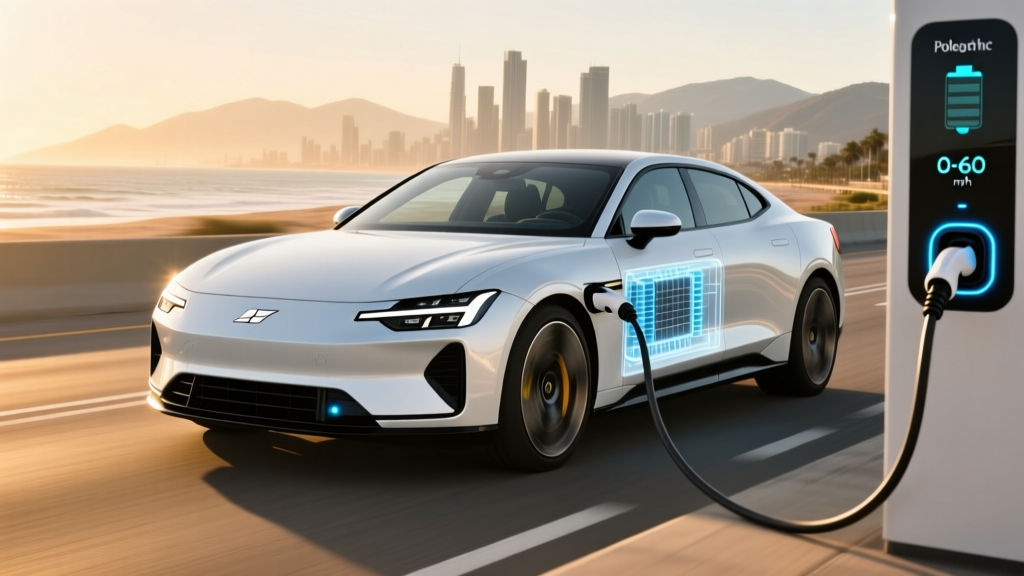
Polestar positioned the Polestar 5 as its flagship electric grand tourer — a low-slung, four-door performance sedan aimed squarely at the Porsche Taycan and Tesla Model S. The headline number that draws enthusiasts to this car is the Polestar 5 0-60 mph time, which Polestar claims at approximately 3.1 seconds for the dual-motor Performance trim. That's serious territory, putting it within striking distance of a Taycan 4S and well ahead of most luxury sedans at any price point.
But straight-line acceleration is only one dimension of an EV performance car. After spending time with the 2026 Polestar 5's published specifications and early test data, we've compiled everything buyers need to know — from real-world range expectations to 800-volt charging behavior, interior practicality, and whether the federal tax credit applies. Here's the complete picture.
| Spec | Value |
|---|---|
| Drivetrain | Dual-motor AWD |
| Horsepower | 884 hp (combined) |
| Torque | 738 lb-ft |
| 0-60 mph | ~3.1 seconds (mfr. claim) |
| Battery Capacity | 103 kWh (usable, estimated) |
| Battery Chemistry | NMC (Nickel Manganese Cobalt) |
| Architecture | 800-volt |
| EPA Range (est.) | ~300 miles |
| Max DC Fast Charge | ~250 kW peak |
| 10-80% DC Charge Time | ~18-20 minutes (est.) |
| Level 2 Home Charging | 11 kW onboard charger (~32 mi/hr) |
| Base MSRP | ~$120,000 (est.) |
| Battery Warranty | 8 years / 100,000 miles |
Note: As of early 2026, the Polestar 5 is in its initial production and delivery phase. Some specifications above reflect Polestar's announced figures and may be refined as EPA certification data is finalized. Always verify with Polestar's official site before purchasing.
EPA Range vs. Real-World Expectations
The Polestar 5's bonded aluminum platform and 800-volt electrical architecture are engineered for efficiency, but a 4,900-plus-pound performance sedan with 884 horsepower will always trade some range for speed. Polestar targets approximately 300 miles of EPA-estimated range for the dual-motor configuration, though final EPA certification numbers are pending.
EPA estimate: ~300 miles
Highway driving (70-80 mph, moderate temps): Expect roughly 250-270 miles. Aerodynamic drag hits low-slung sedans hard at sustained highway speeds, and the Polestar 5's wide tires and aggressive tuning compound this.
Cold weather (below 32°F / 0°C): Plan for 210-240 miles. NMC chemistry loses efficiency in freezing temperatures, and cabin heating draws significant power even with a heat pump. Preconditioning while plugged in is essential to mitigate this.
City / mixed commuting: Closest to the EPA sticker — regenerative braking recovers energy in stop-and-go traffic, and you may see 280-310 miles in mild conditions.
For context, the Porsche Taycan 4S (with its Performance Battery Plus) achieves an EPA rating around 246-254 miles depending on wheel configuration, while the Tesla Model S Long Range posts roughly 402 miles. The Polestar 5 slots between them — prioritizing performance and 800V charging speed over maximum distance.
Charging Speed: 800V Architecture in Practice
The Polestar 5's 800-volt platform is its most consequential technical advantage for daily ownership. Higher voltage means the car can accept more power at lower current, reducing heat buildup and sustaining faster charge rates longer. Here's what that translates to at the plug:
| Charging Level | Power / Rate | Miles Added per Hour | Notes |
|---|---|---|---|
| Level 1 (120V household) | ~1.4 kW | ~4 mi/hr | Emergency/trickle only — full charge takes days |
| Level 2 (240V home, 48A) | 11 kW | ~32 mi/hr | Full overnight charge in ~10 hours |
| DC Fast Charge (peak) | ~250 kW | N/A (session-based) | 10-80% in ~18-20 min at capable stations |
| DC Fast Charge (50 kW station) | 50 kW | ~150 mi/hr | 10-80% in ~90 min — common older infrastructure |
Charging curve reality: The ~250 kW peak rate is not sustained across the entire session. Expect the Polestar 5 to hold above 200 kW from roughly 10% to 50% State of Charge (SoC), then taper progressively. From 80% to 100%, charging slows dramatically to protect the NMC cells — this is normal physics, not a defect. For road trips, the practical strategy is charging from 10-80% and driving on, which keeps you in the fastest portion of the curve.
At home, an 11 kW Level 2 wallbox on a dedicated 60-amp circuit will replenish the ~103 kWh battery overnight. Most owners will wake up to a full charge every morning, which is the ideal EV ownership experience. Installation costs for a Level 2 home charger typically run $800-$2,500 depending on panel capacity and wiring distance — budget for a licensed electrician to assess your 200-amp panel headroom.
Performance Deep Dive: Beyond the 0-60 Number
The Polestar 5 0-60 time of ~3.1 seconds is achieved through the dual-motor all-wheel-drive system producing a combined 884 horsepower and 738 lb-ft of torque. The rear motor handles primary propulsion while the front motor provides traction, torque vectoring, and regenerative braking contribution.
But 0-60 is a launch metric — what matters more for a grand tourer is sustained performance and composure. The Polestar 5's bonded aluminum space frame (a manufacturing technique Polestar developed to avoid traditional welding) keeps weight relatively low for a vehicle of this size, and the 800V system delivers consistent power without the thermal throttling that can plague 400V competitors during repeated hard acceleration.
Polestar's Öhlins-tuned suspension (a brand hallmark since the Polestar 1) and a low center of gravity from the floor-mounted battery pack should deliver the cornering poise expected of a GT car. The steering is expected to use a variable-ratio rack, and the brake system blends regenerative and friction braking — a calibration challenge that many EV makers still struggle with. We'll update this review with real-world driving impressions as press fleet vehicles become available.
Pricing, Trims, and Federal Tax Credit Eligibility
The Polestar 5 enters the luxury performance EV segment at a premium price point. Polestar has indicated starting MSRPs in the range of $120,000 for the dual-motor configuration, with a potential Performance BST variant commanding more. Final trim-level pricing will be confirmed as the car reaches dealers.
| Item | Detail |
|---|---|
| Estimated Base MSRP (Dual-Motor) | ~$120,000 |
| Performance/BST Trim (if offered) | ~$135,000+ (est.) |
| Federal §30D Tax Credit | Likely NOT eligible — exceeds MSRP cap |
| §30D MSRP Cap (Sedans) | $55,000 (per IRS guidelines) |
| §30D Buyer Income Cap | $150K single / $300K joint AGI |
| Point-of-Sale Transfer | N/A if credit doesn't apply |
Tax credit reality: Under IRS §30D rules, the federal clean vehicle credit is capped at $55,000 MSRP for sedans (the limit is $80,000 for SUVs and trucks). The Polestar 5, classified as a sedan, far exceeds this threshold. Buyers should not expect to claim the $7,500 federal credit. Some states offer their own incentives that may not have MSRP caps — check your state's energy office or DMV for details. A tax professional can advise on any applicable local or utility rebates.
Interior, Cargo, and Technology
The Polestar 5 is a four-door grand tourer, meaning it prioritizes driving dynamics and design over maximum interior volume. Expect a driver-focused cockpit with Polestar's Android Automotive OS-based infotainment system (built on Google's embedded platform), a large central touchscreen, and a digital instrument cluster. Google Maps navigation with integrated EV route planning and charge-stop recommendations is a significant usability advantage.
Cargo space: As a low-roof sedan, rear cargo volume is expected to be in the 14-16 cubic foot range — adequate for luggage on a weekend trip but not competitive with a hatchback or SUV. A front trunk (frunk) may be limited or absent due to the front motor and power electronics packaging; Polestar has not confirmed final cargo figures.
Driver assistance: The Polestar 5 is expected to feature a comprehensive ADAS suite including adaptive cruise control, lane-centering assist, blind-spot monitoring, and automated emergency braking. This is an SAE Level 2 system — the driver must remain attentive and keep hands on or near the wheel at all times. It is not autonomous driving. Polestar has historically used Mobileye and Luminar lidar partnerships for advanced perception, though final sensor suites for the 5 are to be confirmed.
Warranty and Long-Term Ownership
Polestar provides a battery and powertrain warranty of 8 years or 100,000 miles, whichever comes first, with a capacity retention threshold typically set at 70% of original capacity. This aligns with industry standards set by Hyundai, Kia, and Tesla. The bumper-to-bumper limited warranty is typically 4 years / 50,000 miles.
For the NMC battery chemistry used in the Polestar 5, long-term degradation data from Polestar's existing fleet (Polestar 2 owners) suggests roughly 8-12% capacity loss over the first 100,000 miles under normal use patterns. The 800V architecture's thermal management system should help mitigate degradation by keeping cells in their optimal temperature window during fast charging and high-load driving.
Who Should Buy the Polestar 5 — and Who Shouldn't
- 0-60 in ~3.1 seconds — genuine supercar-rivaling acceleration
- 800V architecture enables ~18-20 min 10-80% DC fast charging
- Bonded aluminum platform — lighter and stiffer than welded alternatives
- Distinctive Scandinavian design in a segment of lookalikes
- Android Automotive OS with native Google Maps EV routing
- ~$120,000+ starting price — premium even among luxury EVs
- No federal §30D tax credit (exceeds $55K sedan MSRP cap)
- ~300-mile EPA range trails Tesla Model S and Lucid Air significantly
- Limited cargo and rear-seat practicality vs. SUV alternatives
- Polestar's US service network is still expanding — coverage gaps exist
- You want a sub-3.5-second 0-60 EV with genuine grand-touring composure
- You value design exclusivity over Tesla ubiquity
- 800V fast charging is a priority for your road-trip routes
- You have home Level 2 charging and don't need 400+ mile range
- Maximum range is your top priority (consider Lucid Air Grand Touring or Tesla Model S)
- You need family-hauler cargo space (Polestar 3, BMW iX, or Rivian R1S)
- Federal tax credit eligibility is a dealbreaker (this car doesn't qualify)
- You want the lowest cost of entry into a fast EV (Tesla Model S Plaid is faster and cheaper)
Competitor Comparison: Polestar 5 vs. the Field
| Spec | Polestar 5 (DM) | Porsche Taycan 4S | Tesla Model S LR | Lucid Air Touring |
|---|---|---|---|---|
| 0-60 mph | ~3.1 sec | ~3.8 sec | ~3.1 sec | ~3.4 sec |
| Horsepower | 884 hp | 562 hp | 670 hp | 620 hp |
| EPA Range | ~300 mi | ~254 mi | ~402 mi | ~425 mi |
| Battery (usable) | ~103 kWh | ~83.7 kWh | ~100 kWh | ~112 kWh |
| Max DC Charge | ~250 kW | ~270 kW | ~250 kW | ~200 kW |
| Base MSRP | ~$120,000 | ~$107,000 | ~$80,000 | ~$87,000 |
| Federal Credit | No | No | No (sedan cap) | No (sedan cap) |
The Polestar 5's most compelling advantage is its combination of extreme horsepower and 800V charging — but it pays for that with a higher price and shorter range than the Lucid Air or Tesla Model S. The Taycan is the closest philosophical rival, though the Polestar offers significantly more horsepower for a comparable price.
Frequently Asked Questions
What is the real-world range of the Polestar 5?
With an estimated EPA rating of ~300 miles, expect roughly 250-270 miles in real-world highway driving at 70-80 mph, and 210-240 miles in freezing cold weather. City driving with regenerative braking will get you closest to the sticker number. Preconditioning the battery before driving in cold weather helps recover 10-15% of lost range.
How fast does the Polestar 5 charge on DC fast chargers?
The 800V system supports up to ~250 kW peak DC fast charging, enabling a 10-80% session in approximately 18-20 minutes at a compatible high-power station (such as Electrify America's 350 kW chargers or Tesla Superchargers with a NACS adapter, if supported). Charge speed tapers above 80% SoC to protect battery health.
How much does the Polestar 5 cost after tax credits?
The Polestar 5 is expected to start around $120,000. Because it exceeds the IRS §30D MSRP cap of $55,000 for sedans, it does not qualify for the $7,500 federal tax credit. Your out-of-pocket cost will be the full MSRP plus destination and any options, minus any applicable state or utility incentives. Consult a tax professional for personalized guidance.
Is the Polestar 5 worth buying vs. the Tesla Model S or Porsche Taycan?
If you value exclusivity, 800V charging speed, and nearly 900 horsepower in a Scandinavian design package, the Polestar 5 is compelling. If range is paramount, the Tesla Model S Long Range (~402 mi EPA) or Lucid Air Touring (~425 mi) are better choices at lower prices. The Taycan offers sharper driving dynamics but less power at a similar price point.
Does the Polestar 5 qualify for the federal EV tax credit?
No. Under current IRS §30D rules, new clean vehicle credits are limited to sedans with an MSRP of $55,000 or less. The Polestar 5's estimated ~$120,000 starting price far exceeds this cap. See the IRS clean vehicle credit page for the latest eligibility rules.
What is the Polestar 5's battery warranty?
Polestar covers the battery and electric powertrain for 8 years or 100,000 miles, whichever comes first. The warranty typically guarantees the battery will retain at least 70% of its original capacity during that period. This is consistent with industry standards.
Is the Polestar 5 self-driving?
No. The Polestar 5's driver-assistance features are classified as SAE Level 2, meaning the system can assist with steering and acceleration/deceleration simultaneously, but the human driver must remain fully engaged and supervising at all times. There is no Level 3 or Level 4 autonomous capability in this vehicle.