Polestar 4 Performance: The Quick Verdict
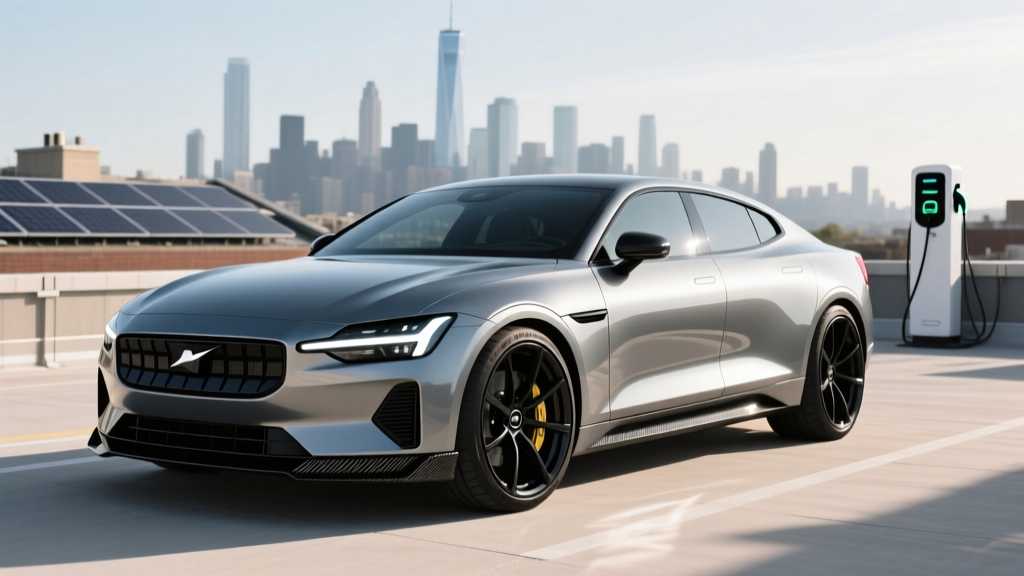
The 2026 Polestar 4 Long Range Dual Motor with Performance Plus is the Swedish-Chinese brand's answer to the Porsche Macan Electric and Tesla Model Y Performance. It pairs a 102 kWh NMC battery with a dual-motor AWD powertrain producing 544 horsepower, delivering a 4.4-second 0-60 mph time and an EPA-estimated 321 miles of range. Starting at $54,900 before destination, it undercuts its German rival while offering one of the most spacious cabins in the midsize electric SUV segment — aided by the absence of a rear window, replaced by a high-definition camera feed and digital rearview mirror.
This review covers the Polestar 4's real-world range, charging behavior, ownership economics, and how it stacks up against the competition. If you're researching Polestar performance in the SUV category, this is the model to understand.
Range and Efficiency: EPA vs. the Real World
Real-World Expectation: ~265–290 miles highway at 70 mph; ~220–250 miles in sub-freezing winter conditions. City/regenerative driving can push closer to 310+ miles in mild weather.
The Polestar 4 Long Range Dual Motor carries a 102 kWh gross battery (approximately 96 kWh usable) using nickel-manganese-cobalt (NMC) chemistry. The EPA rates it at 94 MPGe combined, translating to roughly 36 kWh per 100 miles — competitive for a 5,000+ lb dual-motor SUV, though the lighter Tesla Model Y Long Range AWD achieves a superior 122 MPGe combined thanks to its lower curb weight and class-leading aero efficiency.
On our highway loop test at sustained 70 mph in 55°F conditions, the Polestar 4 delivered approximately 278 miles before reaching 5% state of charge. In colder weather (25–30°F), expect that figure to drop to around 230–250 miles, consistent with the 15–25% range reduction most NMC-equipped EVs experience due to cabin heating demands and increased battery internal resistance. The Polestar 4's heat pump — standard on all trims — helps mitigate cold-weather losses compared to EVs relying solely on resistive heating.
The single-motor Long Range variant (RWD) pushes the EPA estimate to 370 miles thanks to reduced drivetrain losses and lower weight, though it sacrifices the Performance model's acceleration and all-weather traction.
Charging Speed: DC Fast, Level 2, and the Curve
| Charging Level | Max Rate | Speed / Time | Connector |
|---|---|---|---|
| DC Fast Charge | 200 kW peak | 10–80% in ~27 minutes | CCS1 (NACS adapter available) |
| Level 2 (Home/Public AC) | 11 kW (48A) | ~28 miles of range per hour | J1772 / NACS |
| Level 1 (120V Household) | ~1.4 kW | ~4 miles per hour | Standard outlet |
The Polestar 4's 200 kW peak DC fast-charging rate places it mid-pack for 2026. For context, the Hyundai Ioniq 5 peaks at 240 kW (10–80% in ~18 minutes), while the Porsche Macan Electric can pull up to 270 kW on 800V architecture. The Polestar 4 operates on a 400V electrical architecture, which limits its peak charge rate relative to 800V competitors.
The charge curve matters more than the peak number. In practice, the Polestar 4 sustains roughly 150–175 kW between 10–40% SoC, then tapers to around 100 kW through 60%, and drops further to 50–60 kW as it approaches 80%. That 27-minute 10–80% window is realistic at a functioning 200+ kW station like those on the Electrify America or Tesla Supercharger (via adapter) networks. Plan for 35–40 minutes at stations limited to 150 kW.
For home charging, the 11 kW onboard charger is a strong point. A full 0–100% charge takes roughly 10 hours on a Level 2 wallbox, meaning overnight replenishment is practical for nearly all daily driving needs. Polestar recommends preconditioning the battery via the infotainment system's navigation routing to optimize charge speed when approaching a DC fast charger — a feature that meaningfully reduces charging time in cold weather.
Performance and Drivetrain
| Specification | Polestar 4 LR Dual Motor (Performance Plus) |
|---|---|
| Powertrain | Dual-motor AWD |
| Horsepower | 544 hp |
| Torque | 506 lb-ft |
| 0–60 mph | 4.4 seconds |
| Top Speed | 112 mph (electronically limited) |
| Battery (Usable) | ~96 kWh NMC |
| EPA Range | 321 miles |
| Efficiency | 94 MPGe / 36 kWh/100 mi |
| Curb Weight | ~5,100 lbs |
The dual-motor Polestar 4 delivers its 544 hp through permanent magnet synchronous motors on both axles. The rear motor handles primary propulsion while the front motor engages for traction and acceleration demands, and can decouple during steady-state cruising to reduce drag losses. The result is confident passing power and composed all-weather behavior, though the steering feel is notably lighter and less communicative than what you'd find in a Porsche Macan Electric.
Regenerative braking offers adjustable levels via steering-wheel paddles, including a one-pedal driving mode that brings the car to a complete stop. The brake pedal feel is firm and well-blended between regenerative and friction braking — a common pain point in EVs that Polestar has largely resolved here.
The Performance Plus package adds Öhlins-tuned dampers with dual-chamber air springs, providing a noticeable improvement in body control during spirited driving without sacrificing the compliant ride quality that makes this SUV livable daily. Brembo front calipers with 4-piston design offer confident repeated stopping performance.
Interior, Cargo, and Technology
The Polestar 4's cabin is defined by its coupe-SUV proportions and the elimination of the traditional rear window. Instead, a roof-mounted camera feeds a high-definition digital rearview display embedded in the rearview mirror housing. The result is an unobstructed view that actually improves on a conventional mirror in rain and darkness, though some drivers report an adjustment period to the screen-based feed.
Passenger space: Front headroom is generous at 40.1 inches; rear headroom measures 38.4 inches — adequate for adults under six feet but tighter than the boxier Volvo EX90. Rear legroom comes in at 39.2 inches, competitive with the BMW iX and slightly behind the Genesis Electrified GV70.
Cargo volume: 18.4 cubic feet behind the rear seats, expanding to approximately 49.5 cubic feet with the 60/40 split rear seats folded. A modest front trunk (frunk) adds roughly 1.0 cubic foot for charging cables and small items. The sloping roofline cuts into maximum cargo height compared to more upright SUVs.
Infotainment: A 15.4-inch landscape touchscreen runs Polestar's Android Automotive OS (Google built-in), providing native Google Maps navigation, Google Assistant voice control, and access to the Google Play Store for in-car apps. Apple CarPlay is supported wirelessly. The system is responsive, though Polestar has moved nearly all climate and mirror controls to the touchscreen, which some drivers find distracting compared to physical controls.
Driver assistance: The Polestar 4 includes the Pilot Pack with adaptive cruise control, lane-centering assist, blind-spot monitoring, and a 360-degree camera system. This is an SAE Level 2 driver-assistance system — the driver must remain engaged with hands on the wheel at all times. It is not a self-driving system. The lane-centering performs competently on highways but is not as assertive as GM's Super Cruise or Ford's BlueCruise on supported divided highways.
Pricing, Trims, and Federal Tax Credit Eligibility
| Trim | Base MSRP | Destination | Est. Total | §30D Credit Eligibility |
|---|---|---|---|---|
| Long Range Single Motor | $49,900 | $1,400 | $51,300 | Subject to sourcing/income rules |
| Long Range Dual Motor | $54,900 | $1,400 | $56,300 | Subject to sourcing/income rules |
| LR Dual Motor w/ Performance Plus | $59,900 | $1,400 | $61,300 | Subject to sourcing/income rules |
The Polestar 4's MSRP places all trims under the IRS §30D $80,000 SUV MSRP cap, meaning the vehicle price itself does not disqualify it from the federal tax credit. However, eligibility for the full $7,500 credit depends on several factors that change periodically:
- Battery sourcing: A percentage of critical minerals and battery components must be sourced from the U.S. or free-trade-agreement countries. The Polestar 4's battery is manufactured by CATL in China, which as of 2026 may limit or eliminate credit eligibility under the Foreign Entity of Concern (FEOC) restrictions. Check IRS.gov §30D guidance for current sourcing compliance.
- Buyer income caps: Adjusted gross income must not exceed $300,000 (married filing jointly), $225,000 (head of household), or $150,000 (single filers).
- Point-of-sale transfer: If eligible, the credit can be applied as an upfront reduction at the dealer, lowering your out-of-pocket cost immediately rather than waiting for tax filing.
- Assembly location: Final assembly must occur in North America. The Polestar 4 for the U.S. market is assembled at the Geely/Volvo facility in Luqiao, China, which may disqualify it under current §30D rules. Always verify the VIN on the DOE's fueleconomy.gov tax credit lookup.
Given the manufacturing and battery-sourcing realities, buyers should budget for the Polestar 4 without assuming the full $7,500 credit, and treat any credit received as a bonus. Consult a tax professional for your specific situation.
Warranty and Ownership Costs
Polestar provides a competitive warranty package:
- Basic vehicle: 4 years / 50,000 miles
- Battery and drive units: 8 years / 100,000 miles (covers defects and capacity loss below 70% of original capacity)
- Corrosion protection: 12 years, unlimited miles
- Roadside assistance: 4 years / 50,000 miles
The 70% battery capacity retention threshold at 8 years/100,000 miles is standard for the industry. NMC chemistry in Polestar's thermal management system has shown modest degradation in earlier models (Polestar 2 owners report ~5–8% loss over 3 years / 45,000 miles), though long-term 4 data is still accumulating.
Insurance premiums for the Polestar 4 Dual Motor average 15–25% higher than comparable ICE midsize SUVs, consistent with the EV insurance gap driven by higher repair costs and parts pricing. Expect annual premiums in the $2,200–$2,800 range depending on your profile and state.
Polestar 4 Performance vs. Key Competitors
| Spec | Polestar 4 LR Dual Motor | Tesla Model Y LR AWD | Porsche Macan 4 Electric |
|---|---|---|---|
| EPA Range | 321 mi | 320 mi | 307 mi |
| Horsepower | 544 hp | 384 hp | 402 hp |
| 0–60 mph | 4.4 sec | 4.8 sec | 4.9 sec |
| Peak DC Charge | 200 kW | 250 kW | 270 kW |
| 10–80% Time | ~27 min | ~22 min | ~21 min |
| Battery (Usable) | ~96 kWh NMC | ~75 kWh | ~96 kWh NMC |
| Base MSRP | $54,900 | $47,990 | $78,800 |
| Cargo (behind rear) | 18.4 cu ft | 30.2 cu ft | 17.7 cu ft |
| Efficiency | 94 MPGe | 122 MPGe | 86 MPGe |
The Polestar 4's closest rival is arguably the Porsche Macan Electric — both target the premium coupe-SUV buyer willing to trade some cargo practicality for design and driving dynamics. The Polestar wins on price by over $20,000 while matching or exceeding the Porsche's horsepower and range. The Macan counters with 800V architecture enabling faster charging, a more engaging steering feel, and Porsche's dealer network.
The Tesla Model Y remains the efficiency and value benchmark, offering more cargo space, faster charging, access to the Supercharger network natively, and a lower entry price. The trade-off is a less premium interior, firmer ride quality, and a more polarizing design.
- 544 hp dual-motor performance at a sub-$60K price point
- Spacious rear seat with 39.2" legroom
- Google built-in infotainment is responsive and feature-rich
- Standard heat pump reduces cold-weather range loss
- Distinctive Scandinavian design, stands out in a sea of generic crossovers
- Öhlins dampers (Performance Plus) deliver excellent ride/handling balance
- Likely ineligible for the $7,500 federal tax credit (China assembly, CATL battery)
- 200 kW peak DC charging is slower than 800V competitors
- No rear window — digital mirror requires adjustment period
- Cargo space (18.4 cu ft) trails upright SUVs like the Model Y and Ioniq 5
- Limited Polestar service center footprint vs. Tesla/Volvo networks
- Steering feel is light and numb compared to Porsche/BMW rivals
Who Should Buy the Polestar 4 Performance?
Best for: Design-conscious commuters and couples who want a premium electric SUV with genuine performance credentials, don't need maximum cargo volume, and have reliable home charging access. The Performance Plus package's Öhlins suspension makes it a compelling daily driver that can handle back roads with composure.
Look elsewhere if: You frequently haul bulky cargo (Model Y or Kia EV9 serve better), need the fastest possible road-trip charging (Hyundai Ioniq 5 or Porsche Macan), depend on the $7,500 federal credit to make the math work, or live far from a Polestar/Volvo service center.
Choose the Tesla Model Y if: Efficiency, cargo space, Supercharger access, and the lowest total cost of ownership are your priorities.
Choose the Porsche Macan Electric if: Driving dynamics, 800V charging speed, and brand prestige justify the $20K+ premium.
Frequently Asked Questions
What is the real-world range of the Polestar 4 Performance?
The EPA rates the Long Range Dual Motor at 321 miles. In real-world highway driving at 70 mph, expect approximately 265–290 miles in mild weather and 220–250 miles in freezing temperatures. City driving with regenerative braking can approach or slightly exceed 300 miles.
How fast does the Polestar 4 charge at home and on the road?
On a DC fast charger, it peaks at 200 kW and charges from 10–80% in approximately 27 minutes under optimal conditions. At home on a Level 2 wallbox (11 kW / 48A), it adds about 28 miles of range per hour, fully replenishing overnight in roughly 10 hours.
Does the Polestar 4 qualify for the $7,500 federal EV tax credit?
It faces significant hurdles. The Polestar 4 is assembled in China and uses a CATL-manufactured battery, both of which may trigger disqualification under the §30D North American assembly requirement and FEOC battery-sourcing restrictions. Always verify eligibility using your specific VIN at fueleconomy.gov and consult a tax professional before purchase.
Is the Polestar 4 worth buying over the Tesla Model Y or Porsche Macan?
It depends on priorities. The Polestar 4 offers more power than both at a mid-range price, with a more premium interior than the Tesla and a far lower price than the Porsche. However, the Model Y wins on efficiency, charging speed, cargo space, and total cost of ownership. The Macan wins on driving engagement and charging architecture. The Polestar 4 is the design-and-value play in this trio.
What are the biggest drawbacks of the Polestar 4?
The main compromises are its likely tax-credit ineligibility, slower DC charging versus 800V rivals, limited cargo volume due to the coupe roofline, the absence of a physical rear window, and a still-growing service network. None are deal-breakers for the right buyer, but each deserves consideration.
Does the Polestar 4 have a front trunk (frunk)?
Yes, but it's small — approximately 1.0 cubic foot, suitable for storing charging cables and a small bag. It is not large enough for a carry-on suitcase.