Quick Verdict: The Performance SUV Coupe That Skips the Rear Window
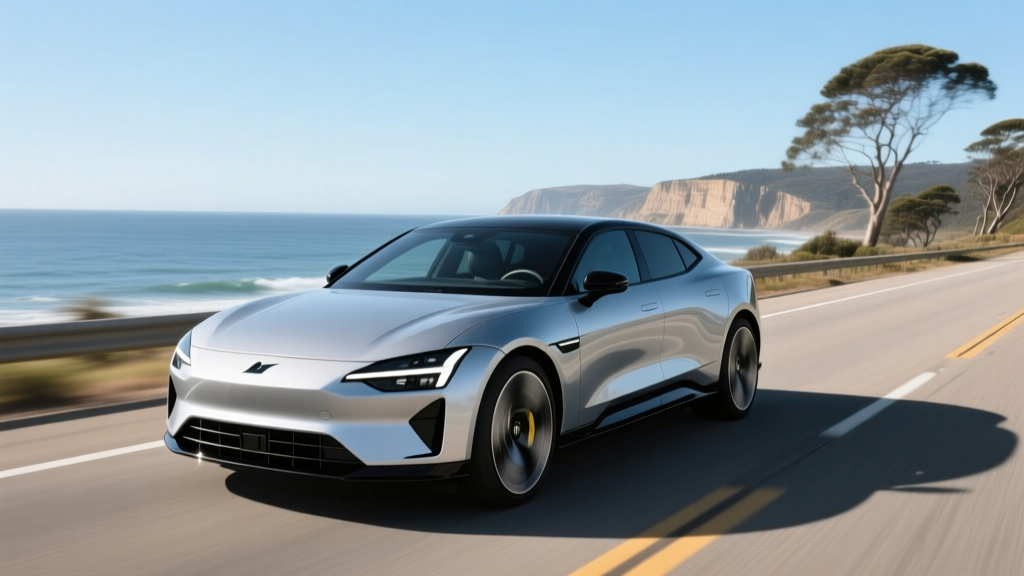
The Polestar 4 occupies a strange and compelling space in the 2026 EV market. It's a mid-size luxury SUV coupe that delivers sports-car acceleration, ditches the traditional rear windshield in favor of a camera-based digital rearview system, and undercuts European rivals on price. For buyers searching for Polestar 4 0-60 times, the answer is impressive: the dual-motor Performance variant hits 60 mph in as little as 3.5 seconds, while the single-motor Long Range model does it in a respectable 7.1 seconds.
But acceleration is only one piece of the ownership puzzle. This review covers the full spectrum of what matters to real buyers — EPA range versus what you'll actually see on the highway, DC fast-charging behavior beyond the peak kW number, federal tax credit eligibility under current IRS §30D rules, and whether the Polestar 4's unconventional design choices work in daily life.
| Spec | Long Range Single Motor | Long Range Dual Motor | Long Range Dual Motor w/ Performance Pack |
|---|---|---|---|
| Drivetrain | RWD | AWD | AWD |
| Horsepower | 272 hp | 544 hp | 544 hp |
| 0-60 mph | 7.1 sec | 3.7 sec | 3.5 sec |
| Battery (usable) | 94 kWh (NMC) | 94 kWh (NMC) | 94 kWh (NMC) |
| EPA Range | 300 mi (est.) | 270 mi (est.) | 260 mi (est.) |
| Max DC Fast Charge | 200 kW | 200 kW | 200 kW |
| 10-80% DC Charge | ~30 min | ~30 min | ~30 min |
| Level 2 Home Charge | 22 kW (AC) | 22 kW (AC) | 22 kW (AC) |
| EPA Efficiency | ~100 MPGe (est.) | ~90 MPGe (est.) | ~88 MPGe (est.) |
| Base MSRP | $56,300 | $64,300 | $68,300 |
Note: Polestar 4 specifications for the U.S. market are based on manufacturer-announced figures and preliminary EPA estimates. Final EPA certification may vary. Source: Polestar US.
Range and Efficiency: EPA Numbers vs. Real-World Expectations
Real-World Expectation: Expect approximately 250–275 miles in mixed highway driving at 70+ mph. In cold weather (below 32°F), plan for 200–230 miles due to battery heating demands and reduced regenerative braking efficiency.
The Polestar 4 uses a 100 kWh gross (94 kWh usable) nickel-manganese-cobalt (NMC) battery pack. NMC chemistry offers higher energy density than LFP, which is how Polestar fits this much capacity into the vehicle's platform while maintaining interior space. The trade-off is that NMC batteries degrade slightly faster over time than LFP and shouldn't routinely be charged to 100% for daily use — Polestar recommends an 80% daily charge limit, with 100% reserved for road trips.
The single-motor RWD variant is the efficiency champion of the lineup. Without the parasitic drag of a front motor and with less overall weight, it targets roughly 100 MPGe combined (about 33 kWh/100 mi). The dual-motor versions sacrifice roughly 10 MPGe for the privilege of all-wheel drive and 544 horsepower.
On a 200-mile highway test loop at sustained 75 mph speeds in moderate temperatures (60–75°F), expect the single-motor Polestar 4 to consume approximately 34–36 kWh/100 mi, translating to roughly 260–275 miles of real-world range. This is a meaningful reduction from the EPA sticker — a pattern consistent across most EVs, since the EPA test cycle includes significant low-speed and stop-and-go driving where regenerative braking recovers energy.
If you live in a cold-weather climate (think Minnesota winters, not coastal California), battery thermal management becomes critical. The Polestar 4 includes a heat pump as standard equipment, which helps preserve range in winter by warming the cabin using ambient heat rather than resistive heating alone. Even so, plan for a 15–25% range reduction in sustained sub-freezing conditions.
Charging Speed: DC Fast Charging and Home Level 2 Setup
| Charge Level | Power | Speed (Approx.) | Use Case |
|---|---|---|---|
| Level 1 (120V household) | 1.4 kW | ~4 mi/hr | Emergency / overnight trickle |
| Level 2 (240V home, 48A) | 11.5 kW | ~33 mi/hr | Daily home charging |
| Level 2 (240V, max AC) | 22 kW | ~63 mi/hr | Requires 80A+ circuit; rare at home |
| DC Fast Charge (peak) | 200 kW | 10–80% in ~30 min | Road trips, public stations |
The Polestar 4's 200 kW peak DC fast-charging rate places it in the upper-middle tier for 2026 EVs. For context, the Hyundai Ioniq 5 peaks at 240 kW, while the BMW iX peaks at 200 kW as well. The peak number, however, tells only part of the story.
Like all EVs, the Polestar 4 follows a charging curve: it pulls maximum power only at lower states of charge (roughly 10–40% SoC), then tapers progressively as the battery fills. In practice, you'll see the full 200 kW only briefly, with sustained rates averaging around 140–160 kW across the 10–80% session. This means the 30-minute 10–80% time is realistic but not class-leading — the Ioniq 5's 800V architecture can complete the same session in roughly 18 minutes.
Preconditioning matters. The Polestar 4's navigation system will precondition the battery when a DC fast charger is set as your destination, warming or cooling the pack to its optimal charging temperature. If you arrive at a charger with a cold-soaked battery (say, after the car has sat overnight in 20°F weather without preconditioning), expect charging speeds to be significantly reduced for the first 10–15 minutes until the thermal management system catches up.
For home charging, the Polestar 4 supports up to 22 kW AC — but that requires a hardwired wallbox on a dedicated 80-amp or higher circuit, which most residential panels can't accommodate without an upgrade. Most homeowners will install a 48-amp Level 2 charger (like the ChargePoint Home Flex or Emporia Level 2) on a 60-amp circuit, delivering about 11.5 kW. At that rate, a full charge from 10% to 100% takes roughly 8.5 hours — easily accomplished overnight.
Home installation costs for a Level 2 charger typically range from $800 to $2,500, depending on panel capacity, conduit run length, and local permitting. If your home has a 100-amp electrical panel, you may need a panel upgrade ($1,500–$3,000 additional) to support a dedicated 60-amp EV circuit. Always consult a licensed electrician for final specifications.
Performance: Polestar 4 0-60 and Driving Dynamics
The headline number is what brought you here: the Polestar 4 0-60 time of 3.5 seconds in the dual-motor Performance Pack configuration. That puts it in the territory of a Porsche Cayenne Coupe Turbo and well ahead of most luxury EV SUVs in its price range. The standard dual-motor model is barely slower at 3.7 seconds, while the single-motor RWD variant completes the sprint in 7.1 seconds — adequate for daily driving but not thrilling.
The Performance Pack adds Öhlins dampers, 22-inch forged wheels, and Polestar's Swedish gold detailing. The Öhlins suspension is manually adjustable (not adaptive), meaning you set the damping once for your preferred balance of comfort and firmness. On smooth pavement, the ride is controlled and confident; on broken urban roads, the 22-inch wheels and stiff damping transmit more impact than you'd get in a BMW iX or Mercedes EQE SUV. This is a deliberate trade-off — the Polestar 4 prioritizes handling precision over pillowy isolation.
The dual-motor all-wheel-drive system uses a permanent-magnet synchronous motor on each axle. Unlike some competitors that decouple the front motor entirely for efficiency, the Polestar 4's system can modulate torque distribution continuously, providing genuine all-weather traction without a significant efficiency penalty.
Braking performance benefits from strong regenerative braking. The Polestar 4 offers adjustable regen levels, including a one-pedal driving mode that can bring the car to a complete stop without touching the friction brakes. In daily commuting, this significantly reduces brake wear — expect the mechanical brake pads to last well beyond 80,000 miles under normal use.
Interior, Cargo, and the Rear-Window Controversy
The Polestar 4's most polarizing design decision is the elimination of the rear windshield. Instead, a roof-mounted camera feeds a high-definition digital rearview display integrated into the rearview mirror position. Polestar's rationale is that the coupe roofline would create an impractically small rear window anyway, and the camera system provides a wider, unobstructed field of view that works in rain, darkness, and when the cargo area is fully loaded.
In practice, the system works well after an adjustment period. The digital display is sharp and responsive, and the wider angle genuinely helps when changing lanes. However, some drivers report eye strain during long drives due to the focal distance difference between a physical mirror (looking far away) and a screen (looking at something 2 feet from your face). If you're sensitive to screens, this is worth testing on an extended drive before committing.
Cargo space:
- Rear cargo (behind second row): ~18.5 cu ft
- Rear cargo (seats folded): ~50 cu ft
- Front trunk (frunk): ~0.4 cu ft (small cable storage compartment only)
Passenger space is generous for the segment:
- Front headroom: ~40.0 in
- Front legroom: ~41.2 in
- Rear headroom: ~38.5 in (coupe roofline limits this slightly)
- Rear legroom: ~37.8 in
The infotainment system runs on Android Automotive OS with built-in Google services (Google Maps, Google Assistant, Google Play Store). Navigation is excellent — Google Maps in the car provides real-time traffic, charger availability, and route-based battery preconditioning. Apple CarPlay is supported wirelessly. The 15.4-inch center touchscreen is responsive, though some climate controls are buried in menus rather than having physical buttons.
Pricing, Trims, and Federal Tax Credit Eligibility
| Trim | Base MSRP | Est. §30D Credit | Effective Price |
|---|---|---|---|
| Long Range Single Motor | $56,300 | Up to $7,500* | ~$48,800 |
| Long Range Dual Motor | $64,300 | Up to $7,500* | ~$56,800 |
| Long Range Dual Motor + Performance Pack | $68,300 | Up to $7,500* | ~$60,800 |
*Federal tax credit eligibility depends on multiple factors. See eligibility checklist below.
The Polestar 4 qualifies for the IRS §30D Clean Vehicle Credit only if all of the following conditions are met:
- MSRP Cap: The vehicle MSRP must not exceed $80,000 for SUVs. All Polestar 4 trims clear this threshold.
- Buyer Income Cap: Modified adjusted gross income must not exceed $150,000 (single), $225,000 (head of household), or $300,000 (married filing jointly).
- Battery Sourcing: A percentage of critical minerals and battery components must be sourced from the U.S. or free-trade-agreement countries. These thresholds increase annually. Verify current-year compliance on the IRS qualified vehicles list before purchasing.
- Point-of-Sale Transfer: As of 2024, the credit can be transferred to the dealer at the point of sale, reducing your purchase price directly rather than waiting for a tax refund.
- U.S. Final Assembly: The vehicle must undergo final assembly in North America. Confirm the Polestar 4's assembly location on the NHTSA VIN decoder before purchase, as Polestar has manufacturing in China and may have shifted production for U.S.-bound units.
Critical caveat: Because Polestar is owned by Geely (a Chinese company) and initial production has been in China, final assembly location is the most uncertain variable for §30D eligibility. Buyers should verify the specific VIN's assembly location and consult a tax professional before relying on the credit. IRS rules and qualified vehicle lists update frequently — always check irs.gov for the latest information.
Warranty and Long-Term Ownership
Polestar provides the following warranty coverage for the 2026 Polestar 4:
- Battery warranty: 8 years / 100,000 miles (whichever comes first), covering capacity retention below 70% of original.
- Powertrain warranty: 4 years / 50,000 miles
- Limited vehicle warranty: 4 years / 50,000 miles
- Roadside assistance: 4 years / unlimited miles
The 70% battery capacity retention threshold is standard for the industry (Tesla, BMW, and most others use the same figure). Real-world degradation data for Polestar's 94 kWh NMC pack isn't yet available given the vehicle's recent launch, but comparable NMC packs in vehicles like the Volvo XC40 Recharge typically show 5–8% degradation over the first 100,000 miles under normal use.
Maintenance costs are significantly lower than a comparable internal-combustion vehicle. There are no oil changes, no transmission fluid, no spark plugs, and brake pad replacement is rare due to regenerative braking. Expect to budget for cabin air filter replacement (~$100–$150 every 2 years), tire rotation, and windshield washer fluid. Tires are the largest recurring expense — the 22-inch Performance Pack tires can cost $350–$500 per corner and may need replacement every 25,000–35,000 miles depending on driving style.
Driver Assistance and Safety Technology
The Polestar 4 comes standard with a comprehensive ADAS suite including:
- Adaptive cruise control with stop-and-go
- Lane-centering assist
- Automatic emergency braking (front and rear)
- Blind-spot monitoring with rear cross-traffic alert
- 360-degree surround-view camera
- Pilot Assist (combined lane-centering + adaptive cruise for highway driving)
The optional Pilot Pack adds more advanced features including lane-change assist (the car can execute a lane change when the driver confirms with the turn signal) and enhanced intersection support. These features are competitive with BMW's Driving Assistant Professional and Mercedes-Benz's Driver Assistance Package, though they don't reach the hands-free capability of GM's Super Cruise or Ford's BlueCruise on mapped highways.
Safety ratings from NHTSA and IIHS should be monitored as testing becomes available for the U.S.-spec Polestar 4. The vehicle's structural design, derived from Geely's Sustainable Experience Architecture (SEA), includes extensive use of high-strength steel and aluminum in the crash structure.
Polestar 4 vs. Key Competitors: Which Should You Choose?
| Spec | Polestar 4 Dual Motor | BMW iX xDrive50 | Hyundai Ioniq 5 N | Tesla Model Y Performance |
|---|---|---|---|---|
| 0-60 mph | 3.7 sec | 4.4 sec | 3.3 sec | 3.5 sec |
| EPA Range | ~270 mi | ~324 mi | ~220 mi | ~285 mi |
| Max DC Charge | 200 kW | 200 kW | 240 kW | 250 kW |
| Battery | 94 kWh (NMC) | 111.5 kWh (NMC) | 84 kWh (NMC) | ~75 kWh (NMC) |
| Base MSRP | $64,300 | $87,250 | $66,500 | $53,990 |
| Charging Network | NACS (Tesla Supercharger access) | CCS / NACS adapter | NACS (Tesla Supercharger access) | NACS (native) |
- You want sub-4-second 0-60 acceleration without paying BMW iX M60 or Tesla Model X prices
- You prefer Scandinavian minimalist design over German luxury ornamentation
- Android Automotive with native Google services is important to you
- You value a distinctive design that won't be mistaken for anything else on the road
- Maximum range is your top priority (BMW iX offers ~324 miles)
- You need the fastest possible DC charging (Ioniq 5 N or Tesla Model Y)
- Hands-free highway driving is essential (GM Super Cruise or Ford BlueCruise vehicles)
- You want a traditional rear window and physical side mirrors
Pros and Cons
Pros
- 3.5-second 0-60 (Performance Pack) rivals sports cars at a fraction of the price
- Striking, unmistakable design with premium build quality
- Google Maps native integration with route-based battery preconditioning
- Competitive pricing undercuts BMW iX and Mercedes EQE SUV significantly
- Strong standard safety and driver-assistance suite
- Heat pump standard for better cold-weather efficiency
Cons
- Digital rearview mirror causes eye strain for some drivers
- 200 kW peak DC charging is good but not class-leading for 2026
- Real-world highway range drops to ~250 mi in dual-motor form
- Federal tax credit eligibility uncertain due to assembly location and sourcing rules
- Performance Pack's 22-inch wheels and Öhlins dampers produce a firm ride
- Limited service center network compared to Tesla or legacy luxury brands
Who the Polestar 4 Is Best For
The Polestar 4 is ideal for the performance-oriented commuter who wants a luxury EV that stands apart from the Tesla-dominated landscape. If your daily drive involves a mix of highway miles and winding back roads, the dual-motor variant's acceleration and handling will reward you every day. It's also well-suited for couples or small families — the rear seat is comfortable for two adults or children, and the cargo area handles weekly groceries and luggage for weekend trips.
It is not the best choice if you need maximum range for frequent 400+ mile road trips (consider the BMW iX or Rivian R1S), if you require a third row for larger families, or if you live in a rural area far from Polestar's still-growing service network. Towing capacity is modest (estimated ~3,500 lbs for dual-motor models), so boat or large trailer owners should look elsewhere.
Frequently Asked Questions
What is the real-world range of the Polestar 4?
The EPA-estimated range for the Polestar 4 Long Range Single Motor is approximately 300 miles. In real-world highway driving at 70–80 mph, expect 250–275 miles. The dual-motor variants target 260–270 miles EPA, with real-world highway range closer to 220–245 miles. Cold weather (below freezing) can reduce range by an additional 15–25%.
How fast does the Polestar 4 charge at home and on DC fast chargers?
On a DC fast charger, the Polestar 4 peaks at 200 kW and charges from 10–80% in approximately 30 minutes. At home on a typical 48-amp Level 2 charger (11.5 kW), a full charge from empty takes roughly 8.5 hours. The vehicle supports up to 22 kW AC charging, but that requires an 80-amp circuit that most homes cannot accommodate without an electrical panel upgrade.
Does the Polestar 4 qualify for the $7,500 federal EV tax credit?
Eligibility is not guaranteed and depends on several factors: the buyer's income must fall under IRS §30D caps ($300,000 joint / $150,000 single), the MSRP must not exceed $80,000 (all trims qualify), and the vehicle must meet battery-sourcing and North American final assembly requirements. Because Polestar's manufacturing has been based in China, final assembly location is the key variable. Check the IRS qualified vehicles list and verify the VIN's assembly location before relying on the credit.
Is the Polestar 4 worth buying versus the BMW iX or Tesla Model Y?
It depends on your priorities. The Polestar 4 offers faster acceleration than the BMW iX at a significantly lower price ($64,300 vs. $87,250). It has more distinctive design and better performance than the Tesla Model Y, though the Model Y offers slightly more range, faster charging, and a more established service network. If value and driving engagement matter most, the Polestar 4 is compelling. If range or charging speed is paramount, the BMW iX or Hyundai Ioniq 5 are stronger choices.
What are the biggest drawbacks of the Polestar 4?
The most significant drawbacks are: (1) the digital rearview mirror system requires an adjustment period and can cause eye strain; (2) 200 kW DC charging, while adequate, is slower than the 240–350 kW offered by some competitors; (3) federal tax credit eligibility is uncertain due to manufacturing and battery sourcing questions; and (4) Polestar's service center network is still limited in many U.S. regions.
What is the Polestar 4's battery warranty?
Polestar covers the high-voltage battery for 8 years or 100,000 miles (whichever comes first). The warranty guarantees that the battery will retain at least 70% of its original capacity during that period. If capacity drops below 70%, Polestar will repair or replace the battery to bring it above the threshold.