Quick Verdict: Scandinavian Luxury Meets Real-World EV Practicality
The Polestar 3 is the Swedish-Chinese brand's entry into the midsize luxury electric SUV segment, aiming squarely at the BMW iX, Audi Q8 e-tron, and Tesla Model X. What sets it apart isn't just its 348-mile EPA range or 250 kW DC fast-charging capability — it's an interior that rejects touchscreen overload in favor of material quality, thoughtful ergonomics, and a genuinely premium cabin experience. After examining the specs, charging behavior, and ownership economics, the Polestar 3 earns its place as a serious luxury EV SUV contender — but buyers need to understand the tax-credit landscape and real-world range trade-offs before signing.
| Spec | Value |
|---|---|
| EPA Range | 348 miles (LRDM); 315 mi (Performance) |
| Battery Capacity | 111 kWh gross (~107 kWh usable), NMC lithium-ion |
| Drivetrain | Dual-motor AWD |
| Horsepower | 489 hp (LRDM); 517 hp (with Performance Pack) |
| 0-60 mph | 4.7 sec (LRDM); 4.2 sec (Performance) |
| Max DC Fast Charge | 250 kW peak |
| 10-80% DC Charge Time | ~30 minutes |
| Level 2 Home Charging | 11 kW onboard (AC) |
| EPA Efficiency | 87 MPGe combined (39 kWh/100 mi) |
| Cargo Volume | 17.1 cu ft (rear seats up); ~38 cu ft (seats folded) |
| Frunk | 1.1 cu ft |
| Base MSRP | $79,900 (LRDM) |
| Battery/Powertrain Warranty | 8 years / 100,000 miles |
Polestar 3 Interior: Design, Materials, and Space
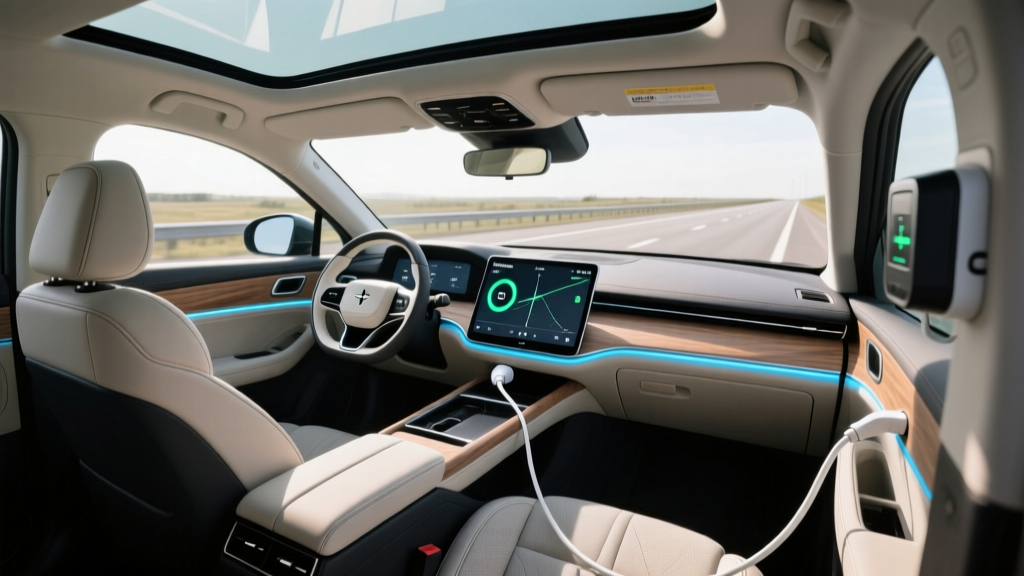
The Polestar 3 interior is the main reason buyers cross-shop this SUV against German rivals. Polestar has leaned hard into Scandinavian minimalism — but unlike the starkness of some Tesla cabins, this feels warm and intentionally curated.
Materials and Build Quality
The cabin uses bio-attributed MicroTech upholstery (a synthetic material derived from renewable sources) as standard, with available Nappa leather from Bridge of Weir. Real wood trim comes from responsibly sourced sources, and the aluminum accents feel substantial rather than cosmetic. Panel gaps are tight, and the switchgear has a satisfying damped action that signals premium intent.
Infotainment and Displays
A 14.5-inch center touchscreen runs Polestar's Android Automotive OS — the same Google-native platform used in the Polestar 2 and several Volvo models. Google Maps, Google Assistant, and the Play Store are built in. A 9-inch driver display handles speed, range, and navigation prompts. A head-up display projects key data onto the windshield. The system is responsive, though some climate controls are buried in menus — a recurring complaint in modern EVs.
Passenger and Cargo Dimensions
Front legroom measures 41.1 inches, with 38.4 inches in the rear — adequate for adults on longer trips but tighter than the BMW iX's generous rear quarters. Headroom is excellent front and rear thanks to the flat floor and SUV roofline. Cargo space at 17.1 cubic feet behind the second row is modest for the class (the iX offers ~35.5 cu ft), but folding the 40/20/40 rear seats expands capacity significantly. The 1.1 cu ft frunk is essentially a charging-cable cubby rather than real storage.
Standout Interior Features
- Bowers & Wilkins 25-speaker premium audio system with Dolby Atmos (optional)
- Biometric LiDAR-based driver monitoring (eye-tracking for fatigue detection)
- Heat pump standard for efficient cabin heating in cold weather
- Ambient lighting with 10 selectable themes
- Available panoramic glass roof with electrochromic dimming
Real-World Range vs. EPA Estimates
EPA Estimated Range: 348 miles (Long Range Dual Motor) / 315 miles (Performance Pack)
Real-World Expectation: Plan for approximately 280-310 miles in mixed highway driving at 70-75 mph. In cold weather (below 30°F), expect a 15-25% reduction, bringing usable range to roughly 240-270 miles depending on cabin heating demand and driving style. City driving with regenerative braking can approach or slightly exceed the EPA figure.
The 111 kWh battery pack (NMC chemistry) is one of the largest in the segment, and it shows in the EPA sticker. However, the Polestar 3 is a heavy vehicle — over 5,700 lbs — and efficiency at sustained highway speeds suffers accordingly. The standard heat pump helps mitigate cold-weather losses by efficiently scavenging waste heat from the powertrain rather than relying solely on resistive cabin heating. For context, the EPA's fueleconomy.gov listing rates the LRDM at 87 MPGe combined, or 39 kWh per 100 miles — competitive with the Audi Q8 e-tron but behind the more aerodynamic BMW iX xDrive50.
Charging Speed: DC Fast and Home Level 2
| Charging Level | Power | Speed / Time | Connector |
|---|---|---|---|
| Level 1 (120V) | ~1.4 kW | ~4 miles per hour | J1772 (adapter) |
| Level 2 (240V Home) | 11 kW (max onboard) | ~33 miles per hour; full charge in ~10 hrs | J1772 / NACS (varies by delivery date) |
| DC Fast Charge | 250 kW peak | 10-80% in ~30 min; adds ~150 mi in 15 min | CCS1 / NACS (varies by delivery date) |
The 250 kW peak DC charge rate is respectable but not class-leading — the Hyundai Ioniq 5 and Kia EV6 can hit 350 kW on compatible chargers. More importantly, the Polestar 3's charge curve is relatively flat in the mid-range, meaning it sustains strong charging power from roughly 20-60% SoC before tapering. Expect the 10-80% sprint to take about 30 minutes at a 350 kW Electrify America or Tesla Supercharger (with adapter) station, though real-world conditions (battery temperature, ambient heat, station power sharing) can push this to 35 minutes.
At home on a Level 2 charger, the 11 kW onboard charger means a full charge from near-empty takes roughly 10 hours. Most owners charging overnight from a typical 20-80% daily window will need only 6-7 hours. We recommend a 48-amp hardwired Level 2 station (such as the ChargePoint Home Flex or Wallbox Pulsar Plus) on a 60-amp circuit to maximize the 11 kW capability. Note: Polestar has been transitioning to the NACS connector for newer deliveries; check your specific vehicle's port configuration, as early 2025 models shipped with CCS1 and a NACS adapter may be required for Tesla Supercharger access.
Performance and Driving Dynamics
The dual-motor AWD powertrain delivers 489 horsepower in standard Long Range Dual Motor trim and 517 hp with the Performance Pack, which also unlocks a torque-vectoring rear motor for sharper cornering. The 4.7-second 0-60 mph time (4.2 with Performance) is quick but not startling for the price — the Tesla Model X Plaid demolishes that benchmark, while the BMW iX M60 hits 3.6 seconds.
Where the Polestar 3 excels is ride quality. The standard air suspension with adaptive damping soaks up road imperfections with a suppleness that rivals the best in the luxury SUV segment. Steering is precise if slightly light, and the regenerative braking offers a one-pedal driving mode with adjustable intensity. This is a grand-touring EV, not a track weapon, and the driving experience reflects that tuning priority.
Pricing, Trims, and Federal Tax Credit Eligibility
| Trim | Base MSRP | Typical As-Tested | §30D Federal Credit Eligibility |
|---|---|---|---|
| Long Range Dual Motor | $79,900 | $83,000-$88,000 | Not eligible (MSRP exceeds $80,000 SUV cap) |
| LRDM + Performance Pack | $85,900 | $90,000-$96,000 | Not eligible |
| LRDM + Plus Pack | $84,400 | $87,000-$92,000 | Not eligible |
This is the critical ownership detail many shoppers miss. Under current IRS §30D rules, SUVs must have an MSRP at or below $80,000 to qualify for the up-to-$7,500 federal EV tax credit. The Polestar 3 Long Range Dual Motor starts at $79,900 — technically under the cap — but virtually any option, package, or destination charge pushes the MSRP above $80,000, disqualifying it. The Performance and Plus packs put it well over the threshold.
§30D Federal Tax Credit Requirements (2025 rules):
- Vehicle MSRP cap: $80,000 for SUVs, $55,000 for sedans
- Buyer income cap: $300,000 (joint), $225,000 (head of household), $150,000 (individual) modified AGI
- Battery critical minerals and component sourcing requirements (phased in annually)
- Vehicle must be assembled in North America (the Polestar 3 is built in Chengdu, China — disqualifying on this basis alone)
- Credit can be transferred to the dealer at point of sale as a purchase-price reduction if eligible
Even if the base MSRP squeaked under the cap, the Polestar 3's Chinese assembly means it fails the North American final-assembly requirement. Buyers should not expect any federal tax credit for this vehicle. Some state and local incentives (such as utility rebates for home charger installation) may still apply — check your state's energy office for current programs. Consult a tax professional for personal eligibility questions.
ADAS and Smart Driving Features
SAE Automation Level: Level 2 — The Polestar 3's Pilot Assist and available Pilot Pack with LiDAR provide advanced driver assistance, but the driver must remain fully engaged with hands on the wheel and eyes on the road at all times. This is not autonomous or self-driving capability.
Standard driver-assistance features include adaptive cruise control with stop-and-go, lane-centering steering, automatic emergency braking with pedestrian and cyclist detection, blind-spot monitoring, and rear cross-traffic alert. The optional Pilot Pack adds a Luminar LiDAR sensor mounted in the roofline, providing enhanced long-range object detection and redundancy for future over-the-air feature updates. Polestar has indicated that advanced highway-driving features will be unlocked via OTA updates, but as of this writing, the system remains a competent Level 2 setup comparable to Volvo's Pilot Assist — reliable for highway cruising but requiring constant driver supervision.
What the Polestar 3 driver-assist does NOT do: It will not navigate city streets autonomously, change lanes without driver confirmation, stop at traffic lights without driver input, or operate without hands on the steering wheel. Treat it as a co-pilot, not a chauffeur.
Ownership Costs, Warranty, and Long-Term Outlook
Polestar backs the Polestar 3 with an 8-year/100,000-mile battery and powertrain warranty, with a capacity-retention threshold of 70% — standard for the luxury EV segment. The basic vehicle warranty is 4 years/50,000 miles. Scheduled maintenance is minimal (cabin air filter, brake fluid checks, tire rotation), and Polestar includes 3 years of complimentary scheduled maintenance.
Insurance costs for the Polestar 3 run higher than average for the segment — expect quotes in the $2,800-$3,600 annually range depending on your profile and location, driven by the vehicle's repair costs and premium parts sourcing. Charging costs at home on a national average electricity rate of $0.16/kWh work out to roughly $6.25 per 100 miles, or about $0.063 per mile — roughly a third of what a comparable gasoline SUV costs in fuel.
The NMC battery chemistry offers high energy density (enabling that 348-mile range in a package that isn't physically enormous) but has a somewhat higher long-term degradation profile than LFP chemistry. Expect roughly 8-12% capacity loss over the first 100,000 miles based on industry averages for NMC packs with active thermal management. Regular use of DC fast charging, frequent 100% charges, and sustained operation in extreme heat will accelerate degradation — keeping daily charges between 20-80% is the single best practice for longevity.
Pros
- Exceptional interior material quality and Scandinavian design ethos
- 348-mile EPA range is among the best in the luxury SUV class
- Standard air suspension delivers a refined, quiet ride
- 250 kW DC fast charging with a usable charge curve
- Standard heat pump for cold-weather efficiency
- LiDAR-equipped ADAS hardware for future capability
- Android Automotive infotainment with native Google apps
Cons
- Not eligible for the $7,500 federal tax credit (Chinese assembly + MSRP cap)
- Cargo space is below class average (17.1 cu ft behind rear seats)
- Small frunk offers minimal additional storage
- Some climate controls buried in touchscreen menus
- 0-60 time trails performance rivals like the iX M60 and Model X
- Charging port configuration (CCS vs NACS) varies by build date — verify before purchase
- Brand-new model with limited long-term reliability data
Who Should Buy the Polestar 3?
Choose the Polestar 3 if: You prioritize interior quality and design over raw performance stats, want 300+ miles of real-world range for road trips, prefer a quieter and less tech-overwhelming cabin than Tesla offers, and don't rely on the federal tax credit to make the math work.
Look elsewhere if: You need maximum cargo space (the BMW iX is significantly larger), want the fastest possible DC charging (Ioniq 5/EV6 at 350 kW), require the $7,500 federal credit to justify the purchase, or prefer established dealer networks with proven long-term service infrastructure.
The Polestar 3 is best suited for design-conscious professionals and small families who commute daily and take occasional road trips, have reliable home Level 2 charging access, and value material quality and understated luxury over badge prestige or sub-4-second acceleration. It's a compelling alternative to the ubiquitous Tesla Model X and the aging Audi Q8 e-tron — but it demands a buyer who has done their homework on incentives and charging logistics.
Frequently Asked Questions
What is the real-world range of the Polestar 3?
The EPA rates the Long Range Dual Motor at 348 miles. In real-world highway driving at 70-75 mph, expect 280-310 miles. Cold weather (below 30°F) can reduce this to 240-270 miles. City driving with regenerative braking can approach the EPA figure.
How fast does the Polestar 3 charge?
On DC fast charging, it peaks at 250 kW, achieving a 10-80% charge in approximately 30 minutes under ideal conditions. At home on Level 2 (240V), the 11 kW onboard charger adds about 33 miles per hour, completing a full charge in roughly 10 hours.
Does the Polestar 3 qualify for the federal EV tax credit?
No. The Polestar 3 is assembled in Chengdu, China, which disqualifies it from the IRS §30D credit regardless of MSRP. Additionally, most configurations exceed the $80,000 SUV MSRP cap. Check IRS.gov for current rules and consult a tax professional.
Is the Polestar 3 worth buying over the BMW iX or Tesla Model X?
The Polestar 3 offers a more distinctive interior and a smoother ride than either rival, with competitive range. However, the BMW iX provides significantly more cargo space and qualifies for the federal credit (US-assembled), while the Tesla Model X offers Supercharger network access and faster acceleration. Your priority — design, space, or performance — should drive the decision.
What battery chemistry does the Polestar 3 use?
The Polestar 3 uses an NMC (nickel manganese cobalt) lithium-ion battery with a gross capacity of 111 kWh (~107 kWh usable). NMC offers high energy density for maximum range but requires more careful charge management for long-term health compared to LFP chemistry.
What is the Polestar 3's towing capacity?
The Polestar 3 is rated to tow up to 3,500 lbs when properly equipped — sufficient for a small trailer, bike rack, or light camper, but not for heavy boat or horse trailers.