Polestar 3 at a Glance: Size, Range, and the Numbers That Matter
The Polestar 3 is a midsize luxury electric SUV that slots between the compact Polestar 2 and the larger Polestar 4 in the brand's lineup. Built on the same SPA2 platform as the Volvo EX90, it targets buyers who want Scandinavian design, serious battery capacity, and a footprint that still fits a standard garage. If you've been searching for Polestar 3 dimensions alongside real-world range and charging data, this profile gives you the exact figures — not just the brochure highlights.
For 2026, the Polestar 3 is offered in two primary configurations: the Long Range Dual Motor (LRDM) and the Long Range Dual Motor with Performance Pack (LRDM PP). Both share the same 111 kWh gross battery pack (NMC chemistry) and all-wheel-drive layout, but differ in power output and 0-60 times. Pricing starts in the mid-$60,000 range before incentives, placing it squarely against the BMW iX, Audi Q8 e-tron, and Tesla Model X.
| Spec | LR Dual Motor | LR Dual Motor + Performance |
|---|---|---|
| EPA Range | ~315 miles | ~279 miles |
| Battery (gross / usable) | 111 kWh / ~107 kWh | 111 kWh / ~107 kWh |
| Chemistry | NMC (Nickel Manganese Cobalt) | NMC |
| Horsepower | 489 hp | 517 hp |
| Torque | 620 lb-ft | 671 lb-ft |
| 0-60 mph | 4.7 seconds | 4.2 seconds |
| Drivetrain | AWD (dual motor) | AWD (dual motor) |
| Max DC Fast Charge | 250 kW | 250 kW |
| 10-80% DC Charge Time | ~30 minutes | ~30 minutes |
| Level 2 Home Charge Rate | 11 kW (AC) | 11 kW (AC) |
| MPGe (combined) | ~81 MPGe | ~74 MPGe |
| Base MSRP | ~$67,900 | ~$73,900 |
| Battery Warranty | 8 yr / 100,000 mi | 8 yr / 100,000 mi |
Polestar 3 Dimensions: Exterior, Interior, and Cargo Measurements
Understanding the physical footprint of the Polestar 3 is essential for garage fitment, parking ease, and family practicality. Here are the key exterior and interior measurements for the 2026 model year:
| Measurement | Value |
|---|---|
| Overall Length | 192.9 in (4,900 mm) |
| Overall Width (with mirrors) | 83.5 in (2,120 mm) |
| Overall Width (mirrors folded) | 76.2 in (1,935 mm) |
| Height | 63.5 in (1,614 mm) |
| Wheelbase | 117.5 in (2,985 mm) |
| Ground Clearance | ~6.9 in (175 mm) |
| Curb Weight | ~5,800 lbs (2,630 kg) |
| Cargo Volume (rear seats up) | ~17.1 cu ft |
| Cargo Volume (rear seats folded) | ~39.0 cu ft |
| Front Trunk (Frunk) | ~1.1 cu ft (small cable storage) |
| Front Legroom | ~41.1 in |
| Rear Legroom | ~37.4 in |
| Front Headroom | ~39.8 in |
| Rear Headroom | ~38.5 in |
At 192.9 inches long, the Polestar 3 is slightly shorter than the BMW iX (195.5 in) but wider than the Audi Q8 e-tron when mirrors are deployed. The 117.5-inch wheelbase translates to generous rear legroom, though the sloping roofline does trim rear headroom compared to boxier competitors. The 17.1 cu ft cargo area behind the second row is adequate for weekly groceries and two large suitcases, but families needing maximum haulage should consider the Volvo EX90 or Tesla Model X, both of which offer significantly more volume with seats folded.
The frunk is disappointingly small — essentially a shallow compartment for charging cables rather than usable luggage space. Polestar prioritized structural rigidity and HVAC components under the hood, a trade-off common in SPA2-based vehicles.
Range and Efficiency: EPA vs. Real-World Expectations
EPA Estimated: ~315 miles (LRDM) / ~279 miles (Performance Pack)
Real-World Highway (70-80 mph, moderate temps): ~255-275 miles (LRDM)
Cold Weather (below 32°F, mixed driving): ~210-240 miles (LRDM)
Efficiency: ~81 MPGe combined / 41 kWh per 100 miles (LRDM)
The Polestar 3's 111 kWh gross battery pack (approximately 107 kWh usable) is one of the largest in its class. The Long Range Dual Motor variant targets ~315 miles of EPA range, which is competitive with the BMW iX xDrive50's ~324-mile rating. However, as with any heavy AWD electric SUV, real-world results diverge significantly from the sticker.
In highway-heavy driving at 70-80 mph with moderate temperatures, expect approximately 255-275 miles from the standard LRDM. The Performance Pack variant, with its larger 22-inch wheels and stickier tires, sacrifices roughly 35 miles of EPA range — and real-world highway figures will land closer to 230-245 miles.
Cold weather is the great equalizer for all lithium-ion batteries. The Polestar 3 uses a liquid thermal management system with a heat pump (standard), which mitigates some winter losses. Still, at temperatures below freezing, plan for a 25-35% reduction in range, bringing the LRDM down to roughly 210-240 miles. The heat pump helps preserve cabin comfort without drawing heavily from the traction battery, a meaningful advantage over resistive-heating systems in competitors like older Audi e-tron models.
According to fueleconomy.gov, the combined efficiency rating of ~81 MPGe translates to roughly 41 kWh consumed per 100 miles of driving. At the national average electricity rate of $0.16/kWh, that's approximately $6.56 per 100 miles — roughly a third of what a comparable gasoline SUV would cost at $3.50/gallon and 22 MPG combined.
Charging Speed: DC Fast Charging and Home Level 2 Data
Charging speed is where the Polestar 3's large battery becomes both an asset and a challenge. More capacity means more range, but it also means longer fill-up times unless the charge rate keeps pace.
| Charge Level | Power / Rate | Speed (miles added) | Time |
|---|---|---|---|
| Level 1 (120V household) | ~1.4 kW | ~3-4 miles per hour | 70+ hours (full) |
| Level 2 (240V, 48A home) | 11 kW | ~27-30 miles per hour | ~10 hours (0-100%) |
| DC Fast Charge (peak) | 250 kW | ~180+ mi in 30 min | ~30 min (10-80%) |
DC Fast Charging: The Polestar 3 peaks at 250 kW on a compatible CCS1 or NACS-equipped DC fast charger (Polestar has confirmed NACS adoption for 2025+ models, granting access to Tesla Supercharger stalls with an adapter or native port depending on build date). At peak rate, the 10-80% charge takes approximately 30 minutes. However, the charge curve is not flat — expect peak rates only between roughly 10-40% State of Charge. Above 60%, the rate tapers significantly, dropping below 100 kW by 75% SoC. This is typical for NMC chemistry at this capacity but means the last 20% adds considerable time. For road trips, plan stops around the 10-80% window to minimize idle time.
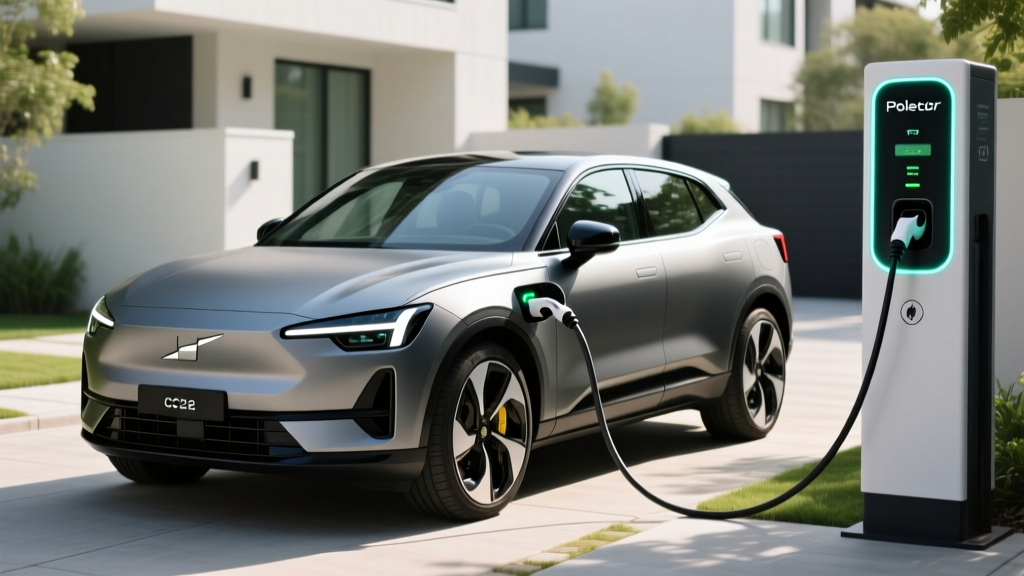
Level 2 Home Charging: The onboard charger accepts up to 11 kW on AC power. With a 48-amp Level 2 home charger (such as a ChargePoint Home Flex or Wallbox Pulsar Max hardwired to a 60A circuit), you'll add roughly 27-30 miles of range per hour. A full 0-100% charge takes approximately 10 hours — easily achievable overnight. Most owners who charge nightly from a 240V outlet will never need to use the full 10-hour window; topping up from 50% to 90% takes roughly 4-5 hours.
Level 1 Emergency Charging: On a standard 120V household outlet, the Polestar 3 adds only 3-4 miles per hour. This is impractical for daily use but sufficient for emergency trickle-charging if you're parked at a cabin or visiting family without a dedicated EV circuit.
Preconditioning the battery before arriving at a DC fast charger is essential. Use the Polestar app or navigation system to initiate preconditioning 15-20 minutes before arrival — the battery management system will warm the pack to optimal temperature, enabling faster peak charge rates. Skipping this step in cold weather can add 10-15 minutes to your 10-80% time.
Performance, Ride Quality, and Drivetrain
The Polestar 3 delivers the kind of effortless acceleration that only a dual-motor AWD electric powertrain can provide. The standard Long Range Dual Motor produces 489 horsepower and 620 lb-ft of torque, reaching 60 mph in 4.7 seconds. The Performance Pack bumps output to 517 hp and 671 lb-ft, dropping the 0-60 time to 4.2 seconds.
These numbers are quick, but not class-leading — the Tesla Model X Plaid exists in a different performance universe, and the BMW iX M60 hits 60 in 3.6 seconds. The Polestar 3's performance philosophy leans toward composed grand-touring capability rather than track-focused aggression. The torque-vectoring rear axle (standard) can disconnect the rear motor entirely during light-load cruising to improve efficiency, then re-engage it in milliseconds when traction or acceleration demands increase.
Ride quality is controlled and firm, with standard adaptive dampers that adjust based on driving mode. The air suspension (available on higher trims) adds a useful 1.5 inches of ride height adjustment, helpful for steep driveways or light trail access. Road noise is well-suppressed, aided by acoustic glass and the inherent quietness of the electric drivetrain. At highway speeds, the Polestar 3 is one of the quietest cabins in its class.
Towing capacity is rated at approximately 4,400 pounds when properly equipped — sufficient for a small utility trailer or a pair of jet skis, but below the Tesla Model X's 5,000-pound rating and well below what body-on-frame electric trucks offer.
Pricing, Trims, and Federal Tax Credit Eligibility
The 2026 Polestar 3 is positioned as a premium luxury EV, and pricing reflects that ambition. Here's the current lineup:
| Trim | Base MSRP | As-Tested (typical options) | §30D Credit Eligibility |
|---|---|---|---|
| Long Range Dual Motor | ~$67,900 | ~$73,000-76,000 | Partial — see below |
| LRDM + Performance Pack | ~$73,900 | ~$79,000-84,000 | Partial — see below |
- MSRP Cap: SUVs/vans must be ≤ $80,000 MSRP to qualify. The base LRDM at ~$67,900 clears this cap, but adding options packages can push the MSRP above $80,000, disqualifying the vehicle.
- Buyer Income Cap: Modified adjusted gross income must not exceed $150,000 (single), $225,000 (head of household), or $300,000 (joint filers).
- Battery Sourcing: The credit is split into two halves ($3,750 each): one tied to critical minerals sourcing and one to battery component manufacturing. As of 2026, battery components must be manufactured or assembled in North America, and critical minerals must be sourced from the U.S. or a free-trade-agreement partner. Polestar has been working to localize its supply chain, but eligibility for the full $7,500 is not guaranteed — check the IRS clean vehicle credit page for the most current VIN-specific eligibility before purchasing.
- Point-of-Sale Transfer: The credit can now be transferred to the dealer at purchase, reducing your out-of-pocket cost immediately rather than waiting for tax filing.
Always consult a tax professional and verify eligibility with the dealer before relying on the credit. Rules change, and individual circumstances vary.
Technology, Safety, and Driver Assistance
The Polestar 3 runs on a Snapdragon Cockpit Platform powering a 14.5-inch center touchscreen with Google built-in (Google Maps, Google Assistant, and Google Play Store). The interface is clean, responsive, and among the best in the luxury EV segment — a meaningful step above the cluttered menus in some German competitors. Wireless Apple CarPlay is supported, and over-the-air (OTA) updates continuously add features and refine performance.
The driver-assistance suite includes adaptive cruise control with stop-and-go, lane-centering assist, blind-spot monitoring, rear cross-traffic alert, and a 360-degree camera system. Polestar equips the 3 with LiDAR hardware from Luminar (standard on the Performance Pack, optional on the base trim), which enhances the vehicle's perception capabilities for future feature unlocks. However, it's critical to understand the automation level here:
The Polestar 3's driver-assistance features are classified as SAE Level 2. This means the system can manage steering, acceleration, and braking under certain conditions, but the driver must remain fully engaged, hands on or near the wheel, and eyes on the road at all times. This is not self-driving. Only Level 4 services (like Waymo robotaxis operating in geofenced areas) offer driverless capability. Do not treat any Level 2 system as autonomous.
Safety ratings from NHTSA and IIHS were not yet fully published at the time of this writing for the 2026 model year, but the SPA2 platform was engineered to exceed global crash-test standards, with a robust aluminum and boron-steel safety cell. Check NHTSA.gov and IIHS.org for updates as testing results are released.
Notable tech drawbacks: The Polestar 3 lacks a traditional instrument cluster, relying instead on a compact driver display and the head-up display (HUD). Some buyers find this minimalist approach liberating; others miss having a dedicated speed/range screen directly in their sightline. The phone-as-key system works via Bluetooth but has drawn early complaints about connection latency — carrying the physical key fob is recommended until OTA improvements address this.
Warranty Coverage and Long-Term Ownership
Polestar provides competitive warranty coverage for the 2026 model year:
- Battery & Powertrain: 8 years / 100,000 miles (whichever comes first), with a capacity retention threshold of 70% — if the battery degrades below 70% of original capacity within the warranty period, Polestar will repair or replace it.
- Limited Vehicle Warranty: 4 years / 50,000 miles
- Corrosion Warranty: 12 years (unlimited miles)
- Roadside Assistance: 4 years / 50,000 miles
The 70% battery retention threshold is standard for the industry (Tesla uses the same benchmark). For context, NMC batteries typically degrade 10-15% over the first 100,000 miles under normal use, meaning most owners will remain well within warranty coverage. To maximize battery longevity, avoid routinely charging to 100% for daily use — set your charge limit to 80-90% and save 100% sessions for road trips. The Polestar 3's thermal management system actively conditions the battery during fast charging, reducing degradation risk from high-C-rate sessions.
Who Should Buy the Polestar 3 — And Who Should Look Elsewhere
Choose the Polestar 3 If:
- You want a luxury electric SUV with distinctive Scandinavian design that stands out from the ubiquitous Tesla Model X or German competitors
- You prioritize ride comfort, cabin quietness, and grand-touring composure over outright performance numbers
- You need 250+ miles of real-world highway range with DC fast charging fast enough for road trips (30 min, 10-80%)
- You value Google built-in infotainment and OTA updates in a clean, minimal interface
- Standard LiDAR hardware and future-ready sensor suites matter to you
Look Elsewhere If:
- Maximum cargo volume is essential — the 17.1 cu ft behind the rear seats is modest for this class
- You need three rows of seating (consider the Volvo EX90, Kia EV9, or Tesla Model X)
- Budget is under $60,000 — the Polestar 3 starts near $68K and options climb quickly
- You want the fastest acceleration in the segment (BMW iX M60 or Tesla Model X Plaid)
- You require guaranteed full $7,500 federal tax credit eligibility — verify VIN sourcing before committing
Pros
- 111 kWh battery provides genuine 250+ mile real-world range
- 250 kW DC fast charging is competitive with the best in class
- Refined, quiet ride with adaptive suspension
- Google built-in infotainment is responsive and intuitive
- Standard LiDAR hardware on Performance Pack
- Heat pump standard for cold-weather efficiency
Cons
- Cargo volume (17.1 cu ft) trails key competitors
- Tiny frunk is essentially unusable for luggage
- High starting price; options push past $80K MSRP cap
- No third-row option
- Phone-as-key reliability needs improvement
- Federal tax credit eligibility uncertain due to sourcing rules
Frequently Asked Questions
What is the real-world range of the Polestar 3?
The EPA rates the Long Range Dual Motor at approximately 315 miles, but real-world highway driving at 70-80 mph yields roughly 255-275 miles in moderate temperatures. In cold weather (below freezing), expect 210-240 miles. The Performance Pack variant loses about 35 miles of EPA range due to larger wheels and stickier tires.
How fast does the Polestar 3 charge at home and on the road?
On a DC fast charger, the Polestar 3 peaks at 250 kW and charges from 10-80% in approximately 30 minutes. At home on a 240V Level 2 charger (11 kW), it adds about 27-30 miles per hour, with a full charge taking roughly 10 hours. Level 1 (120V) adds only 3-4 miles per hour and is not practical for daily use.
How much does the Polestar 3 cost after tax credits?
The base LRDM starts at approximately $67,900. If you qualify for the full $7,500 federal tax credit under §30D (subject to income caps, MSRP ≤ $80,000, and battery sourcing requirements), the effective price drops to roughly $60,400. However, the full credit is not guaranteed — verify eligibility with your dealer and consult the IRS clean vehicle credit page before purchasing.
Does the Polestar 3 qualify for the federal EV tax credit?
It may qualify for partial or full credit, depending on your income, the vehicle's MSRP (must be ≤ $80,000 for SUVs), and battery component/critical mineral sourcing. Polestar has been localizing its supply chain, but 2026 rules are strict. Always check the IRS §30D guidance and confirm with your dealer using the specific VIN before relying on the credit.
Is the Polestar 3 worth buying over the BMW iX or Tesla Model X?
The Polestar 3 excels in cabin refinement, design distinctiveness, and Google-native infotainment. The BMW iX offers more cargo space and a slightly longer EPA range. The Tesla Model X provides falcon-wing doors, more cargo volume, and access to the Supercharger network natively (though Polestar now supports NACS). If you value Scandinavian design and a composed ride, the Polestar 3 is compelling. If cargo space or third-row seating are non-negotiable, look at the Model X or Volvo EX90.
What are the Polestar 3's exterior dimensions?
The Polestar 3 measures 192.9 inches long, 76.2 inches wide (mirrors folded), and 63.5 inches tall, with a 117.5-inch wheelbase. Curb weight is approximately 5,800 lbs. It will fit in a standard single-car garage, but verify your garage width — at 83.5 inches with mirrors deployed, it's wider than many midsize SUVs.
What battery chemistry does the Polestar 3 use?
The Polestar 3 uses NMC (Nickel Manganese Cobalt) chemistry in its 111 kWh gross battery pack. NMC offers higher energy density than LFP (Lithium Iron Phosphate), enabling the 315-mile EPA range in a package that fits the vehicle's footprint. The trade-off is that NMC batteries are more sensitive to sustained 100% SoC storage and high-temperature fast charging — follow Polestar's recommended charge limits for daily use (80-90%) to maximize longevity.