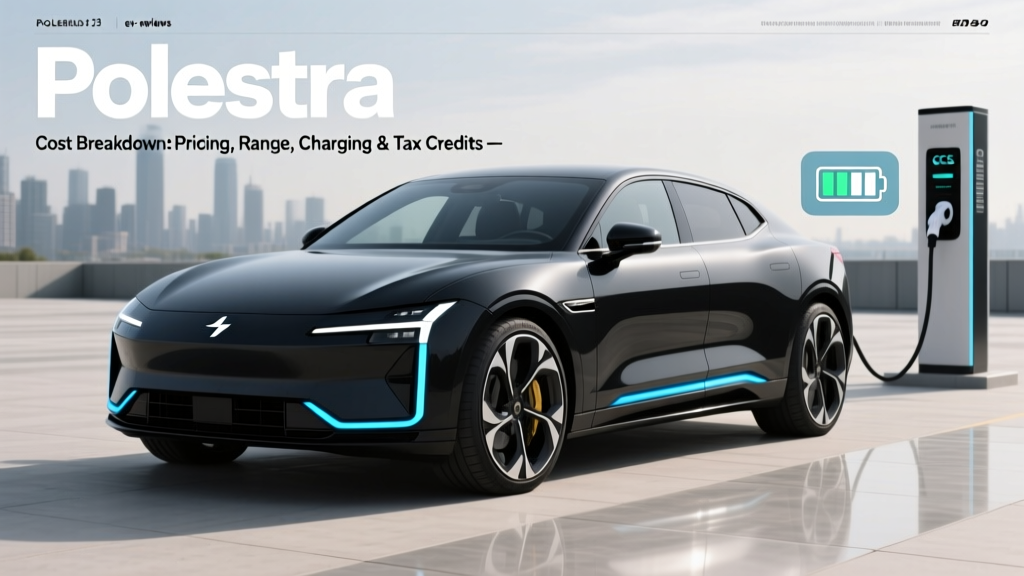
The Polestar 3 positions itself as a premium electric SUV with Scandinavian design, dual-motor performance, and a tech-forward cabin. But premium positioning means a premium price tag — and for buyers weighing this against the Tesla Model X, BMW iX, or Audi Q8 e-tron, the real question is whether the Polestar 3 cost justifies what you get. Below, we break down every number that matters: MSRP, real-world range, charging speed, tax credit eligibility, and total ownership economics.
Polestar 3 at a Glance: Key Specs
| Spec | Long Range Dual Motor | Long Range Dual Motor w/ Performance Pack |
|---|---|---|
| EPA Range | ~315 miles | ~287 miles |
| Battery (usable) | 111 kWh (NMC) | 111 kWh (NMC) |
| Horsepower | 489 hp | 523 hp |
| 0-60 mph | 4.8 sec | 4.5 sec |
| Drivetrain | AWD (dual motor) | AWD (dual motor) |
| Max DC Fast Charge | 250 kW | 250 kW |
| 10-80% DC Time | ~30 min | ~30 min |
| Level 2 Charge Rate | 11 kW (~33 mi/hr) | 11 kW (~33 mi/hr) |
| Efficiency | ~81 MPGe / 41 kWh/100mi | ~76 MPGe / 44 kWh/100mi |
| Base MSRP | $69,900 | $75,900 |
| Battery Warranty | 8 yr / 100,000 mi | 8 yr / 100,000 mi |
How Much Does the Polestar 3 Actually Cost?
The Polestar 3 launched in the U.S. with a single Long Range Dual Motor configuration and an optional Performance Pack. Pricing has shifted slightly for the 2026 model year, but the core structure remains:
- Long Range Dual Motor: $69,900 MSRP (before destination)
- Long Range Dual Motor with Performance Pack: $75,900 MSRP
- Destination fee: ~$1,400
Options like the Nappa leather upgrade, Bowers & Wilkins audio, and specific 22-inch wheel designs add between $2,500 and $5,500. A fully loaded Performance Pack model with the Plus and Pilot packages can approach $83,000-$85,000 before any incentives.
Federal Tax Credit: Does the Polestar 3 Qualify?
Under IRS §30D clean vehicle credit rules, the Polestar 3 faces the SUV MSRP cap of $80,000. The base Long Range Dual Motor at $69,900 clears this threshold, and most moderately optioned builds stay under $80,000. However, a fully loaded Performance Pack model with all packages can push past the cap, eliminating credit eligibility.
§30D Requirements for Polestar 3 (2026 rules):
- MSRP cap: Must not exceed $80,000 (SUV classification)
- Buyer income cap: AGI ≤ $150,000 (single) / $300,000 (joint)
- Battery sourcing: Critical minerals and battery components must meet phased-in domestic/free-trade sourcing thresholds — check the specific VIN on fueleconomy.gov for current eligibility
- Point-of-sale transfer: Eligible buyers can apply the credit as a down-payment reduction at the dealer
- Final assembly: Must occur in North America — Polestar 3 production for the U.S. market occurs at the Volvo plant in Ridgeville, South Carolina
| Configuration | MSRP | Est. Federal Credit | Effective Price |
|---|---|---|---|
| LR Dual Motor (base) | $69,900 | Up to $7,500* | ~$62,400 |
| LR Dual Motor + Perf. Pack | $75,900 | Up to $7,500* | ~$68,400 |
| LR DM + Perf. Pack + All Options | ~$83,000 | $0 (exceeds cap) | ~$83,000 |
*Credit amount depends on battery component and critical-mineral sourcing compliance per IRS guidance. Verify your VIN before purchase. Consult a tax professional for personal eligibility.
Real-World Range: What to Expect Beyond the EPA Sticker
EPA Estimated Range: 315 miles (base) / 287 miles (Performance Pack)
Real-World Expectations:
- Mixed driving (55-70 mph, moderate climate): ~275-295 miles
- Sustained highway (75+ mph): ~240-265 miles
- Cold weather (below 32°F): ~200-240 miles (20-35% reduction typical for NMC packs without consistent preconditioning)
The Polestar 3's 111 kWh usable battery is among the largest in its class, but that mass works against efficiency. At roughly 41-44 kWh per 100 miles, the Polestar 3 is less efficient than the Tesla Model X (which achieves similar range with a smaller, lighter pack) but comparable to the BMW iX xDrive50. The heat pump — standard on U.S. models — helps mitigate cold-weather range loss, but any large, heavy dual-motor SUV will see significant highway and winter penalties.
For most commuters covering 30-50 miles round-trip, the Polestar 3 needs charging only twice a week. Road-trippers should plan stops at roughly 200-mile intervals to stay in the 10-80% fast-charge sweet spot.
Charging Speed: DC Fast Charge and Home Level 2
| Charging Level | Power / Rate | Speed | Notes |
|---|---|---|---|
| Level 1 (120V household) | ~1.4 kW | ~3-4 mi/hr | Emergency/trickle only — full charge in 3+ days |
| Level 2 (240V home) | 11 kW | ~33 mi/hr | Full 0-100% in ~11 hours; overnight is sufficient |
| DC Fast Charge | Peak 250 kW | 10-80% in ~30 min | Curve tapers significantly above 80%; 80-100% adds ~25 min |
The 250 kW peak DC rate is competitive but not class-leading — the Hyundai Ioniq 5 and Kia EV6 accept up to 350 kW, and the Lucid Gravity peaks near 300 kW. In practice, the Polestar 3 sustains strong charging power through the 20-60% range, then progressively tapers. Expect roughly 180-200 miles of range added in the first 15 minutes at a 250+ kW station, with the curve flattening meaningfully past 80%.
For home charging, the 11 kW onboard charger is a practical advantage over vehicles limited to 7.7 kW or 9.6 kW. On a 48-amp Level 2 circuit (the common residential setup requiring a 60-amp breaker), the Polestar 3 adds about 33 miles of range per hour — enough to fully replenish overnight from any daily driving.
Installation note: A 48-amp Level 2 home charger typically requires a 240V/60A dedicated circuit. Installation costs range from $800 to $2,500 depending on panel proximity and local permitting. Homes with older 100-amp electrical panels may need a $1,500-$3,000 panel upgrade. Always consult a licensed electrician for final specifications.
Performance, Handling, and Drivetrain
The Polestar 3's dual-motor AWD powertrain delivers 489 horsepower in standard form, rising to 523 hp with the Performance Pack (which also adds torque vectoring on the rear axle). The 0-60 mph times of 4.8 and 4.5 seconds respectively are brisk but not extreme — BMW's iX M60 hits 60 in 3.6 seconds, and the Tesla Model X Plaid is in a different universe at 2.5 seconds.
Where the Polestar 3 distinguishes itself is ride quality. The standard air suspension (rear axle) and available active damper tuning deliver a composed, GT-like character. This is a cruiser, not a track car. Road noise isolation is excellent, and the steering — while numb by sports-sedan standards — is appropriately weighted for a luxury SUV.
Towing capacity is rated at 4,400 pounds (braked), adequate for a small boat or utility trailer but below the Rivian R1S (7,700 lb) and Tesla Model X (5,000 lb). Towing will cut range by 30-50% depending on trailer weight and speed.
Interior, Cargo, and Technology
Passenger and Cargo Space
- Front headroom: ~40.2 inches
- Front legroom: ~41.1 inches
- Rear headroom: ~38.7 inches
- Rear legroom: ~37.4 inches
- Cargo (rear seats up): ~17.1 cu ft
- Cargo (rear seats folded): ~40.3 cu ft
- Front trunk (frunk): ~1.1 cu ft (small — fits a charging cable bag)
The Polestar 3's cargo volume is modest for its exterior footprint. The BMW iX offers ~35.5 cu ft behind the rear seats, and the Tesla Model X provides substantially more. The Polestar 3's sloping roofline prioritizes design over utility — if maximum cargo is your priority, look elsewhere.
Infotainment and Driver Assistance
The cabin centers on a 14.5-inch portrait touchscreen running a Google-based infotainment system (Android Automotive OS). Google Maps navigation, Google Assistant, and the Google Play Store are native. Apple CarPlay is supported. The system is responsive, but the heavy reliance on touchscreen controls — including climate and mirror adjustments — can frustrate drivers who prefer physical buttons.
Driver assistance includes:
- Pilot Pack (standard): Adaptive cruise control, lane centering, blind-spot monitoring
- Pilot Pack with LiDAR (optional, ~$5,000): Luminar liDAR sensor for enhanced perception, preparing for future over-the-air ADAS upgrades
SAE Automation Level: All current Polestar 3 driver-assistance features are Level 2 — the driver must remain fully engaged, hands on or near the wheel, and eyes on the road at all times. The optional liDAR hardware does not enable self-driving today. It is positioned as a future-ready sensor for potential OTA-enabled features, but no timeline or Level 3/4 capability has been confirmed for U.S. roads.
Notable Drawbacks
- Heavy touchscreen reliance — no physical climate knobs or volume dial
- Rear visibility compromised by thick C-pillars and sloping rear glass (a digital rearview mirror helps)
- Cargo space below class average
- Charging network: Polestar relies on third-party networks (Electrify America, EVgo, Tesla Superchargers via NACS adapter) — no proprietary network
- LiDAR option adds significant cost with no current functional advantage over standard cameras
Pros, Cons, and Who Should Buy the Polestar 3
Pros
- Distinctive Scandinavian design — stands out in a sea of Tesla and German SUVs
- Large 111 kWh battery delivers genuine 270+ mile real-world range
- 11 kW Level 2 charging is faster than most competitors
- Air suspension and GT-tuned ride quality
- Google Automotive OS is intuitive and well-integrated
- U.S. production (South Carolina) supports §30D tax credit eligibility
Cons
- Starting near $70K, fully loaded past $80K — expensive even with tax credit
- Cargo space lags BMW iX, Tesla Model X, and Rivian R1S
- 250 kW peak DC charge rate trails 800V competitors (Ioniq 5, EV6, Lucid)
- Efficiency (kWh/100mi) is below class average due to vehicle weight
- LiDAR option is costly with no near-term feature payoff
- No proprietary charging network — dependent on third-party reliability
Who Is the Polestar 3 For?
- Choose the Polestar 3 if: You want a design-forward luxury EV SUV with a comfortable ride, Google-native tech, and real 270+ mile range — and you value standing apart from the Tesla/BMW crowd.
- Look at the BMW iX if: Cargo space and efficiency matter more than exterior design, and you want a proven dealer/service network.
- Look at the Tesla Model X if: Supercharger access, maximum range, and third-row seating are priorities.
- Look at the Rivian R1S if: You need serious towing, three rows, or off-road capability.
- Look at the Hyundai Ioniq 5 or Kia EV9 if: Budget matters — both offer strong charging and space for $20K-$30K less.
Warranty and Ownership Costs
Polestar provides the following warranty coverage, consistent with Volvo Group standards:
- Limited vehicle warranty: 4 years / 50,000 miles
- Battery and powertrain warranty: 8 years / 100,000 miles (covers battery capacity falling below 70% of original)
- Corrosion warranty: 12 years, unlimited mileage
- Roadside assistance: 4 years / unlimited mileage
The 70% battery capacity retention threshold is standard for the industry but less generous than some competitors (Rivian guarantees 70%, Hyundai guarantees 70% on the Ioniq 5). Polestar does not currently offer a free maintenance plan, though scheduled EV maintenance is minimal — cabin air filter replacement and tire rotation are the primary recurring costs.
Insurance premiums for the Polestar 3 run higher than average for the segment due to the vehicle's price, repair costs for aluminum body panels, and limited claims history. Expect annual premiums in the $2,800-$3,800 range depending on your profile and location — get quotes before committing.
Frequently Asked Questions
What is the real-world range of the Polestar 3?
The EPA rates the base Long Range Dual Motor at approximately 315 miles, with the Performance Pack at 287 miles. In real-world mixed driving, expect 275-295 miles. Sustained highway driving at 75+ mph drops this to roughly 240-265 miles, and cold weather (below freezing) can reduce range by 20-35%, yielding 200-240 miles.
How fast does the Polestar 3 charge at home and on the road?
On a Level 2 home charger (240V, 48A), the Polestar 3 accepts up to 11 kW, adding about 33 miles of range per hour — a full charge takes roughly 11 hours overnight. On a DC fast charger, it peaks at 250 kW, reaching 10-80% in approximately 30 minutes. Charging slows considerably above 80% to protect battery health.
How much does the Polestar 3 cost after federal tax credits?
The base model starts at $69,900. If your VIN qualifies for the full $7,500 §30D credit and your income is within limits, the effective price drops to roughly $62,400. The Performance Pack model at $75,900 could drop to ~$68,400. However, heavily optioned builds exceeding the $80,000 SUV MSRP cap are ineligible. Always verify VIN-specific eligibility on fueleconomy.gov and consult a tax professional.
Does the Polestar 3 qualify for the federal EV tax credit?
It can. The Polestar 3 is assembled in South Carolina (meeting the North American final-assembly requirement), and base/mid-spec builds fall under the $80,000 SUV MSRP cap. However, eligibility depends on battery sourcing compliance (critical minerals and component thresholds set by the IRS), buyer income limits ($150K single / $300K joint AGI), and the specific VIN. Check fueleconomy.gov for the latest qualifying list.
Is the Polestar 3 worth buying vs. the BMW iX or Tesla Model X?
It depends on priorities. The Polestar 3 offers superior design distinctiveness, a comfortable GT ride, and Google-native tech. The BMW iX provides more cargo space and better efficiency. The Tesla Model X delivers Supercharger network access, longer range, and optional third-row seating. If design and ride quality top your list, the Polestar 3 is compelling. If practicality and charging infrastructure dominate, the competitors have edges.
What charging connector does the Polestar 3 use?
U.S.-market Polestar 3 vehicles come equipped with the NACS (North American Charging Standard) connector, granting access to Tesla Supercharger stations. For Electrify America and other CCS-equipped networks, a NACS-to-CCS adapter may be needed — confirm adapter availability with your dealer at purchase.
Sources: Polestar USA specifications, fueleconomy.gov, IRS §30D Clean Vehicle Credit. Pricing and incentive rules reflect 2026 model-year data and are subject to change. Verify all figures with your dealer and tax professional before purchase.