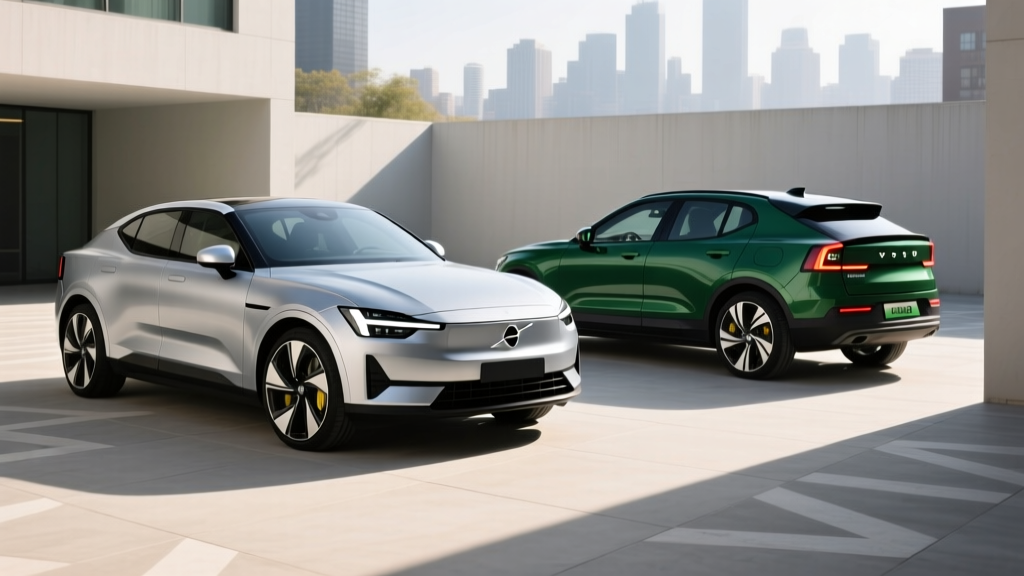
If you've been researching the Polestar Volvo connection, you already know these two Scandinavian brands share DNA — both born from Volvo Cars and backed by Geely. But in 2026, the Polestar 2 and Volvo C40 Recharge (now rebranded as the EC40) have diverged in meaningful ways. Same SEA-derived platform roots, different execution. This review breaks down the real numbers — range, charging curves, pricing after federal credits, and daily livability — to help you pick the right one.
Range & Efficiency: EPA Numbers vs. Real-World Reality
The EPA posts one number on the window sticker. Your commute rarely matches it. Here's what both cars actually deliver.
| Model / Trim | Battery (usable kWh) | Chemistry | EPA Range (mi) | MPGe (city/hwy/combined) | kWh/100mi |
|---|---|---|---|---|---|
| Polestar 2 LR Single Motor | 79 kWh | NMC | 320 | 124 / 106 / 115 | 29 |
| Polestar 2 LR Dual Motor | 79 kWh | NMC | 298 | 111 / 95 / 103 | 32 |
| Volvo EC40 LR Single Motor | 79 kWh | NMC | 310 | 121 / 103 / 112 | 30 |
| Volvo EC40 LR Twin Motor | 79 kWh | NMC | 293 | 108 / 93 / 101 | 33 |
Real-World Range Reality: The Polestar 2 Long Range Single Motor's EPA 320-mile figure holds up reasonably in city and suburban driving — expect 290–310 miles in mild weather. On sustained highway runs at 75 mph, plan for 255–275 miles. In sub-freezing winter conditions (20°F or below), range drops 20–30%, putting realistic winter highway range around 210–230 miles. The EC40 tracks similarly, though its slightly less aerodynamic crossover body costs it roughly 10–15 miles on the highway compared to the Polestar 2 sedan.
Both cars use NMC (nickel manganese cobalt) lithium-ion cells — higher energy density than LFP, but with a slightly more pronounced degradation curve over the long term. Neither offers an LFP option in 2026, which is worth noting if you're a high-mileage driver planning to keep the car past 100,000 miles.
Charging Speed: DC Fast, Level 2, and the Curve Nobody Talks About
Peak kW numbers get headlines. Sustained charging curves get you home. Here's the full picture.
| Charging Level | Rate | Polestar 2 | Volvo EC40 |
|---|---|---|---|
| Level 1 (120V) | ~1.4 kW | ~4 mi/hr | ~4 mi/hr |
| Level 2 (240V, 48A) | 11 kW onboard | ~37 mi/hr (full in ~8.5 hrs) | ~36 mi/hr (full in ~8.5 hrs) |
| DC Fast Charge (peak) | 200 kW | 10–80% in ~28 min | 10–80% in ~28 min |
Both cars peak at 200 kW on DC fast chargers, but here's what the marketing material skips: that peak only holds between roughly 10–35% state of charge. From 35–60%, the rate tapers to ~150 kW, and above 80% it drops sharply to under 50 kW. This is standard NMC charge-curve behavior, but it means the last 20% can take nearly as long as the first 60%. On a road trip, the practical move is charging from 10–80% and skipping the slow top-off.
Level 2 home charging at 11 kW means overnight replenishment is a non-issue. A typical commute of 40–60 miles round-trip needs only 1.5–2 hours on a home Level 2 unit. For home charger installation costs, expect $800–$2,500 depending on whether your panel needs upgrading — a detail dealers rarely mention upfront.
Performance & Drivetrain: What You Actually Feel
| Spec | Polestar 2 LR SM | Polestar 2 LR DM | Volvo EC40 LR SM | Volvo EC40 LR TM |
|---|---|---|---|---|
| Horsepower | 299 hp | 421 hp | 299 hp | 421 hp |
| Torque | 361 lb-ft | 523 lb-ft | 361 lb-ft | 523 lb-ft |
| 0–60 mph | 5.9 sec | 4.2 sec | 6.1 sec | 4.4 sec |
| Drivetrain | RWD | AWD (dual motor) | RWD | AWD (twin motor) |
| Top Speed | 100 mph (limited) | 100 mph (limited) | 112 mph (limited) | 112 mph (limited) |
The dual-motor variants in both cars hit 60 mph in the low-4-second range — genuinely quick. But the single-motor RWD models are the smarter buy for most drivers. They're lighter on the front axle (better efficiency), still adequately quick, and the 320-mile EPA range on the Polestar 2 single motor is the best number in this lineup.
Polestar offers the optional Performance Pack ($5,000) on dual-motor trims: Öhlins dampers, Brembo brakes, and a software bump to 476 hp. It transforms the car's handling but deletes some range. Worth it only if you regularly drive canyon roads or track days.
Interior, Cargo & Daily Livability
This is where body style matters. The Polestar 2 is a fastback sedan; the EC40 is a coupe-style crossover.
| Dimension | Polestar 2 | Volvo EC40 |
|---|---|---|
| Cargo (rear seats up) | 14.4 cu ft (trunk) + 1.4 cu ft (frunk) | 16.3 cu ft (rear) + 0.7 cu ft (frunk) |
| Cargo (rear seats folded) | 38.7 cu ft | 49.0 cu ft |
| Front legroom | 42.2 in | 41.9 in |
| Rear legroom | 33.4 in | 36.1 in |
| Rear headroom | 36.4 in | 37.0 in |
The EC40 wins on cargo versatility — its hatchback opening and fold-flat rear seats give it a meaningful edge for anyone hauling gear, dog crates, or child seats. The Polestar 2's traditional trunk opening is narrower and less practical for bulky items, even though the total volume with seats folded is respectable.
Both cars run Google Built-in (Android Automotive OS) for infotainment — native Google Maps with real-time range estimation, Google Assistant voice control, and over-the-air updates. The 11.2-inch touchscreen is responsive. Wireless Apple CarPlay is standard. One quirk: neither car includes a physical start button. You sit down, buckle up, and drive — a love-it-or-hate-it feature that takes about a week to normalize.
The Polestar 2's interior uses a vegan textile called WeaveTech as standard, with optional Nappa leather ($4,000). Volvo's EC40 has gone fully leather-free across all trims — a deliberate brand choice. Both interiors feel premium but minimalist, which reads as "elegant" to some buyers and "sparse for the price" to others.
Pricing, Tax Credits & Total Cost
Here's where the math gets specific. Both cars have shifted pricing for the 2026 model year.
| Trim | Base MSRP | Federal Tax Credit (§30D) | Effective Price |
|---|---|---|---|
| Polestar 2 Standard Range SM | $49,900 | Up to $7,500* | ~$42,400 |
| Polestar 2 Long Range SM | $53,400 | Up to $7,500* | ~$45,900 |
| Polestar 2 Long Range DM | $57,900 | Up to $7,500* | ~$50,400 |
| Volvo EC40 Core (LR SM) | $53,550 | Up to $7,500* | ~$46,050 |
| Volvo EC40 Plus (LR TM) | $58,450 | Up to $7,500* | ~$50,950 |
| Volvo EC40 Ultimate (LR TM) | $62,450 | Up to $7,500* | ~$54,950 |
*Federal §30D Tax Credit Eligibility — Critical Caveats:
- MSRP cap: Sedans (Polestar 2) must be under $55,000 MSRP. SUVs/crossovers (EC40) have an $80,000 cap. This means the Polestar 2 Long Range Dual Motor at $57,900 exceeds the sedan cap and does NOT qualify for the credit unless reclassified. Check the latest IRS guidance on vehicle classification.
- Buyer income cap: AGI must not exceed $150,000 (single), $225,000 (head of household), or $300,000 (joint).
- Battery sourcing: Critical minerals and battery component requirements phase in annually. As of 2026, sourcing rules are strict — verify current compliance at fueleconomy.gov.
- Point-of-sale transfer: You can apply the credit as a down-payment reduction at the dealer instead of waiting for tax filing.
Consult a tax professional for your specific situation. Rules change and eligibility is not guaranteed.
On insurance, both cars run 10–15% above their gas-powered equivalents. Expect $1,800–$2,400/year depending on your state and driving record. Polestar includes 2 years of scheduled maintenance; Volvo includes 3 years. Both include 4 years of roadside assistance.
Warranty & Long-Term Battery Outlook
| Coverage | Polestar 2 | Volvo EC40 |
|---|---|---|
| Limited vehicle warranty | 4 yr / 50,000 mi | 4 yr / 50,000 mi |
| Battery & powertrain | 8 yr / 100,000 mi | 8 yr / 100,000 mi |
| Battery capacity threshold | 70% retention | 70% retention |
| Corrosion warranty | 12 yr / unlimited mi | 12 yr / unlimited mi |
The 70% retention threshold at 8 years/100,000 miles is industry-standard but not generous. Some competitors (Hyundai/Kia) offer 10-year battery warranties. Real-world NMC degradation data from early Polestar 2 owners (2021–2023 models) suggests roughly 8–12% capacity loss at 60,000 miles with normal charging habits — well within the warranty buffer. To maximize longevity, avoid routinely charging to 100% and minimize DC fast charging when Level 2 is available.
If the battery does need out-of-warranty replacement, current estimates run $15,000–$22,000 for the full pack — a worst-case scenario that's worth knowing but statistically rare within the first decade of ownership.
Driver Assistance & Safety
Both cars include the Pilot Assist suite as standard: adaptive cruise control with stop-and-go, lane-centering steering, and blind-spot intervention. This is a Level 2 SAE driver-assistance system — it does not drive the car for you. You must keep your hands on the wheel and eyes on the road at all times.
SAE Automation Level: Level 2. Pilot Assist handles longitudinal (speed/distance) and lateral (steering) control simultaneously, but the driver remains fully responsible. This is not autonomous driving. Disengagement and driver-monitoring alerts are frequent by design.
Both the Polestar 2 and EC40 earned IIHS Top Safety Pick+ ratings in their most recent test cycles. Standard features across all trims include automatic emergency braking with pedestrian/cyclist detection, run-off-road protection (a Volvo signature), and rear cross-traffic alert with auto-brake.
Neither car offers hands-free highway driving like GM's Super Cruise or Ford's BlueCruise. If that's a priority, look at the Cadillac Lyriq or Ford Mustang Mach-E instead.
Pros, Cons & Final Verdict
Polestar 2 Pros
- Best-in-class EPA range (320 mi, single motor)
- Sharper driving dynamics, lower center of gravity
- Unique Scandinavian design — stands out in a crowded segment
- Performance Pack option (Öhlins/Brembo) is genuinely transformative
- Google Built-in infotainment is best-in-class for EV route planning
Polestar 2 Cons
- Trunk opening is narrow; less practical than a hatchback
- Rear seat legroom is tight (33.4 in) for taller passengers
- Dual Motor AWD exceeds sedan MSRP cap — may lose tax credit
- Dealer/service network still thin in rural areas
Volvo EC40 Pros
- Hatchback versatility with 49 cu ft cargo space (seats folded)
- All trims qualify under $80K SUV MSRP cap for tax credit
- More rear headroom and legroom than the Polestar 2
- Larger Volvo dealer network for service
- Fully leather-free interior standard
Volvo EC40 Cons
- 10–15 fewer miles of EPA range than Polestar 2 equivalent
- Ride quality is firmer than expected for a comfort-oriented brand
- No hands-free driving option (no Super Cruise equivalent)
- Infotainment learning curve if you're not already in the Google ecosystem
Choose the Polestar 2 if: You prioritize maximum range, prefer a sedan's driving dynamics, rarely carry rear-seat passengers, and want the most distinctive design in the segment. The single-motor Long Range at ~$45,900 after the credit is the sweet spot.
Choose the Volvo EC40 if: You need cargo flexibility, regularly carry rear passengers, want the broader dealer service network, and value guaranteed tax-credit eligibility across all trims. The Core (single motor) trim at ~$46,050 is the value pick.
Frequently Asked Questions
What is the real-world range of the Polestar 2 and Volvo EC40?
In mild weather with mixed driving, expect 285–310 miles from the Polestar 2 single motor and 275–300 from the EC40 single motor. Sustained highway driving at 75+ mph drops that to roughly 255–275 miles (Polestar) and 245–265 miles (Volvo). In winter below freezing, subtract another 20–30%. Both cars include a heat pump as standard, which helps mitigate cold-weather losses compared to EVs without one.
How fast do these cars charge at home and on the road?
On a DC fast charger, both peak at 200 kW and charge from 10–80% in approximately 28 minutes. At home on a Level 2 (240V/48A) charger, both replenish at 11 kW — adding roughly 36–37 miles of range per hour, with a full charge taking about 8.5 hours. On a standard 120V outlet, expect roughly 4 miles per hour — useful only for emergency top-offs or very low-mileage days.
Does the Polestar 2 qualify for the $7,500 federal EV tax credit?
It depends on the trim. The Standard Range and Long Range Single Motor trims (under $55,000 MSRP) qualify, assuming you meet income requirements and battery sourcing rules are satisfied. The Long Range Dual Motor at $57,900 exceeds the $55,000 sedan MSRP cap and likely does not qualify. The EC40, classified as an SUV, has an $80,000 cap — all trims qualify on MSRP grounds. Always verify current rules at IRS.gov and consult a tax professional.
Is the Polestar 2 or Volvo EC40 worth buying over a Tesla Model Y or Hyundai Ioniq 5?
It depends on your priorities. The Tesla Model Y offers more cargo space, access to the Supercharger network (though NACS adapters now open this to Polestar/Volvo), and better range per dollar. The Hyundai Ioniq 5 charges significantly faster (10–80% in ~18 minutes on 800V architecture). Where the Polestar 2 and EC40 win is build quality, ride refinement, and design distinctiveness. If you value a premium interior and don't road-trip frequently, they're strong choices. If fast charging and maximum utility are your top priorities, cross-shop the Ioniq 5 and Model Y seriously.
What is the relationship between Polestar and Volvo?
Polestar was originally Volvo's performance division, then became a standalone electrified brand co-owned by Volvo Cars and Geely Holding. They share platform architecture, powertrain components, and supply chains. In practice, the Polestar 2 and Volvo EC40 use the same battery pack, similar motors, and the same Android Automotive infotainment system — but Polestar is positioned as the sportier, more design-forward brand while Volvo emphasizes safety, comfort, and family utility.
How long will the battery last?
Both cars use NMC chemistry with an 8-year/100,000-mile warranty guaranteeing at least 70% capacity retention. Based on real-world data from 2021–2023 Polestar 2 models, expect roughly 8–12% degradation at 60,000 miles with normal use. To maximize battery life, charge to 80–90% for daily use, avoid leaving the car at 100% state of charge for extended periods, and use Level 2 charging when possible instead of DC fast charging.